若您需要咨询产品或有任何技术问题,请通过官方电话 400 885 9050 或邮箱 info.cn@stemcell.com 与我们联系。

EasySep™ PE正选试剂盒 II

PE 偶联抗体标记细胞的免疫磁珠正选
只有 %1
¥6,834.00

产品号 #(选择产品)

产品号 #17684_C

PE 偶联抗体标记细胞的免疫磁珠正选

产品优势

  • 快捷、操作简单          
  • 无需分离柱

产品组分包括

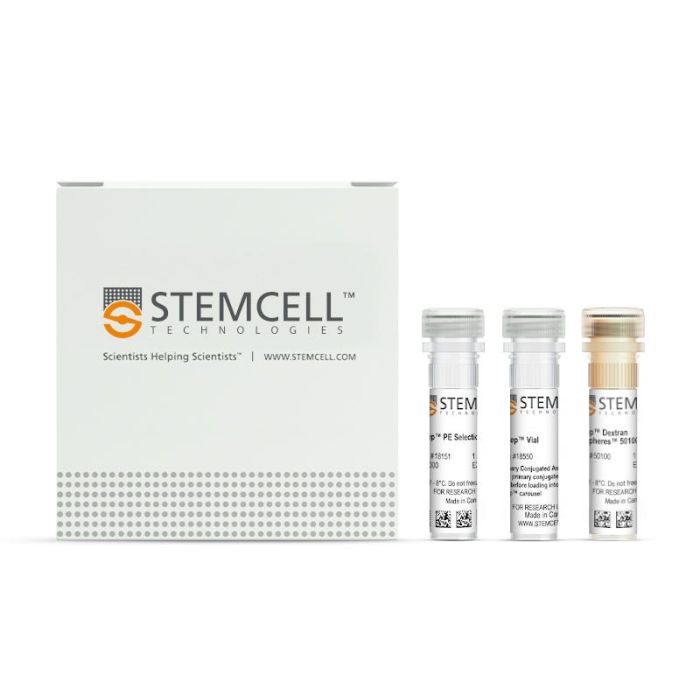
  • EasySep™ PE 正选试剂盒 II(产品号 #17684)
    • EasySep™ PE分选抗体混合物,1 mL
    • EasySep™ Dextran RapidSpheres™磁珠,1 mL
    • RoboSep™ 偶联一抗专用管(手动操作无需使用),1支
  • RoboSep™ PE正选 试剂盒 II (产品号 #17684RF)
    • EasySep™ PE分选抗体混合物,1 mL
    • EasySep™ Dextran RapidSpheres™磁珠,1 mL
    • RoboSep™ 偶联一抗专用管(手动操作无需使用),1支
    • RoboSep™ 缓冲液(产品号 #20104)
    • RoboSep™ 过滤吸头(产品号 #20125)x 2
New look, same high quality and support! You may notice that your instrument or reagent packaging looks slightly different from images displayed on the website, or from previous orders. We are updating our look but rest assured, the products themselves and how you should use them have not changed. Learn more
专为您的实验方案打造的产品
要查看实验方案所需的所有配套产品,请参阅《实验方案与技术文档》

总览

使用EasySep™ PE正选 试剂盒 II,通过免疫磁珠正选,可从任何单细胞悬液样本中分离高纯度的藻红蛋白(PE)偶联抗体标记的细胞。EasySep™结合了单克隆抗体的特异性和无柱磁性系统的简便性,迄今已广泛应用于发表的研究中超过20年。    

在此EasySep™正选过程中,目的细胞被识别PE的抗体复合物和磁珠结合标记,使用EasySep™进行无柱分选,只需倾倒或吸弃非目的 细胞,目标细胞则保留在管中。磁珠分选获得的PE阳性细胞即可用于下游应用。

该产品可替代EasySep™PE 正选试剂盒 (产品号 #18557) 以进行更快的细胞分选。

了解更多关于免疫磁珠EasySep™技术的工作原理,或如何通过RoboSep™实现全自动化免疫磁珠细胞分选。探索更多优化您实验流程的产品,包括培养基、添加剂、抗体等。

磁极兼容性
• EasySep™磁极(产品号 #18000)
• “The Big Easy” EasySep™磁极(产品号 #18001)
• EasyEights™ EasySep™磁极(产品号 #18103)
• RoboSep™-S(产品号 #21000)
 
分类
细胞分选试剂盒
 
细胞类型
B 细胞,树突状细胞(DCs),粒细胞及其亚群,造血干/祖细胞,巨噬细胞,骨髓基质细胞,间充质干/祖细胞,单核细胞,单个核细胞,髓系细胞,NK 细胞,其他物种,血浆,T 细胞
 
种属
非人灵长类,其他物种,大鼠
 
样本来源
骨髓,白膜层,脐带血,白细胞单采术样本,其他物种,PBMC,外周血,脾脏
 
分选方法
正选
 
应用
细胞分选
 
品牌
EasySep,RoboSep
 
研究领域
免疫
 

产品说明书及文档

请在《产品说明书》中查找相关支持信息和使用说明,或浏览下方更多实验方案。

Document Type
Product Name
Catalog #
Lot #
Language
Catalog #
17684
Lot #
All
Language
English
Catalog #
17684RF
Lot #
All
Language
English
Document Type
Safety Data Sheet 1
Catalog #
17684
Lot #
All
Language
English
Document Type
Safety Data Sheet 2
Catalog #
17684
Lot #
All
Language
English
Document Type
Safety Data Sheet 1
Catalog #
17684RF
Lot #
All
Language
English
Document Type
Safety Data Sheet 2
Catalog #
17684RF
Lot #
All
Language
English
Document Type
Safety Data Sheet 3
Catalog #
17684RF
Lot #
All
Language
English

相关材料与文献

技术资料 (6)

文献 (7)

High Treg and PMN-MDSC densities are a hallmark of tertiary lymphoid structures in fatal cases of cervical cancer L. A. Syding et al. Journal for Immunotherapy of Cancer 2025 Sep

Abstract

BackgroundHigh densities of tertiary lymphoid structures (TLSs) are associated with improved clinical outcomes in various malignancies, including human papillomavirus (HPV)-associated head and neck squamous cell carcinoma (HNSCC). However, the role of TLSs in shaping antitumor immunity in HPV-induced cervical cancer (CESC) remains unclear. Therefore, we analyzed the density, composition, and prognostic impact of TLSs in patients with CESC as well as patients with HNSCC.MethodsMultiplex immunofluorescence, immunohistochemistry, and spatial transcriptomics were used to analyze TLS density and composition in HNSCC and CESC tissue sections with respect to patient prognosis. The spatial approach was supplemented by flow cytometry-based analysis of the polymorphonuclear myeloid-derived suppressor cell (PMN-MDSC) phenotype in freshly resected primary tumor tissues.ResultsAlthough both indications were associated with HPV infection, we confirmed a positive correlation between TLS density and improved overall survival only in patients with HNSCC. The TLS composition differed markedly between HNSCC and CESC samples, with a shift toward high regulatory T cell (Treg) and PMN-MDSC abundance in CESC samples. The highest Treg and PMN-MDSC levels were observed in patients with CESC who died of the disease. CESC-infiltrating PMN-MDSCs showed high arginase 1 expression, which correlated with diminished T-cell receptor (TCR)ζ chain expression in CESC-infiltrating T cells. Additionally, the high number of PMN-MDSCs in TLSs was associated with the absence of HPV-specific T cells in CESC.ConclusionsUnlike in HNSCC, the composition of TLSs, rather than their quantity, was associated with the overall survival of patients with CESC. High numbers of Tregs and PMN-MDSCs infiltrating immature TLSs prevail in patients with CESC who succumbed to the disease and seem to affect tumor-specific immune responses.
FOXO1 is a master regulator of memory programming in CAR T cells Nature 2024 Apr

Abstract

A major limitation of chimeric antigen receptor (CAR) T cell therapies is the poor persistence of these cells in vivo1. The expression of memory-associated genes in CAR T cells is linked to their long-term persistence in patients and clinical efficacy2–6, suggesting that memory programs may underpin durable CAR T cell function. Here we show that the transcription factor FOXO1 is responsible for promoting memory and restraining exhaustion in human CAR T cells. Pharmacological inhibition or gene editing of endogenous FOXO1 diminished the expression of memory-associated genes, promoted an exhaustion-like phenotype and impaired the antitumour activity of CAR T cells. Overexpression of FOXO1 induced a gene-expression program consistent with T cell memory and increased chromatin accessibility at FOXO1-binding motifs. CAR T cells that overexpressed FOXO1 retained their function, memory potential and metabolic fitness in settings of chronic stimulation, and exhibited enhanced persistence and tumour control in vivo. By contrast, overexpression of TCF1 (encoded by TCF7) did not enforce canonical memory programs or enhance the potency of CAR T cells. Notably, FOXO1 activity correlated with positive clinical outcomes of patients treated with CAR T cells or tumour-infiltrating lymphocytes, underscoring the clinical relevance of FOXO1 in cancer immunotherapy. Our results show that overexpressing FOXO1 can increase the antitumour activity of human CAR T cells, and highlight memory reprogramming as a broadly applicable approach for optimizing therapeutic T cell states. The transcription factor FOXO1 has a key role in human T cell memory, and manipulating FOXO1 expression could provide a way to enhance CAR T cell therapies by increasing CAR T cell persistence and antitumour activity.
FACS and immunomagnetic isolation of early erythroid progenitor cells from mouse fetal liver. T. W. Braun et al. STAR protocols 2022 mar

Abstract

Early erythroid progenitors are transit-amplifying cells with high proliferative capacity committed to undergoing red cell differentiation. CD71/CD24low progenitors are less mature and have greater proliferative capacity than CD71/CD24high. We present protocols for isolation of CD71/CD24low progenitors from mouse fetal liver using both fluorescence-activated cell sorting (FACS) and immunomagnetic enrichment. CD71/CD24low progenitors isolated with both approaches show similar transcriptomes at single-cell resolution and exhibit characteristic proliferative responses to glucocorticoids. For complete details on the use and execution of this protocol, please refer to Li et al. (2019).

更多信息

更多信息
物种 其它物种, 大鼠, 非人灵长类
Magnet Compatibility • EasySep™ Magnet (Catalog #18000) • “The Big Easy” EasySep™ Magnet (Catalog #18001) • EasyEights™ EasySep™ Magnet (Catalog #18103) • RoboSep™-S (Catalog #21000)
样本来源 PBMC, 其它细胞系, 外周血, 白细胞单采术样本, 白膜层, 脐带血, 脾脏, 骨髓
Selection Method Positive
法律声明:

Users of this kit should ensure that they are entitled to use the antibody of interest. STEMCELL Technologies Inc. is not responsible for patent infringements or violations that may occur when using this product. 质量保证:

产品仅供研究使用,不用于针对人或动物的诊断或治疗。 欲获悉更多关于STEMCELL的质控信息,请访问 STEMCELL.CN/COMPLIANCE.
Copyright © 2025 by STEMCELL Technologies. All rights reserved.

在线联系