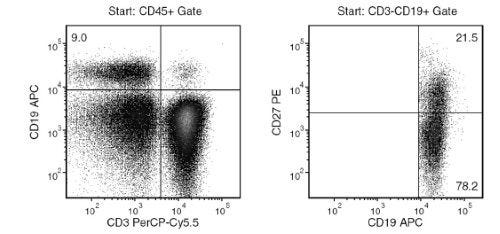
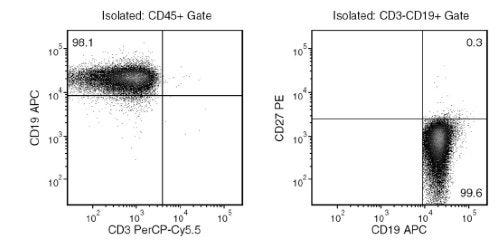
Figure 1. Typical EasySep™ Human Naïve B Cell Isolation Profile
Starting with human PBMCs, the naïve B cell (CD3-CD19+CD27-) content of the isolated fraction is typically 94.9 ± 2.2% (mean ± SD). In the above example, the purities of the start and final isolated fractions are 7.1% and 97.7%, respectively.
<div class="faq-section"> <h2 class="mobile-popup-trigger">常见问题</h2> <div class="questions mobile-popup view-more-content" data-visible-height="350" style="max-height:374px; overflow:hidden;"> <div class="faqs grid_6_lg grid_12_md grid_12_sm grid_12_xs"> <div class="faq"> <h1 class="question"> <i class="fa fa-plus-circle"></i> <span>Can EasySep™ be used for either positive or negative selection?</span> </h1> <div class="answer"> Yes. The EasySep™ kits use either a negative selection approach by targeting and removing unwanted cells or a positive selection approach targeting desired cells. Depletion kits are also available for the removal of cells with a specific undesired marker (e.g. GlyA). </div> </div> <div class="faq"> <h1 class="question"> <i class="fa fa-plus-circle"></i> <span>How does the separation work?</span> </h1> <div class="answer"> Magnetic particles are crosslinked to cells using Tetrameric Antibody Complexes (TAC). When placed in the EasySep™ Magnet, labeled cells migrate to the wall of the tube. The unlabeled cells are then poured off into a separate fraction. </div> </div> <div class="faq"> <h1 class="question"> <i class="fa fa-plus-circle"></i> <span>Which columns do I use?</span> </h1> <div class="answer"> The EasySep™ procedure is column-free. That's right - no columns! </div> </div> <div class="faq"> <h1 class="question"> <i class="fa fa-plus-circle"></i> <span>How can I analyze the purity of my enriched sample?</span> </h1> <div class="answer"> The Product Information Sheet provided with each EasySep™ kit contains detailed staining information. </div> </div> <div class="faq"> <h1 class="question"> <i class="fa fa-plus-circle"></i> <span>Can EasySep™ separations be automated?</span> </h1> <div class="answer"> Yes. RoboSep™, the fully automated cell separator, automates all EasySep™ labeling and cell separation steps. </div> </div> <div class="faq"> <h1 class="question"> <i class="fa fa-plus-circle"></i> <span>Can EasySep™ be used to isolate rare cells?</span> </h1> <div class="answer"> Yes. We recommend a cell concentration of 2x10<sup>8</sup> cells/mL and a minimum working volume of 100 µL. Samples containing 2x10<sup>7</sup> cells or fewer should be suspended in 100 µL of buffer. </div> </div> </div> <div class="faqs grid_6_lg grid_12_md grid_12_sm grid_12_xs"> <div class="faq"> <h1 class="question"> <i class="fa fa-plus-circle"></i> <span>Are the EasySep™ magnetic particles FACS-compatible?</span> </h1> <div class="answer"> Yes, the EasySep™ particles are flow cytometry-compatible, as they are very uniform in size and about 5000X smaller than other commercially available magnetic beads used with column-free systems. </div> </div> <div class="faq"> <h1 class="question"> <i class="fa fa-plus-circle"></i> <span>Can the EasySep™ magnetic particles be removed after enrichment?</span> </h1> <div class="answer"> No, but due to the small size of these particles, they will not interfere with downstream applications. </div> </div> <div class="faq"> <h1 class="question"> <i class="fa fa-plus-circle"></i> <span>Can I alter the separation time in the magnet?</span> </h1> <div class="answer"> Yes; however, this may impact the kit's performance. The provided EasySep™ protocols have already been optimized to balance purity, recovery and time spent on the isolation. </div> </div> <div class="faq"> <h1 class="question"> <i class="fa fa-plus-circle"></i> <span>For positive selection, can I perform more than 3 separations to increase purity?</span> </h1> <div class="answer"> Yes, the purity of targeted cells will increase with additional rounds of separations; however, cell recovery will decrease. </div> </div> <div class="faq"> <h1 class="question"> <i class="fa fa-plus-circle"></i> <span>How does the binding of the EasySep™ magnetic particle affect the cells? is the function of positively selected cells altered by the bound particles?</span> </h1> <div class="answer"> Hundreds of publications have used cells selected with EasySep™ positive selection kits for functional studies. Our in-house experiments also confirm that selected cells are not functionally altered by the EasySep™ magnetic particles. <br> <br>If particle binding is a key concern, we offer two options for negative selection. The EasySep™ negative selection kits can isolate untouched cells with comparable purities, while RosetteSep™ can isolate untouched cells directly from whole blood without using particles or magnets. </div> </div> </div> <div class="view-more-wrapper hidden"> <a class="view-more-button"> 查看更多 </a> <a class="view-less-button"> 显示更少 </a> </div> </div> </div>
文献 (3)
Trypanosoma cruzi Induces Regulatory B Cell Alterations in Patients With Chronic Chagas Disease. M. C. Girard et al.
Frontiers in cellular and infection microbiology 2021
Abstract
The clinical evolution of patients with chronic Chagas disease (CCD) is mainly associated with an excessive inflammation and a defective immunomodulatory profile caused by the interaction between T. cruzi and the host. Regulatory B (Breg) cells exert immune suppression mostly through IL-10 production (B10 cells),but also through IL-10-independent mechanisms. Previously,we demonstrated that CCD patients with cardiomyopathy show changes in the ex vivo Breg cell phenotypic distribution although maintain IL-10 production capacity. Here,we sought to identify potential alterations on Breg cells upon in vitro stimulation. Isolated B cells from CCD patients with or without cardiomyopathy and non-infected (NI) donors were stimulated with T. cruzi lysate or CpG + CD40L,and characterized by flow cytometry based on the expression of CD24,CD27,CD38,and the regulatory molecules IL-10 and PD-L1. IL-10 and IL-17 secretion in the supernatant of B cells was evaluated by ELISA. Data showed that T. cruzi stimulation diminished the expression of CD24 and CD38 on CD27- B cells while reducing the percentage of CD24high inside CD27+ B cells. Furthermore,T. cruzi induced a regulatory B cell phenotype by increasing B10 cells and IL-10 secretion in all the groups. The innate-like B10 cells expansion observed in patients with cardiomyopathy would be associated with CD27- B10 cell subsets,while no predominant phenotype was found in the other groups. Patients with cardiomyopathy also displayed higher IL-17 secretion levels in T. cruzi-activated B cells. CpG + CD40L stimulation revealed that B cells from CCD patients and NI donors had the same ability to differentiate into B10 cells and secrete IL-10 in vitro. Additionally,CCD patients showed an increased frequency of CD24-CD27- B cells and a reduction in the percentage of CD24highCD27+ Breg cells,which appeared to be inversely correlated with the presence of T. cruzi DNA in blood. Finally,CCD patients exhibited a higher frequency of PD-L1+ B cells in T. cruzi-stimulated samples,suggesting that IL-10-independent mechanisms could also be tangled in the control of inflammation. Altogether,our results provide evidence about the potential role of Breg cells in the immune response developed against T. cruzi and its contribution to chronic Chagas cardiomyopathy.
Inhibition of PI3K p110$\delta$ activity reduces IgE production in IL-4 and anti-CD40 stimulated human B cell cultures. A. Cutrina-Pons et al.
Immunology 2023 dec
Abstract
Phosphoinositide 3-kinase (PI3K) p110$\delta$ signalling negatively regulates the production of mouse IgE. However,there are disparities between the mouse and human IgE biology,and the role of PI3K p110$\delta$ in the production of human IgE is yet to be determined. To investigate the effect of PI3K p110$\delta$ inhibition in the production of human IgE we isolated human B cells from tonsil tissue and stimulated them with IL-4 and anti-CD40 antibody to induce class switching to IgE and IgG1 in the presence or absence of IC87114,a small molecule inhibitor of PI3K p110$\delta$. Using FACS,RT-PCR and ELISA we examined the effect of PI3K p110$\delta$ inhibition on IgE production and determined the mechanisms involved. Unlike in mice,we observed that PI3K p110$\delta$ inhibition significantly reduces the number of IgE+ switched cells and the amounts of secreted IgE in IL4 and anti-CD40 cultures. However,the number of IgG1+ cells and secreted IgG1 were largely unaffected by PI3K p110$\delta$ inhibition. The expression levels of AID,$\epsilon$ and $\gamma$1 germinal transcripts or other factors involved in the regulation of CSR to IgE and IgG1 were also unaffected by IC87114. However,we found that IC87114 significantly decreases the proliferation of tonsil B cells stimulated with IL-4 and anti-CD40,specifically reducing the frequency of cells that had undergone 4 divisions or more. In addition,PI3K p110$\delta$ inhibition reduced the levels of IRF4 expression in IgE+ germinal centre-like B cells leading to a block in plasma cell differentiation. In conclusion,PI3K p110$\delta$ signalling is required for the production of human IgE,which makes it a pharmacological target for the treatment of allergic disease.
Replication competent HIV-guided CRISPR screen identifies antiviral factors including targets of the accessory protein Nef
Nature Communications 2024 May
Abstract
Innate antiviral factors are essential for effective defense against viral pathogens. However,the identity of major restriction mechanisms remains elusive. Current approaches to discover antiviral factors usually focus on the initial steps of viral replication and are limited to a single round of infection. Here,we engineered libraries of >1500 replication-competent HIV-1 constructs each expressing a single gRNAs to target >500 cellular genes for virus-driven discovery of antiviral factors. Passaging in CD4+ T cells robustly enriched HIV-1 encoding sgRNAs against GRN,CIITA,EHMT2,CEACAM3,CC2D1B and RHOA by >50-fold. Using an HIV-1 library lacking the accessory nef gene,we identified IFI16 as a Nef target. Functional analyses in cell lines and primary CD4+ T cells support that the HIV-driven CRISPR screen identified restriction factors targeting virus entry,transcription,release and infectivity. Our HIV-guided CRISPR technique enables sensitive discovery of physiologically relevant cellular defense factors throughout the entire viral replication cycle. Innate immune mechanisms are critical for antiviral defense. Here,the authors developed a CRISPR/Cas9-based HIV-driven approach to identify cellular factors compromising viral transcription,assembly,release or infectivity in human T cells. They identify targets of the Nef protein as antiviral factors.
Thank you for your interest in IntestiCult™ Organoid Growth Medium (Human). Please provide us with your contact information and your local representative will contact you with a customized quote. Where appropriate, they
can also assist you with a(n):
Estimated delivery time for your area
Product sample or exclusive offer
In-lab demonstration
By submitting this form, you are providing your consent to STEMCELL Technologies Canada Inc. and its subsidiaries and affiliates (“STEMCELL”) to collect and use your information, and send you newsletters and emails in accordance with our
privacy policy. Please contact us with any questions that you may have. You can unsubscribe or change your email preferences at any time.


 EasySep™小鼠TIL(CD45)正选试剂盒











 沪公网安备31010102008431号