若您需要咨询产品或有任何技术问题,请通过官方电话 400 885 9050 或邮箱 info.cn@stemcell.com 与我们联系。

EasySep™人CD14正选试剂盒II

人CD14+细胞的免疫磁珠正选
只有 %1
¥8,634.00

产品号 #(选择产品)

产品号 #17858_C

人CD14+细胞的免疫磁珠正选

产品优势

  • 快捷、操作简单
  • 纯度高达97%
  • 无需分离柱

产品组分包括

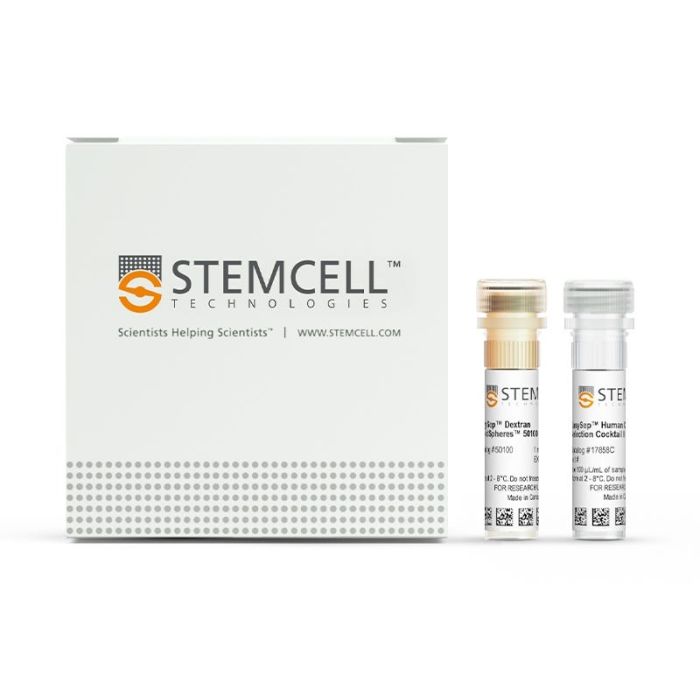
  • EasySep™人CD1 4正选试剂盒II(产品号 #17858)
    • EasySep™人CD14正选抗体混合物II,1mL
    • EasySep™ Dextran RapidSpheres™ 50100 磁珠,1mL
  • EasySep™人CD1 4正选试剂盒II(产品号 #100-0694)
    • EasySep™人CD14正选抗体混合物II,1x10mL
    • EasySep™ Dextran RapidSpheres™ 50100 磁珠,2x1mL
  • RoboSep™人CD1 4正选试剂盒II(产品号 #17858RF)
    • EasySep™人CD14正选抗体混合物II,1mL
    • EasySep™ Dextran RapidSpheres™ 50100 磁珠,1mL
    • RoboSep™ 缓冲液(产品号 #20104)
    • RoboSep™过滤吸头(产品号 #20125)
New look, same high quality and support! You may notice that your instrument or reagent packaging looks slightly different from images displayed on the website, or from previous orders. We are updating our look but rest assured, the products themselves and how you should use them have not changed. Learn more
专为您的实验方案打造的产品
要查看实验方案所需的所有配套产品,请参阅《实验方案与技术文档》

您也可以直接选用即用型、符合伦理来源的总览

使用EasySep™人CD14正选试剂盒II,通过免疫磁正选从新鲜或先冻存的人外周血单个核细胞(PBMCs)或洗净的白细胞样品中分离高纯度的人CD14+细胞。EasySep™结合了单克隆抗体的特异性和无柱磁性系统的简便性,迄今已广泛应用于发表的研究中超过20年。    

在这个EasySep™正选过程中,目的细胞被标记为识别CD14和磁性颗粒的抗体复合物。使用EasySep™磁极和简单地倾倒或移液除去不需要的细胞来分离标记的细胞。感兴趣的细胞留在试管中。在短至22分钟的磁珠分选后,目的CD14+细胞就可以用于流式细胞术、培养或DNA/RNA提取等下游应用。CD14抗原在单核细胞和巨噬细胞上强表达,在粒细胞上弱表达。它也在大多数组织巨噬细胞上表达。

该产品可替代EasySep™人CD14正选试剂盒(产品号#18058)以进行更快的细胞分选。 

如需从白细胞单采术样本中大规模分选人CD14+细胞,请参见大包装(1x10^10细胞)试剂盒(产品号#100-0694)。 

了解更多关于免疫磁珠EasySep™技术工作原理,或如何通过RoboSep™实现全自动化免疫磁珠细胞分选。 您也可以直接选用即用型、符合伦理来源的人外周血CD14+单核细胞,冷冻使用EasySep™人CD14正选试剂盒II进行分选。探索更多为您实验流程优化的产品,包括培养基、添加剂、抗体等。

磁极兼容性
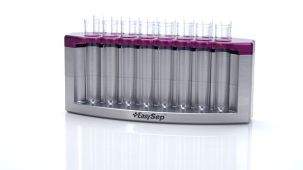
• EasySep™磁极(产品号 #18000)
• “The Big Easy” EasySep™磁极(产品号 #18001)
• EasyPlate™ EasySep™磁极(产品号 #18102)
• Easy 50 EasySep™磁极(产品号 #18002)
• EasyEights™ EasySep™磁极(产品号 #18103)
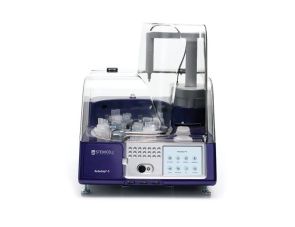
• RoboSep™-S(产品号 #21000)
• Easy 250 EasySep™磁极(产品号 #100-0821)
 
分类
细胞分选试剂盒
 
细胞类型
单核细胞,髓系细胞
 
种属

 
样本来源
PBMC
 
分选方法
正选
 
应用
细胞分选
 
品牌
EasySep,RoboSep
 
研究领域
嵌合体,免疫
 

实验数据

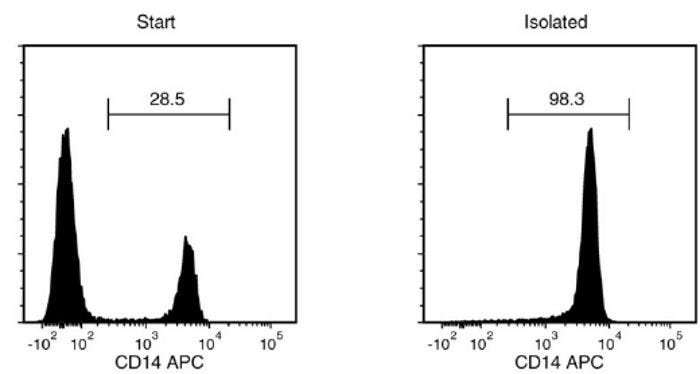
Figure 1. Typical EasySep™ Human CD14 Positive Selection II Isolation Profile

Starting with a single cell suspension of human PBMCs, the CD14+ cell content of the isolated fraction is typically 95.3 ± 4.5% (mean ± SD using the purple EasySep™ Magnet).

FACS Data for Anti-Human CD14 Antibody, Clone M5E2, Alexa Fluor® 488-Conjugated

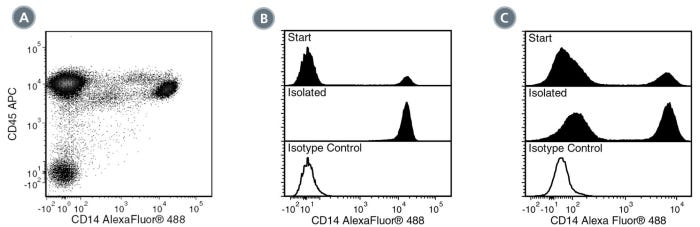
Figure 2. FACS Data for Anti-Human CD14 Antibody, Clone M5E2, Alexa Fluor® 488-Conjugated

(A) Flow cytometry analysis of human peripheral blood mononuclear cells (PBMCs) labeled with Anti-Human CD14 Antibody, Clone M5E2, Alexa Fluor® 488 (Catalog #60004AD) and Anti-Human CD45 Antibody, Clone HI30, APC (Catalog #60018AD). (B) Flow cytometry analysis of human PBMCs processed with the EasySep™ Human CD14 Positive Selection Kit (Catalog #17858) and labeled with Anti-Human CD14 Antibody, Clone M5E2, Alexa Fluor® 488. Histograms show labeling of PBMCs (Start) and isolated cells (Isolated). Labeling of start cells with Mouse IgG2a, kappa Isotype Control Antibody, Clone MOPC-173, Alexa Fluor® 488 (Catalog #60071AD) is shown (solid line histogram). (C) Flow cytometry analysis of human whole blood nucleated cells processed with the EasySep™ HLA Whole Blood CD33 Positive Selection Kit (Catalog #17885) and labeled with Anti-Human CD14 Antibody, Clone M5E2, Alexa Fluor® 488. Histograms show labeling of whole blood nucleated cells (Start) and isolated cells (Isolated). Labeling of start cells with Mouse IgG2a, kappa Isotype Control Antibody, Clone MOPC-173, Alexa Fluor® 488 is shown (solid line histogram).

FACS Data for Anti-Human CD14 Antibody, Clone M5E2, PE-Conjugated

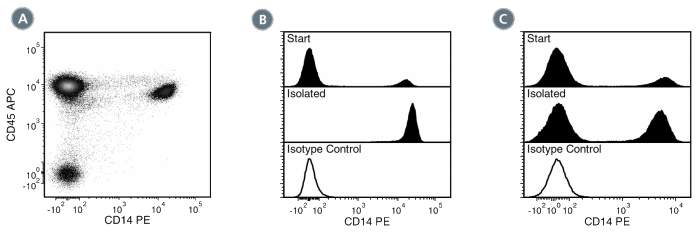
Figure 3. FACS Data for Anti-Human CD14 Antibody, Clone M5E2, PE-Conjugated

(A) Flow cytometry analysis of human peripheral blood mononuclear cells (PBMCs) labeled with Anti-Human CD14 Antibody, Clone M5E2, PE (filled histogram; Catalog #60004PE), or Mouse IgG2a, kappa Isotype Control Antibody, Clone HI30, APC (Catalog #60018AZ). (B) Flow cytometry analysis of human PBMCs processed with the EasySep™ Human CD14 Positive Selection Kit (Catalog #17858) and labeled with Anti-Human CD14 Antibody, Clone M5E2, PE. Histograms show labeling of PBMCs (Start) and isolated cells (Isolated). Labeling of start cells with Mouse IgG2a, kappa Isotype Control Antibody, Clone MOPC-173, PE (Catalog #60071PE) is shown (solid line historgram). (C) Flow cytometry analysis of human whole blood nucleated cells processed with the EasySep™ HLA Whole Blood CD33 Positive Selection Kit (Catalog #17885) and labeled with Anti-Human CD14 Antibody, Clone M5E2, FITC. Histograms show labeling of whole blood nucleated cells (Start) and isolated cells (Isolated). Labeling of start cells with Mouse IgG2a, kappa Isotype Control Antibody, Clone MOPC-173, PE is shown (solid line histogram).

产品说明书及文档

请在《产品说明书》中查找相关支持信息和使用说明,或浏览下方更多实验方案。

Document Type
Product Name
Catalog #
Lot #
Language
Catalog #
17858RF
Lot #
All
Language
English
Catalog #
17858
Lot #
All
Language
English
Catalog #
17858
Lot #
All
Language
English
Document Type
Safety Data Sheet 1
Catalog #
17858RF
Lot #
All
Language
English
Document Type
Safety Data Sheet 2
Catalog #
17858RF
Lot #
All
Language
English
Document Type
Safety Data Sheet 3
Catalog #
17858RF
Lot #
All
Language
English
Document Type
Safety Data Sheet 1
Catalog #
17858
Lot #
All
Language
English
Document Type
Safety Data Sheet 2
Catalog #
17858
Lot #
All
Language
English
Document Type
Safety Data Sheet 1
Catalog #
100-0694
Lot #
All
Language
English
Document Type
Safety Data Sheet 2
Catalog #
100-0694
Lot #
All
Language
English

应用领域

本产品专为以下研究领域设计,适用于工作流程中的高亮阶段。探索这些工作流程,了解更多我们为各研究领域提供的其他配套产品。

相关材料与文献

技术资料 (9)

常见问题 (11)

Can EasySep™ be used for either positive or negative selection?

Yes. The EasySep™ kits use either a negative selection approach by targeting and removing unwanted cells or a positive selection approach targeting desired cells. Depletion kits are also available for the removal of cells with a specific undesired marker (e.g. GlyA).

How does the separation work?

Magnetic particles are crosslinked to cells using Tetrameric Antibody Complexes (TAC). When placed in the EasySep™ Magnet, labeled cells migrate to the wall of the tube. The unlabeled cells are then poured off into a separate fraction.

Which columns do I use?

The EasySep™ procedure is column-free. That's right - no columns!

How can I analyze the purity of my enriched sample?

The Product Information Sheet provided with each EasySep™ kit contains detailed staining information.

Can EasySep™ separations be automated?

Yes. RoboSep™, the fully automated cell separator, automates all EasySep™ labeling and cell separation steps.

Can EasySep™ be used to isolate rare cells?

Yes. We recommend a cell concentration of 2x10⁸ cells/mL and a minimum working volume of 100 µL. Samples containing 2x10⁷ cells or fewer should be suspended in 100 µL of buffer.

Are the EasySep™ magnetic particles FACS-compatible?

Yes, the EasySep™ particles are flow cytometry-compatible, as they are very uniform in size and about 5000X smaller than other commercially available magnetic beads used with column-free systems.

Can the EasySep™ magnetic particles be removed after enrichment?

No, but due to the small size of these particles, they will not interfere with downstream applications.

Can I alter the separation time in the magnet?

Yes; however, this may impact the kit's performance. The provided EasySep™ protocols have already been optimized to balance purity, recovery and time spent on the isolation.

For positive selection, can I perform more than 3 separations to increase purity?

Yes, the purity of targeted cells will increase with additional rounds of separations; however, cell recovery will decrease.

How does the binding of the EasySep™ magnetic particle affect the cells? is the function of positively selected cells altered by the bound particles?

Hundreds of publications have used cells selected with EasySep™ positive selection kits for functional studies. Our in-house experiments also confirm that selected cells are not functionally altered by the EasySep™ magnetic particles.

If particle binding is a key concern, we offer two options for negative selection. The EasySep™ negative selection kits can isolate untouched cells with comparable purities, while RosetteSep™ can isolate untouched cells directly from whole blood without using particles or magnets.

文献 (42)

A semi‐automated ASC speck assay to evaluate pyrin inflammasome activation P. Dai et al. Clinical & Translational Immunology 2025 Oct

Abstract

Objective: To develop a rapid functional assay to validate variants of uncertain significance (VUS) in the MEFV gene. Methods: Overactivity of the pyrin inflammasome pathway and ASC speck oligomerisation in response to stimulation with low concentrations of Clostridium difficile toxin A was directly visualised by immunofluorescence microscopy. A semi‐automated algorithm was developed to count cells and ASC specks. Results: The semi‐automated ASC speck assay is able to discriminate between healthy controls and patients with familial Mediterranean fever (FMF) and pyrin inflammasome overactivity with high sensitivity. It is also able to discriminate pyrin inflammasome overactivity from other autoinflammatory disease controls with high specificity. Conclusion: The semi‐automated ASC speck assay may be a useful test to functionally validate VUS in the MEFV gene and screen for pyrin inflammasome overactivity. A semi‐automated ASC speck assay using machine learning is able to discriminate between healthy controls and patients with familial Mediterranean fever (FMF) with high sensitivity. It is also able to discriminate FMF from other autoinflammatory diseases with high specificity.
Identification and characterization of a ubiquitin E3 RING ligase of the Chlamydia-like bacterium Simkania negevensis E-M. Hörner et al. PLOS Pathogens 2025 Nov

Abstract

In the arms race between a pathogen and the host, the defense mechanisms of the host cell, including the ubiquitin system, are often counteracted by bacteria. Simkania negevensis (Sne), an obligate intracellular Chlamydia-like bacterium connected with respiratory diseases, possesses numerous deubiquitinases, but not much is known about its other ubiquitin-modifying enzymes. Sne infects a wide range of hosts, developing inside a tubular vacuole in close contact with the host endoplasmic reticulum (ER) and mitochondria. Our study describes an uncharacterized Sne ubiquitin E3 RING-ligase (SNE_A12920 or SneRING), which primarily generates K63- and K11-linked ubiquitin chains and preferentially interacts with UbcH5b and UBE2T E2 enzymes. SneRING is expressed upon infection of various human cell lines, as well as amoebae. We show that a portion of the expressed SneRING co-localizes with mitochondria and ER and that the SneRING interactome includes mitochondrial and ER proteins involved in organelle morphology and stress response. Our work offers an initial characterization of a bacterial RING ligase potentially involved in the host cell remodeling to accommodate the unique intracellular lifestyle of Sne. Author summaryUbiquitination is a protein modification system that regulates protein degradation, localization, or interactions. As such, ubiquitination has many important functions in cell signalling, and its dysregulation can lead to cancer and neurodegenerative diseases. Bacteria that live and develop inside human or other eukaryotic cells, such as Chlamydia, often modulate the ubiquitination system to ensure their own survival. Simkania negevensis is a Chlamydia-like bacterium connected to respiratory diseases in humans. We have discovered a novel enzyme expressed by these bacteria that can ubiquitinate other proteins and thus potentially modify host cell processes that would otherwise hinder infection. In this work, we explore the function of this enzyme and determine its possible cellular localization, as well as some of the proteins it interacts with. Our study provides new insights into how bacterial pathogens adapt to and manipulate host cells using one of the major cell function regulatory systems.
Inactivation of branched-chain amino acid uptake halts Staphylococcus aureus growth and induces bacterial quiescence within macrophages PLOS Pathogens 2025 Aug

Abstract

Staphylococcus aureus is a notorious human pathogen that thrives in macrophages. It resides in mature phagolysosomes, where a subset of the bacteria eventually begin to proliferate. How S. aureus acquires essential nutrients, such as amino acids, for growth in this niche is poorly understood. Using a long-term primary human macrophage infection model, we show that branched-chain amino acid (BCAA) uptake mediated by the major transporter BrnQ1 is required by S. aureus for intracellular replication in macrophages and we provide mechanistic insight into the role of BCAAs in the success of intracellular S. aureus. Loss of BrnQ1 function renders intracellular S. aureus non-replicative and non-cytotoxic. The defective intracellular growth of S. aureus brnQ1 mutants can be rescued by supplementation with BCAAs or by overexpression of the BCAA transporters BrnQ1 or BcaP. Inactivation of the CodY repressor rescues the ability of S. aureus brnQ1 mutants to proliferate intracellularly independent of endogenous BCAA synthesis but dependent on BcaP expression. Non-replicating brnQ1 mutants in primary human macrophages become metabolically quiescent and display aberrant gene expression marked by failure to respond to intraphagosomal iron starvation. The bacteria remain, however, viable for an inordinate length of time. This dormant, yet viable bacterial state is distinct from classical persisters and small colony variants. Author summaryStaphylococcus aureus is a prominent human pathogen causing acute and chronic disease. It is facultatively intracellular and can reside within many host cell types, including professional phagocytes such as macrophages. The intracellular state contributes to dissemination, recurrence and infection chronicity. Chronic and relapsing infections are often associated with so-called persister phenotypes. Growth arrest and metabolic quiescence, accompanied by antibiotic tolerance, are hallmarks of persistence in bacteria. Antibiotic pressure is a major factor in triggering intracellular persistence. The small colony variant (SCV), an extensively studied form of S. aureus persister, can arise in the absence of antibiotic pressure and exhibits very distinctive phenotypic characteristics.Here, we describe a different growth-arrested state of S. aureus, which conforms to the definition of a non-antibiotic-driven form of intracellular dormancy, triggered by branched-chain amino acid starvation in macrophages. We show that loss of function of the major branched-chain amino acid transporter BrnQ1 renders intracellular S. aureus non-replicative and metabolically quiescent for an inordinate period of time. Upon stochastic exit from infected macrophages, brnQ1 mutants retain full virulence. This dormancy differs from classical persistence or SCVs and uncovers an underestimated role for BCAA uptake in the success of intracellular S. aureus.

更多信息

更多信息
物种 人类
Magnet Compatibility • EasySep™ Magnet (Catalog #18000) • “The Big Easy” EasySep™ Magnet (Catalog #18001) • EasyPlate™ EasySep™ Magnet (Catalog #18102) • EasyEights™ EasySep™ Magnet (Catalog #18103) • Easy 50 EasySep™ Magnet (Catalog #18002) • RoboSep™-S (Catalog #21000) • Ea
样本来源 PBMC
Selection Method Positive
标记抗体

Quality Statement:

PRODUCTS ARE FOR RESEARCH USE ONLY AND NOT INTENDED FOR HUMAN OR ANIMAL DIAGNOSTIC OR THERAPEUTIC USES UNLESS OTHERWISE STATED. FOR ADDITIONAL INFORMATION ON QUALITY AT STEMCELL, REFER TO WWW.STEMCELL.CN/COMPLIANCE.

Copyright © 2025 by STEMCELL Technologies. All rights reserved.

在线联系