若您需要咨询产品或有任何技术问题,请通过官方电话 400 885 9050 或邮箱 info.cn@stemcell.com 与我们联系。

EasySep™ Direct人单核细胞分选试剂盒

直接从全血中免疫磁珠负选人单核细胞
只有 %1
¥6,938.00

产品号 #(选择产品)

产品号 #19669_C

直接从全血中免疫磁珠负选人单核细胞

产品优势

  • 99.9%红细胞去除率,无需密度梯度离心、沉降或裂解
  • 分选获得的细胞纯度高达92%
  • 操作简单、快捷,且无需分离柱
  • 分选得到的细胞不带标记

产品组分包括

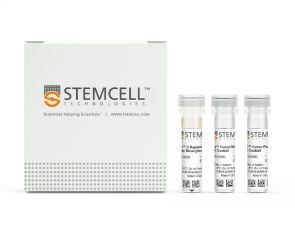
  • EasySep™ Direct人单核细胞分选试剂盒 (产品号 #19669)    
    • EasySep™ Direct人单核细胞分选抗体混合物, 2 x 2.5 mL
    • EasySep™ Direct RapidSpheres™  磁珠, 4 x 2.5 mL
  • RoboSep™ 人单核细胞分选试剂盒(带过滤吸头)(产品号 #19669RF)
    • EasySep™ Direct人单核细胞分选抗体混合物, 2 x 2.5 mL
    • EasySep™ Direct RapidSpheres™ 磁珠, 4 x 2.5 mL
    • RoboSep™ 缓冲液(产品号 #20104)
    • RoboSep™过滤吸头(产品号 #20125)x 2
New look, same high quality and support! You may notice that your instrument or reagent packaging looks slightly different from images displayed on the website, or from previous orders. We are updating our look but rest assured, the products themselves and how you should use them have not changed. Learn more
专为您的实验方案打造的产品
要查看实验方案所需的所有配套产品,请参阅《实验方案与技术文档》

总览

使用EasySep™ Direct人单核细胞分选试剂盒,可轻松高效地从人全血样本中通过免疫磁珠负选获得高纯度人CD14+单核细胞。EasySep™技术结合单克隆抗体的特异性和免磁柱系统的简便性,已在发表的研究中广泛应用超过20年。

在该EasySep™负选流程中,非目的细胞会被抗体复合物和EasySep™ Direct RapidSpheres™磁珠标记。以下非目的 细胞会被特异性去除:粒细胞、T细胞、B细胞、NK细胞、树突状细胞、血小板和红系细胞。通过EasySep™磁极将被磁珠标记的细胞与未被标记的目的细胞分离,目的细胞可被轻松收集到新试管中,分选后的细胞可立即用于下游应用,例如流式细胞术、培养或DNA/RNA 提取。    

了解更多EasySep™免疫磁珠     技术的工作原理,或者如何通过RoboSep™实现全自动化免疫磁珠细胞分选。探索更多为您的实验流程优化的产品,包括细胞鉴定 、冷冻保存等相关试剂 。

磁极兼容性
• EasySep™磁极(产品号 #18000)
• “The Big Easy” EasySep™磁极(产品号 #18001)
• Easy 50 EasySep™磁极(产品号 #18002)
• EasyEights™ EasySep™磁极(产品号 #18103)
• RoboSep™-S(产品号 #21000)
 
分类
细胞分选试剂盒
 
细胞类型
单核细胞,髓系细胞
 
种属

 
样本来源
全血
 
分选方法
负选
 
应用
细胞分选
 
品牌
EasySep,RoboSep
 
研究领域
免疫
 

实验数据

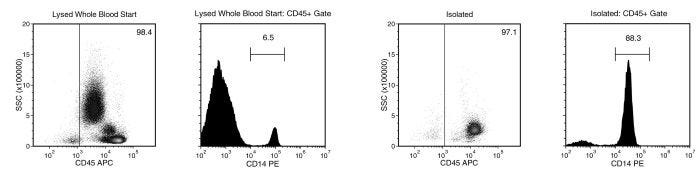
Monocyte separation using EasySep™ Direct Human Monocyte Isolation Kit

Figure 1. Typical EasySep™ Direct Human Monocyte Isolation Profile

Starting with human whole blood from normal healthy donors, the typical monocyte (CD14+) content of the non-lysed final Isolated fraction is 82.2 ± 8.4% (gated on CD45) or 79.0 ± 10.1% (not gated on CD45). In the example above, the monocyte (CD14+) content of the lysed whole blood start sample and the non-lysed final isolated fraction is 6.5% and 88.3% (gated on CD45), respectively, or 6.4% and 85.7% (not gated on CD45), respectively. The starting frequency of monocytes in the non-lysed whole blood start sample above is approximately 0.007% (data not shown).

Use of Highly Enriched Lymphocytes Isolated with EasySep™ Direct Improves Donor Specific Antibody DSA Detection Compared to Whole Leukocyte Cell Preparations

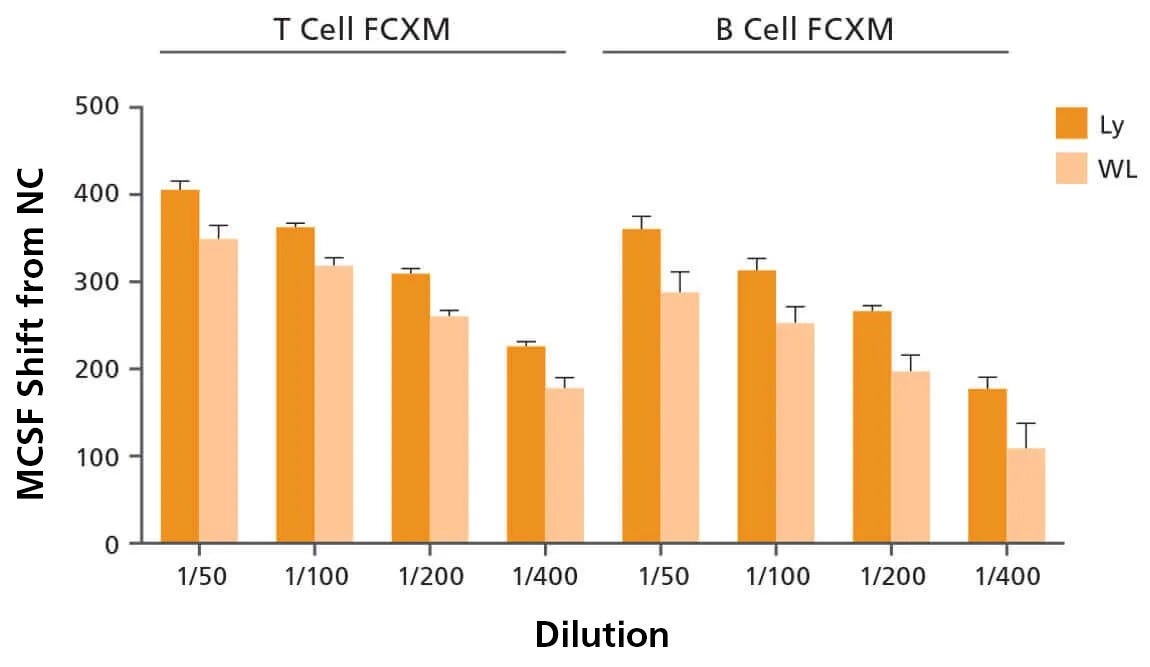
Figure 2. Use of Highly Enriched Lymphocytes Isolated with EasySep™ Direct Improves Donor Specific Antibody DSA Detection Compared to Whole Leukocyte Cell Preparations

Lymphocytes (Ly), neutrophils (Nu), and monocytes (Mo) were isolated from volunteer donors (n=5) using EasySep™ Direct Human Total Lymphocyte Isolation Kit (Catalog #19655), Human Neutrophil Isolation Kit (Catalog #19666), and Human Monocyte Isolation Kit (Catalog #19669). Whole leukocyte (WL) preparations were obtained by adding Ly, Nu, and Mo cells in equal proportions. WL (low lymphocyte purity) and Ly (high lymphocyte purity) preparations were treated with pronase and then used to perform the FCXM assay against negative control sera or several dilutions of positive control sera. The median channel fluorescence shifts (MCFS) were generated by using the negative control sera samples as a baseline. The MCF shifts between WL and Ly were then compared. Each column with error bars represents the mean ± SEM (n = 5 donors). Data kindly provided by Dr. Robert Liwski.

产品说明书及文档

请在《产品说明书》中查找相关支持信息和使用说明,或浏览下方更多实验方案。

Document Type
Product Name
Catalog #
Lot #
Language
Catalog #
19669RF
Lot #
All
Language
English
Catalog #
19669
Lot #
All
Language
English
Document Type
Safety Data Sheet 1
Catalog #
19669RF
Lot #
All
Language
English
Document Type
Safety Data Sheet 2
Catalog #
19669RF
Lot #
All
Language
English
Document Type
Safety Data Sheet 3
Catalog #
19669RF
Lot #
All
Language
English
Document Type
Safety Data Sheet 1
Catalog #
19669
Lot #
All
Language
English
Document Type
Safety Data Sheet 2
Catalog #
19669
Lot #
All
Language
English

应用领域

本产品专为以下研究领域设计,适用于工作流程中的高亮阶段。探索这些工作流程,了解更多我们为各研究领域提供的其他配套产品。

相关材料与文献

技术资料 (11)

常见问题 (11)

Can EasySep™ be used for either positive or negative selection?

Yes. The EasySep™ kits use either a negative selection approach by targeting and removing unwanted cells or a positive selection approach targeting desired cells. Depletion kits are also available for the removal of cells with a specific undesired marker (e.g. GlyA).

How does the separation work?

Magnetic particles are crosslinked to cells using Tetrameric Antibody Complexes (TAC). When placed in the EasySep™ Magnet, labeled cells migrate to the wall of the tube. The unlabeled cells are then poured off into a separate fraction.

Which columns do I use?

The EasySep™ procedure is column-free. That's right - no columns!

How can I analyze the purity of my enriched sample?

The Product Information Sheet provided with each EasySep™ kit contains detailed staining information.

Can EasySep™ separations be automated?

Yes. RoboSep™, the fully automated cell separator, automates all EasySep™ labeling and cell separation steps.

Can EasySep™ be used to isolate rare cells?

Yes. We recommend a cell concentration of 2x10⁸ cells/mL and a minimum working volume of 100 µL. Samples containing 2x10⁷ cells or fewer should be suspended in 100 µL of buffer.

Are the EasySep™ magnetic particles FACS-compatible?

Yes, the EasySep™ particles are flow cytometry-compatible, as they are very uniform in size and about 5000X smaller than other commercially available magnetic beads used with column-free systems.

Can the EasySep™ magnetic particles be removed after enrichment?

No, but due to the small size of these particles, they will not interfere with downstream applications.

Can I alter the separation time in the magnet?

Yes; however, this may impact the kit's performance. The provided EasySep™ protocols have already been optimized to balance purity, recovery and time spent on the isolation.

For positive selection, can I perform more than 3 separations to increase purity?

Yes, the purity of targeted cells will increase with additional rounds of separations; however, cell recovery will decrease.

How does the binding of the EasySep™ magnetic particle affect the cells? is the function of positively selected cells altered by the bound particles?

Hundreds of publications have used cells selected with EasySep™ positive selection kits for functional studies. Our in-house experiments also confirm that selected cells are not functionally altered by the EasySep™ magnetic particles.

If particle binding is a key concern, we offer two options for negative selection. The EasySep™ negative selection kits can isolate untouched cells with comparable purities, while RosetteSep™ can isolate untouched cells directly from whole blood without using particles or magnets.

文献 (11)

Imaging of macrophage accumulation in solid tumors with ultrasound Nature Communications 2025 Jul

Abstract

Imaging macrophage trafficking in solid tumors has major implications for cancer diagnosis, prognosis, and therapy. Here, we show that macrophage labeling with lipid-shelled microbubbles enables ultrasound imaging at single-cell level. Crucially, microbubble labeling and sonication at low mechanical indexes do not affect macrophage viability, migration, phenotype, and cytokine secretion profile, supporting the notion that ultrasound imaging can be used for nondestructive macrophage imaging. Despite the damping exerted on the microbubble oscillations by the cellular compartments, the microbubbles exhibit highly nonlinear behavior upon sonication, allowing for high specificity nonlinear US imaging under in vitro and in vivo conditions. Subsequently, we demonstrate that nonlinear ultrasound imaging can selectively monitor macrophage accumulation and extravasation in solid tumors in rodents for at least 8 h after intravenous administration. These findings establish ultrasound as a noninvasive platform for immune cell trafficking in solid tumors and highlight its potential to advance cancer diagnosis, monitoring, and therapy. Imaging macrophage trafficking in solid tumors has implications for cancer diagnosis and prognosis. by labeling macrophages with lipid-shelled microbubbles in combination with ultrasound, the authors here achieve nondestructive in vivo intravenously administrated macrophage imaging at single cell level with 100 µm resolution till 8 h in solid tumors in rodents.
Targeting CD37 promotes macrophage-dependent phagocytosis of multiple cancer cell types and facilitates tumor clearance in mice Nature Communications 2025 Jul

Abstract

Macrophages play vital roles in innate and adaptive immunity, and their functions are mediated via phagocytosis and antigen presentation. Despite the effort to identify phagocytic checkpoints and explore their mechanism of action, current checkpoint-scanning strategies cannot provide a complete and systematic list of such immune checkpoints. Here, we perform in vitro phagocytosis assays using primary healthy donor macrophages co-cultured with breast cancer cells followed by ribosome profiling of sorted macrophages, to identify immune system-specific checkpoints. We observe a downregulation of CD37 in phagocytic macrophages and demonstrate that targeting CD37 with a specific antibody promotes the phagocytosis of multiple cancer cells in vitro. Mechanistically, tumorous macrophage migration inhibitory factor (MIF) directly binds to CD37, promoting the phosphorylation of CD37Y13 and activating a transduction cascade that involves the recruitment of SHP1 and inhibition of AKT signaling, ultimately impairing phagocytosis. In vivo, targeting CD37 promotes tumor clearance in multiple preclinical mouse models and synergizes with anti-CD47 therapy. Thus, our study identifies a previously unidentified phagocytic checkpoint and provides new potential for precise therapy. Cancer cells evade the immune system by disrupting phagocytic clearance. Here, the authors identify CD37 as a potential checkpoint molecule expressed on non-phagocytes and propose that binding to tumor-derived MIF reduces the phagocytic ability via inhibiting the AKT pathway. In preclinical mouse models, anti-CD37-based therapy enhances phagocytosis by macrophages, facilitating tumor clearance.
Profiling migration of human monocytes in response to chemotactic and barotactic guidance cues Cell Reports Methods 2024 Sep

Abstract

SummaryMonocytes are critical to innate immunity, participating in chemotaxis during tissue injury, infection, and inflammatory conditions. However, the migration dynamics of human monocytes under different guidance cues are not well characterized. Here, we developed a microfluidic device to profile the migration characteristics of human monocytes under chemotactic and barotactic guidance cues while also assessing the effects of age and cytokine stimulation. Human monocytes preferentially migrated toward the CCL2 gradient through confined microchannels, regardless of donor age and migration pathway. Stimulation with interferon (IFN)-γ, but not granulocyte-macrophage colony-stimulating factor (GM-CSF), disrupted monocyte navigation through complex paths and decreased monocyte CCL2 chemotaxis, velocity, and CCR2 expression. Additionally, monocytes exhibited a bias toward low-hydraulic-resistance pathways in asymmetric environments, which remained consistent across donor ages, cytokine stimulation, and chemoattractants. This microfluidic system provides insights into the unique migratory behaviors of human monocytes and is a valuable tool for studying peripheral immune cell migration in health and disease. Graphical abstract Highlights•The MAP chip profiles migration of human monocytes under various chemotactic and barotactic cues•Monocytes preferentially migrate toward CCL2 gradients, regardless of migration pathway and donor age•IFN-γ reduces human monocyte chemotaxis, velocity, and CCR2 expression•Human monocytes show biased migration toward low-hydraulic-resistance pathways MotivationCell migration is fundamental to the biological processes that drive health and disease. While in vivo models provide invaluable insights into cell migration within complex biological environments, precise control over the microenvironment and single-cell tracking is essential to deepen our understanding of the fundamental characteristics of cell migration. We present a high-throughput microfluidic platform, termed the migration analysis of peripheral immune cells (MAP) chip, that features four distinct sets of microchannels designed to assess the effects of both chemotactic and barotactic stimuli on cell migration at a single-cell level. By profiling human monocyte migration using the MAP chip, we demonstrated the utility of this device in characterizing migration of human monocytes under diverse conditions. Hall et al. introduce the MAP chip, a microfluidic platform for profiling human monocytes under chemotactic and barotactic guidance cues. It reveals biased migration toward low-hydraulic-resistance pathways, disrupted migration upon cytokine stimulation, and consistent chemotaxis and barotaxis across donor ages—enhancing our understanding of human monocyte migration characteristics.

更多信息

更多信息
物种 人类
Magnet Compatibility • EasySep™ Magnet (Catalog #18000) • “The Big Easy” EasySep™ Magnet (Catalog #18001) • Easy 50 EasySep™ Magnet (Catalog #18002) • EasyEights™ EasySep™ Magnet (Catalog #18103) • RoboSep™-S (Catalog #21000)
样本来源 全血
Selection Method Negative
标记抗体
质量保证:

产品仅供研究使用,不用于针对人或动物的诊断或治疗。 欲获悉更多关于STEMCELL的质控信息,请访问 STEMCELL.CN/COMPLIANCE.
Copyright © 2025 by STEMCELL Technologies. All rights reserved.

在线联系