若您需要咨询产品或有任何技术问题,请通过官方电话 400 885 9050 或邮箱 info.cn@stemcell.com 与我们联系。

EasySep™人CD138正选试剂盒 II

人CD138+细胞的免疫磁珠正选
只有 %1
¥9,102.00

产品号 #(选择产品)

产品号 #17877_C

人CD138+细胞的免疫磁珠正选

产品优势

  • 快捷 、操作简单
  • 无需分离柱     

产品组分包括

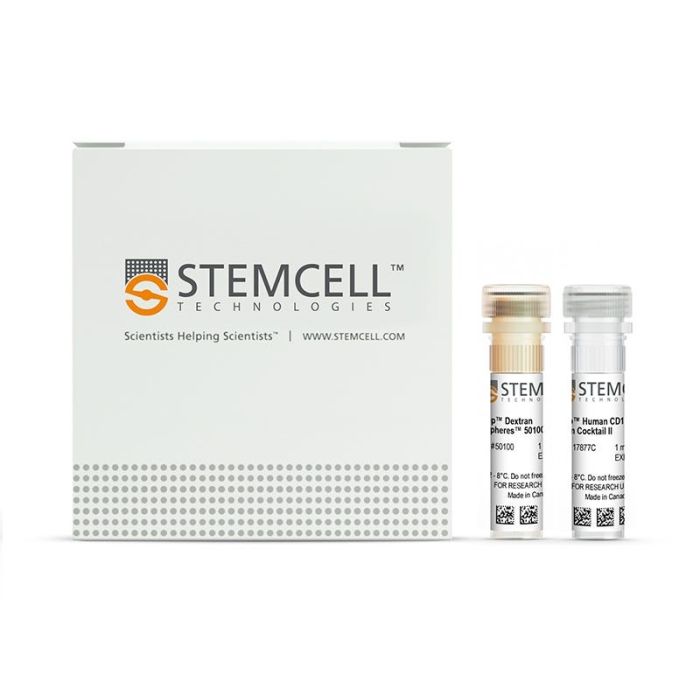
  • EasySep™人CD138正选试剂盒 II(产品号 #17877)
    • EasySep™人CD138正选试剂盒 II 抗体混合物,1 mL
    • EasySep™ Dextran RapidSpheres™ 50100 磁珠,1 mL
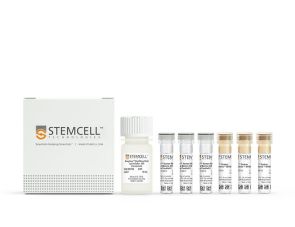
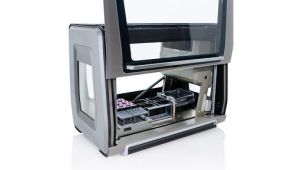
  • RoboSep™ 人CD138正选试剂盒 II(含过滤吸头,产品号 #17877RF)
    • EasySep™人CD138正选试剂盒 II 抗体混合物,1 mL
    • EasySep™ Dextran RapidSpheres™ 50100 磁珠,1 mL
    • RoboSep™ 缓冲液(产品号 #20104)
    • RoboSep™过滤吸头(产品号 #20125)
专为您的实验方案打造的产品
要查看实验方案所需的所有配套产品,请参阅《实验方案与技术文档》

总览

使用EasySep™人CD138正选试剂盒 II,通过免疫磁珠正选可从新鲜或冻存的人骨髓或外周血单个核细胞(MNC)中分离高纯度的CD138+(syndecan-1)细胞。EasySep™结合了单克隆抗体的特异性和无柱磁性系统的简便性,迄今已广泛应用于发表的研究中超过20年。    

在此EasySep™正选过程中,目的细胞被识别CD138的抗体四聚体复合物和磁珠结合标记,该抗体复合物中还含有人Fc受体阻断剂,可最大程度减少非特异性结合 。通过EasySep™磁极分离被标记的目的细胞,只需将非目的细胞倾倒或吸出,而目的细胞则被保留在管中。经磁珠分选后获得的CD138+细胞可直接用于流式细胞术、细胞培养或DNA/RNA提取等下游应用。CD138抗原在正常和恶性浆细胞表面表达(成熟B细胞不表达)。

该产品可替代EasySep™人CD138细胞正选试剂盒 (产品号 #18357) 以进行更快的细胞分选。

若需从全血和骨髓中分选CD138+细胞,推荐使用EasySep™人全血及骨髓CD138正选试剂盒(产品号 #17887)。

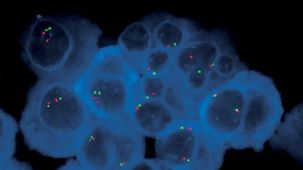
参加我们免费的CD138+细胞分选在线课程,学习如何处理骨髓样本并分选CD138+浆细胞以提高多发性骨髓瘤FISH检测的灵敏度。您还可以查阅关于CD138+浆细胞分选的常见问题解答(FAQs),了解如何提升FISH检测灵敏度。

了解更多关于免疫磁珠EasySep™技术的工作原理,或如何通过RoboSep™实现全自动化免疫磁珠细胞分选。探索更多优化您实验流程的产品,包括培养基、添加剂、抗体等。


磁极兼容性
• EasySep™磁极(产品号 #18000)
• “The Big Easy” EasySep™磁极(产品号 #18001)
• EasyEights™ EasySep™磁极(产品号 #18103)
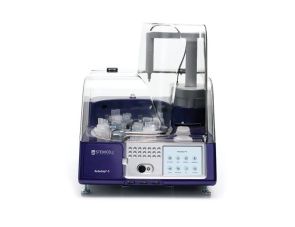
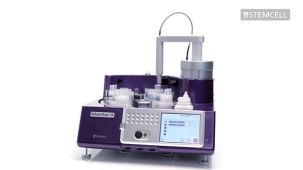
• RoboSep™-S(产品号 #21000)
 
分类
细胞分选试剂盒
 
细胞类型
B 细胞,浆细胞,骨髓瘤
 
种属

 
样本来源
骨髓,PBMC
 
分选方法
正选
 
应用
细胞分选
 
品牌
EasySep,RoboSep
 
研究领域
癌症,免疫
 

实验数据

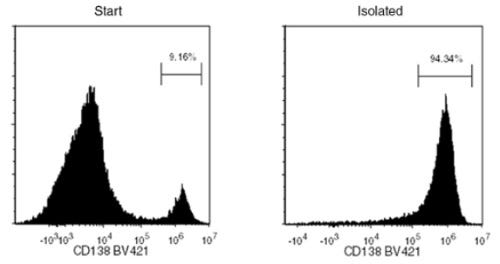
Typical EasySep™ Human CD138 Positive Selection Profile

Figure 1. Typical EasySep™ Human CD138 Positive Selection Profile

Starting with thawed PBMCs spiked with a multiple myeloma cell line, U266, the CD138+ cell content of the isolated fraction typically ranges from 93.0 - 98.2%. In the above example, the purities of the start and final isolated fractions are 9.16% and 94.34%, respectively.

产品说明书及文档

请在《产品说明书》中查找相关支持信息和使用说明,或浏览下方更多实验方案。

Document Type
Product Name
Catalog #
Lot #
Language
Document Type
产品说明书
Catalog #
17877RF
Lot #
All
Language
中文
Document Type
产品说明书
Catalog #
17877
Lot #
All
Language
中文
Catalog #
17877RF
Lot #
All
Language
English
Catalog #
17877
Lot #
All
Language
English
Document Type
Safety Data Sheet 1
Catalog #
17877RF
Lot #
All
Language
English
Document Type
Safety Data Sheet 2
Catalog #
17877RF
Lot #
All
Language
English
Document Type
Safety Data Sheet 3
Catalog #
17877RF
Lot #
All
Language
English
Document Type
Safety Data Sheet 1
Catalog #
17877
Lot #
All
Language
English
Document Type
Safety Data Sheet 2
Catalog #
17877
Lot #
All
Language
English

应用领域

本产品专为以下研究领域设计,适用于工作流程中的高亮阶段。探索这些工作流程,了解更多我们为各研究领域提供的其他配套产品。

相关材料与文献

技术资料 (14)

文献 (33)

CRISPR/Cas9-Correctable mutation-related molecular and physiological phenotypes in iPSC-derived Alzheimer's PSEN2 N141I neurons. M. Ortiz-Virumbrales et al. Acta neuropathologica communications 2017 dec

Abstract

Basal forebrain cholinergic neurons (BFCNs) are believed to be one of the first cell types to be affected in all forms of AD,and their dysfunction is clinically correlated with impaired short-term memory formation and retrieval. We present an optimized in vitro protocol to generate human BFCNs from iPSCs,using cell lines from presenilin 2 (PSEN2) mutation carriers and controls. As expected,cell lines harboring the PSEN2 N141I mutation displayed an increase in the A$\beta$42/40 in iPSC-derived BFCNs. Neurons derived from PSEN2 N141I lines generated fewer maximum number of spikes in response to a square depolarizing current injection. The height of the first action potential at rheobase current injection was also significantly decreased in PSEN2 N141I BFCNs. CRISPR/Cas9 correction of the PSEN2 point mutation abolished the electrophysiological deficit,restoring both the maximal number of spikes and spike height to the levels recorded in controls. Increased A$\beta$42/40 was also normalized following CRISPR/Cas-mediated correction of the PSEN2 N141I mutation. The genome editing data confirms the robust consistency of mutation-related changes in A$\beta$42/40 ratio while also showing a PSEN2-mutation-related alteration in electrophysiology.
An inhibitor of proteasome $\beta$2 sites sensitizes myeloma cells to immunoproteasome inhibitors. S. Downey-Kopyscinski et al. Blood advances 2018 OCT

Abstract

Proteasome inhibitors bortezomib,carfilzomib and ixazomib (approved by the US Food and Drug Administration [FDA]) induce remissions in patients with multiple myeloma (MM),but most patients eventually become resistant. MM and other hematologic malignancies express ubiquitous constitutive proteasomes and lymphoid tissue-specific immunoproteasomes; immunoproteasome expression is increased in resistant patients. Immunoproteasomes contain 3 distinct pairs of active sites,$\beta$5i,$\beta$1i,and $\beta$2i,which are different from their constitutive $\beta$5c,$\beta$1c,and $\beta$2c counterparts. Bortezomib and carfilzomib block $\beta$5c and $\beta$5i sites. We report here that pharmacologically relevant concentrations of $\beta$5i-specific inhibitor ONX-0914 show cytotoxicity in MM cell lines similar to that of carfilzomib and bortezomib. In addition,increasing immunoproteasome expression by interferon-$\gamma$ increases sensitivity to ONX-0914 but not to carfilzomib. LU-102,an inhibitor of $\beta$2 sites,dramatically sensitizes MM cell lines and primary cells to ONX-0914. ONX-0914 synergizes with all FDA-approved proteasome inhibitors in MM in vitro and in vivo. Thus,immunoproteasome inhibitors,currently in clinical trials for the treatment of autoimmune diseases,should also be considered for the treatment of MM.
Assessing genome-wide copy number aberrations and copy-neutral loss-of-heterozygosity as best practice: An evidence-based review from the Cancer Genomics Consortium working group for plasma cell disorders. T. J. Pugh et al. Cancer genetics 2018 DEC

Abstract

BACKGROUND Plasma cell neoplasms (PCNs) encompass a spectrum of disorders including monoclonal gammopathy of undetermined significance,smoldering myeloma,plasma cell myeloma,and plasma cell leukemia. Molecular subtypes have been defined by recurrent cytogenetic abnormalities and somatic mutations that are prognostic and predictive. Karyotype and fluorescence in situ hybridization (FISH) have historically been used to guide management; however,new technologies and markers raise the need to reassess current testing algorithms. METHODS We convened a panel of representatives from international clinical laboratories to capture current state-of-the-art testing from published reports and to put forward recommendations for cytogenomic testing of plasma cell neoplasms. We reviewed 65 papers applying FISH,chromosomal microarray (CMA),next-generation sequencing,and gene expression profiling for plasma cell neoplasm diagnosis and prognosis. We also performed a survey of our peers to capture current laboratory practice employed outside our working group. RESULTS Plasma cell enrichment is widely used prior to FISH testing,most commonly by magnetic bead selection. A variety of strategies for direct,short- and long-term cell culture are employed to ensure clonal representation for karyotyping. Testing of clinically-informative 1p/1q,del(13q) and del(17p) are common using karyotype,FISH and,increasingly,CMA testing. FISH for a variety of clinically-informative balanced IGH rearrangements is prevalent. Literature review found that CMA analysis can detect abnormalities in 85-100{\%} of patients with PCNs; more specifically,in 5-53{\%} (median 14{\%}) of cases otherwise normal by FISH and cytogenetics. CMA results in plasma cell neoplasms are usually complex,with alteration counts ranging from 1 to 74 (median 10-20),primarily affecting loci not covered by FISH testing. Emerging biomarkers include structural alterations of MYC as well as somatic mutations of KRAS,NRAS,BRAF,and TP53. Together,these may be measured in a comprehensive manner by a combination of newer technologies including CMA and next-generation sequencing (NGS). Our survey suggests most laboratories have,or are soon to have,clinical CMA platforms,with a desire to move to NGS assays in the future. CONCLUSION We present an overview of current practices in plasma cell neoplasm testing as well as an algorithm for integrated FISH and CMA testing to guide treatment of this disease.

更多信息

更多信息
物种
Magnet Compatibility • EasySep™ Magnet (Catalog #18000) • “The Big Easy” EasySep™ Magnet (Catalog #18001) • EasyEights™ EasySep™ Magnet (Catalog #18103) • RoboSep™-S (Catalog #21000)
样本来源 PBMC, 骨髓
Selection Method Positive
标记抗体
质量保证:

产品仅供研究使用,不用于针对人或动物的诊断或治疗。 欲获悉更多关于STEMCELL的质控信息,请访问 STEMCELL.CN/COMPLIANCE.
Copyright © 2026 by STEMCELL Technologies. All rights reserved.

在线联系