若您需要咨询产品或有任何技术问题,请通过官方电话 400 885 9050 或邮箱 info.cn@stemcell.com 与我们联系。

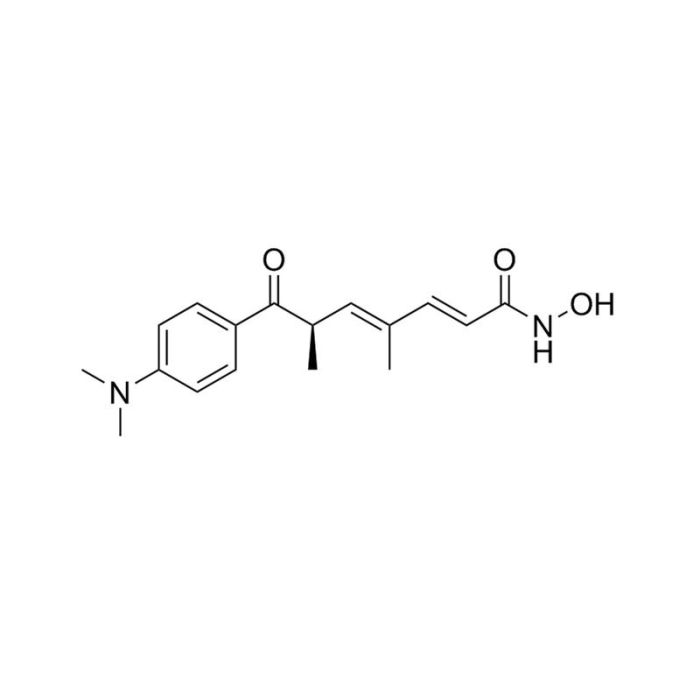
曲古抑菌素 A(Trichostatin A)

表观遗传修饰剂;抑制组蛋白去乙酰化酶 (HDAC)1 和 HDAC6
只有 %1
¥2,382.00

产品号 #(选择产品)

产品号 #72282_C

表观遗传修饰剂;抑制组蛋白去乙酰化酶 (HDAC)1 和 HDAC6

总览

曲古抑菌素 A(Trichostatin A)一种强效且可逆的组蛋白去乙酰化酶 (HDAC) 抑制剂,因此可通过阻止组蛋白尾部赖氨酸残基乙酰基的去除发挥表观遗传修饰作用。曲古抑菌素 A 可抑制 I 类和 II 类 HDAC,包括 HDAC1 (IC₅₀ = 6 nM)、HDAC4 (IC₅₀ = 38 nM) 和 HDAC6 (IC₅₀ = 8.6 nM)。(Furumai et al.; Yoshida et al.)

重编程
·提高小鼠胚胎成纤维细胞重编程为诱导多能干细胞 (iPS) 的效率(Huangfu et al.)。
·与 5-氮杂胞苷联合使用,可重置小鼠 iPS 细胞的表观遗传记忆(Kim et al.)。
·通过体细胞核移植提高克隆小鼠胚胎发育效率(Kishigami et al.)。

维持和自我更新
·防止培养大鼠原代肝细胞去分化,维持肝脏特异性细胞功能(Henkens et al.)。

分化
·促进人间充质干细胞向肝细胞分化(Snykers et al.)。

细胞类型
肝细胞,间充质干/祖细胞,多能干细胞
 
种属
人,小鼠,非人灵长类,其他物种,大鼠
 
应用
分化,培养,重编程
 
研究领域
上皮细胞研究,干细胞生物学
 
CAS 编号
58880-19-6
 
化学式
C₁₇H₂₂N₂O₃
 
纯度
≥ 95 %
 
通路
表观遗传学
 
靶点
HDAC
 

产品说明书及文档

请在《产品说明书》中查找相关支持信息和使用说明,或浏览下方更多实验方案。

Document Type
Product Name
Catalog #
Lot #
Language
Product Name
Trichostatin A
Catalog #
72284, 72282
Lot #
For 72282 Lot# 1000123223 or higher | For 72284 Lot# 1000092807 or higher
Language
English
Product Name
Trichostatin A
Catalog #
72284, 72282
Lot #
For 72282 Lot# 1000123222 or lower | For 72284 Lot# 1000092806 or lower
Language
English
Document Type
Safety Data Sheet
Product Name
Trichostatin A
Catalog #
72284, 72282
Lot #
All
Language
English

应用领域

本产品专为以下研究领域设计,适用于工作流程中的高亮阶段。探索这些工作流程,了解更多我们为各研究领域提供的其他配套产品。

相关材料与文献

技术资料 (3)

文献 (7)

Potent histone deacetylase inhibitors built from trichostatin A and cyclic tetrapeptide antibiotics including trapoxin. Furumai R et al. Proceedings of the National Academy of Sciences of the United States of America 2001 JAN

Abstract

Trichostatin A (TSA) and trapoxin (TPX) are potent inhibitors of histone deacetylases (HDACs). TSA is proposed to block the catalytic reaction by chelating a zinc ion in the active-site pocket through its hydroxamic acid group. On the other hand,the epoxyketone is suggested to be the functional group of TPX capable of alkylating the enzyme. We synthesized a novel TPX analogue containing a hydroxamic acid instead of the epoxyketone. The hybrid compound cyclic hydroxamic acid-containing peptide (CHAP) 1 inhibited HDAC1 at low nanomolar concentrations. The HDAC1 inhibition by CHAP1 was reversible as it was by TSA,in contrast to the irreversible inhibition by TPX. CHAP with an aliphatic chain length of five,which corresponded to that of acetylated lysine,was stronger than those with other lengths. These results suggest that TPX is a substrate mimic and that the replacement of the epoxyketone with the hydroxamic acid converted TPX to an inhibitor chelating the zinc like TSA. Interestingly,HDAC6,but not HDAC1 or HDAC4,was resistant to TPX and CHAP1,whereas TSA inhibited these HDACs to a similar extent. HDAC6 inhibition by TPX at a high concentration was reversible,probably because HDAC6 is not alkylated by TPX. We further synthesized the counterparts of all known naturally occurring cyclic tetrapeptides containing the epoxyketone. HDAC1 was highly sensitive to all these CHAPs much more than HDAC6,indicating that the structure of the cyclic tetrapeptide framework affects the target enzyme specificity. These results suggest that CHAP is a unique lead to develop isoform-specific HDAC inhibitors.
Significant improvement of mouse cloning technique by treatment with trichostatin A after somatic nuclear transfer. Kishigami S et al. Biochemical and biophysical research communications 2006 FEB

Abstract

The low success rate of animal cloning by somatic cell nuclear transfer (SCNT) is believed to be associated with epigenetic errors including abnormal DNA hypermethylation. Recently,we elucidated by using round spermatids that,after nuclear transfer,treatment of zygotes with trichostatin A (TSA),an inhibitor of histone deacetylase,can remarkably reduce abnormal DNA hypermethylation depending on the origins of transferred nuclei and their genomic regions [S. Kishigami,N. Van Thuan,T. Hikichi,H. Ohta,S. Wakayama. E. Mizutani,T. Wakayama,Epigenetic abnormalities of the mouse paternal zygotic genome associated with microinsemination of round spermatids,Dev. Biol. (2005) in press]. Here,we found that 5-50 nM TSA-treatment for 10 h following oocyte activation resulted in more efficient in vitro development of somatic cloned embryos to the blastocyst stage from 2- to 5-fold depending on the donor cells including tail tip cells,spleen cells,neural stem cells,and cumulus cells. This TSA-treatment also led to more than 5-fold increase in success rate of mouse cloning from cumulus cells without obvious abnormality but failed to improve ES cloning success. Further,we succeeded in establishment of nuclear transfer-embryonic stem (NT-ES) cells from TSA-treated cloned blastocyst at a rate three times higher than those from untreated cloned blastocysts. Thus,our data indicate that TSA-treatment after SCNT in mice can dramatically improve the practical application of current cloning techniques.
Trichostatin A, a critical factor in maintaining the functional differentiation of primary cultured rat hepatocytes. Henkens T et al. Toxicology and applied pharmacology 2007 JAN

Abstract

Histone deacetylase inhibitors (HDI) have been shown to increase differentiation-related gene expression in several tumor-derived cell lines by hyperacetylating core histones. Effects of HDI on primary cultured cells,however,have hardly been investigated. In the present study,the ability of trichostatin A (TSA),a prototype hydroxamate HDI,to counteract the loss of liver-specific functions in primary rat hepatocyte cultures has been investigated. Upon exposure to TSA,it was found that the cell viability of the cultured hepatocytes and their albumin secretion as a function of culture time were increased. TSA-treated hepatocytes also better maintained cytochrome P450 (CYP)-mediated phase I biotransformation capacity,whereas the activity of phase II glutathione S-transferases (GST) was not affected. Western blot and qRT-PCR analysis of CYP1A1,CYP2B1 and CYP3A11 protein and mRNA levels,respectively,further revealed that TSA acts at the transcriptional level. In addition,protein expression levels of the liver-enriched transcription factors (LETFs) hepatic nuclear factor 4 alpha (HNF4alpha) and CCAAT/enhancer binding protein alpha (C/EBPalpha) were accordingly increased by TSA throughout culture time. In conclusion,these findings indicate that TSA plays a major role in the preservation of the differentiated hepatic phenotype in culture. It is suggested that the effects of TSA on CYP gene expression are mediated via controlling the expression of LETFs.

更多信息

更多信息
物种 人, 其它物种, 大鼠, 小鼠, 非人灵长类
Cas Number 58880-19-6
Chemical Formula C₁₇H₂₂N₂O₃
纯度 ≥ 95 %
Target HDAC
Pathway Epigenetic
质量保证:

产品仅供研究使用,不用于针对人或动物的诊断或治疗。 欲获悉更多关于STEMCELL的质控信息,请访问 STEMCELL.CN/COMPLIANCE.
Copyright © 2026 by STEMCELL Technologies. All rights reserved.

在线联系