若您需要咨询产品或有任何技术问题,请通过官方电话 400 885 9050 或邮箱 info.cn@stemcell.com 与我们联系。

EasySep™人CD19正选试剂盒II

人CD19+细胞的免疫磁珠正选
只有 %1
¥8,288.00

产品号 #(选择产品)

产品号 #17854_C

人CD19+细胞的免疫磁珠正选

产品优势

  • 快捷、操作简单
  • 纯度高达99%
  • 无需分离柱

产品组分包括

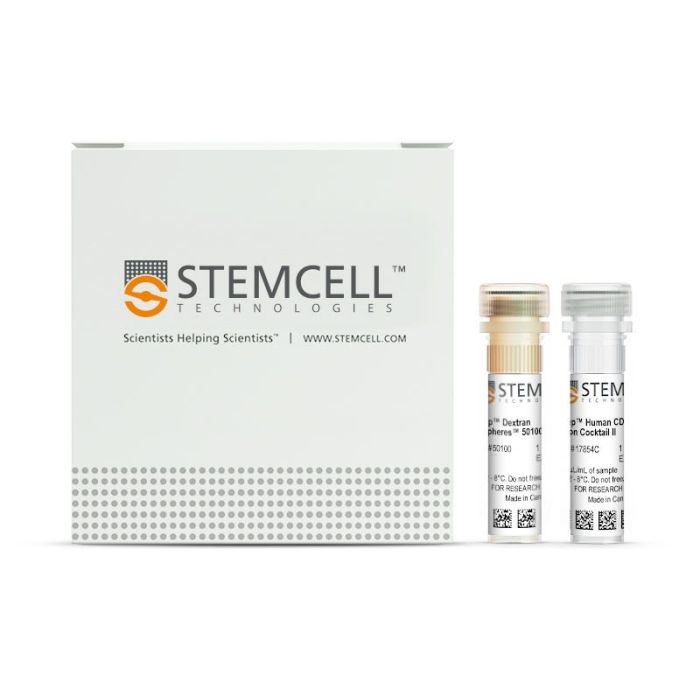
  • EasySep™人CD19     正选试剂盒II(产品号 #17854)
    • EasySep™人CD19正选抗体混合物II,1mL
    • EasySep™ Dextran RapidSpheres™ 50100 磁珠,1mL
  • RoboSep™人CD34正选试剂盒II(产品号 #17854RF)
    • EasySep™人CD19正选抗体混合物II,1mL
    • EasySep™ Dextran RapidSpheres™ 50100 磁珠,1mL
    • RoboSep™ 缓冲液(产品号 #20104)
    • RoboSep™过滤吸头(产品号#20125)
专为您的实验方案打造的产品
要查看实验方案所需的所有配套产品,请参阅《实验方案与技术文档》

总览

使用EasySep™人CD19正选试剂盒II,通过免疫磁性正选法可从新鲜、冻存的人外周血单个核细胞(PBMCs)或白细胞单采样品中分离出高纯度CD19+细胞。

该过程使用识别CD19的抗体复合物和磁性颗粒,并包含抗人Fc受体抗体以防非特异结合。标记细胞经EasySep™磁体分离后,未标记细胞被去除,目标CD19+细胞保留在试管中,整个过程最短仅需18分钟。所得CD19+细胞可立即用于流式细胞术、培养或核酸提取。

本产品替代旧版EasySep™ CD19试剂盒(产品号#18054),速度更快。

了解更多EasySep™免疫磁性技术RoboSep™系统。


磁极兼容性
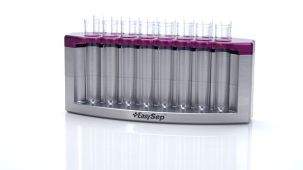
• EasySep™磁极(产品号 #18000)
• “The Big Easy” EasySep™磁极(产品号 #18001)
• EasyPlate™ EasySep™磁极(产品号 #18102)
• Easy 50 EasySep™磁极(产品号 #18002)
• EasyEights™ EasySep™磁极(产品号 #18103)
• RoboSep™-S(产品号 #21000)
 
分类
细胞分选试剂盒
 
细胞类型
B 细胞
 
种属

 
样本来源
PBMC
 
分选方法
正选
 
应用
细胞分选
 
品牌
EasySep,RoboSep
 
研究领域
嵌合体,免疫
 

实验数据

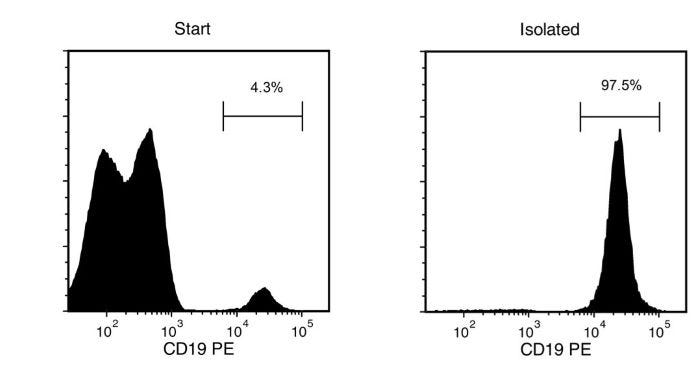
Typical EasySep™ Human CD19 Positive Selection Profile

Figure 1. Typical EasySep™ Human CD19 Positive Selection Profile

Starting with a single cell suspension of human PBMCs, the CD19+ cell content of the isolated fraction is typically 98 ± 1% (mean ± SD) using the purple EasySep™ Magnet.

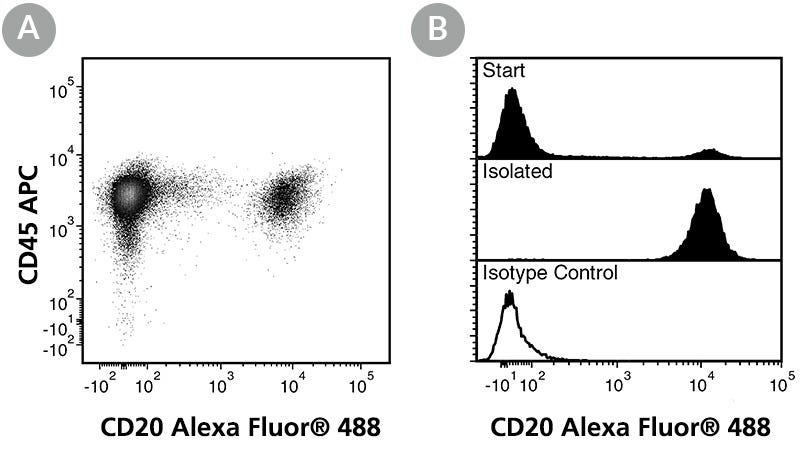
FACS Data for Anti-Human CD20 Antibody, Clone 2H7, Alexa Fluor® 488-Conjugated

Figure 2. FACS Data for Anti-Human CD20 Antibody, Clone 2H7, Alexa Fluor® 488-Conjugated

(A) Flow cytometry analysis of human peripheral blood mononuclear cells (PBMCs) labeled with Anti-Human CD20 Antibody, Clone 2H7, Alexa Fluor® 488 (Catalog #60008AD) and anti-human CD45 APC.

(B) Flow cytometry analysis of human PBMCs processed with the EasySep™ Human CD19 Positive Selection Kit (Catalog #17854) and labeled with Anti-Human CD20 Antibody, Clone 2H7, Alexa Fluor® 488. Histograms show labeling of the PBMCs (Start) and isolated cells (Isolated). Labeling of start cells with a mouse IgG2b, kappa Alexa Fluor® 488 isotype control antibody is shown in the bottom panel (open histogram).

产品说明书及文档

请在《产品说明书》中查找相关支持信息和使用说明,或浏览下方更多实验方案。

Document Type
Product Name
Catalog #
Lot #
Language
Catalog #
17854RF
Lot #
All
Language
中文
Catalog #
17854
Lot #
All
Language
中文
Catalog #
17854RF
Lot #
All
Language
English
Catalog #
17854
Lot #
All
Language
English
Catalog #
17854
Lot #
All
Language
English
Document Type
Safety Data Sheet 1
Catalog #
17854RF
Lot #
All
Language
English
Document Type
Safety Data Sheet 2
Catalog #
17854RF
Lot #
All
Language
English
Document Type
Safety Data Sheet 3
Catalog #
17854RF
Lot #
All
Language
English
Document Type
Safety Data Sheet 1
Catalog #
17854
Lot #
All
Language
English
Document Type
Safety Data Sheet 2
Catalog #
17854
Lot #
All
Language
English

应用领域

本产品专为以下研究领域设计,适用于工作流程中的高亮阶段。探索这些工作流程,了解更多我们为各研究领域提供的其他配套产品。

相关材料与文献

技术资料 (11)

常见问题 (11)

Can EasySep™ be used for either positive or negative selection?

Yes. The EasySep™ kits use either a negative selection approach by targeting and removing unwanted cells or a positive selection approach targeting desired cells. Depletion kits are also available for the removal of cells with a specific undesired marker (e.g. GlyA).

How does the separation work?

Magnetic particles are crosslinked to cells using Tetrameric Antibody Complexes (TAC). When placed in the EasySep™ Magnet, labeled cells migrate to the wall of the tube. The unlabeled cells are then poured off into a separate fraction.

Which columns do I use?

The EasySep™ procedure is column-free. That's right - no columns!

How can I analyze the purity of my enriched sample?

The Product Information Sheet provided with each EasySep™ kit contains detailed staining information.

Can EasySep™ separations be automated?

Yes. RoboSep™, the fully automated cell separator, automates all EasySep™ labeling and cell separation steps.

Can EasySep™ be used to isolate rare cells?

Yes. We recommend a cell concentration of 2x10⁸ cells/mL and a minimum working volume of 100 µL. Samples containing 2x10⁷ cells or fewer should be suspended in 100 µL of buffer.

Are the EasySep™ magnetic particles FACS-compatible?

Yes, the EasySep™ particles are flow cytometry-compatible, as they are very uniform in size and about 5000X smaller than other commercially available magnetic beads used with column-free systems.

Can the EasySep™ magnetic particles be removed after enrichment?

No, but due to the small size of these particles, they will not interfere with downstream applications.

Can I alter the separation time in the magnet?

Yes; however, this may impact the kit's performance. The provided EasySep™ protocols have already been optimized to balance purity, recovery and time spent on the isolation.

For positive selection, can I perform more than 3 separations to increase purity?

Yes, the purity of targeted cells will increase with additional rounds of separations; however, cell recovery will decrease.

How does the binding of the EasySep™ magnetic particle affect the cells? is the function of positively selected cells altered by the bound particles?

Hundreds of publications have used cells selected with EasySep™ positive selection kits for functional studies. Our in-house experiments also confirm that selected cells are not functionally altered by the EasySep™ magnetic particles.

If particle binding is a key concern, we offer two options for negative selection. The EasySep™ negative selection kits can isolate untouched cells with comparable purities, while RosetteSep™ can isolate untouched cells directly from whole blood without using particles or magnets.

文献 (10)

CRISPR/Cas9-Correctable mutation-related molecular and physiological phenotypes in iPSC-derived Alzheimer's PSEN2 N141I neurons. M. Ortiz-Virumbrales et al. Acta neuropathologica communications 2017 dec

Abstract

Basal forebrain cholinergic neurons (BFCNs) are believed to be one of the first cell types to be affected in all forms of AD,and their dysfunction is clinically correlated with impaired short-term memory formation and retrieval. We present an optimized in vitro protocol to generate human BFCNs from iPSCs,using cell lines from presenilin 2 (PSEN2) mutation carriers and controls. As expected,cell lines harboring the PSEN2 N141I mutation displayed an increase in the A$\beta$42/40 in iPSC-derived BFCNs. Neurons derived from PSEN2 N141I lines generated fewer maximum number of spikes in response to a square depolarizing current injection. The height of the first action potential at rheobase current injection was also significantly decreased in PSEN2 N141I BFCNs. CRISPR/Cas9 correction of the PSEN2 point mutation abolished the electrophysiological deficit,restoring both the maximal number of spikes and spike height to the levels recorded in controls. Increased A$\beta$42/40 was also normalized following CRISPR/Cas-mediated correction of the PSEN2 N141I mutation. The genome editing data confirms the robust consistency of mutation-related changes in A$\beta$42/40 ratio while also showing a PSEN2-mutation-related alteration in electrophysiology.
Multiplexed droplet single-cell RNA-sequencing using natural genetic variation. Kang HM et al. Nature biotechnology 2018 JAN

Abstract

Droplet single-cell RNA-sequencing (dscRNA-seq) has enabled rapid,massively parallel profiling of transcriptomes. However,assessing differential expression across multiple individuals has been hampered by inefficient sample processing and technical batch effects. Here we describe a computational tool,demuxlet,that harnesses natural genetic variation to determine the sample identity of each droplet containing a single cell (singlet) and detect droplets containing two cells (doublets). These capabilities enable multiplexed dscRNA-seq experiments in which cells from unrelated individuals are pooled and captured at higher throughput than in standard workflows. Using simulated data,we show that 50 single-nucleotide polymorphisms (SNPs) per cell are sufficient to assign 97% of singlets and identify 92% of doublets in pools of up to 64 individuals. Given genotyping data for each of eight pooled samples,demuxlet correctly recovers the sample identity of<99% of singlets and identifies doublets at rates consistent with previous estimates. We apply demuxlet to assess cell-type-specific changes in gene expression in 8 pooled lupus patient samples treated with interferon (IFN)-β and perform eQTL analysis on 23 pooled samples.
Co-stimulatory signaling determines tumor antigen sensitivity and persistence of CAR T cells targeting PSCA+ metastatic prostate cancer. S. J. Priceman et al. Oncoimmunology 2018

Abstract

Advancing chimeric antigen receptor (CAR)-engineered adoptive T cells for the treatment of solid cancers is a major focus in the field of immunotherapy,given impressive recent clinical responses in hematological malignancies. Prostate cancer may be amenable to T cell-based immunotherapy since several tumor antigens,including prostate stem-cell antigen (PSCA),are widely over-expressed in metastatic disease. While antigen selectivity of CARs for solid cancers is crucial,it is problematic due to the absence of truly restricted tumor antigen expression and potential safety concerns with on-target off-tumor" activity. Here

更多信息

更多信息
物种
Magnet Compatibility • EasySep™ Magnet (Catalog #18000) • “The Big Easy” EasySep™ Magnet (Catalog #18001) • EasyPlate™ EasySep™ Magnet (Catalog #18102) • EasyEights™ EasySep™ Magnet (Catalog #18103) • Easy 50 EasySep™ Magnet (Catalog #18002) • RoboSep™-S (Catalog #21000)
样本来源 PBMC
Selection Method Positive
标记抗体
质量保证:

产品仅供研究使用,不用于针对人或动物的诊断或治疗。 欲获悉更多关于STEMCELL的质控信息,请访问 STEMCELL.CN/COMPLIANCE.
Copyright © 2026 by STEMCELL Technologies. All rights reserved.

在线联系