

 EasySep™小鼠TIL(CD45)正选试剂盒




IntestiCult™ 肠道类器官培养基
IntestiCult™ 类器官培养基是完整的生长培养基,支持人、大鼠或小鼠从肠道隐窝建立、扩展、长期维持培养和进一步分化为肠道类器官。这款成分明确的完全培养基是与Hans Clevers博士和HUB Organoids合作开发的,可以在不到一周的时间内从肠隐窝中生成类器官。这些“迷你肠道”保留了隐窝和绒毛样结构、中心管腔和所有在成人肠上皮中发现的主要细胞类型。这些类器官功能齐全,可用于多种研究应用,包括疾病建模、药物筛选和组织再生。
解决肠道研究中的挑战
研究肠上皮可能会面临多重挑战。传统的体外单层培养方法方便,但缺乏成人肠道的关键结构特征和细胞多样性。活体动物模型可在完整的肠道上进行实验,但通常更加困难和昂贵,并且与人体生理学的相关性有限。肠道类器官通过提供一个方便的体外系统解决了许多这些问题,具有高度的生理相关性。
什么是肠道类器官?
肠类器官是三维多细胞结构,保留了成人肠上皮的主要特征,如隐窝和绒毛样结构、中央管腔和主要细胞类型:肠干细胞、潘氏细胞、杯状细胞、肠内分泌细胞和肠细胞。类器官培养是一种方便且与生理相关的工具,可用于各种研究应用。
为什么使用 Inteticult™ ?
- 不需要额外生长因子的完全培养基。
- 类器官保留了成人肠上皮的主要特征和所有主要细胞类型。
- 在不到一周的时间内高效、可再生地生成类器官。
- 产品规格简单,流程优化且一目了然。
肠道类器官培养基

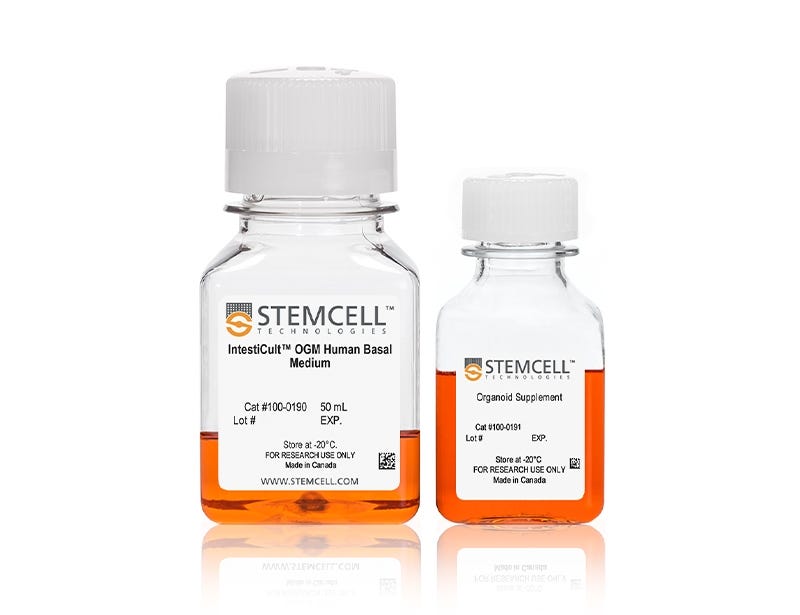
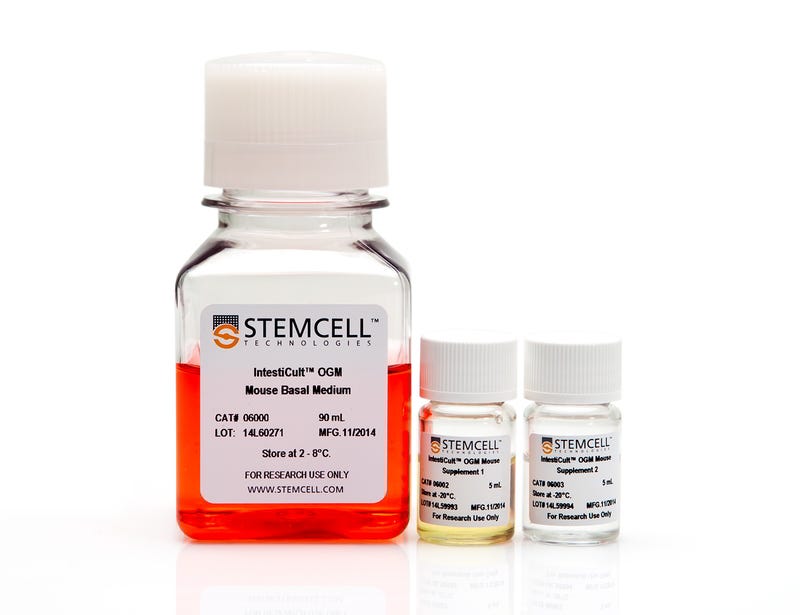
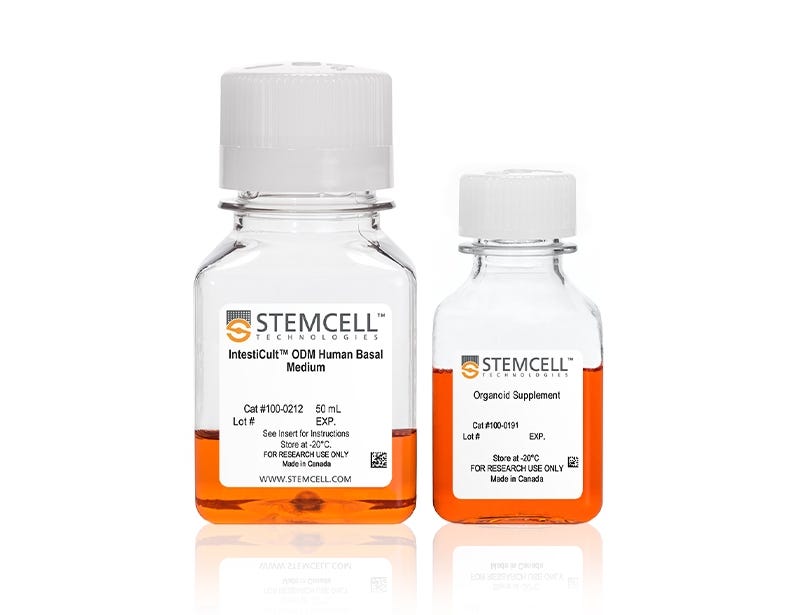
品牌的历史
Hans Clevers博士和他的研究小组在干细胞和类器官培养领域做出了重大贡献。在2007年,Nick Barker博士等人确定了肠隐窝中LGR5+的干细胞的存在。在2009年,Toshiro Sato等人发表了从肠隐窝或单个肠干细胞建立类器官结构的方案。该方案描述了支持这些类器官长期扩增且不需要间充质微环境的培养条件。2014年,Clevers博士协同The HUB foundation for Organoid Technology与STEMCELL Technologies签署了一项协议 - 制造和销售类器官的细胞培养基。此后,在2015年推出的IntestiCult™类器官生长培养基(小鼠) 和在2017年推出的 IntestiCult™ 类器官生长培养基(人) 为研究人员提供了一种方便、完全和负担得起的培养基来建立类器官培养。
2025年,STEMCELL Technologies推出了新一代肠道类器官培养基IntestiCult™ Plus。IntestiCult™ Plus凝聚了近十年的创新成果,可用于肠道类器官的同步扩增和分化,从而有效平衡细胞扩增与细胞多样性。这种无血清、无条件培养基的配方,通过促进包括簇状细胞和成熟肠细胞在内的多种肠道细胞类型在单一培养系统中的发育,可提高生理相关性。IntestiCult™ Plus延续了该品牌一贯的传统,致力于提供稳定、可放大且高性能的解决方案,从而高效推进肠道类器官研究。
我们很高兴STEMCELL将成为我们的合作伙伴,共同为科学界提供用于类器官培养的专用培养基。作为全球领先的细胞培养基和细胞分选产品厂家,STEMCELL提供的现货细胞培养基的广泛应用,对于这项振奋人心的技术的进一步推广应用而言,无疑是至关重要的一步。
Hans Clevers博士,HUB的创始董事
肠道类器官的关键应用
上皮细胞生物学
肠道干细胞微环境
基因表达与功能
移植和植入
囊性纤维化
Schwank G et al. (2013) Functional repair of CFTR by CRISPR/Cas9 in intestinal stem cell organoids of cystic fibrosis patients. Cell Stem Cell 13(6): 653-8.
癌症
Ye Q et al (2024) Orchestrating NK and T cells via tri-specific nano-antibodies for synergistic antitumor immunity. Nat Commun 15, 6211.
Kim S et al. (2023) YWHAZ and TBP are potential reference gene candidates for qPCR analysis of response to radiation therapy in colorectal cancer. Sci Rep 13, 12902.
Lee SH et al. (2023) Apposition of Fibroblasts with Metaplastic Gastric Cells Promotes Dysplastic Transition. Gastroenterology. 165(2): 374–90.
Yao L et al. (2022) Application of tumoroids derived from advanced colorectal cancer patients to predict individual response to chemotherapy. J Chemother 35(2): 104–16.
Sui Q et al. (2021) Dickkopf 1 impairs the tumor response to PD-1 blockade by inactivating CD8+ T cells in deficient mismatch repair colorectal cancer. J Immunother Cancer 9(3): e001498.
Li Y et al. (2020) Butyrate enhances the efficacy of radiotherapy via FOXO3A in colorectal cancer. Int J Oncol 57(6): 1307–18.
Nag D et al. (2019) Auranofin protects intestine against radiation injury by modulating p53/p21 pathway and radiosensitizes human colon tumor. Clin Cancer Res 25(15): 4791–807.
Tsai S et al. (2018) Development of primary human pancreatic cancer organoids, matched stromal and immune cells and 3D tumor microenvironment models. BMC Cancer 18(1): 335.
Banerjee A et al. (2016) Endoplasmic reticulum stress and IRE-1 signaling cause apoptosis in colon cancer cells in response to andrographolide treatment. Oncotarget 7(27): 41432–44.
Matano M et al. (2015) Modeling colorectal cancer using CRISPR-Cas9-mediated engineering of human intestinal organoids. Nat Med 21(3):256–62.
药物筛选
病毒感染
Li NF et al. (2025) Macrophage phagocytosis of human norovirus-infected cells in an ex vivo human enteroid-macrophage coculture model. mBio 16:301180-25.
Rader A et al. (2025) Autophagy-enhancing strategies to promote intestinal viral resistance and mucosal barrier function in SARS-CoV-2 infection. Autophagy Reports, 4(1).
Hayashi T et al. (2025) Identification of FDA-Approved Drugs That Inhibit SARS-CoV-2 and Human Norovirus Replication. Biological and Pharmaceutical Bulletin 48(7):994-1000.
Ianevski A et al. (2024) ) The combination of pleconaril, rupintrivir, and remdesivir efficiently inhibits enterovirus infections in vitro, delaying the development of drug-resistant virus variants. Antiviral Res 224: 105842.
Santos-Ferreira A et al. (2024) Molnupiravir inhibits human norovirus and rotavirus replication in 3D human intestinal enteroids. Antiviral Res 223: 105839.
Euller-Nicolas G et al. (2023) Human Sapovirus replication in human intestinal enteroids. J Virol 97: e00383-23.
Guo Y et al. (2021) Infection of porcine small intestinal enteroids with human and pig rotavirus A strains reveals contrasting roles for histo-blood group antigens and terminal sialic acids. PLoS Pathog 17(1): e1009237.
Overbey KN et al. (2021) Optimizing human intestinal enteroids for environmental monitoring of human norovirus. Food Environ Virol 13(4): 470–84.
Lindesmith LC et al. (2019) Sera antibody repertoire analyses reveal mechanisms of broad and pandemic strain neutralizing responses after human norovirus vaccination. Immunity 50(6): 1530–41.e8.
Zhu S et al. (2017) Nlrp9b inflammasome restricts rotavirus infection in intestinal epithelial cells. Nature 546: 667–70.
细菌感染
Roodsant TJ et al. (2024) Translocation across a human enteroid monolayer by zoonotic Streptococcus suis correlates with the presence of Gb3-positiv cells. iScience, 27(3):109178.
Baryalai P et al. (2025) Hemagglutinin Protease HapA Associated with Vibrio cholerae Outer Memberane Vesicles (OMVs) Disrupts Tight and Adherens Junctions. J Extracell Vesicles. 14: e70092.
Grüttner J et al. (2023) Trophozoite fitness dictates the intestinal epithelial cell response to Giardia intestinalis infection. PLOS Pathog 19(5): e1011372.
Horvath TD et al. (2023) Interrogation of the mammalian gut–brain axis using LC–MS/MS-based targeted metabolomics with in vitro bacterial and organoid cultures and in vivo gnotobiotic mouse models. Nat Protoc 18: 490–529.
Xiong Z et al. (2022) Intestinal Tuft-2 cells exert antimicrobial immunity via sensing bacterial metabolite N-undecanoylglycine. Immunity 55(4): 686–700.e7.
Yue R et al. (2020) Essential role of IFN-γ in regulating gut antimicrobial peptides and microbiota to protect against alcohol-induced bacterial translocation and hepatic inflammation in mice. Front Physiol 11: 629141.
Sittipo P et al. (2020) Irradiation-induced intestinal damage is recovered by the indigenous gut bacteria Lactobacillus acidophilus. Front Cell Infect Microbiol 10: 415.
Ishii Y et al. (2018) Activation of signal transduction and activator of transcription 3 signaling contributes to Helicobacter-associated gastric epithelial proliferation and inflammation. Gastroenterol Res Pract 2018: 9050715.
Farin HF et al (2014) Paneth cell extrusion and release of antimicrobial products is directly controlled by immune cell-derived IFN-γ. J Exp Med 211(7): 1393–405.
Wilson SS et al. (2014) A small intestinal organoid model of non-invasive enteric pathogen-epithelial cell interactions. Mucosal Immunol 8(2): 352–61.
Zhang YG et al. (2014) Salmonella-infected crypt-derived intestinal organoid culture system for host-bacterial interactions. Physiol Rep 2(9): e12147.
炎症
Bao LL et al. (2025) Epithelial OPA1 links mitochondrial fusion to inflammatory bowel disease. Sci Transl Med. 17(781):eadn8699.
Pei Y et al. (2025) Mitsugumin 53 drives stem cell differentiation easing intestinal injury an inflammation. Signal Transduct Target Ther. 10(1):183.
Kaya GG et al. (2025) Unfolded protein response transcription factor XBP1 suppresses necroptosis-induced colitis by reinforcing the mucus barrier. Immunity 58(9):2208–25.
Yang X et al. (2024) Btbd8 deficiency reduces susceptibility to colitis by enhancing intestinal barrier function and suppressing inflammation. Front Immunol 15: 1382661.
Mishra SP et al. (2023) A mechanism by which gut microbiota elevates permeability and inflammation in obese/diabetic mice and human gut. Gut 72(10): 1848–65.
Wahida A et al. (2021) XIAP restrains TNF-driven intestinal inflammation and dysbiosis by promoting innate immune responses of Paneth and dendritic cells. Sci Immunol 6: eabf7235.
Burgueño JF et al. (2019) Intestinal epithelial cells respond to chronic inflammation and dysbiosis by synthesizing H₂O₂. Front Physiol 10: 1484.
Huang K et al. (2018) Targeting the PXR–TLR4 signaling pathway to reduce intestinal inflammation in an experimental model of necrotizing enterocolitis. Pediatr Res 83(5): 1031–40.
Yassin M et al. (2018) Rectal insulin instillation inhibits inflammation and tumor development in chemically induced colitis. J Crohns Colitis 12(12): 1459–74.
毒性
Galli G et al. (2025) Development of Sheep Duodenum Intestinal Organoids and Implementation of High-Throughput Screening Platform for Veterinary Applications. Int. J. Mol. Sci 26(7): 3452.
Akama Y et al. (2024) Extracellular CIRP induces CD4 CD8αα intraepithelial lymphocyte cytotoxicity in sepsis. Mol Med 30: 17.
Rodrigues D et al. (2022) A transcriptomic approach to elucidate the mechanisms of gefitinib‑induced toxicity in healthy human intestinal organoids. Int J Mol Sci 23: 2213.
Rodrigues D et al. (2022) Unravelling mechanisms of doxorubicin‑induced toxicity in 3D human intestinal organoids. Int J Mol Sci 23: 1286.
Tirado FR et al. (2021) Radiation‑induced toxicity in rectal epithelial stem cell contributes to acute radiation injury in rectum. Stem Cell Res Ther 12: 63.
Rodrigues D et al. (2021) New insights into the mechanisms underlying 5‑fluorouracil‑induced intestinal toxicity based on transcriptomic and metabolomic responses in human intestinal organoids. Arch Toxicol 95: 2691–718.
Hale AT et al. (2020) Modulation of sulfur assimilation metabolic toxicity overcomes anemia and hemochromatosis in mice. Adv Biol Regul 76: 100694.


 沪公网安备31010102008431号