若您需要咨询产品或有任何技术问题,请通过官方电话 400 885 9050 或邮箱 info.cn@stemcell.com 与我们联系。

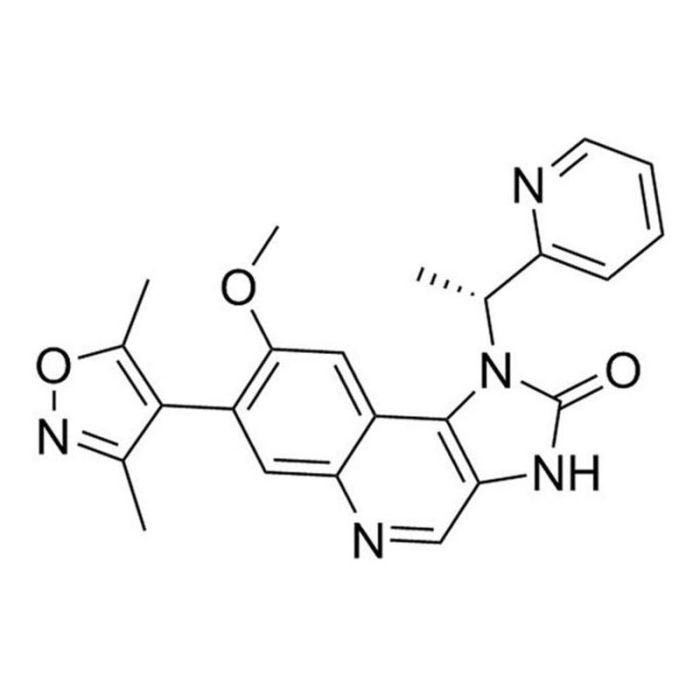
I-BET151

BET家族抑制剂;抑制BRD2,BRD3和BRD4
只有 %1
¥4,010.00

产品号 #(选择产品)

产品号 #73712_C

BET家族抑制剂;抑制BRD2,BRD3和BRD4

总览

I-BET151是溴结构域和额外末端(BET)家族蛋白的抑制剂。BET蛋白通过其2个溴结构域识别乙酰化赖氨酸残基(Gallenkamp et al.)。I-BET151抑制BRD2、BRD3和BRD4,IC₅₀值分别为0.5、0.25和0.79µM (Kline et al.; Vidler et al.; Hewings et al.; Dawson et al. 2012)。

重编程
·与ISX-9、Forskolin和CHIR99021联合,可增强小鼠成纤维细胞向神经元的重编程(Li et al.)。

癌症研究
·通过阻断BCL2、C-MYC和CDK6等关键基因的转录,诱导人和小鼠MLL融合白血病细胞系的早期细胞周期阻滞和凋亡(Dawson et al. 2011)。

细胞类型
癌细胞及细胞系,神经元,多能干细胞
 
种属
人,小鼠,非人灵长类,其他物种,大鼠
 
应用
重编程
 
研究领域
癌症,神经科学
 
CAS 编号
1300031-49-5
 
化学式
C₂₃H₂₁N₅O₃
 
纯度
≥98%
 
通路
表观遗传学
 
靶点
BET
 

产品说明书及文档

请在《产品说明书》中查找相关支持信息和使用说明,或浏览下方更多实验方案。

Document Type
Product Name
Catalog #
Lot #
Language
Product Name
I-BET151
Catalog #
73712, 73714
Lot #
All
Language
English
Document Type
Safety Data Sheet
Product Name
I-BET151
Catalog #
73712, 73714
Lot #
All
Language
English

相关材料与文献

文献 (7)

文献 (7)

Inhibition of BET recruitment to chromatin as an effective treatment for MLL-fusion leukaemia. Dawson MA et al. Nature 2011 OCT

Abstract

Recurrent chromosomal translocations involving the mixed lineage leukaemia (MLL) gene initiate aggressive forms of leukaemia,which are often refractory to conventional therapies. Many MLL-fusion partners are members of the super elongation complex (SEC),a critical regulator of transcriptional elongation,suggesting that aberrant control of this process has an important role in leukaemia induction. Here we use a global proteomic strategy to demonstrate that MLL fusions,as part of SEC and the polymerase-associated factor complex (PAFc),are associated with the BET family of acetyl-lysine recognizing,chromatin 'adaptor' proteins. These data provided the basis for therapeutic intervention in MLL-fusion leukaemia,via the displacement of the BET family of proteins from chromatin. We show that a novel small molecule inhibitor of the BET family,GSK1210151A (I-BET151),has profound efficacy against human and murine MLL-fusion leukaemic cell lines,through the induction of early cell cycle arrest and apoptosis. I-BET151 treatment in two human leukaemia cell lines with different MLL fusions alters the expression of a common set of genes whose function may account for these phenotypic changes. The mode of action of I-BET151 is,at least in part,due to the inhibition of transcription at key genes (BCL2,C-MYC and CDK6) through the displacement of BRD3/4,PAFc and SEC components from chromatin. In vivo studies indicate that I-BET151 has significant therapeutic value,providing survival benefit in two distinct mouse models of murine MLL-AF9 and human MLL-AF4 leukaemia. Finally,the efficacy of I-BET151 against human leukaemia stem cells is demonstrated,providing further evidence of its potent therapeutic potential. These findings establish the displacement of BET proteins from chromatin as a promising epigenetic therapy for these aggressive leukaemias.
Druggability analysis and structural classification of bromodomain acetyl-lysine binding sites. Vidler LR et al. Journal of medicinal chemistry 2012 SEP

Abstract

Bromodomains are readers of the epigenetic code that specifically bind acetyl-lysine containing recognition sites on proteins. Recently the BET family of bromodomains has been demonstrated to be druggable through the discovery of potent inhibitors,sparking an interest in protein-protein interaction inhibitors that directly target gene transcription. Here,we assess the druggability of diverse members of the bromodomain family using SiteMap and show that there are significant differences in predicted druggability. Furthermore,we trace these differences in druggability back to unique amino acid signatures in the bromodomain acetyl-lysine binding sites. These signatures were then used to generate a new classification of the bromodomain family,visualized as a classification tree. This represents the first analysis of this type for the bromodomain family and can prove useful in the discovery of inhibitors,particularly for anticipating screening hit rates,identifying inhibitors that can be explored for lead hopping approaches,and selecting proteins for selectivity screening.
Targeting epigenetic readers in cancer. Dawson MA et al. The New England journal of medicine 2012 AUG

更多信息

更多信息
物种 人, 其它物种, 大鼠, 小鼠, 非人灵长类
Cas Number 1300031-49-5
Chemical Formula C₂₃H₂₁N₅O₃
纯度 ≥ 98%
Target BET
Pathway Epigenetic
质量保证:

产品仅供研究使用,不用于针对人或动物的诊断或治疗。 欲获悉更多关于STEMCELL的质控信息,请访问 STEMCELL.CN/COMPLIANCE.
Copyright © 2026 by STEMCELL Technologies. All rights reserved.

在线联系