若您需要咨询产品或有任何技术问题,请通过官方电话 400 885 9050 或邮箱 info.cn@stemcell.com 与我们联系。

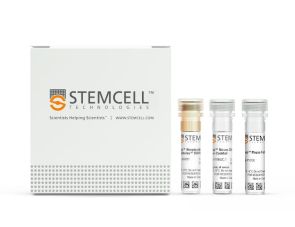
EasySep™小鼠Naïve CD4+ T细胞分选试剂盒

小鼠Naïve CD4+ T细胞的免疫磁珠负选
只有 %1
¥9,988.00

产品号 #(选择产品)

产品号 #19765_C

小鼠Naïve CD4+ T细胞的免疫磁珠负选

产品优势

  • 操作简单、快捷,且无需分离柱
  • 纯度高达95%
  • 获得的活细胞无标记 

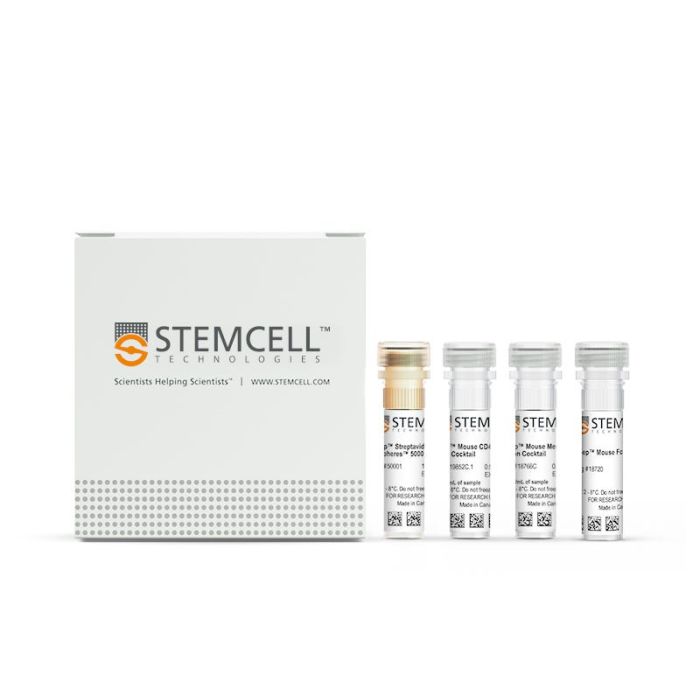
产品组分包括

  • EasySep™小鼠Naïve CD4+ T细胞分选试剂盒(产品号 #19765)
    • EasySep™小鼠CD4+ T细胞分选抗体混合物,0.5 mL
    • EasySep™小鼠记忆T细胞去除抗体混合物,0.5 mL
    • EasySep™ Streptavidin RapidSpheres™ 50001磁珠 ,1 mL
    • EasySep™小鼠FcR阻断剂,0.1 mL
  • RoboSep™小鼠Naïve CD4+ T细胞分选试剂盒(产品号 #19765RF)
    • EasySep™小鼠CD4+ T细胞分选抗体混合物,0.5 mL
    • EasySep™小鼠记忆T细胞去除抗体混合物,0.5 mL
    • EasySep™ Streptavidin RapidSpheres™ 50001磁珠,1 mL
    • EasySep™小鼠FcR阻断剂,0.1 mL
    • RoboSep™缓冲液(产品号 #20104)
    • RoboSep™过滤吸头(产品号 #20125)
专为您的实验方案打造的产品
要查看实验方案所需的所有配套产品,请参阅《实验方案与技术文档》

总览

使用EasySep™小鼠初始CD4+ T细胞分选试剂盒,可通过免疫磁珠负选轻松高效地从小鼠脾细胞中分离高纯度初始CD4+ T细胞(CD4+CD44lowCD62Lhigh)。当使用其它类型组织来源的单细胞悬液时,该试剂盒可能需要优化。EasySep™结合了单克隆抗体的特异性和无柱磁珠分选系统的简便性,迄今已广泛应用于发表的研究中超过20年。

在此EasySep™负选过程中,非目的细胞通过抗体复合物与磁珠标记。通过EasySep™磁极将被磁珠标记的细胞与未被标记的目的初始CD4+ T细胞(CD4+CD44lowCD62Lhigh)细胞分离,接着简单地将目的细胞倾倒或吸取至一个新的试管中即可。仅需15分钟磁珠分选后, 获得的初始CD4+ T细胞可直接用于流式细胞术、细胞培养或基于细胞的实验 等下游应用。

了解更多关于EasySep™免疫磁珠分选技术的工作原理,或如何通过RoboSep™实现全自动化免疫磁珠细胞分选 。探索更多优化您实验流程的产品,包括培养基、添加物、抗体等。


磁极兼容性
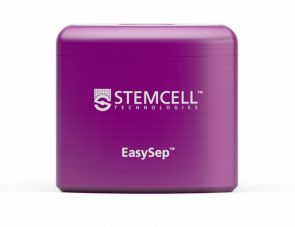
• EasySep™磁极(产品号 #18000)
• “The Big Easy” EasySep™磁极(产品号 #18001)
• EasyEights™ EasySep™磁极(产品号 #18103)
• RoboSep™-S(产品号 #21000)
 
分类
细胞分选试剂盒
 
细胞类型
T 细胞,T 细胞,CD4+
 
种属
小鼠
 
样本来源
其他组织,脾脏
 
分选方法
负选
 
应用
细胞分选
 
品牌
EasySep,RoboSep
 
研究领域
免疫
 

实验数据

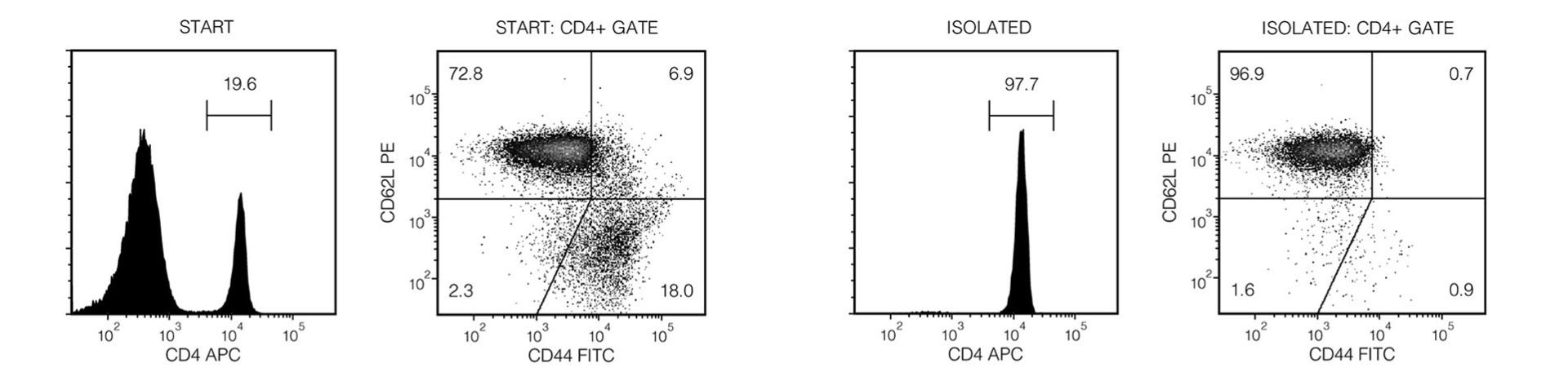
Typical EasySep™ Mouse Naïve CD4+ T Cell Isolation Profile

Figure 1. Typical EasySep™ Mouse Naïve CD4+ T Cell Isolation Profile

Starting with mouse splenocytes from an uninfected mouse, the naïve CD4+ T cell content (CD4+CD44lowCD62Lhigh) of the isolated fraction typically ranges from 87.6 - 95.6%. In the above example, the purities of the start and final isolated fractions are 14.3% and 94.7%, respectively.

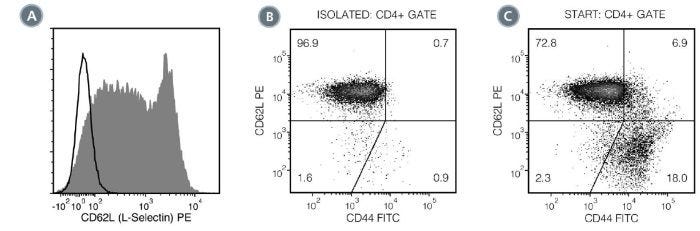
CD4+ Mouse Splenocytes Labeled with PE-Conjugated, Anti-Mouse CD62L (L-Selectin) Antibody, Clone MEL-14

Figure 2. CD4+ Mouse Splenocytes Labeled with PE-Conjugated, Anti-Mouse CD62L (L-Selectin) Antibody, Clone MEL-14

(A) Flow cytometry analysis of C57BL/6 mouse splenocytes labeled with Anti-Mouse CD62L (L-Selectin) Antibody, Clone MEL-14, PE (Catalog #60109PE; filled histogram) or Rat IgG2a, kappa Isotype Control Antibody, Clone RTK2758, PE (Catalog #60076PE) (solid line histogram). (B) Flow cytometry analysis of mouse splenocytes (gated on CD4+ cells) processed with EasySep™ Mouse Naïve CD4+ T Cell Isolation Kit (Catalog #19765) and labeled with Anti-Mouse CD62L (L-Selectin) Antibody, Clone MEL-14, PE and an anti-mouse CD44 antibody, FITC. (C) Labeling of the Start splenocytes prior to cell isolation.

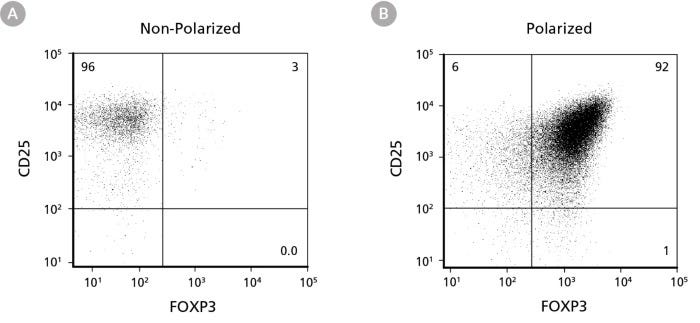
ImmunoCult™ Mouse Treg Differentiation Supplement Produces CD4+CD25+FOXP3+ Cells Under Treg Polarizing Conditions

Figure 3. ImmunoCult™ Mouse Treg Differentiation Supplement Produces CD4+CD25+FOXP3+ Cells Under Treg Polarizing Conditions

Naïve CD4+ T cells were isolated from mouse splenocytes using the EasySep™ Mouse Naive CD4+ T Cell Isolation Kit (Catalog #19765), activated with plate-bound anti-CD3 and soluble anti-CD28 and cultured in medium alone (Non-polarizing cultures), or in medium supplemented with ImmunoCult™ Mouse Treg Differentiation Supplement (Catalog #10957; polarizing cultures) for 6 days. Cells were subsequently stained with anti-CD4, anti-CD25, anti-FOXP3, and a viability dye and analyzed by flow cytometry. Shown is the expression of CD25 and FOXP3 back-gated on viable CD4+ cells from non-polarized (A) or polarized cultures (B). The mean proportion of CD4+FOXP3+ cells is significantly higher in cells cultured in ImmunoCult™ Mouse Treg Differentiation Supplement (91 ± 2%) compared to non-polarized cells (2 ± 0.4%) (p < 0.001; n = 14). Data from experimental groups were compared using a paired T-test.

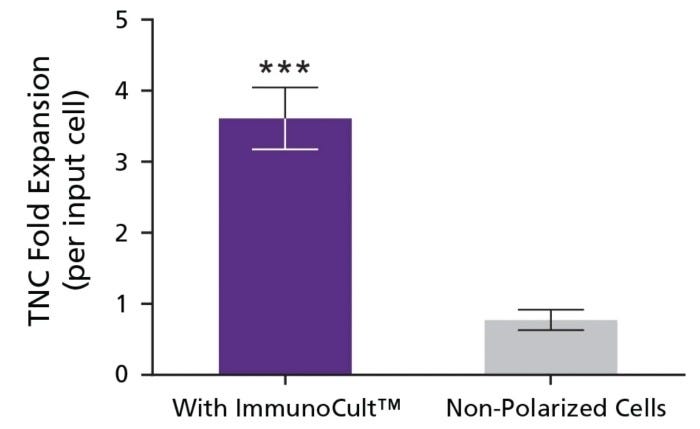
ImmunoCult™ Mouse Treg Differentiation Supplement Expands Viable CD4+ Cells Under Treg Polarizing Conditions

Figure 4. ImmunoCult™ Mouse Treg Differentiation Supplement Expands Viable CD4+ Cells Under Treg Polarizing Conditions

Naïve CD4+ T cells were isolated from mouse splenocytes using the EasySep™ Mouse Naive CD4+ T Cell Isolation Kit (Catalog #19765), activated with plate-bound anti-CD3 and soluble anti-CD28, and cultured in medium alone, or medium containing ImmunoCult™ Mouse Treg Differentiation Supplement (Catalog #10957) for 6 days. A 3.6-fold expansion of total nuclear cells (TNC) occurs in cultures polarized with ImmunoCult™ Mouse Treg Differentiation Supplement (purple column), which is significantly higher compared to non-polarized cultures (grey column). (Data represent the mean ± SEM, n = 14, ***p < 0.001. Data from experimental groups were compared using a paired T-test).

产品说明书及文档

请在《产品说明书》中查找相关支持信息和使用说明,或浏览下方更多实验方案。

Document Type
Product Name
Catalog #
Lot #
Language
Document Type
产品说明书
Catalog #
19765RF
Lot #
1000116887 or higher
Language
中文
Document Type
产品说明书
Catalog #
19765
Lot #
1000116887 or higher
Language
中文
Catalog #
19765RF
Lot #
1000116887 or higher
Language
English
Catalog #
19765
Lot #
1000116887 or higher
Language
English
Document Type
Safety Data Sheet 1
Catalog #
19765RF
Lot #
All
Language
English
Document Type
Safety Data Sheet 2
Catalog #
19765RF
Lot #
All
Language
English
Document Type
Safety Data Sheet 3
Catalog #
19765RF
Lot #
All
Language
English
Document Type
Safety Data Sheet 4
Catalog #
19765RF
Lot #
All
Language
English
Document Type
Safety Data Sheet 5
Catalog #
19765RF
Lot #
All
Language
English
Document Type
Safety Data Sheet 6
Catalog #
19765RF
Lot #
All
Language
English
Document Type
Safety Data Sheet 1
Catalog #
19765
Lot #
All
Language
English
Document Type
Safety Data Sheet 2
Catalog #
19765
Lot #
All
Language
English
Document Type
Safety Data Sheet 3
Catalog #
19765
Lot #
All
Language
English
Document Type
Safety Data Sheet 4
Catalog #
19765
Lot #
All
Language
English
Document Type
Safety Data Sheet 5
Catalog #
19765
Lot #
All
Language
English

应用领域

本产品专为以下研究领域设计,适用于工作流程中的高亮阶段。探索这些工作流程,了解更多我们为各研究领域提供的其他配套产品。

相关材料与文献

技术资料 (11)

常见问题 (7)

Can EasySep™ Streptavidin RapidSpheres™ be used for either positive or negative selection?

Currently, EasySep™ Streptavidin RapidSphere™ kits are only available for negative selection and work by targeting and removing unwanted cells.

How does the separation work?

Streptavidin RapidSphere™ magnetic particles are crosslinked to unwanted cells using biotinylated antibodies. When placed in the EasySep™ Magnet, labeled cells migrate to the wall of the tube. The unlabeled cells are then poured off into a new tube.

Which columns do I use?

The EasySep™ procedure is column-free. That's right - no columns!

How can I analyze the purity of my enriched sample?

The Product Information Sheet provided with each EasySep™ kit contains detailed staining information.

Can EasySep™ Streptavidin RapidSphere™ separations be automated?

Yes. RoboSep™, the fully automated cell separator, automates all EasySep™ labeling and cell separation steps.

Are cells isolated using EasySep™ RapidSphere™ products FACS-compatible?

Yes. Desired cells are unlabeled and ready to use in downstream applications, such as FACS analysis.

Can I alter the separation time in the magnet?

Yes; however, this may impact the kit's performance. The provided EasySep™ protocols have already been optimized to balance purity, recovery and time spent on the isolation.

文献 (12)

CD28/CTLA-4/B7 costimulatory pathway blockade affects regulatory T-cell function in autoimmunity Vogel I et al. The European Journal of Immunology 2015

Abstract

Naïve T cells require B7/CD28 costimulation in order to be fully activated. Attempts to block this pathway have been effective in preventing unwanted immune reactions. As B7 blockade might also affect Treg cells and interfere with negative signaling through membrane CTLA-4 on effector T (Teff) cells,its immune-modulatory effects are potentially more complex. Here,we used the mouse model of multiple sclerosis (MS),EAE,to study the effect of B7 blockade. An effective therapy for MS patients has to interfere with ongoing inflammation,and therefore we injected CTLA-4Ig at day 7 and 9 after immunization,when myelin-reactive T cells have been primed and start migrating toward the CNS. Surprisingly,B7 blockade exacerbated disease signs and resulted in more severe CNS inflammation and demyelination,and was associated with an enhanced production of the inflammatory cytokines IL-17 and IFN-γ. Importantly,CTLA-4Ig treatment resulted in a transient reduction of Ki67 and CTLA-4 expression and function of peripheral Treg cells. Taken together,B7 blockade at a particular stage of the autoimmune response can result in the suppression of Treg cells,leading to a more severe disease.
Dichotomous Expression of TNF Superfamily Ligands on Antigen-Presenting Cells Controls Post-priming Anti-viral CD4+ T Cell Immunity. Y.-H. Chang et al. Immunity 2017

Abstract

T cell antigen-presenting cell (APC) interactions early during chronic viral infection are crucial for determining viral set point and disease outcome,but how and when different APC subtypes contribute to these outcomes is unclear. The TNF receptor superfamily (TNFRSF) member GITR is important for CD4+ T cell accumulation and control of chronic lymphocytic choriomeningitis virus (LCMV). We found that type I interferon (IFN-I) induced TNFSF ligands GITRL,4-1BBL,OX40L,and CD70 predominantly on monocyte-derived APCs and CD80 and CD86 predominantly on classical dendritic cells (cDCs). Mice with hypofunctional GITRL in Lyz2+ cells had decreased LCMV-specific CD4+ T cell accumulation and increased viral load. GITR signals in CD4+ T cells occurred after priming to upregulate OX40,CD25,and chemokine receptor CX3CR1. Thus IFN-I (signal 3) induced a post-priming checkpoint (signal 4) for CD4+ T cell accumulation,revealing a division of labor between cDCs and monocyte-derived APCs in regulating T cell expansion.
Astragaloside IV regulates differentiation and induces apoptosis of activated CD4+ T cells in the pathogenesis of experimental autoimmune encephalomyelitis. L. Yang et al. Toxicology and applied pharmacology 2018 OCT

Abstract

CD4+ T cells,especially T-helper (Th) cells (Th1,Th2 and Th17) and regulatory T cells (Treg) play pivotal role in the pathogenesis of multiple sclerosis (MS),a demyelinating autoimmune disease occurring in central nervous system (CNS). Astragaloside IV (ASI,CAS: 84687-43-4) is one of the saponins isolated from Astragalus membranceus,a traditional Chinese medicine with immunomodulatory effect. So far,whether ASI has curative effect on experimental autoimmune encephalomyelitis (EAE),an animal model of MS,and how it affects the subsets of CD4+ T cells,as well as the underlying mechanism have not been clearly elucidated. In the present study,ASI was found to ameliorate the progression and hamper the recurrence of EAE effectively in the treatment regimens. It significantly reduced the demyelination and inflammatory infiltration of CNS in EAE mice by suppressing the percentage of Th1 and Th17 cells,which was closely associated with the inhibition of JAK/STAT and NF-$\kappa$B signaling pathways. ASI also increased the percentage of Treg cells in spleen and CNS,which was accompanied by elevated Foxp3. However,in vitro experiments disclosed that ASI could regulate the differentiation of Th17 and Treg cells but not Th1 cells. In addition,it induced the apoptosis of MOG-stimulated CD4+ T cells probably through modulating STAT3/Bcl-2/Bax signaling pathways. Together,our findings suggested that ASI can modulate the differentiation of autoreactive CD4+ T cells and is a potential prodrug or drug for the treatment of MS and other similar autoimmune diseases.

更多信息

更多信息
物种 小鼠
Magnet Compatibility • EasySep™ Magnet (Catalog #18000) • “The Big Easy” EasySep™ Magnet (Catalog #18001) • EasyEights™ EasySep™ Magnet (Catalog #18103) • RoboSep™-S (Catalog #21000)
样本来源 其它细胞系, 脾脏
Selection Method Negative
标记抗体

质量声明:

产品仅供研究使用,不用于针对人或动物的诊断或治疗。 欲获悉更多关于STEMCELL的质控信息,请访问 STEMCELL.CN/COMPLIANCE.

Copyright © 2026 by STEMCELL Technologies. All rights reserved.

在线联系