若您需要咨询产品或有任何技术问题,请通过官方电话 400 885 9050 或邮箱 info.cn@stemcell.com 与我们联系。

EasySep™小鼠CD4+ CD62L+ T细胞分选试剂盒

对来源于小鼠脾细胞或其他组织的单细胞悬液中初始 CD4⁺ T 细胞(CD4⁺CD62L⁺)先进行免疫磁珠负选,后进行正选分离

只有 %1
¥11,374.00

产品号 #(选择产品)

产品号 #18765_C

免疫磁珠分选试剂盒,先负选后正选

产品优势

  • 操作简单、快速
  • 纯度高达97%
  • 无需分离柱

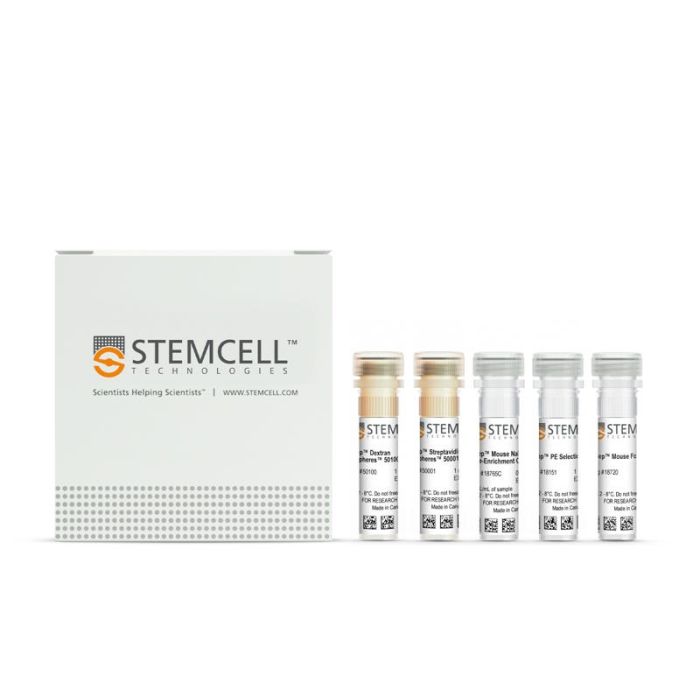
产品组分包括

  • EasySep™ 小鼠CD4+CD62L+ T细胞分选试剂盒(产品号 #18765)
    • EasySep™ 小鼠Naïve CD4+ T细胞预富集抗体混合物, 0.5 mL
    • EasySep™ Streptavidin RapidSpheres™ 50001磁珠, 1 mL    
    • EasySep™ PE正选抗体混合物, 1 mL
    • EasySep™ Dextran RapidSpheres™ 50100 磁珠, 1 mL
    • EasySep™ 小鼠FcR阻断剂(产品号 #18720),0.1 mL    
  • RoboSep™ 小鼠CD4+CD62L+ T 细胞分选试剂盒(产品号 #18765RF)
    • EasySep™ 小鼠Naïve CD4+ T细胞预富集抗体混合物, 0.5 mL
    • EasySep™ Streptavidin RapidSpheres™ 50001磁珠, 1 mL    
    • EasySep™ PE正选抗体混合物, 1 mL
    • EasySep™ Dextran RapidSpheres™ 50100 磁珠, 1 mL
    • EasySep™ 小鼠FcR阻断剂(产品号 #18720),0.1mL    
    • RoboSep™ 缓冲液(产品号 #20104)
    • RoboSep™ 过滤吸头(产品号 #20125)x 2
专为您的实验方案打造的产品
要查看实验方案所需的所有配套产品,请参阅《实验方案与技术文档》

总览

使用 EasySep™ 小鼠 CD4⁺CD62L⁺ T 细胞分选试剂盒,可通过免疫磁珠负选结合正选法,从小鼠脾细胞或其他组织的单细胞悬液中高效分离高纯度的小鼠初始 CD4⁺ T 细胞(CD4⁺CD62L⁺)。EasySep™ 技术在发表研究中已被广泛使用超过 20 年,其结合了单克隆抗体的特异性与无柱磁珠分选系统的简便性。

在此 EasySep™ 分选步骤中,初始 CD4⁺ T 细胞首先通过负选预富集,使用 EasySep™ 小鼠初始 CD4⁺ T 细胞预富集抗体混合物,其中包含针对非初始 CD4⁺ T 细胞的生物素化抗体。以下标志物阳性的细胞将被去除:CD8、CD11b、CD11c、CD19、CD24、CD25、CD45R、CD49b、TCRγ/δ、TER119。随后,预先用 CD62L PE 标记 CD4⁺CD62L⁺ 细胞,通过 EasySep™ PE 分选试剂混合物进行正选。目的细胞通过抗体和磁珠进行标记。经 EasySep™ 磁极分离后,不需要的细胞被倒出,目标细胞留在管中。磁珠分选完成后,CD62L⁺ 细胞已带有 PE 标记,可直接用于流式细胞术评估纯度,并适用于流式细胞术、培养或 DNA/RNA 提取等下游应用。

了解更多关于 EasySep™ 免疫磁珠细胞分选技术的工作原理,或了解如何使用 RoboSep™ 实现全自动化免疫磁珠细胞分选。探索更多产品,包括培养基、添加物、抗体等,以优化您的实验流程。


磁极兼容性
• EasySep™磁极(产品号 #18000)
• “The Big Easy” EasySep™磁极(产品号 #18001)
• RoboSep™-S(产品号 #21000)
 
分类
细胞分选试剂盒
 
细胞类型
T 细胞,CD4+ T细胞
 
种属
小鼠
 
样本来源
其他组织,脾脏
 
分选方法
正选
 
应用
细胞分选
 
品牌
EasySep,RoboSep
 
研究领域
免疫
 

实验数据

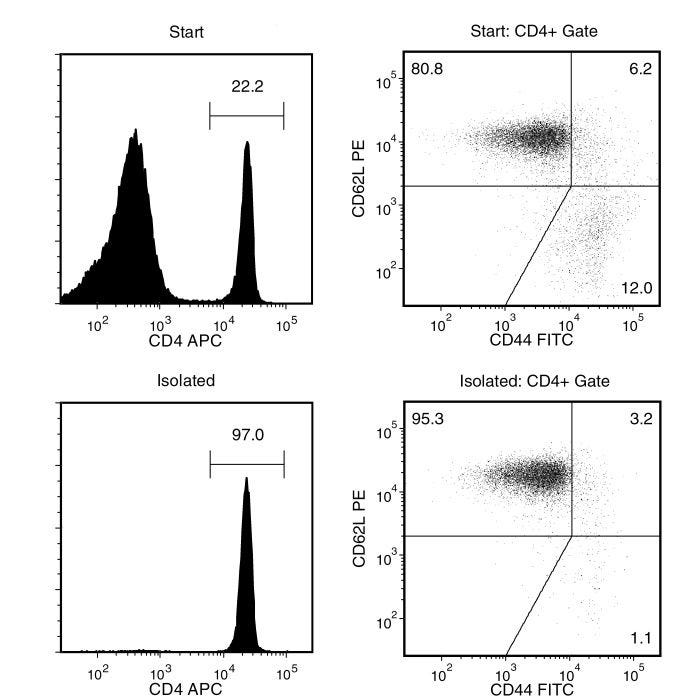
Typical EasySep™ Mouse CD4+CD62L+ T Cell Isolation Profile

Figure 1. Typical EasySep™ Mouse CD4+CD62L+ T Cell Isolation Profile

Starting with a single-cell suspension of splenocytes, the naïve CD4 + T cell (CD4+CD44low CD62Lhigh) content of the final isolated fraction typically ranges from 91.7% - 96.7%. In the example above, the final purities of the start and isolated fractions are 17.9% and 92.4%, respectively.

产品说明书及文档

请在《产品说明书》中查找相关支持信息和使用说明,或浏览下方更多实验方案。

Document Type
Product Name
Catalog #
Lot #
Language
Document Type
产品说明书
Catalog #
18765RF
Lot #
1000157904 or higher
Language
中文
Document Type
产品说明书
Catalog #
18765
Lot #
1000157904 or higher
Language
中文
Catalog #
18765RF
Lot #
1000157904 or higher
Language
English
Catalog #
18765
Lot #
1000157904 or higher
Language
English
Document Type
Safety Data Sheet 1
Catalog #
18765RF
Lot #
All
Language
English
Document Type
Safety Data Sheet 2
Catalog #
18765RF
Lot #
All
Language
English
Document Type
Safety Data Sheet 3
Catalog #
18765RF
Lot #
All
Language
English
Document Type
Safety Data Sheet 4
Catalog #
18765RF
Lot #
All
Language
English
Document Type
Safety Data Sheet 5
Catalog #
18765RF
Lot #
All
Language
English
Document Type
Safety Data Sheet 6
Catalog #
18765RF
Lot #
All
Language
English
Document Type
Safety Data Sheet 7
Catalog #
18765RF
Lot #
All
Language
English
Document Type
Safety Data Sheet 1
Catalog #
18765
Lot #
All
Language
English
Document Type
Safety Data Sheet 2
Catalog #
18765
Lot #
All
Language
English
Document Type
Safety Data Sheet 3
Catalog #
18765
Lot #
All
Language
English
Document Type
Safety Data Sheet 4
Catalog #
18765
Lot #
All
Language
English
Document Type
Safety Data Sheet 5
Catalog #
18765
Lot #
All
Language
English

应用领域

本产品专为以下研究领域设计,适用于工作流程中的高亮阶段。探索这些工作流程,了解更多我们为各研究领域提供的其他配套产品。

相关材料与文献

技术资料 (8)

文献 (3)

Nanoparticles Containing an Insulin-ChgA Hybrid Peptide Protect from Transfer of Autoimmune Diabetes by Shifting the Balance between Effector T Cells and Regulatory T Cells. B. L. Jamison et al. Journal of immunology (Baltimore,Md. : 1950) 2019 jul

Abstract

CD4 T cells play a critical role in promoting the development of autoimmunity in type 1 diabetes. The diabetogenic CD4 T cell clone BDC-2.5,originally isolated from a NOD mouse,has been widely used to study the contribution of autoreactive CD4 T cells and relevant Ags to autoimmune diabetes. Recent work from our laboratory has shown that the Ag for BDC-2.5 T cells is a hybrid insulin peptide (2.5HIP) consisting of an insulin C-peptide fragment fused to a peptide from chromogranin A (ChgA) and that endogenous 2.5HIP-reactive T cells are major contributors to autoimmune pathology in NOD mice. The objective of this study was to determine if poly(lactide-co-glycolide) (PLG) nanoparticles (NPs) loaded with the 2.5HIP Ag (2.5HIP-coupled PLG NPs) can tolerize BDC-2.5 T cells. Infusion of 2.5HIP-coupled PLG NPs was found to prevent diabetes in an adoptive transfer model by impairing the ability of BDC-2.5 T cells to produce proinflammatory cytokines through induction of anergy,leading to an increase in the ratio of Foxp3+ regulatory T cells to IFN-gamma+ effector T cells. To our knowledge,this work is the first to use a hybrid insulin peptide,or any neoepitope,to re-educate diabetogenic T cells and may have significant implications for the development of an Ag-specific therapy for type 1 diabetes patients.
NF-kappaB-driven miR-34a impairs Treg/Th17 balance via targeting Foxp3. M. Xie et al. Journal of autoimmunity 2019 may

Abstract

The subset of regulatory T (Treg) cells,with its specific transcription Foxp3,is a unique cell type for the maintenance of immune homeostasis by controlling effector T (Teff) cell responses. Although it is common that a defect in Treg cells with Treg/Teff disorder causes autoimmune diseases; however,the precise mechanisms are not thoroughly revealed. Here,we report that miR-34a could attenuate human and murine Foxp3 gene expression via targeting their 3' untranslated regions (3' UTR). The human miR-34a,increased in peripheral blood mononuclear cells (PBMCs) and CD4+ T cells from rheumatoid arthritis (RA) or systemic lupus erythematosus (SLE) patients,displayed a positive correlation with some serum markers of inflammation including rheumatoid factor (RF),anti-streptolysin antibody (ASO),erythrocyte sedimentation rate (ESR) and C-reactive protein (CRP) as well as Th17 signature gene RORgammat,but inversely correlated with the mRNA expression levels of FOXP3. In addition,murine miR-34a levels were downregulated in TGF-beta-induced Treg cells but upregulated in Th17 cells induced in vitro compared to activated CD4+ T cells. It has also been demonstrated that elevated miR-34a disrupting Treg/Th17 balance in vivo contributed to the progress of pathogenesis of collagen induced arthritis (CIA) mice. Furthermore,IL-6 and TNF-alpha were responsible for the upregulation of miR-34a and downregulation of Foxp3,which was reverted by the addition of NF-kappaB/p65 inhibitor BAY11-7082,thus indicating that NF-kappaB/p65 inhibited Foxp3 expression in an miR-34a-dependent manner. Finally,IL-6 or TNF-alpha-activated p65 could bind to the miR-34a promotor and enhance its activity,resulting in upregulation of its transcription. Taken together,we show that NF-kappaB activated by inflammatory cytokines,such as IL-6 and TNF-alpha,ameliorates Foxp3 levels via regulating miR-34a expression,which provides a new mechanistic and therapeutic insight into the ongoing of autoimmune diseases.
Targeting Lymph Node Niches Enhances Type 1 Immune Responses to Immunization. J. Lian et al. Cell reports 2020 may

Abstract

Generating robust CD4+ T-helper cell type 1 (Th1) responses is essential for protective vaccine-induced type 1 immunity. Here,we examine whether immunization formulation associated with enhanced vaccine efficacy promotes antigen targeting and cell recruitment into lymph node (LN) niches associated with optimal type 1 responses. Immunization with antigen and Toll-like receptor agonist emulsified in oil leads to an increased differentiation of IFN$\gamma$/TNF-$\alpha$+ polyfunctional Th1 cells compared to an identical immunization in saline. Oil immunization results in a rapid delivery and persistence of antigen in interfollicular regions (IFRs) of the LN,whereas without oil,antigen is distributed in the medullary region. Following oil immunization,CXCL10-producing inflammatory monocytes accumulate in the IFR,which mobilizes antigen-specific CD4+ T cells into this niche. In this microenvironment,CD4+ T cells are advantageously positioned to encounter arriving IL-12-producing inflammatory dendritic cells (DCs). These data suggest that formulations delivering antigen to the LN IFR create an inflammatory niche that can improve vaccine efficacy.

更多信息

更多信息
物种 小鼠
Magnet Compatibility • EasySep™ Magnet (Catalog #18000) • “The Big Easy” EasySep™ Magnet (Catalog #18001) • RoboSep™-S (Catalog #21000)
样本来源 其它细胞系, 脾脏
Selection Method Positive
标记抗体

质量声明:

产品仅供研究使用,不用于针对人或动物的诊断或治疗。 欲获悉更多关于STEMCELL的质控信息,请访问 STEMCELL.CN/COMPLIANCE.

Copyright © 2026 by STEMCELL Technologies. All rights reserved.

在线联系