若您需要咨询产品或有任何技术问题,请通过官方电话 400 885 9050 或邮箱 info.cn@stemcell.com 与我们联系。

EasySep™小鼠CD138正选试剂盒

免疫磁珠正选小鼠CD138+细胞分选试剂盒
只有 %1
¥9,548.00

产品号 #(选择产品)

产品号 #18957_C

免疫磁珠正选小鼠CD138+细胞分选试剂盒

产品优势

  • 快捷、易于操作,且无需分离柱
  • 免疫小鼠分选纯度高达97%
  • 可用于富集浆细胞
  • 与杂交瘤制备方案兼容,包括电融合

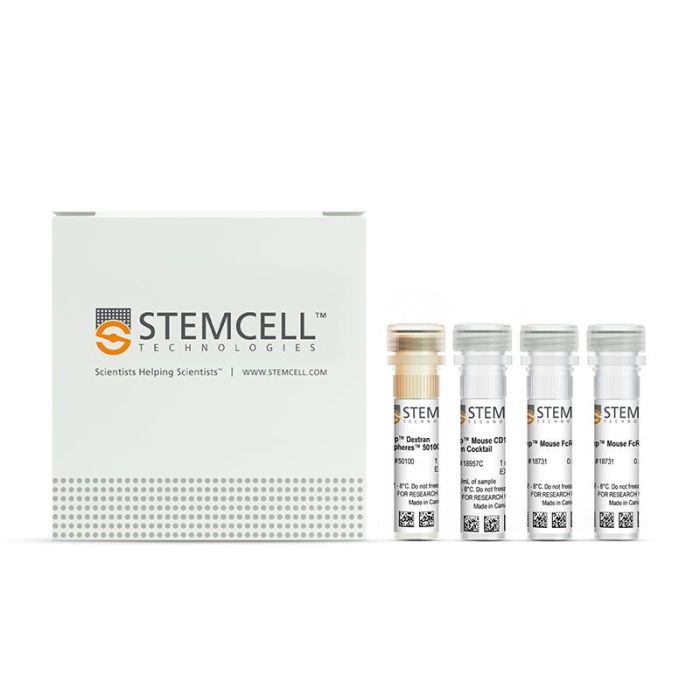
产品组分包括

  • EasySep™小鼠CD138正选试剂盒(产品号 #18957)
    • EasySep™小鼠CD138正选抗体混合物,1mL
    • EasySep™ Dextran RapidSpheres™ 50100 磁珠,1mL
    • EasySep™小鼠FcR阻断剂,2 x 0.5 mL
  • RoboSep™小鼠CD138正选试剂盒(产品号 #18957RF)
    • EasySep™小鼠CD138正选抗体混合物,1mL
    • EasySep™ Dextran RapidSpheres™ 50100 磁珠,1mL
    • EasySep™小鼠FcR阻断剂,2 x 0.5 mL
    • RoboSep™ 缓冲液(产品号 #20104)
    • RoboSep™过滤吸头(产品号#20125)
    • EasySep™ EasyTube™-14(产品号#20128)×2
New look, same high quality and support! You may notice that your instrument or reagent packaging looks slightly different from images displayed on the website, or from previous orders. We are updating our look but rest assured, the products themselves and how you should use them have not changed. Learn more
专为您的实验方案打造的产品
要查看实验方案所需的所有配套产品,请参阅《实验方案与技术文档》

总览

EasySep™小鼠CD138正选试剂盒,通过免疫磁珠正选技术,从小鼠脾细胞、淋巴结或骨髓样本中分离高纯度的小鼠CD138+细胞。EasySep™技术结合单克隆抗体的特异性和无需分离柱的简便磁分选系统 ,已在发表的研究中广泛应用超过20年。

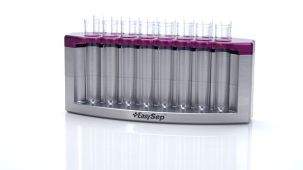
本EasySep™阳性分选方案通过识别CD138的抗体复合物与磁珠标记目标细胞,使用EasySep™磁分选系统分离标记细胞,只需倾倒或移液吸取非目的细胞。目的细胞保留在分离管中。分选后的目的细胞 CD138+ 可直接用于流式细胞术、细胞培养和杂交瘤制备等下游应用。

了解更多关于免疫磁珠EasySep™技术的工作原理,或如何通过RoboSep™实现免疫磁珠细胞分选全自动化。探索为您的实验流程优化的更多产品,包括培养基、添加剂、抗体等。


磁极兼容性
• EasySep™磁极(产品号 #18000)
• “The Big Easy” EasySep™磁极(产品号 #18001)
• EasyEights™ EasySep™磁极(产品号 #18103)
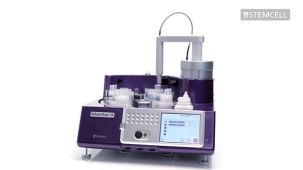
• RoboSep™-S(产品号 #21000)
 
分类
细胞分选试剂盒
 
细胞类型
B 细胞,血浆
 
种属
小鼠
 
样本来源
骨髓,淋巴结,其他物种,脾脏
 
分选方法
正选
 
应用
细胞分选
 
品牌
EasySep,RoboSep
 
研究领域
免疫
 

实验数据

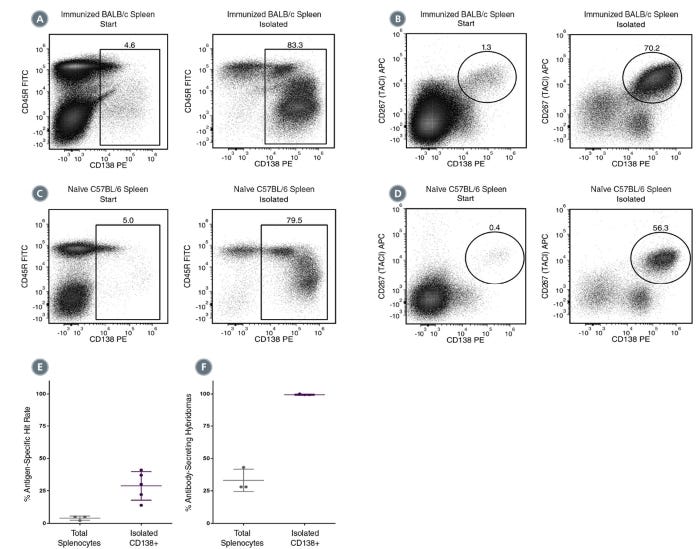
Typical EasySep™ Mouse CD138 Positive Cell Isolation Profile

Figure 1. Typical EasySep™ Mouse CD138 Positive Cell Isolation Profile

(A) Starting with immunized BALB/c mouse splenocytes, the CD138+ cell content of the isolated fraction is typically 81.5 ± 4.9% (mean ± SD). In the above example, the purities of the start and final isolated fractions are 4.6% and 83.3%, respectively.

(B) Starting with immunized BALB/c mouse splenocytes, the plasma cell (CD138+CD267 (TACI)+) content is typically 68.5 ± 11.3% (mean ± SD). In the above example, the purities of the start and final isolated fractions are 1.3% and 70.2%, respectively.

(C) Starting with naïve C57BL/6 mouse splenocytes, the CD138+ cell content of the isolated fraction is typically 78.3 ± 5.7% (mean ± SD). In the above example, the purities of the start and final isolated fractions are 5.0% and 79.5%, respectively.

(D) Starting with naïve C57BL/6 mouse splenocytes, the plasma cell (CD138+CD267 (TACI)+) content is typically 50.8 ± 10.0 % (mean ± SD). In the above example, the purities of the start and final isolated fractions are 0.4% and 56.3%, respectively.

(E) Isolated CD138+ cells or total splenocytes from mice immunized with various antigens were fused with Sp2/0 mouse myeloma cells and plated in semi-solid medium using ClonaCell™-HY Hybridoma Kit (Catalog #03800). The % antigen-specific hit rate was determined by ELISA. The % antigen-specific hit rates for total splenocytes and CD138+ cells were 4.1 ± 1.6% and 28.8 ± 11.0% (mean ± SD), respectively.

(F) Isolated CD138+ cells or total splenocytes from mice immunized with various antigens were fused with Sp2/0 mouse myeloma cells and plated in semi-solid medium using ClonaCell™-HY Hybridoma Kit (Catalog #03800). The % antibody-secreting hybridomas was determined by ELISA. The % antibody-secreting hybridomas for total splenocytes and CD138+ cells were 33.0 ± 8.7% and 99.3 ± 0.6% (mean ± SD), respectively.

产品说明书及文档

请在《产品说明书》中查找相关支持信息和使用说明,或浏览下方更多实验方案。

Document Type
Product Name
Catalog #
Lot #
Language
Catalog #
18957
Lot #
All
Language
English
Catalog #
18957RF
Lot #
All
Language
English
Document Type
Safety Data Sheet 1
Catalog #
18957
Lot #
All
Language
English
Document Type
Safety Data Sheet 2
Catalog #
18957
Lot #
All
Language
English
Document Type
Safety Data Sheet 3
Catalog #
18957
Lot #
All
Language
English
Document Type
Safety Data Sheet 1
Catalog #
18957RF
Lot #
All
Language
English
Document Type
Safety Data Sheet 2
Catalog #
18957RF
Lot #
All
Language
English
Document Type
Safety Data Sheet 3
Catalog #
18957RF
Lot #
All
Language
English
Document Type
Safety Data Sheet 4
Catalog #
18957RF
Lot #
All
Language
English

应用领域

本产品专为以下研究领域设计,适用于工作流程中的高亮阶段。探索这些工作流程,了解更多我们为各研究领域提供的其他配套产品。

相关材料与文献

技术资料 (12)

文献 (3)

Structural stabilization of the intrinsically disordered SARS-CoV-2 N by binding to RNA sequences engineered from the viral genome fragment Nature Communications 2025 Jul

Abstract

The nucleocapsid N is one of four structural proteins of the coronaviruses. Its essential role in genome encapsidation makes it a critical therapeutic target for COVID-19 and related diseases. However, the inherent disorder of full-length N hampers its structural analysis. Here, we describe a stepwise method using viral-derived RNAs to stabilize SARS-CoV-2 N for EM analysis. We identify pieces of RNA from the SARS-CoV-2 genome that promote the formation of structurally homogeneous N dimers, intermediates of assembly, and filamentous capsid-like structures. Building on these results, we engineer a symmetric RNA to stabilize N protein dimers, the building block of high-order assemblies, for EM studies. We combine domain-specific monoclonal antibodies against N with chemical cross-linking mass spectrometry to validate the spatial arrangement of the N domains within the dimer. Additionally, our cryo-EM analysis reveals novel antigenic sites on the N protein. Our findings provide insights into N protein´s architectural and antigenic principles, which can guide design of pan-coronavirus therapeutics. The authors stabilize the SARS-CoV-2 nucleocapsid (N) dimer assembly using a short RNA and chemical crosslinker for EM analysis, revealing its domain arrangement and antigenic sites to advance understanding and guide pan-coronavirus therapeutic design.
Preclinical development of an immunoassay for the detection of TREM2: a new biomarker for Alzheimer’s disease Scientific Reports 2025 Jul

Abstract

Alzheimer’s disease (AD) is a neurodegenerative disorder characterized by the accumulation of amyloid-β (Aβ) plaques and neurofibrillary tangles composed of hyperphosphorylated tau protein. The combination of biomarkers is crucial for AD diagnosis. The triggering receptor expressed on myeloid cells 2 (TREM2), a receptor expressed on microglia, is important in AD pathogenesis. Impairment of TREM2 function aggravates the toxic effects of amyloid plaques, and its activation has been shown to reduce Aβ burden and memory deficits. Increased levels of soluble TREM2 (sTREM2) in blood and cerebrospinal fluid is associated with AD. Therefore, TREM2 could serve as a non-invasive biomarker for AD. In this study, we developed a preclinical immunoassay to detect TREM2 for AD diagnosis. Highly sensitive and specific TREM2 antibodies were produced using the hybridoma technique. The three optimized immunoassays exhibited lower limit of quantitation (LLOQ) of 0.474, 0.807, and 0.415 ng/mL, respectively. These preclinical immunoassays showed high sensitivity and specificity. The sandwich enzyme-linked immunosorbent assay (ELISA) could potentially be used for AD diagnosis.
Sensory neurons regulate stimulus-dependent humoral immunity in mouse models of bacterial infection and asthma Nature Communications 2024 Oct

Abstract

Sensory neurons sense pathogenic infiltration to drive innate immune responses, but their role in humoral immunity is unclear. Here, using mouse models of Streptococcus pneumoniae infection and Alternaria alternata asthma, we show that sensory neurons are required for B cell recruitment and antibody production. In response to S. pneumoniae, sensory neuron depletion increases bacterial burden and reduces B cell numbers, IgG release, and neutrophil stimulation. Meanwhile, during A. alternata-induced airway inflammation, sensory neuron depletion decreases B cell population sizes, IgE levels, and asthmatic characteristics. Mechanistically, during bacterial infection, sensory neurons preferentially release vasoactive intestinal polypeptide (VIP). In response to asthma, sensory neurons release substance P. Administration of VIP into sensory neuron-depleted mice suppresses bacterial burden, while VIPR1 deficiency increases infection. Similarly, exogenous substance P delivery aggravates asthma in sensory neuron-depleted mice, while substance P deficiency ameliorates asthma. Our data, thus demonstrate that sensory neurons release select neuropeptides which target B cells dependent on the immunogen. Sensory neurons may regulate innate immune cells, but their roles in humoral immunity is still unclear. Here the authors show that bacterial infection and asthma induction induce sensory neuron production of distinct neurotransmitters to dampen B cell responses but differentially target IgG and IgE, respectively, to specifically modulate the symptoms.

更多信息

更多信息
物种 小鼠
Magnet Compatibility • EasySep™ Magnet (Catalog #18000) • “The Big Easy” EasySep™ Magnet (Catalog #18001) • EasyEights™ EasySep™ Magnet (Catalog #18103) • RoboSep™-S (Catalog #21000)
样本来源 其它细胞系, 淋巴结, 脾脏, 骨髓
Selection Method Positive
标记抗体
质量保证:

产品仅供研究使用,不用于针对人或动物的诊断或治疗。 欲获悉更多关于STEMCELL的质控信息,请访问 STEMCELL.CN/COMPLIANCE.
Copyright © 2025 by STEMCELL Technologies. All rights reserved.

在线联系