若您需要咨询产品或有任何技术问题,请通过官方电话 400 885 9050 或邮箱 info.cn@stemcell.com 与我们联系。

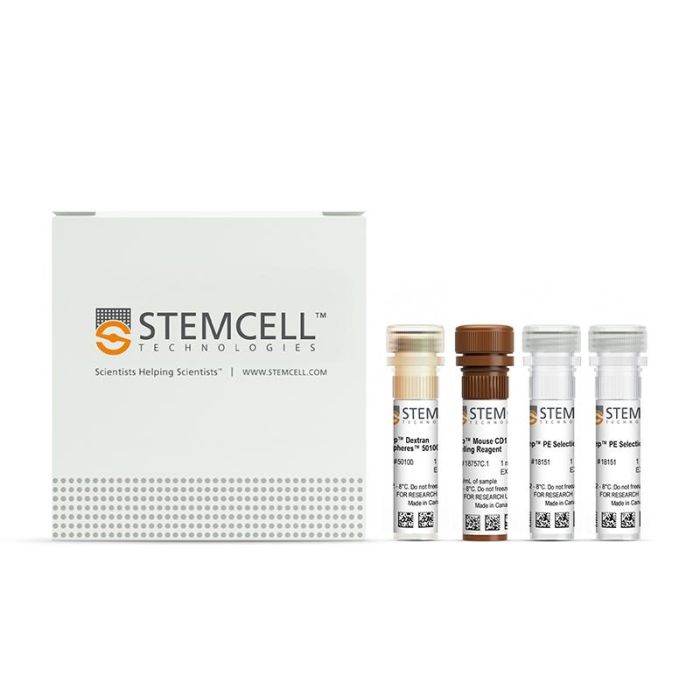
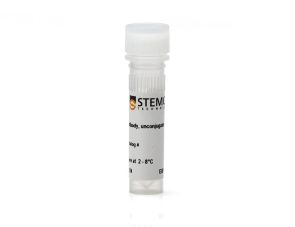
EasySep™小鼠CD117(cKIT)正选试剂盒

对来源于小鼠骨髓或其他组织样本的 CD117⁺(cKIT⁺)细胞进行免疫磁珠正选分离

只有 %1
¥12,234.00

产品号 #(选择产品)

产品号 #18757_C

免疫磁珠正选试剂盒

产品优势

  • 操作简单、快速
  • 纯度高达95%
  • 无需分离柱

产品组分包括

  • EasySep™小鼠CD117(cKIT)正选试剂盒(产品号 #18957)
    • EasySep™小鼠CD117(cKIT)PE标记试剂, 1 mL
    • EasySep™ PE正选抗体混合物, 2 x 1 mL
    • EasySep™ Dextran RapidSpheres™磁珠, 1 mL
  • RoboSep™ 小鼠CD117(cKIT)正选试剂盒(含滤芯吸头)(产品号 #18757RF)
    • EasySep™小鼠CD117(cKIT)PE标记试剂, 1 mL
    • EasySep™ PE正选抗体混合物, 2 x 1 mL
    • EasySep™ Dextran RapidSpheres™磁珠, 1 mL
    • RoboSep™ 缓冲液(产品号 #20104)
    • RoboSep™过滤吸头(产品号 #20125)x 2
专为您的实验方案打造的产品
要查看实验方案所需的所有配套产品,请参阅《实验方案与技术文档》

总览

使用 EasySep™ 小鼠 CD117 (cKIT) 正选试剂盒,可通过免疫磁珠正选法从小鼠骨髓或其他组织的单细胞悬液中高效分离高纯度的 CD117⁺(cKIT⁺)细胞。EasySep™ 技术在发表研究中已被广泛使用超过 20 年,结合了单克隆抗体的特异性与无柱磁分选系统的简便性。

在此 EasySep™ 正选步骤中, CD117⁺ 目的细胞首先使用 EasySep™ PE 正选试剂混合物标记,该混合物含有结合 CD117 的藻红蛋白(PE)标记抗体。随后,这些 PE 标记的抗体被能够同时识别 PE 和右旋糖的抗体复合物及磁性颗粒靶向识别。经 EasySep™ 磁极分离后,不需要的细胞被倒出, CD117⁺ 目的细胞保留在试管中。磁性细胞分离后,CD117⁺ 细胞已带有 PE 标记,可直接用于流式细胞术、细胞培养及 DNA/RNA 提取等下游应用。

了解更多关于 EasySep™ 免疫磁性细胞分选技术的工作原理,或了解如何使用 RoboSep™ 实现全自动化免疫磁性细胞分离。探索更多产品,包括培养基、补充物、抗体等,以优化您的实验流程。


磁极兼容性
• EasySep™磁极(产品号 #18000)
• “The Big Easy” EasySep™磁极(产品号 #18001)
• RoboSep™-S(产品号 #21000)
 
分类
细胞分选试剂盒
 
细胞类型
造血干/祖细胞
 
种属
小鼠
 
样本来源
骨髓
 
分选方法
正选
 
应用
细胞分选
 
品牌
EasySep,RoboSep
 
研究领域
免疫,干细胞生物学
 

实验数据

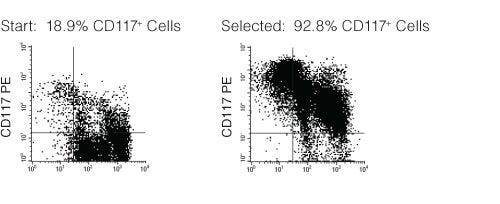
FACS Profile Results with EasySep™ Mouse CD117 (c-KIT) Positive Selection Kit

Figure 1. FACS Profile Results with EasySep™ Mouse CD117 (c-KIT) Positive Selection Kit

Starting with mouse bone marrow, the CD117+ cell content of the selected cells typically ranges from 88 - 95%.

产品说明书及文档

请在《产品说明书》中查找相关支持信息和使用说明,或浏览下方更多实验方案。

Document Type
Product Name
Catalog #
Lot #
Language
Document Type
产品说明书
Catalog #
18757RF
Lot #
All
Language
中文
Document Type
产品说明书
Catalog #
18757
Lot #
All
Language
中文
Catalog #
18757
Lot #
All
Language
English
Catalog #
18757RF
Lot #
All
Language
English
Document Type
Safety Data Sheet 1
Catalog #
18757
Lot #
All
Language
English
Document Type
Safety Data Sheet 2
Catalog #
18757
Lot #
All
Language
English
Document Type
Safety Data Sheet 3
Catalog #
18757
Lot #
All
Language
English
Document Type
Safety Data Sheet 1
Catalog #
18757RF
Lot #
All
Language
English
Document Type
Safety Data Sheet 2
Catalog #
18757RF
Lot #
All
Language
English
Document Type
Safety Data Sheet 3
Catalog #
18757RF
Lot #
All
Language
English
Document Type
Safety Data Sheet 4
Catalog #
18757RF
Lot #
All
Language
English

应用领域

本产品专为以下研究领域设计,适用于工作流程中的高亮阶段。探索这些工作流程,了解更多我们为各研究领域提供的其他配套产品。

相关材料与文献

技术资料 (8)

常见问题 (11)

Can EasySep™ be used for either positive or negative selection?

Yes. The EasySep™ kits use either a negative selection approach by targeting and removing unwanted cells or a positive selection approach targeting desired cells. Depletion kits are also available for the removal of cells with a specific undesired marker (e.g. GlyA).

How does the separation work?

Magnetic particles are crosslinked to cells using Tetrameric Antibody Complexes (TAC). When placed in the EasySep™ Magnet, labeled cells migrate to the wall of the tube. The unlabeled cells are then poured off into a separate fraction.

Which columns do I use?

The EasySep™ procedure is column-free. That's right - no columns!

How can I analyze the purity of my enriched sample?

The Product Information Sheet provided with each EasySep™ kit contains detailed staining information.

Can EasySep™ separations be automated?

Yes. RoboSep™, the fully automated cell separator, automates all EasySep™ labeling and cell separation steps.

Can EasySep™ be used to isolate rare cells?

Yes. We recommend a cell concentration of 2x10⁸ cells/mL and a minimum working volume of 100 µL. Samples containing 2x10⁷ cells or fewer should be suspended in 100 µL of buffer.

Are the EasySep™ magnetic particles FACS-compatible?

Yes, the EasySep™ particles are flow cytometry-compatible, as they are very uniform in size and about 5000X smaller than other commercially available magnetic beads used with column-free systems.

Can the EasySep™ magnetic particles be removed after enrichment?

No, but due to the small size of these particles, they will not interfere with downstream applications.

Can I alter the separation time in the magnet?

Yes; however, this may impact the kit's performance. The provided EasySep™ protocols have already been optimized to balance purity, recovery and time spent on the isolation.

For positive selection, can I perform more than 3 separations to increase purity?

Yes, the purity of targeted cells will increase with additional rounds of separations; however, cell recovery will decrease.

How does the binding of the EasySep™ magnetic particle affect the cells? is the function of positively selected cells altered by the bound particles?

Hundreds of publications have used cells selected with EasySep™ positive selection kits for functional studies. Our in-house experiments also confirm that selected cells are not functionally altered by the EasySep™ magnetic particles.

If particle binding is a key concern, we offer two options for negative selection. The EasySep™ negative selection kits can isolate untouched cells with comparable purities, while RosetteSep™ can isolate untouched cells directly from whole blood without using particles or magnets.

文献 (8)

Promoter trapping reveals significant differences in integration site selection between MLV and HIV vectors in primary hematopoietic cells. De Palma M et al. Blood 2005 MAR

Abstract

Recent reports have indicated that human immunodeficiency virus (HIV) and murine leukemia virus (MLV) vectors preferentially integrate into active genes. Here,we used a novel approach based on genetic trapping to rapidly score several thousand integration sites and found that MLV vectors trapped cellular promoters more efficiently than HIV vectors. Remarkably,1 in 5 MLV integrations trapped an active promoter in different cell lines and primary hematopoietic cells. Such frequency was even higher in growth-stimulated lymphocytes. We show that the different behavior of MLV and HIV vectors was dependent on a different integration pattern within transcribed genes. Whereas MLV-based traps showed a strong bias for promoter-proximal integration leading to efficient reporter expression,HIV-based traps integrated throughout transcriptional units and were limited for expression by the distance from the promoter and the reading frame of the targeted gene. Our results indicate a strong propensity of MLV to establish transcriptional interactions with cellular promoters,a behavior that may have evolved to enhance proviral expression and may increase the insertional mutagenesis risk. Promoter trapping efficiency provides a convenient readout to assess transcriptional interactions between the vector and its flanking genes at the integration site and to compare integration site selection among different cell types and in different growth conditions.
Lentiviral transduction of apoAI into hematopoietic progenitor cells and macrophages: applications to cell therapy of atherosclerosis. Su YR et al. Arteriosclerosis,thrombosis,and vascular biology 2008 AUG

Abstract

OBJECTIVE: We used genetically engineered mouse hematopoietic progenitor cells (HPCs) to investigate the therapeutic effects of human apoAI on atherosclerosis in apoE(-/-) mice. METHODS AND RESULTS: Lentiviral constructs expressing either human apoAI (LV-apoAI) or green fluorescent protein (LV-GFP) cDNA under a macrophage specific promoter (CD68) were generated and used for ex vivo transduction of mouse HPCs and macrophages. The transduction efficiency was textgreater25% for HPCs and textgreater70% for macrophages. ApoAI was found in the macrophage culture media,mostly associated with the HDL fraction. Interestingly,a significant increase in mRNA and protein levels for ATP binding cassette A1 (ABCA1) and ABCG1 were found in apoAI-expressing macrophages after acLDL loading. Expression of apoAI significantly increased cholesterol efflux in wild-type and apoE(-/-) macrophages. HPCs transduced with LV-apoAI ex vivo and then transplanted into apoE(-/-) mice caused a 50% reduction in atherosclerotic lesion area compared to GFP controls,without influencing plasma HDL-C levels. CONCLUSIONS: Lentiviral transduction of apoAI into HPCs reduces atherosclerosis in apoE(-/-) mice. Expression of apoAI in macrophages improves cholesterol trafficking in wild-type apoE-producing macrophages and causes upregulation of ABCA1 and ABCG1. These novel observations set the stage for a cell therapy approach to atherosclerosis regression,exploiting the cooperation between apoE and apoAI to maximize cholesterol exit from the plaque.
c-Kit function is necessary for in vitro myogenic differentiation of bone marrow hematopoietic cells. Xaymardan M et al. Stem cells (Dayton,Ohio) 2009 AUG

Abstract

In recent years,the differentiation of bone marrow cells (BMCs) into myocytes has been extensively investigated,but the findings remain inconclusive. The purpose of this study was to determine the conditions necessary to induce myogenic differentiation in short-term cultures of adult BMCs,and to identify the BMC subpopulation responsible for this phenomenon. We report that high-density cultures of murine hematopoietic BMCs gave rise to spontaneous beating cell clusters in the presence of vascular endothelial and fibroblast growth factors. These clusters originated from c-kit(pos) cells. The formation of the clusters could be completely blocked by adding a c-kit/tyrosine kinase inhibitor,Gleevec (imatinib mesylate; Novartis International,Basel,Switzerland,http://www.novartis.com),to the culture. Cluster formation was also blunted in BMCs from c-kit-deficient (Kit(W)/Kit(W-v)) mice. Clustered cells expressed cardiomyocyte-specific transcription factor genes Gata-4 and Nkx2.5,sarcomeric proteins beta-MHC and MLC-2v,and ANF and connexin-43. Immunostaining revealed alpha-sarcomeric actinin expression in more than 90% of clustered cells. Under electron microscopy,the clustered cells exhibited a sarcomeric myofiber arrangement and z-bands. This study defines the microenvironment required to achieve a reproducible in vitro model of beating,myogenic cell clusters. This model could be used to examine the mechanisms responsible for the postnatal myogenic differentiation of BMCs. Our results identify c-kit(pos) bone marrow hematopoietic cells as the source of the myogenic clusters.

更多信息

更多信息
物种 小鼠
Magnet Compatibility • EasySep™ Magnet (Catalog #18000) • “The Big Easy” EasySep™ Magnet (Catalog #18001) • RoboSep™-S (Catalog #21000)
样本来源 骨髓
Selection Method Positive
标记抗体
质量保证:

产品仅供研究使用,不用于针对人或动物的诊断或治疗。 欲获悉更多关于STEMCELL的质控信息,请访问 STEMCELL.CN/COMPLIANCE.
Copyright © 2026 by STEMCELL Technologies. All rights reserved.

在线联系