产品号 #(选择产品)
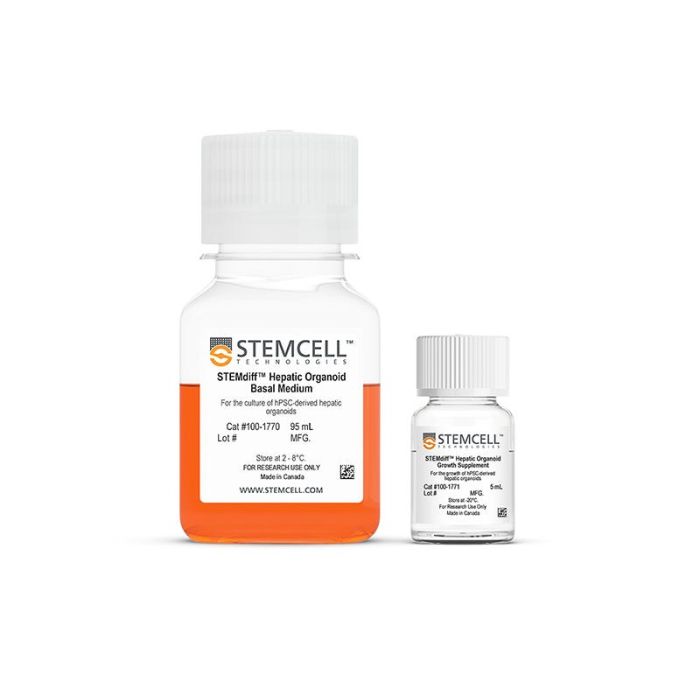
用于培养和分化人多能干细胞来源的肝细胞样细胞形成肝脏类器官的无血清细胞培养基
若您需要咨询产品或有任何技术问题,请通过官方电话 400 885 9050 或邮箱 info.cn@stemcell.com 与我们联系。
用于培养和分化人多能干细胞来源的肝细胞样细胞形成肝脏类器官的无血清细胞培养基
用于将hPSC衍生的肝脏类器官进一步分化为更成熟表型的培养基
用于培养和分化人多能干细胞来源的肝细胞样细胞形成肝脏类器官的无血清细胞培养基
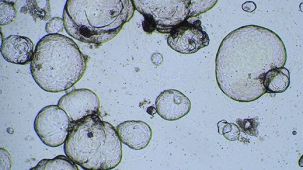
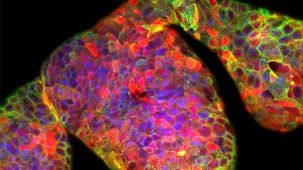
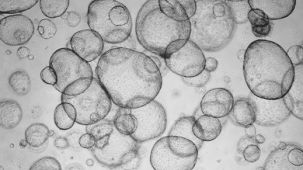
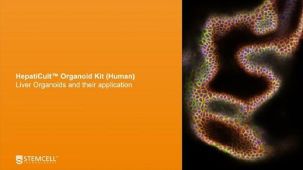
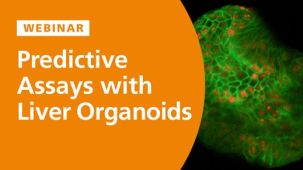
使用 STEMdiff™ 肝类器官培养基,可从人多能干细胞(hPSC)衍生的肝细胞中可靠地建立、扩增并分化肝类器官。该体系兼容灵活的培养方法,并展现成熟肝细胞的关键特征。hPSC 衍生的肝类器官为发育生物学、疾病模型和药物发现研究提供了一种多用途、可规模化的替代模型。
STEMdiff™ 肝类器官培养基工作流程包括两种可单独购买的培养基产品:
STEMdiff™ 肝类器官生长培养基(Hepatic Organoid Growth Medium)用于建立和扩增新鲜或冻存的 hPSC 衍生肝类器官,适用于后续实验或生物样本库建设。
STEMdiff™ 肝类器官分化培养基(Hepatic Organoid Differentiation Medium)用于生成表现出更成熟肝表型的 hPSC 衍生肝类器官。
当与 STEMdiff™ 肝细胞试剂盒(Hepatocyte Kit) 联合使用,并配合在 mTeSR™1、mTeSR™ Plus 或 eTeSR™ 中维持的 hPSC 系,STEMdiff™ 肝类器官培养基可提供一个完整的肝类器官建立、扩增和分化流程,从而避免原代人肝组织的获取需求。
最终获得的 hPSC 衍生肝类器官可适配多种培养方案,包括 96 孔和 384 孔板检测、悬浮培养、基因组编辑以及 2D(类器官来源)单层培养。
相关实验流程可参考肝细胞培养方法库(hepatic cell culture methods library)。
Figure 1. STEMdiff™ Hepatic Organoid Media Enables Establishment, Expansion, and Differentiation of hPSC-Derived Hepatic Organoids
(A) Mature hepatic organoids can be generated starting from hPSC-derived HLCs or HPs. For the generation of HLCs or HPs, see documentation for STEMdiff™ Hepatocyte Kit (Catalog #100-0520). HLCs (recommended) or HPs are mechanically dissociated and replated as fragments in Matrigel® domes and cultured in STEMdiff™ Hepatic Organoid Growth Medium (Catalog #100-1773) to generate confluent cultures within 7 to 14 days. These organoids can be expanded every 6 - 8 days via fragment passaging in STEMdiff™ Organoid Growth Medium, and can also be cryopreserved as fragments. (B) After one passage, cultures can be switched to STEMdiff™ Hepatic Organoid Differentiation Medium (Catalog #100-1774) to differentiate organoids toward more mature hepatic cell types. hPSCs = human pluripotent stem cells; HPs = hepatic progenitor cells; HLCs = hepatocyte-like cells.
Figure 2. HP- and HLC-Derived Liver Organoids Can Be Reliably Generated and Expanded Using STEMdiff™ Hepatic Organoid Media
hPSC-derived organoids can be established from HPs and HLCs generated using the STEMdiff™ Hepatocyte Kit, and then expanded for at least 10 passages. Shown are representative images of HP- and HLC-derived organoids cultured in STEMdiff™ Hepatic Organoid Growth Medium at (A, C) passage 1 and (B, D) passage 9. The HP- and HLC-derived organoids were further differentiated using STEMdiff™ Hepatic Organoid Differentiation Medium at (E, G) passage 1, and (F, H) passage 9. The HP- and HLC-derived organoids shown were derived from the same hPSC line. hPSC = human pluripotent stem cells; HPs = hepatic progenitor cells; HLCs = hepatocyte-like cells.
Figure 3. Proliferating Hepatic Organoids Display Characteristics of Hepatic Progenitors While Differentiated Hepatic Organoids Display Characteristics of Mature Hepatocytes
(A-C) Hepatic organoids cultured in STEMdiff™ Hepatic Organoid Growth Medium organoids express epithelial marker EPCAM, proliferation marker KI67, ductal markers CK19 and SOX9, and the fetal serum protein marker AFP. (D-F) Differentiated hepatic organoids cultured in STEMdiff™ Hepatic Organoid Differentiation Medium express mature hepatocyte markers ALB and A1AT as well as hepatic transcription factor HNF4A. Some organoid regions also retain expression of hepatic progenitor/ductal markers AFP and CK19. Nuclei are counterstained with DAPI.
Figure 4. STEMdiff™ Hepatic Organoid Growth Medium Enables Efficient Establishment and Expansion of hPSC-Derived Hepatic Organoids
(A) STEMdiff™ Hepatic Organoid Growth Medium supports more efficient organoid establishment from HLCs as compared to HPs, generating significantly more organoids from 1 well of HLCs in a 24-well plate than 1 well of HPs in a 24-well plate. (N = 3 cell lines) (B) Once established, HP- and HLC-derived organoids expanded in STEMdiff™ Hepatic Organoid Growth Medium exhibit similar average growth rates across 10 passages. (N = 3 cell lines). Error bars = SD. Welch’s t-test used for statistical testing (**** p-value <0.0001). HPs = Hepatic progenitor cells; HLCs = Hepatocyte-like cells.
Figure 5. HLC-Derived Organoids Maintained in STEMdiff™ Organoid Growth Medium Can Be Cryopreserved and Efficiently Recovered and Expanded Post-Thaw
(A) HLC-derived organoids can be cryopreserved as organoid fragments, and successfully thawed with high post-thaw recovery of fragments (N = 3 cell lines). (B) Recovered fragments retain their proliferative capacity and can be expanded in STEMdiff™ Organoid Growth Medium for several passages. Growth rates for organoids established from cryopreserved fragments are comparable to matched cultures that were never cryopreserved (N = 3 cell lines). Error bars = SD.
Figure 6. HP- and HLC-Derived Hepatic Organoids Exhibit Gene Expression Consistent with Hepatic Maturation When Differentiated Using STEMdiff™ Hepatic Organoid Differentiation Medium
hPSC-derived liver organoids were established, expanded for up to 10 passages, differentiated, and harvested for gene expression analysis through qPCR at each passage. Compared to two-dimensional cultures of HPs and HLCs collected on Day 10 and Day 21 of differentiation, respectively, three-dimensional organoid cultures established from these stages and further matured in STEMdiff™ Hepatic Organoid Differentiation Medium (hODM) exhibited up-regulated expression of mature hepatic markers ALB, ASGR1, and CYP3A4 at levels comparable to PHH. Expression levels are normalized to housekeeping genes (**** represents an adjusted p-value <0.0001, ** represents an adjusted p-value of 0.0035, * represents an adjusted p-value of 0.0397). hPSC = human pluripotent stem cells; HPs = hepatic progenitors; HLCs = hepatocyte-like cells; ALB = albumin; PHH = primary human hepatocyte, hOGM = STEMdiff™ Hepatic Organoid Growth Medium, hODM = STEMdiff™ Hepatic Organoid Differentiation Medium.
Figure 7. RNA Sequencing Analysis Confirms a More Mature Functional State of HLC-Derived Organoids Upon Differentiation Using STEMdiff™ Hepatic Organoid Media
HLC-derived organoids further differentiated in STEMdiff™ Hepatic Organoid Differentiation Medium express increased levels of markers associated with mature hepatocyte identity and functionality, including serum protein synthesis (ALB), phase 1 and 2 drug metabolism (CYP2B6, CYP2C9, CYP3A4, UGT1A1, GSTA1), glucose metabolism (SLC2A2, GYS1, G6PC), lipid and cholesterol metabolism (FASN, PLIN2, NR1H3), bile acid synthesis (CYP27A1, BAAT), and urea synthesis (OTC, ARG1). Differentiated HLC-derived organoids also show reduced levels of fetal hepatocyte marker AFP. Columns represent 2 biological replicates analyzed by bulk RNA-seq in the first passage after organoids are established from HLCs, on Day 9 in STEMdiff™ Hepatic Organoid Growth Medium, and on Day 19 in STEMdiff™ Hepatic Organoid Differentiation Medium. The housekeeping gene TBP is included as a reference. hPSC = human pluripotent stem cells; HPs = hepatic progenitors; HLCs = hepatocyte-like cells; ALB = albumin; PHH = primary human hepatocyte; AFP = Alpha-fetoprotein.
请在《产品说明书》中查找相关支持信息和使用说明,或浏览下方更多实验方案。
Thank you for your interest in IntestiCult™ Organoid Growth Medium (Human). Please provide us with your contact information and your local representative will contact you with a customized quote. Where appropriate, they can also assist you with a(n):
Estimated delivery time for your area
Product sample or exclusive offer
In-lab demonstration
无动物成分,含有10% DMSO的冻存液
用于人肝脏类器官生成、生长和分化的培养基试剂盒
用于将人多能干细胞分化为肝细胞样细胞的无血清分化试剂盒
人多能干细胞系,冷冻
质量保证:
本产品仅供研究使用,除非另有说明,不得用于人或动物的诊断或治疗用途。有关 STEMCELL 质量体系的更多信息,请参阅:www.stemcell.cn/compliance
安全声明:
加州警告:本产品可能使您接触到包括乙醇在内的化学物质,加州已知这些物质会导致癌症、出生缺陷或其他生殖危害。更多信息请访问 www.P65Warnings.ca.gov
扫描二维码或搜索微信号STEMCELLTech,即可关注我们的微信平台,第一时间接收丰富的技术资源和最新的活动信息。
如您有任何问题,欢迎发消息给STEMCELLTech微信公众平台,或与我们通过电话/邮件联系:400 885 9050 INFO.CN@STEMCELL.COM。
在线联系