若您需要咨询产品或有任何技术问题,请通过官方电话 400 885 9050 或邮箱 info.cn@stemcell.com 与我们联系。

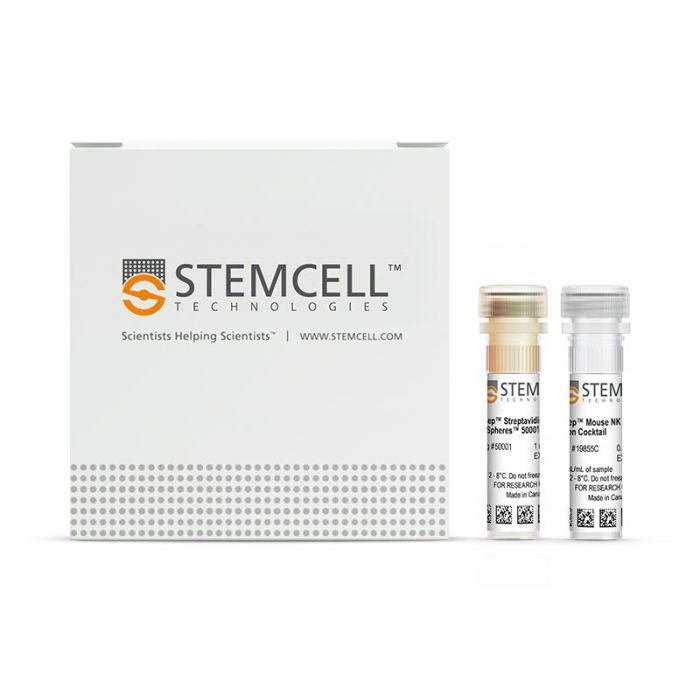
EasySep™小鼠NK细胞分选试剂盒

免疫磁珠负选不带标记的小鼠NK细胞
只有 %1
¥9,638.00

产品号 #(选择产品)

产品号 #19855_C

免疫磁珠负选不带标记的小鼠NK细胞

产品优势

  • 操作简便、快速
  • 无需分离柱
  • 获得不带标记的活细胞

产品组分包括

  • EasySep™小鼠NK细胞分选试剂盒(产品号 #19855)
    • EasySep™小鼠NK细胞分选抗体混合物,5 mL
    • EasySep™ Streptavidin RapidSpheres™ 50001磁珠,1 mL
  • RoboSep™小鼠NK细胞分选试剂盒(产品号 #19855RF)
    • EasySep™小鼠NK细胞分选抗体混合物,5 mL
    • EasySep™ Streptavidin RapidSpheres™ 50001磁珠,1 mL
    • RoboSep™ 缓冲液(产品号 #20104)
    • RoboSep™过滤吸头(产品号 #20125)
New look, same high quality and support! You may notice that your instrument or reagent packaging looks slightly different from images displayed on the website, or from previous orders. We are updating our look but rest assured, the products themselves and how you should use them have not changed. Learn more
专为您的实验方案打造的产品
要查看实验方案所需的所有配套产品,请参阅《实验方案与技术文档》

总览

使用EasySep™小鼠NK细胞分选试剂盒,可通过免疫磁珠负选,轻松高效地从小鼠脾脏单细胞悬液及其他组织样本中分离高纯度的小鼠自然杀伤(NK)细胞(CD3-CD49b+)。EasySep™技术结合单克隆抗体的特异性和无柱磁分选系统的简便性,已在发表的研究中广泛应用超过20年。

在该EasySep™负选流程中,非目的细胞通过抗体复合物与磁珠标记。表达以下标志物的非目的细胞将被靶向去除:CD4、CD5、Ly6G、CD8a、F4/80、CD3e、CD19、CD24、TCRgd及7-4。使用EasySep™磁极吸附后,通过简单地将目的细胞倾倒或吸取至一个新的试管中,即可将被磁珠标记的细胞与不带标记的目的细胞分离开来。在短至25分钟的磁珠分选后,目的NK细胞可立即用于流式细胞术、细胞培养、基于细胞的实验等下游应用。

了解更多EasySep™免疫磁珠技术的工作原理,或者如何通过RoboSep™实现全自动化免疫磁珠细胞分选。探索更多为您的实验流程优化的产品,包括培养基、补充剂、抗体等。

磁极兼容性
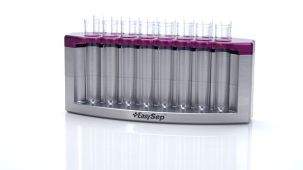
• EasySep™磁极(产品号 #18000)
• “The Big Easy” EasySep™磁极(产品号 #18001)
• EasyEights™ EasySep™磁极(产品号 #18103)
• RoboSep™-S(产品号 #21000)
 
分类
细胞分选试剂盒
 
细胞类型
NK 细胞
 
种属
小鼠
 
样本来源
脾脏
 
分选方法
负选
 
应用
细胞分选
 
品牌
EasySep,RoboSep
 
研究领域
免疫
 

实验数据

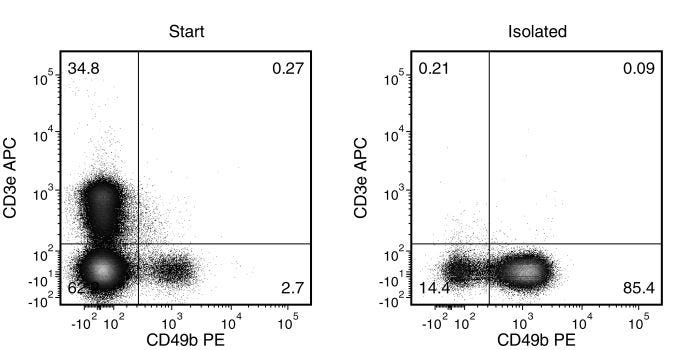
Typical EasySep™ Mouse NK Cell Isolation Profile

Figure 1. Typical EasySep™ Mouse NK Cell Isolation Profile

Starting with mouse splenocytes, the NK cell (CD3-CD49b+) content of the isolated fraction typically ranges from 67 - 89%.

产品说明书及文档

请在《产品说明书》中查找相关支持信息和使用说明,或浏览下方更多实验方案。

Document Type
Product Name
Catalog #
Lot #
Language
Catalog #
19855RF
Lot #
1000100904 and higher
Language
English
Catalog #
19855
Lot #
1000100904 and higher
Language
English
Document Type
Safety Data Sheet 1
Catalog #
19855RF
Lot #
All
Language
English
Document Type
Safety Data Sheet 2
Catalog #
19855RF
Lot #
All
Language
English
Document Type
Safety Data Sheet 3
Catalog #
19855RF
Lot #
All
Language
English
Document Type
Safety Data Sheet 1
Catalog #
19855
Lot #
All
Language
English
Document Type
Safety Data Sheet 2
Catalog #
19855
Lot #
All
Language
English

应用领域

本产品专为以下研究领域设计,适用于工作流程中的高亮阶段。探索这些工作流程,了解更多我们为各研究领域提供的其他配套产品。

相关材料与文献

技术资料 (8)

常见问题 (11)

Can EasySep™ be used for either positive or negative selection?

Yes. The EasySep™ kits use either a negative selection approach by targeting and removing unwanted cells or a positive selection approach targeting desired cells. Depletion kits are also available for the removal of cells with a specific undesired marker (e.g. GlyA).

How does the separation work?

Magnetic particles are crosslinked to cells using Tetrameric Antibody Complexes (TAC). When placed in the EasySep™ Magnet, labeled cells migrate to the wall of the tube. The unlabeled cells are then poured off into a separate fraction.

Which columns do I use?

The EasySep™ procedure is column-free. That's right - no columns!

How can I analyze the purity of my enriched sample?

The Product Information Sheet provided with each EasySep™ kit contains detailed staining information.

Can EasySep™ separations be automated?

Yes. RoboSep™, the fully automated cell separator, automates all EasySep™ labeling and cell separation steps.

Can EasySep™ be used to isolate rare cells?

Yes. We recommend a cell concentration of 2x10⁸ cells/mL and a minimum working volume of 100 µL. Samples containing 2x10⁷ cells or fewer should be suspended in 100 µL of buffer.

Are the EasySep™ magnetic particles FACS-compatible?

Yes, the EasySep™ particles are flow cytometry-compatible, as they are very uniform in size and about 5000X smaller than other commercially available magnetic beads used with column-free systems.

Can the EasySep™ magnetic particles be removed after enrichment?

No, but due to the small size of these particles, they will not interfere with downstream applications.

Can I alter the separation time in the magnet?

Yes; however, this may impact the kit's performance. The provided EasySep™ protocols have already been optimized to balance purity, recovery and time spent on the isolation.

For positive selection, can I perform more than 3 separations to increase purity?

Yes, the purity of targeted cells will increase with additional rounds of separations; however, cell recovery will decrease.

How does the binding of the EasySep™ magnetic particle affect the cells? is the function of positively selected cells altered by the bound particles?

Hundreds of publications have used cells selected with EasySep™ positive selection kits for functional studies. Our in-house experiments also confirm that selected cells are not functionally altered by the EasySep™ magnetic particles.

If particle binding is a key concern, we offer two options for negative selection. The EasySep™ negative selection kits can isolate untouched cells with comparable purities, while RosetteSep™ can isolate untouched cells directly from whole blood without using particles or magnets.

文献 (20)

Adoptive NK cell transfer confers neuroprotection by attenuating neuroinflammation and alpha-synuclein pathology in a mouse model of synucleinopathy A. Adebowale et al. Molecular Neurodegeneration Advances 2025 Nov

Abstract

Background: Natural killer (NK) cells are key effector lymphoid cells involved in both innate and adaptive immunity and are capable of clearing abnormally aggregated α-synuclein (αSyn). In preclinical Parkinson’s disease (PD) models, NK cell depletion worsens motor deficits and increases insoluble αSyn accumulation, suggesting a neuroprotective role. However, the therapeutic potential of NK cell transfer in modulating αSyn pathology and neurodegeneration remains unexplored. Methods: To assess the efficacy of NK cell therapy, we administered biweekly systemic injections of untouched NK cells isolated from B6C3H donor mice into 2-month-old presymptomatic homozygous M83 transgenic mice injected with human αSyn preformed fibrils. Neurological function was assessed via clasping behavior and clinical scoring. αSyn pathology and dopaminergic neurodegeneration were evaluated via immunohistochemistry. CyTOF-based immune profiling and multiplex ELISA were performed to characterize central and peripheral immune responses. Results: Adoptive NK cell transfers improved motor function and reduced αSyn pathology in a region- and dose-dependent manner, with significant reductions in phosphorylated-αSyn inclusions and tyrosine hydroxylase-positive neuronal loss in the substantia nigra. NK cell transfer modulated the CNS immune landscape by reducing CD11b+CD45high and MHCII+ activated microglial, CD4⁺ T cells, and neutrophil infiltration, while promoting CD19+ B and CD8+ T cells. Similar immunomodulatory effects were observed in the periphery, including restoration of follicular B cells and reduced neutrophil frequencies. Mechanistically, αSyn exposure downregulated activating NK ligands and upregulated inhibitory receptor ligand mQa1b, along with p21 induction in microglia, suggesting a senescence-associated, immune-evasive phenotype that may contribute to reduced therapeutic efficacy at later disease stages. Conclusions: Our study provides direct evidence of NK cells exerting neuroprotective and immunomodulatory effects in a preclinical model of synucleinopathy. These findings support NK cell transfer as a novel therapeutic strategy for PD and related neurodegenerative disorders.
Resveratrol from Peanut Sprout Extract Promotes NK Cell Activation and Antitumor Activity Biomolecules & Therapeutics 2025 Feb

Abstract

Natural killer (NK) cells are innate immune cells that are crucial for anticancer activity and have been developed as an immune cell therapy for leukemia. However, their limited effectiveness against solid tumors has prompted research into methods to enhance NK cell activity through combination therapies. Health supplements capable of boosting immune surveillance against tumor cells are gaining attention owing to their potential benefits. Resveratrol, a stilbenoid produced by several plants including peanuts and grapes, reportedly exerts anticancer effects and can activate immune cells. The peanut sprout extract cultivated with fermented sawdust medium (PSEFS) is rich in resveratrol, leveraging its health benefits in terms of the dry weight of herbal products, thus maximizing the utilization of resveratrol’s beneficial properties. Our study compared the efficacy of resveratrol and PSEFS and revealed that PSEFS significantly enhanced NK cell activation compared with an equivalent dose of resveratrol. We investigated the ability of PSEFS to potentiate NK cell anticancer activity, focusing on NK cell survival, tumor cell lysis, and NK cell activation in PSEFS-administered mice. Our findings suggest that PSEFS could be a potential NK cell booster for cancer immunotherapy.
Cladophora wrightiana Var. Minor Extract Acts as an Adjuvant to Promote Natural Killer Cell Activation by Nasal Influenza Vaccine T. L. Ho et al. Food Science & Nutrition 2025 Aug

Abstract

Natural killer (NK) cells, which are key components of the innate immune response, are crucial for ensuring the efficacy of vaccines as they rapidly eliminate infected cells and enhance the adaptive immune response, ensuring robust and lasting protection. In this report, we investigated the effect of Cladophora wrightiana var. minor (CW) extract, a marine alga, in activating NK cells, as an adjuvant to inactivated A/Puerto Rico/8/34 H1N1 influenza vaccine (iPR8). In vitro, CW extract significantly enhanced the level of activation markers CD69 and CD107a on NK cells and triggered intracellular secretion of interferon gamma (IFN‐γ) and granzyme B (GrB), indicating effective NK cell stimulation and cytotoxic function. In vivo, CW extract promoted substantial NK cell recruitment and activation, resulting in higher NK cell populations and elevated post‐immunization levels of activation markers. Additionally, CW extract increased IFN‐γ and GrB production in CD8+ T cells, highlighting its broader impact on the immune response. We also found direct evidence that CW‐activated NK cells and dendritic cells (DCs) interacted with and induced the activation of immature DCs and resting NK cells, respectively. These findings suggest that CW extract is a promising adjuvant for nasal vaccines, enhancing cellular immunity by activating NK cells and supporting interactions with DCs and CD8+ T cells. Cladophora wrightiana var. minor (CW) extract, administered as an adjuvant with inactivated influenza virus (iPR8), stimulates both innate and adaptive immune responses. CW enhances NK cell activation, cytotoxic function, and reciprocal crosstalk with dendritic cells, while also promoting CD8+ T cell responses and antigen‐specific IgG production. These findings support CW as a potent nasal vaccine adjuvant capable of boosting protective immunity. https://app.biorender.com/illustrations/6893f7d09e3fc89e9d953f76?slideId=2a6a42b6‐a3d9‐400a‐b839‐fa297b3108c5.

更多信息

更多信息
物种 小鼠
Magnet Compatibility • EasySep™ Magnet (Catalog #18000) • “The Big Easy” EasySep™ Magnet (Catalog #18001) • EasyEights™ EasySep™ Magnet (Catalog #18103) • RoboSep™-S (Catalog #21000)
样本来源 脾脏
Selection Method Negative
标记抗体
质量保证:

产品仅供研究使用,不用于针对人或动物的诊断或治疗。 欲获悉更多关于STEMCELL的质控信息,请访问 STEMCELL.CN/COMPLIANCE.
Copyright © 2025 by STEMCELL Technologies. All rights reserved.

在线联系