若您需要咨询产品或有任何技术问题,请通过官方电话 400 885 9050 或邮箱 info.cn@stemcell.com 与我们联系。

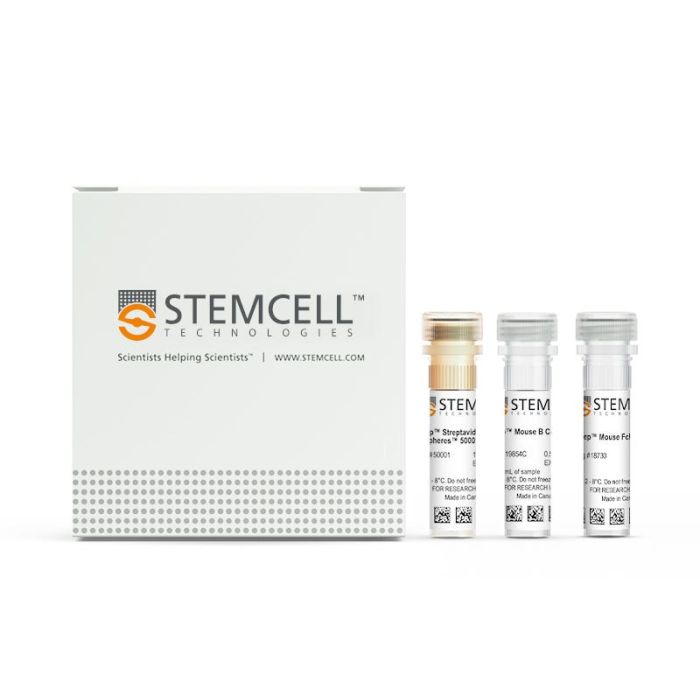
EasySep™小鼠B细胞分选试剂盒

通过免疫磁珠负选分离出无磁珠标记的小鼠B细胞

产品号 #(选择产品)

产品号 #19854_C

通过免疫磁珠负选分离出无磁珠标记的小鼠B细胞

产品优势

  • 易于操作、快速
  • 纯度高达95%
  • 无需分离柱
  • 获得的活细胞无标记

产品组分包括

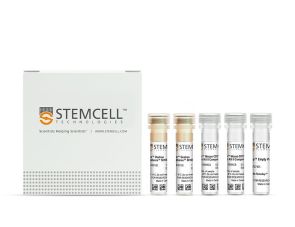
  • EasySep™小鼠B细胞分选试剂盒(产品号 #19854)
    • EasySep™小鼠B细胞分选抗体混合物,0.5 mL
    • EasySep™ Streptavidin RapidSpheres™ 50001磁珠,1 mL
    • EasySep™小鼠FcR阻断剂,0.2 mL
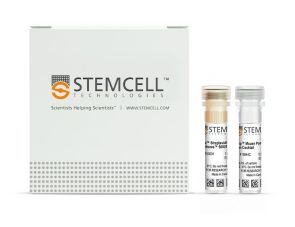
  • RoboSep™小鼠B细胞分选试剂盒(产品号 #19854RF)
    • EasySep™小鼠B细胞分选抗体混合物,0.5 mL
    • EasySep™ Streptavidin RapidSpheres™ 50001磁珠,1 mL
    • EasySep™小鼠FcR阻断剂,0.2 mL
    • RoboSep™ 缓冲液(产品号#20104)
    • RoboSep™过滤吸头(产品号#20125)
专为您的实验方案打造的产品
要查看实验方案所需的所有配套产品,请参阅《实验方案与技术文档》

总览

使用 EasySep™ 小鼠 B 细胞分离试剂盒,可通过免疫磁性负选法从脾细胞或其他组织样本的单细胞悬液中轻松高效地分离高纯度的小鼠 B 细胞。EasySep™ 技术在已发表研究中被广泛应用超过 20 年,结合了单克隆抗体的特异性与无柱磁系统的简便性。

在此 EasySep™ 负选步骤中,不需要的细胞通过抗体复合物和磁性颗粒进行标记。表达以下标志物的细胞将被去除:CD11b、CD4、CD8a、Ly6G/C、Ter119、CD43、CD49b 和 CD90.2。经 EasySep™ 磁体分离后,带有磁性标记的不需要细胞被去除,未标记的目标 B 细胞通过倾倒或移液方式转移至新试管中。磁性细胞分离最快可在 15 分钟内完成,目标 B 细胞可直接用于流式细胞术、培养及基于细胞的实验等下游应用。

如需分离表达 CD11b 或 CD43 的 B 细胞,建议使用 EasySep™ 小鼠全 B 细胞分离试剂盒(产品号#19844)。

了解更多关于 EasySep™ 免疫磁性技术的工作原理,或了解如何使用 RoboSep™ 实现免疫磁性细胞分离的全自动化。探索更多优化实验流程的产品,包括培养基、补充物、抗体等。


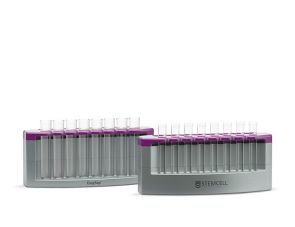
磁极兼容性
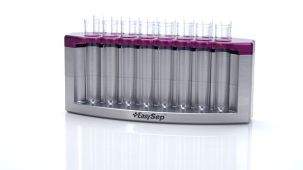
• EasySep™磁极(产品号 #18000)
• “The Big Easy” EasySep™磁极(产品号 #18001)
• EasyPlate™ EasySep™磁极(产品号 #18102)
• EasyEights™ EasySep™磁极(产品号 #18103)
• RoboSep™-S(产品号 #21000)
 
分类
细胞分选试剂盒
 
细胞类型
B 细胞
 
种属
小鼠
 
样本来源
其他物种,脾脏
 
分选方法
负选
 
应用
细胞分选
 
品牌
EasySep,RoboSep
 
研究领域
免疫
 

实验数据

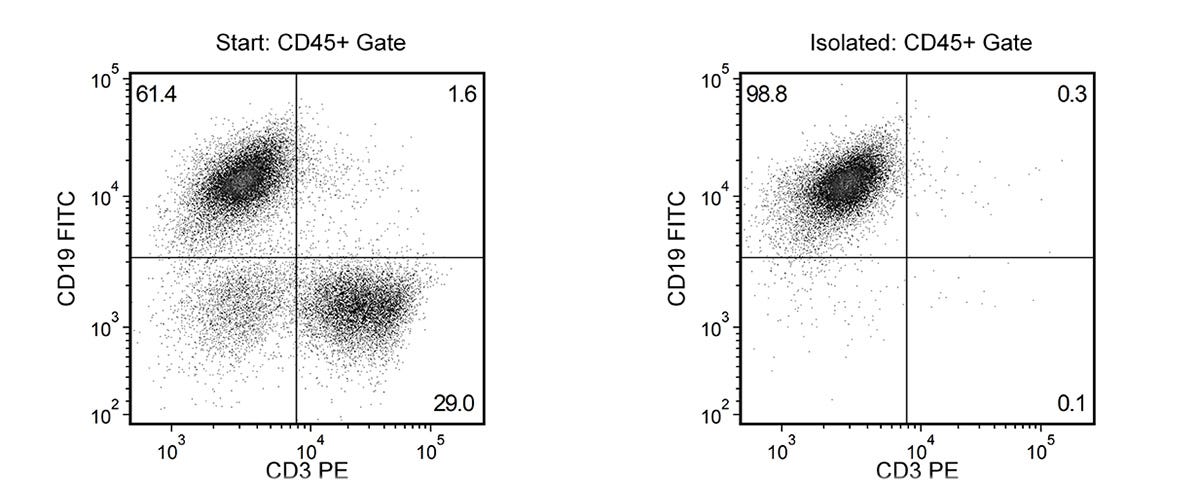
Typical EasySep™ Mouse B Cell Isolation Profile

Figure 1. Typical EasySep™ Mouse B Cell Isolation Profile

Starting with mouse splenocytes, the B cell content (CD19+CD3-) of the isolated fraction is 97.6 ± 1.7% (mean ± SD), using the purple EasySep™ Magnet.

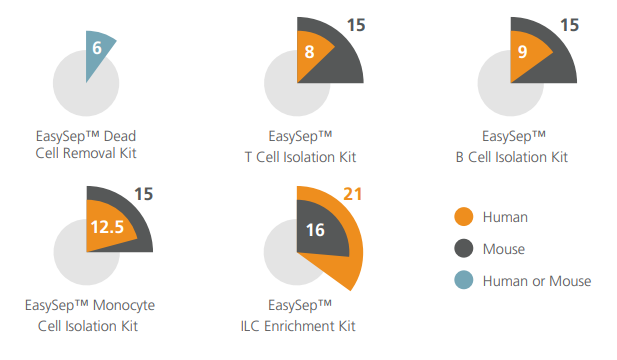
EasySep™ Cell Isolation Protocol Lengths

Figure 2. EasySep™ Cell Isolation Protocol Lengths

Typical time taken (in minutes) to isolate cells using select EasySep™ kits.

产品说明书及文档

请在《产品说明书》中查找相关支持信息和使用说明,或浏览下方更多实验方案。

Document Type
Product Name
Catalog #
Lot #
Language
Catalog #
19854RF
Lot #
All
Language
English
Catalog #
19854
Lot #
All
Language
English
Document Type
Safety Data Sheet 1
Catalog #
19854RF
Lot #
All
Language
English
Document Type
Safety Data Sheet 2
Catalog #
19854RF
Lot #
All
Language
English
Document Type
Safety Data Sheet 3
Catalog #
19854RF
Lot #
All
Language
English
Document Type
Safety Data Sheet 4
Catalog #
19854RF
Lot #
All
Language
English
Document Type
Safety Data Sheet 5
Catalog #
19854RF
Lot #
All
Language
English
Document Type
Safety Data Sheet 1
Catalog #
19854
Lot #
All
Language
English
Document Type
Safety Data Sheet 2
Catalog #
19854
Lot #
All
Language
English
Document Type
Safety Data Sheet 3
Catalog #
19854
Lot #
All
Language
English
Document Type
Safety Data Sheet 4
Catalog #
19854
Lot #
All
Language
English

应用领域

本产品专为以下研究领域设计,适用于工作流程中的高亮阶段。探索这些工作流程,了解更多我们为各研究领域提供的其他配套产品。

相关材料与文献

技术资料 (10)

常见问题

Can EasySep™ Streptavidin RapidSpheres™ be used for either positive or negative selection?

Currently, EasySep™ Streptavidin RapidSphere™ kits are only available for negative selection and work by targeting and removing unwanted cells.

How does the separation work?

Streptavidin RapidSphere™ magnetic particles are crosslinked to unwanted cells using biotinylated antibodies. When placed in the EasySep™ Magnet, labeled cells migrate to the wall of the tube. The unlabeled cells are then poured off into a new tube.

Which columns do I use?

The EasySep™ procedure is column-free. That's right - no columns!

How can I analyze the purity of my enriched sample?

The Product Information Sheet provided with each EasySep™ kit contains detailed staining information.

Can EasySep™ Streptavidin RapidSphere™ separations be automated?

Yes. RoboSep™, the fully automated cell separator, automates all EasySep™ labeling and cell separation steps.

Are cells isolated using EasySep™ RapidSphere™ products FACS-compatible?

Yes. Desired cells are unlabeled and ready to use in downstream applications, such as FACS analysis.

Can I alter the separation time in the magnet?

Yes; however, this may impact the kit's performance. The provided EasySep™ protocols have already been optimized to balance purity, recovery and time spent on the isolation.

文献 (37)

Co-modulation of T cells and B cells enhances the inhibition of inflammation in experimental hypersensitivity pneumonitis. O. Courtemanche et al. Respiratory research 2022 oct

Abstract

BACKGROUND Hypersensitivity pneumonitis (HP) is an interstitial lung disease characterized by antigen-triggered neutrophilic exacerbations. Although CD4+ T cells are sufficient for HP pathogenesis, this never translated into efficient T cell-specific therapies. Increasing evidence shows that B cells also play decisive roles in HP. Here, we aimed to further define the respective contributions of B and T cells in subacute experimental HP. METHODS Mice were subjected to a protocol of subacute exposure to the archaeon Methanosphaera stadmanae to induce experimental HP. Using models of adoptive transfers of B cells and T cells in Rag1-deficient mice and of B cell-specific S1P1 deletion, we assessed the importance of B cells in the development of HP by evaluating inflammation in bronchoalveolar lavage fluid. We also aimed to determine if injected antibodies targeting B and/or T cells could alleviate HP exacerbations using a therapeutic course of intervention. RESULTS Even though B cells are not sufficient to induce HP, they strongly potentiate CD4+ T cell-induced HP?‘associated neutrophilic inflammation in the airways. However, the reduction of 85% of lung B cells in mice with a CD19-driven S1P1 deletion does not dampen HP inflammation, suggesting that lung B cells are not necessary in large numbers to sustain local inflammation. Finally, we found that injecting antibodies targeting B cells after experimental HP was induced does not dampen neutrophilic exacerbation. Yet, injection of antibodies directed against B cells and T cells yielded a potent 76% inhibition of neutrophilic accumulation in the lungs. This inhibition occurred despite partial, sometimes mild, depletion of B cells and T cells subsets. CONCLUSIONS Although B cells are required for maximal inflammation in subacute experimental HP, partial reduction of B cells fails to reduce HP-associated inflammation by itself. However, co-modulation of T cells and B cells yields enhanced inhibition of HP exacerbation caused by an antigenic rechallenge.
Immune correlates of protection following Rift Valley fever virus vaccination. J. D. Doyle et al. NPJ vaccines 2022 oct

Abstract

Rift Valley fever virus (RVFV) is a hemorrhagic fever virus with the potential for significant economic and public health impact. Vaccination with an attenuated strain, DelNSsRVFV, provides protection from an otherwise lethal RVFV challenge, but mechanistic determinants of protection are undefined. In this study, a murine model was used to assess the contributions of humoral and cellular immunity to DelNSsRVFV-mediated protection. Vaccinated mice depleted of T cells were protected against subsequent challenge, and passive transfer of immune serum from vaccinated animals to na{\{i}}ve animals was also protective demonstrating that T cells were dispensable in the presence of humoral immunity and that humoral immunity alone was sufficient. Animals depleted of B cells and then vaccinated were protected against challenge. Total splenocytes but not T cells alone B cells alone or B??+??T cells harvested from vaccinated animals and then transferred to na{\"{i}}ve animals were sufficient to confer protection suggesting that multiple cellular interactions were required for effective cellular immunity. Together these data indicate that humoral immunity is sufficient to confer vaccine-mediated protection and suggests that cellular immunity plays a role in protection that requires the interaction of various cellular components."
Pre-Germinal Center Interactions with T Cells Are Natural Checkpoints to Limit Autoimmune B Cell Responses. K. A. Parham et al. Journal of immunology (Baltimore, Md. : 1950) 2022 nov

Abstract

Interactions with Ag-specific T cells drive B cell activation and fate choices that ultimately determine the quality of high-affinity Ab responses. As such, these interactions, and especially the long-lived interactions that occur before germinal center formation, may be important checkpoints to regulate undesirable responses. Using mouse model Ag systems, we directly observed interactions between T and B cells responding to the self-antigen myelin oligodendrocyte glycoprotein (MOG) and found that they are of lower quality compared with interactions between cells responding to the model foreign Ag nitrophenyl-haptenated OVA. This was associated with reduced expression of molecules that facilitate these interactions on the B cells, but not on T cells. B cell expression of these molecules was not dictated by the T cell partner, nor could the relative lack of expression on MOG-specific (MOG-sp.) B cells be reversed by a multivalent Ag. Instead, MOG-sp. B cells were inherently less responsive to BCR stimulation than MOG-non-sp. cells. However, the phenotype of MOG-sp. B cells was not consistent with previous descriptions of autoimmune B cells that had been tolerized via regular exposure to systemically expressed self-antigen. This suggests that alternate anergy pathways may exist to limit B cell responses to tissue-restricted self-antigens.

更多信息

更多信息
物种 小鼠
Magnet Compatibility • EasySep™ Magnet (Catalog #18000) • “The Big Easy” EasySep™ Magnet (Catalog #18001) • EasyPlate™ EasySep™ Magnet (Catalog 18102) • EasyEights™ EasySep™ Magnet (Catalog #18103) • RoboSep™-S (Catalog #21000)
样本来源 其它细胞系, 脾脏
Selection Method Negative
质量保证:

产品仅供研究使用,不用于针对人或动物的诊断或治疗。 欲获悉更多关于STEMCELL的质控信息,请访问 STEMCELL.CN/COMPLIANCE.
Copyright © 2025 by STEMCELL Technologies. All rights reserved.

在线联系