若您需要咨询产品或有任何技术问题,请通过官方电话 400 885 9050 或邮箱 info.cn@stemcell.com 与我们联系。

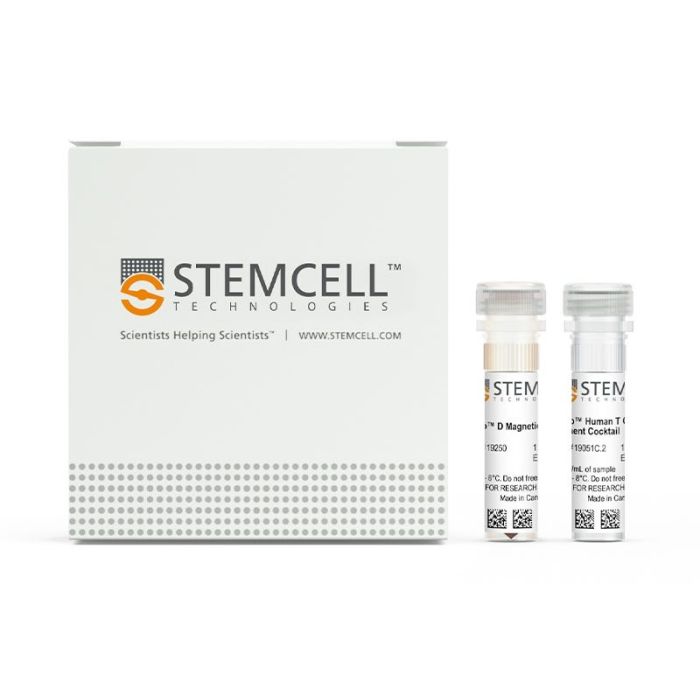
EasySep™人T细胞富集试剂盒

通过免疫磁珠负选分离出无磁珠标记的人T细胞
只有 %1
¥11,738.00

产品号 #(选择产品)

产品号 #19051_C

通过免疫磁珠负选分离出无磁珠标记的人T细胞

产品优势

  • 易于操作、快速,且无需分离柱
  • 纯度高达99%
  • 获得的活细胞无标记

产品组分包括

  • EasySep™ 人T细胞富集试剂盒(产品号#19051)
    • EasySep™ 人T细胞富集抗体混合物,1 mL
    • EasySep™ D Magnetic Particles磁珠,1 mL
  • RoboSep™ 人T细胞富集试剂盒(含过滤吸头)(产品号 #19051RF)
    • EasySep™ 人T细胞富集抗体混合物,1 mL
    • EasySep™ D Magnetic Particles磁珠, 1 mL
    • RoboSep™ 缓冲液(产品号#20104)
    • RoboSep™过滤吸头(产品号#20125)
New look, same high quality and support! You may notice that your instrument or reagent packaging looks slightly different from images displayed on the website, or from previous orders. We are updating our look but rest assured, the products themselves and how you should use them have not changed. Learn more
专为您的实验方案打造的产品
要查看实验方案所需的所有配套产品,请参阅《实验方案与技术文档》

总览

通过免疫磁珠负选,从新鲜或冻存的人外周血单个核细胞 (PBMCs) 或白细胞单采术样本中分离出高度纯化的T细胞。EasySep™技术结合单克隆抗体的特异性和无柱磁分选系统的简便性,已在发表的研究中广泛应用超过20年。

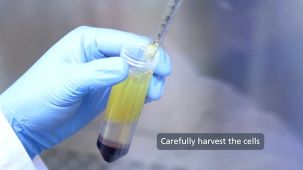
在此 EasySep™ 负选方案中,非目的细胞通过抗体复合物与磁珠标记。表面表达以下标志物的非目的细胞将被特异性去除:CD14、CD16、CD19、CD20、CD36、CD56、CD66b、CD123及GlyA。通过EasySep™磁极,将这些被磁珠标记的细胞与未被标记的目的细胞分离,接着简单的将目的细胞倾倒或吸取至一个新的试管中。完成磁珠分选后,分选得到的T细胞可直接用于流式细胞术、细胞培养或DNA/RNA提取等下游应用。

如需更快速的细胞分选方案,我们推荐EasySep™ 人T细胞分选试剂盒(产品号 #17951),仅需8分钟即可完成分选。

了解更多关于免疫磁珠EasySep™技术的工作原理,或如何通过RoboSep™实现免疫磁珠细胞分选全自动化。另外,您还可以选择即用型、符合伦理来源的冷冻人外周血原代 Pan-T 细胞,这些细胞使用EasySep™ 人T细胞富集试剂盒分选得到。探索为您的实验流程优化的更多产品,包括培养基、添加剂、抗体等。

磁极兼容性
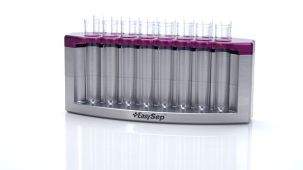
• EasySep™磁极(产品号 #18000)
• “The Big Easy” EasySep™磁极(产品号 #18001)
• Easy 50 EasySep™磁极(产品号 #18002)
• EasyPlate™ EasySep™磁极(产品号 #18102)
• EasyEights™ EasySep™磁极(产品号 #18103)
• RoboSep™-S(产品号 #21000)
 
分类
细胞分选试剂盒
 
细胞类型
T 细胞
 
种属

 
样本来源
白细胞单采术样本、PBMC
 
分选方法
负选
 
应用
细胞分选
 
品牌
EasySep,RoboSep
 
研究领域
免疫
 

实验数据

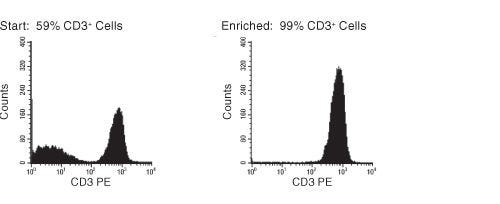
FACS Histogram Results With EasySep™ Human T Cell Enrichment Kit

Figure 1. FACS Histogram Results With EasySep™ Human T Cell Enrichment Kit

Starting with previously frozen mononuclear cells, the CD3+ cell content of the enriched fraction typically ranges from 95% - 99%.

产品说明书及文档

请在《产品说明书》中查找相关支持信息和使用说明,或浏览下方更多实验方案。

Document Type
Product Name
Catalog #
Lot #
Language
Catalog #
19051
Lot #
All
Language
English
Catalog #
19051RF
Lot #
All
Language
English
Document Type
Safety Data Sheet 1
Catalog #
19051
Lot #
All
Language
English
Document Type
Safety Data Sheet 2
Catalog #
19051
Lot #
All
Language
English
Document Type
Safety Data Sheet 1
Catalog #
19051RF
Lot #
All
Language
English
Document Type
Safety Data Sheet 2
Catalog #
19051RF
Lot #
All
Language
English
Document Type
Safety Data Sheet 3
Catalog #
19051RF
Lot #
All
Language
English

应用领域

本产品专为以下研究领域设计,适用于工作流程中的高亮阶段。探索这些工作流程,了解更多我们为各研究领域提供的其他配套产品。

相关材料与文献

技术资料 (11)

常见问题 (11)

Can EasySep™ be used for either positive or negative selection?

Yes. The EasySep™ kits use either a negative selection approach by targeting and removing unwanted cells or a positive selection approach targeting desired cells. Depletion kits are also available for the removal of cells with a specific undesired marker (e.g. GlyA).

How does the separation work?

Magnetic particles are crosslinked to cells using Tetrameric Antibody Complexes (TAC). When placed in the EasySep™ Magnet, labeled cells migrate to the wall of the tube. The unlabeled cells are then poured off into a separate fraction.

Which columns do I use?

The EasySep™ procedure is column-free. That's right - no columns!

How can I analyze the purity of my enriched sample?

The Product Information Sheet provided with each EasySep™ kit contains detailed staining information.

Can EasySep™ separations be automated?

Yes. RoboSep™, the fully automated cell separator, automates all EasySep™ labeling and cell separation steps.

Can EasySep™ be used to isolate rare cells?

Yes. We recommend a cell concentration of 2x10⁸ cells/mL and a minimum working volume of 100 µL. Samples containing 2x10⁷ cells or fewer should be suspended in 100 µL of buffer.

Are the EasySep™ magnetic particles FACS-compatible?

Yes, the EasySep™ particles are flow cytometry-compatible, as they are very uniform in size and about 5000X smaller than other commercially available magnetic beads used with column-free systems.

Can the EasySep™ magnetic particles be removed after enrichment?

No, but due to the small size of these particles, they will not interfere with downstream applications.

Can I alter the separation time in the magnet?

Yes; however, this may impact the kit's performance. The provided EasySep™ protocols have already been optimized to balance purity, recovery and time spent on the isolation.

For positive selection, can I perform more than 3 separations to increase purity?

Yes, the purity of targeted cells will increase with additional rounds of separations; however, cell recovery will decrease.

How does the binding of the EasySep™ magnetic particle affect the cells? is the function of positively selected cells altered by the bound particles?

Hundreds of publications have used cells selected with EasySep™ positive selection kits for functional studies. Our in-house experiments also confirm that selected cells are not functionally altered by the EasySep™ magnetic particles.

If particle binding is a key concern, we offer two options for negative selection. The EasySep™ negative selection kits can isolate untouched cells with comparable purities, while RosetteSep™ can isolate untouched cells directly from whole blood without using particles or magnets.

文献 (31)

A ROR1 targeted bispecific T cell engager shows high potency in the pre-clinical model of triple negative breast cancer Breast Cancer Research : BCR 2025 Mar

Abstract

BackgroundTriple negative breast cancer (TNBC) is an aggressive breast cancer subtype characterized with poor prognosis and high metastatic potential. Although traditional chemotherapy, radiation, and surgical resection remain the standard treatment options for TNBC, bispecific antibody-based immunotherapy is emerging as new strategy in TNBC treatment. Here, we found that the receptor tyrosine kinase-like Orphan Receptor 1 (ROR1) was highly expressed in TNBC but minimally expressed in normal tissue. A bispecific ROR1-targeted CD3 T cell engager (TCE) was designed in IgG-based format with extended half-life.MethodThe expression of ROR1 in TNBC was detected by RT-qPCR and immunohistology analysis. The killing of ROR1/CD3 antibody on TNBC cells was determined by the in vitro cytotoxicity assay and in vivo PBMC reconstituted mouse model. The activation of ROR1/CD3 on T cells was analyzed by the flow cytometry and ELISA assay. Pharmacokinetics study of ROR1/CD3 was performed in mouse.ResultsThe ROR1/CD3 TCE triggered T cell activation and proliferation, which showed potent and specific killing to TNBC cells in ROR1-depedent manner. In vivo mouse model indicated that ROR1/CD3 TCE redirected the cytotoxic activity of T cells to lyse TNBC cells and induced significant tumor regression. Additionally, the ROR1/CD3 bispecific antibody exhibited an extended half-life in mouse, which may enable intermittent administration in clinic.ConclusionsCollectively, these results demonstrated that ROR1/CD3 TCE has a promising efficacy profile in preclinical studies, which suggested it as a possible option for the treatment of ROR1-expressing TNBC.Supplementary InformationThe online version contains supplementary material available at 10.1186/s13058-025-02005-w.
Improved CAR internalization and recycling through transmembrane domain optimization reduces CAR-T cytokine release and exhaustion Frontiers in Immunology 2025 Mar

Abstract

BackgroundAnti-CD19 chimeric antigen receptor T (CAR-T) cell therapy has proven effective for treating relapsed or refractory acute B cell leukemia. However, challenges such as cytokine release syndrome, T cell dysfunction, and exhaustion persist. Enhancing CAR-T cell efficacy through changing CAR internalization and recycling is a promising approach. The transmembrane domain is the easiest motif to optimize for modulating CAR internalization and recycling without introducing additional domains, and its impact on CAR internalization and recycling has not yet been thoroughly explored. In this study, we aim to enhance CAR-T cell function by focusing on the solely transmembrane domain design.MethodsUtilizing plasmid construction and lentivirus generation, we get two different transmembrane CAR-T cells [19CAR-T(1a) and 19CAR-T(8α)]. Through co-culture with tumor cells, we evaluate CAR dynamic change, activation levels, exhaustion markers, mitochondrial function, and differentiation in both CAR-T cells. Furthermore, immunofluorescence microscopy analysis is performed to reveal the localization of internalized CAR molecules. RNA sequencing is used to detect the transcriptome of activated CAR-T cells. Finally, a mouse study is utilized to verify the anti-tumor efficacy of 19CAR-T(1a) cells in vivo.ResultsOur findings demonstrate that 19CAR-T(1a) has lower surface CAR expression, faster internalization, and a higher recycling rate compared to 19CAR-T(8α). Internalized 19CAR(1a) co-localizes more with early and recycling endosomes, and less with lysosomes than 19CAR(8α). These features result in lower activation levels, less cytokine release, and reduced exhaustion markers in 19CAR-T(1a). Furthermore, CAR-T cells with CD1a transmembrane domain also exhibit a superior anti-tumor ability and reduced exhaustion in vivo.ConclusionOverall, we demonstrate that the transmembrane domain plays a critical role in CAR-T cell function. An optimized transmembrane domain can alleviate cytokine release syndrome and reduce CAR-T cell exhaustion, providing a direction for CAR design to enhance CAR-T cell function.
Antigen specificity shapes distinct aging trajectories of memory CD8⁺ T cells Nature Communications 2025 Jul

Abstract

Memory T cells are a highly heterogeneous collection of antigen-experienced cells that undergo dynamic adaptations upon antigen re-encounter and environmental signals. This heterogeneity hinders studies on memory T cell durability and age-related dysfunction. Using chronic Epstein-Barr virus (EBV) infection and barcode-enabled antigen tracing, we assess the influence of age on memory states at the level of single antigen-specific CD8+ T cells. In young adults (<40 years), EBV-specific CD8+ T cells recognizing different antigenic peptides assume divergent preferred differentiation phenotypes. In older adults (>65-years), antigen-specific cells show largely distinct phenotypic and transcriptomic aging trajectories. Common to many albeit not all antigen-specific populations are maintained TCR diversity, gained natural killer cell-like, innate signatures and lost stem-like features while no evidence is seen for cellular senescence or exhaustion. TCR avidity contributes to these phenotypic differences and aging-related changes. Collectively, our data uncover divergent antigen-guided aging shifts in memory T cell phenotypes, which are informative for antigen selection in optimizing vaccine design and adoptive T cell therapy. Homeostasis of memory T cells is modulated by each antigen encounter, thereby creating a heterogeneous population preventing precise tracking. Here, the authors use barcode-assisted tracing of Epstein-Barr virus-specific CD8+ memory T cells of young and older individuals to find antigen-guided, clonally divergent aging trajectories.

更多信息

更多信息
物种 人类
Magnet Compatibility • EasySep™ Magnet (Catalog #18000) • “The Big Easy” EasySep™ Magnet (Catalog #18001) • Easy 50 EasySep™ Magnet (Catalog #18002) • EasyPlate™ EasySep™ Magnet (Catalog 18102) • EasyEights™ EasySep™ Magnet (Catalog #18103) • RoboSep™-S (Catalog #21000)
样本来源 PBMC, 白细胞单采术样本
Selection Method Negative
标记抗体
质量保证:

产品仅供研究使用,不用于针对人或动物的诊断或治疗。 欲获悉更多关于STEMCELL的质控信息,请访问 STEMCELL.CN/COMPLIANCE.
Copyright © 2025 by STEMCELL Technologies. All rights reserved.

在线联系