若您需要咨询产品或有任何技术问题,请通过官方电话 400 885 9050 或邮箱 info.cn@stemcell.com 与我们联系。

EasySep™人Naïve CD4+ T细胞分选试剂盒

人Naïve CD4+ T细胞的免疫磁珠负选
只有 %1
¥11,818.00

产品号 #(选择产品)

产品号 #19555_C

人Naïve CD4+ T细胞的免疫磁珠负选

产品优势

  • 操作简单、快捷,且无需分离柱
  • 纯度高达96%
  • 分选得到的细胞无标记

产品组分包括

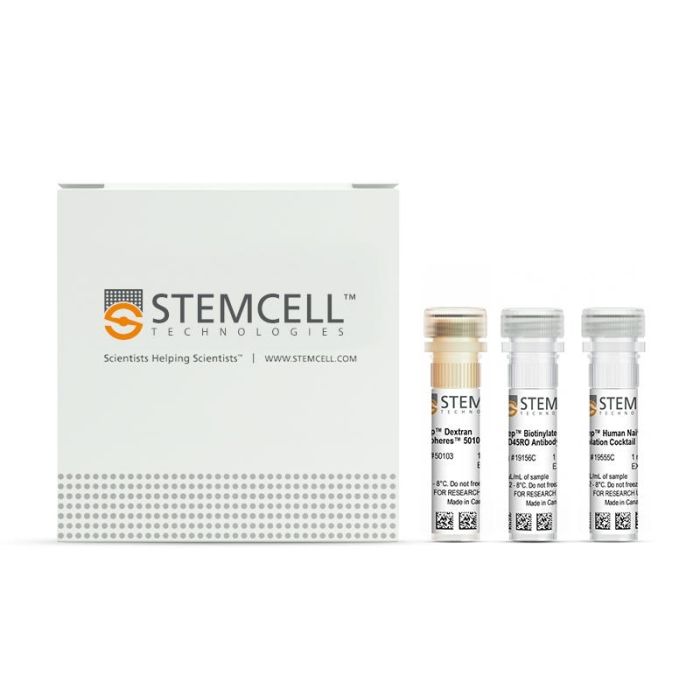
  • EasySep™ 人 Naïve CD4+ T细胞分选试剂盒(产品号 #19555)
    • EasySep™ 人Naïve CD4+ T细胞分选抗体混合物,1 mL
    • EasySep™ 生物素标记的抗CD45RO抗体,1 mL
    • EasySep™ Dextran RapidSpheres™磁珠,1 mL
  • RoboSep™人Naïve CD4+ T细胞分选试剂盒(产品号 #19555RF)
    • EasySep™人Naïve CD4+ T细胞分选抗体混合物,1 mL
    • EasySep™ 生物素标记的抗CD45RO抗体,1 mL
    • EasySep™ Dextran RapidSpheres™磁珠,1 mL
    • RoboSep™ 缓冲液(产品号 #20104)
    • RoboSep™ 过滤吸头(产品号 #20125)
专为您的实验方案打造的产品
要查看实验方案所需的所有配套产品,请参阅《实验方案与技术文档》

总览

使用EasySep™人Naïve CD4+ T细胞分选试剂盒,可轻松高效地通过免疫磁珠负选从新鲜或冻存的人外周血单个核细胞(PBMC)样本中分离高纯度的初始CD4+ T细胞。EasySep™结合了单克隆抗体的特异性和无柱磁性系统的简便性,迄今已广泛应用于发表的研究中超过20年。

在此EasySep™负选过程中,表达以下标记物的非目标细胞通过抗体复合物和磁珠标记被靶向去除:CD8、CD14、CD16、CD19、CD20、CD25、CD36、CD56、TCRγδ、GlyA、CD61、CD66b、CD123、HLA-DR及CD45RO。通过EasySep™磁极将被磁珠标记的细胞与未被标记的目的初始CD4+ T细胞分离,接着简单地将目的细胞倾倒或吸取至一个新的试管中即可。经磁珠分选获得的初始CD4+ T细胞可直接用于流式细胞术、细胞培养或DNA/RNA提取等下游实验。

如需更快速的细胞分选方案,我们推荐EasySep™人初始CD4+ T细胞分选试剂盒 II(产品号 #17555),仅需11分钟即可完成细胞分离。

了解更多关于免疫磁珠EasySep™技术的工作原理,或如何通过RoboSep™实现全自动化免疫磁珠细胞分选 。探索更多优化您实验流程的产品,包括培养基、添加剂、抗体等。


磁极兼容性
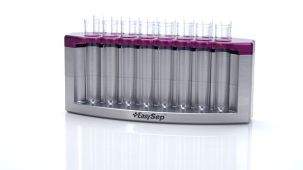
• EasySep™磁极(产品号 #18000)
• “The Big Easy” EasySep™磁极(产品号 #18001)
• Easy 50 EasySep™磁极(产品号 #18002)
• EasyEights™ EasySep™磁极(产品号 #18103)
• RoboSep™-S(产品号 #21000)
 
分类
细胞分选试剂盒
 
细胞类型
T 细胞,T 细胞,CD4+
 
种属

 
样本来源
PBMC
 
分选方法
负选
 
应用
细胞分选
 
品牌
EasySep,RoboSep
 
研究领域
免疫
 

实验数据

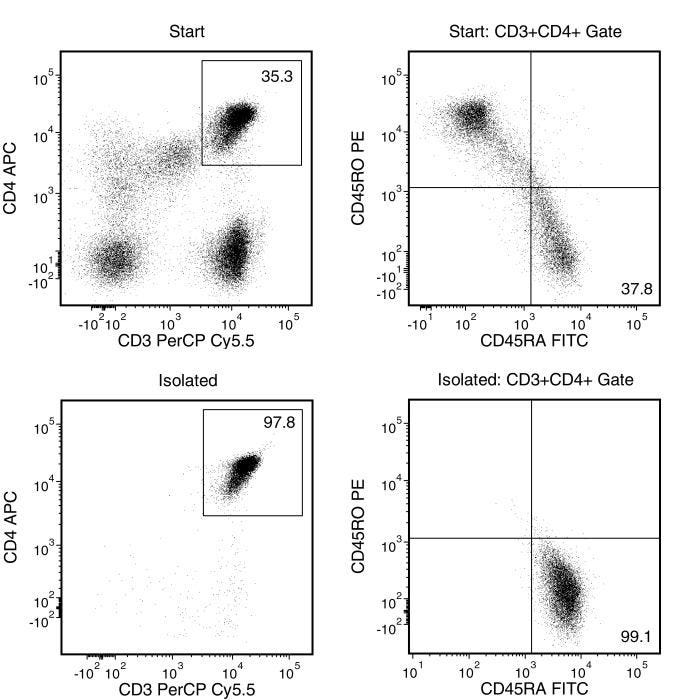
Typical EasySep™ Human Naïve CD4+ T Cell Isolation Profile

Figure 1. Typical EasySep™ Human Naïve CD4+ T Cell Isolation Profile

Starting with a single-cell suspension of PBMCs, the naïve CD4+ T cell (CD3+CD4+CD45RA+CD45RO-) content of the isolated fraction typically ranges from 91.3% - 96.9%. In the example above, the purities of the start and isolated fraction are 11.1% and 93.2%, respectively.

产品说明书及文档

请在《产品说明书》中查找相关支持信息和使用说明,或浏览下方更多实验方案。

Document Type
Product Name
Catalog #
Lot #
Language
Document Type
产品说明书
Catalog #
19555RF
Lot #
All
Language
中文
Document Type
产品说明书
Catalog #
19555
Lot #
All
Language
中文
Catalog #
19555RF
Lot #
All
Language
English
Catalog #
19555
Lot #
All
Language
English
Document Type
Safety Data Sheet 1
Catalog #
19555RF
Lot #
All
Language
English
Document Type
Safety Data Sheet 2
Catalog #
19555RF
Lot #
All
Language
English
Document Type
Safety Data Sheet 3
Catalog #
19555RF
Lot #
All
Language
English
Document Type
Safety Data Sheet 4
Catalog #
19555RF
Lot #
All
Language
English
Document Type
Safety Data Sheet 1
Catalog #
19555
Lot #
All
Language
English
Document Type
Safety Data Sheet 2
Catalog #
19555
Lot #
All
Language
English
Document Type
Safety Data Sheet 3
Catalog #
19555
Lot #
All
Language
English

应用领域

本产品专为以下研究领域设计,适用于工作流程中的高亮阶段。探索这些工作流程,了解更多我们为各研究领域提供的其他配套产品。

相关材料与文献

技术资料 (10)

常见问题 (11)

Can EasySep™ be used for either positive or negative selection?

Yes. The EasySep™ kits use either a negative selection approach by targeting and removing unwanted cells or a positive selection approach targeting desired cells. Depletion kits are also available for the removal of cells with a specific undesired marker (e.g. GlyA).

How does the separation work?

Magnetic particles are crosslinked to cells using Tetrameric Antibody Complexes (TAC). When placed in the EasySep™ Magnet, labeled cells migrate to the wall of the tube. The unlabeled cells are then poured off into a separate fraction.

Which columns do I use?

The EasySep™ procedure is column-free. That's right - no columns!

How can I analyze the purity of my enriched sample?

The Product Information Sheet provided with each EasySep™ kit contains detailed staining information.

Can EasySep™ separations be automated?

Yes. RoboSep™, the fully automated cell separator, automates all EasySep™ labeling and cell separation steps.

Can EasySep™ be used to isolate rare cells?

Yes. We recommend a cell concentration of 2x10⁸ cells/mL and a minimum working volume of 100 µL. Samples containing 2x10⁷ cells or fewer should be suspended in 100 µL of buffer.

Are the EasySep™ magnetic particles FACS-compatible?

Yes, the EasySep™ particles are flow cytometry-compatible, as they are very uniform in size and about 5000X smaller than other commercially available magnetic beads used with column-free systems.

Can the EasySep™ magnetic particles be removed after enrichment?

No, but due to the small size of these particles, they will not interfere with downstream applications.

Can I alter the separation time in the magnet?

Yes; however, this may impact the kit's performance. The provided EasySep™ protocols have already been optimized to balance purity, recovery and time spent on the isolation.

For positive selection, can I perform more than 3 separations to increase purity?

Yes, the purity of targeted cells will increase with additional rounds of separations; however, cell recovery will decrease.

How does the binding of the EasySep™ magnetic particle affect the cells? is the function of positively selected cells altered by the bound particles?

Hundreds of publications have used cells selected with EasySep™ positive selection kits for functional studies. Our in-house experiments also confirm that selected cells are not functionally altered by the EasySep™ magnetic particles.

If particle binding is a key concern, we offer two options for negative selection. The EasySep™ negative selection kits can isolate untouched cells with comparable purities, while RosetteSep™ can isolate untouched cells directly from whole blood without using particles or magnets.

文献 (12)

Staphylococcus aureus-derived factors induce IL-10, IFN-γ and IL-17A-expressing FOXP3(+)CD161(+) T-helper cells in a partly monocyte-dependent manner. Bjö et al. Scientific Reports 2016 FEB

Abstract

Staphylococcus aureus (S. aureus) is a human pathogen as well as a frequent colonizer of skin and mucosa. This bacterium potently activates conventional T-cells through superantigens and it is suggested to induce T-cell cytokine-production as well as to promote a regulatory phenotype in T-cells in order to avoid clearance. This study aimed to investigate how S. aureus impacts the production of regulatory and pro-inflammatory cytokines and the expression of CD161 and HELIOS by peripheral CD4(+)FOXP3(+) T-cells. Stimulation of PBMC with S. aureus 161:2-cell free supernatant (CFS) induced expression of IL-10,IFN-γ and IL-17A in FOXP3(+) cells. Further,CD161 and HELIOS separated the FOXP3(+) cells into four distinct populations regarding cytokine-expression. Monocyte-depletion decreased S. aureus 161:2-induced activation of FOXP3(+) cells while pre-stimulation of purified monocytes with S. aureus 161:2-CFS and subsequent co-culture with autologous monocyte-depleted PBMC was sufficient to mediate activation of FOXP3(+) cells. Together,these data show that S. aureus potently induces FOXP3(+) cells and promotes a diverse phenotype with expression of regulatory and pro-inflammatory cytokines connected to increased CD161-expression. This could indicate potent regulation or a contribution of FOXP3(+) cells to inflammation and repression of immune-suppression upon encounter with S. aureus.
Nef-Mediated CD3-TCR Downmodulation Dampens Acute Inflammation and Promotes SIV Immune Evasion. S. Joas et al. Cell reports 2020 feb

Abstract

The inability of Nef to downmodulate the CD3-T cell receptor (TCR) complex distinguishes HIV-1 from other primate lentiviruses and may contribute to its high virulence. However,the role of this Nef function in virus-mediated immune activation and pathogenicity remains speculative. Here,we selectively disrupted this Nef activity in SIVmac239 and analyzed the consequences for the virological,immunological,and clinical outcome of infection in rhesus macaques. The inability to downmodulate CD3-TCR does not impair viral replication during acute infection but is associated with increased immune activation and antiviral gene expression. Subsequent early reversion in three of six animals suggests strong selective pressure for this Nef function and is associated with high viral loads and progression to simian AIDS. In the absence of reversions,however,viral replication and the clinical course of infection are attenuated. Thus,Nef-mediated downmodulation of CD3 dampens the inflammatory response to simian immunodeficiency virus (SIV) infection and seems critical for efficient viral immune evasion.
The human liver microenvironment shapes the homing and function of CD4+ T-cell populations. B. G. Wiggins et al. Gut 2022 jul

Abstract

OBJECTIVE Tissue-resident memory T cells (TRM) are vital immune sentinels that provide protective immunity. While hepatic CD8+ TRM have been well described,little is known about the location,phenotype and function of CD4+ TRM. DESIGN We used multiparametric flow cytometry,histological assessment and novel human tissue coculture systems to interrogate the ex vivo phenotype,function and generation of the intrahepatic CD4+ T-cell compartment. We also used leukocytes isolated from human leukocyte antigen (HLA)-disparate liver allografts to assess long-term retention. RESULTS Hepatic CD4+ T cells were delineated into three distinct populations based on CD69 expression: CD69-,CD69INT and CD69HI. CD69HICD4+ cells were identified as tissue-resident CD4+ T cells on the basis of their exclusion from the circulation,phenotypical profile (CXCR6+CD49a+S1PR1-PD-1+) and long-term persistence within the pool of donor-derived leukcoocytes in HLA-disparate liver allografts. CD69HICD4+ T cells produced robust type 1 polyfunctional cytokine responses on stimulation. Conversely,CD69INTCD4+ T cells represented a more heterogenous population containing cells with a more activated phenotype,a distinct chemokine receptor profile (CX3CR1+CXCR3+CXCR1+) and a bias towards interleukin-4 production. While CD69INTCD4+ T cells could be found in the circulation and lymph nodes,these cells also formed part of the long-term resident pool,persisting in HLA-mismatched allografts. Notably,frequencies of CD69INTCD4+ T cells correlated with necroinflammatory scores in chronic hepatitis B infection. Finally,we demonstrated that interaction with hepatic epithelia was sufficient to generate CD69INTCD4+ T cells,while additional signals from the liver microenvironment were required to generate liver-resident CD69HICD4+ T cells. CONCLUSIONS High and intermediate CD69 expressions mark human hepatic CD4+ TRM and a novel functionally distinct recirculating population,respectively,both shaped by the liver microenvironment to achieve diverse immunosurveillance.

更多信息

更多信息
物种
Magnet Compatibility • EasySep™ Magnet (Catalog #18000) • “The Big Easy” EasySep™ Magnet (Catalog #18001) • Easy 50 EasySep™ Magnet (Catalog #18002) • EasyEights™ EasySep™ Magnet (Catalog #18103) • RoboSep™-S (Catalog #21000)
样本来源 PBMC
Selection Method Negative
标记抗体
质量保证:

产品仅供研究使用,不用于针对人或动物的诊断或治疗。 欲获悉更多关于STEMCELL的质控信息,请访问 STEMCELL.CN/COMPLIANCE.
Copyright © 2026 by STEMCELL Technologies. All rights reserved.

在线联系