若您需要咨询产品或有任何技术问题,请通过官方电话 400 885 9050 或邮箱 info.cn@stemcell.com 与我们联系。

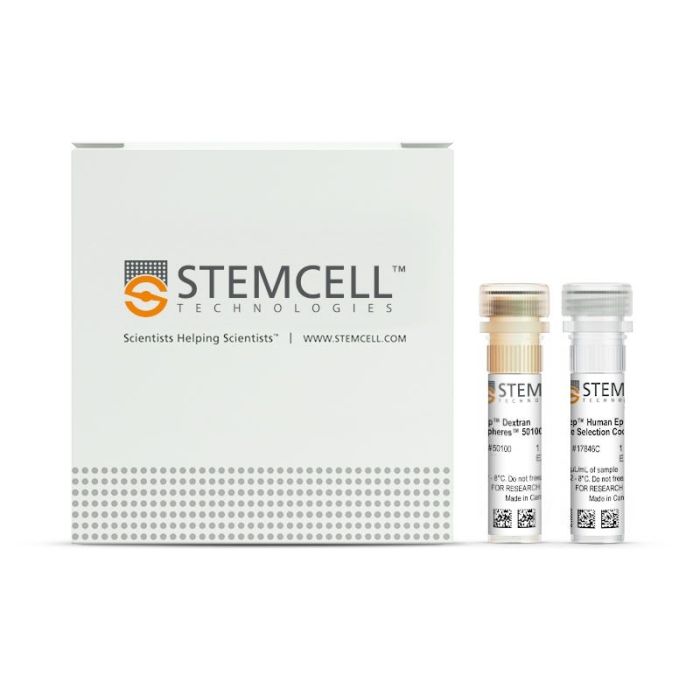
EasySep™人EpCAM正选试剂盒II

对来源于新鲜、冻存人乳腺上皮细胞培养物或其他组织消化样本中的 EpCAM⁺(如乳腺上皮细胞)进行免疫磁珠正选分离

只有 %1
¥9,322.00

产品号 #(选择产品)

产品号 #17846_C

免疫磁珠正选试剂盒

产品优势

  • 操作简单、快速
  • 纯度高达99%
  • 无需分离柱

产品组分包括

  • EasySep™人EpCAM 正选试剂盒II(产品号 #17846)
    • EasySep™人EpCAM 正选抗体混合物,1 mL
    • EasySep™ Dextran RapidSpheres™ 50100 磁珠,1 mL
  • RoboSep™ 人EpCAM 正选试剂盒II(含过滤吸头)(产品号#17846RF)
    • EasySep™人EpCAM 正选抗体混合物,1 mL
    • EasySep™ Dextran RapidSpheres™ 50100 磁珠,1 mL
    • RoboSep™ 缓冲液(产品号 #20104)
    • RoboSep™过滤吸头(产品号 #20125)
New look, same high quality and support! You may notice that your instrument or reagent packaging looks slightly different from images displayed on the website, or from previous orders. We are updating our look but rest assured, the products themselves and how you should use them have not changed. Learn more
专为您的实验方案打造的产品
要查看实验方案所需的所有配套产品,请参阅《实验方案与技术文档》

总览

使用EasySep™人EpCAM正选试剂盒II,通过免疫磁性正选法可从新鲜、冻存的人乳腺上皮细胞或其他解离的组织样品中分离出高纯度EpCAM阳性细胞。EpCAM(上皮细胞黏附分子)是上皮细胞表面标志物。

该步骤中,目标细胞通过识别EpCAM的抗体复合物和磁珠标记,经EasySep™磁体分离后,未标记细胞被去除,EpCAM+细胞保留在试管中,可直接用于流式细胞术、培养或核酸提取。EpCAM阳性细胞群包含腔面细胞、腔型限制性细胞及双能祖细胞。

了解更多EasySep™免疫磁性技术RoboSep™系统。


磁极兼容性
• EasySep™磁极(产品号 #18000)
• “The Big Easy” EasySep™磁极(产品号 #18001)
• RoboSep™-S(产品号 #21000)
 
分类
细胞分选试剂盒
 
细胞类型
乳腺细胞
 
种属

 
样本来源
其他物种,原代细胞
 
分选方法
正选
 
应用
细胞分选
 
品牌
EasySep,RoboSep
 
研究领域
癌症,上皮细胞研究
 

实验数据

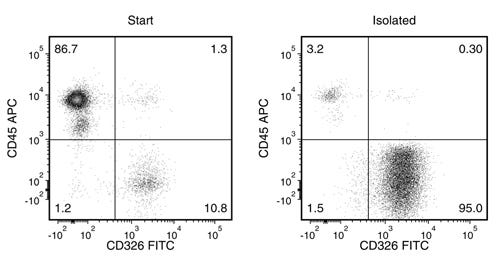
Starting with peripheral blood mononuclear cells (PBMCs) seeded with MCF-7 cells (breast cancer cell line) at a starting frequency of 10.8 - 50.0%, the EpCAM+ cell content (epithelial cell+CD45-)of the isolated fraction is typically 96.2 ± 3% (mean ± SD using the purple EasySep™ Magnet). In the above example, the purities of the start and final isolated fractions are 10.8% and 95.0%, respectively.

产品说明书及文档

请在《产品说明书》中查找相关支持信息和使用说明,或浏览下方更多实验方案。

Document Type
Product Name
Catalog #
Lot #
Language
Catalog #
17846
Lot #
All
Language
English
Catalog #
17846RF
Lot #
All
Language
English
Document Type
Safety Data Sheet 1
Catalog #
17846
Lot #
All
Language
English
Document Type
Safety Data Sheet 2
Catalog #
17846
Lot #
All
Language
English
Document Type
Safety Data Sheet 1
Catalog #
17846RF
Lot #
All
Language
English
Document Type
Safety Data Sheet 2
Catalog #
17846RF
Lot #
All
Language
English
Document Type
Safety Data Sheet 3
Catalog #
17846RF
Lot #
All
Language
English

应用领域

本产品专为以下研究领域设计,适用于工作流程中的高亮阶段。探索这些工作流程,了解更多我们为各研究领域提供的其他配套产品。

相关材料与文献

技术资料 (5)

文献 (2)

Blood and tissue HIV-1 reservoirs display plasticity and lack of compartmentalization in virally suppressed people M. Pardons et al. Nature Communications 2025 Mar

Abstract

Characterizing the HIV-1 reservoir in blood and tissues is crucial for the development of curative strategies. Using an HIV Tat mRNA-containing lipid nanoparticle (Tat-LNP) in combination with panobinostat, we show that p24+ cells from blood and lymph nodes exhibit distinct phenotypes. Blood p24+ cells are found in both central/transitional (TCM/TTM) and effector memory subsets, mostly lack CXCR5 expression and are enriched in GZMA+ cells. In contrast, most lymph node p24+ cells display a TCM/TTM phenotype, with approximately 50% expressing CXCR5 and nearly all lacking GZMA expression. Furthermore, germinal center T follicular helper cells do not appear to harbor the translation-competent reservoir in long-term suppressed individuals. Near full-length HIV-1 sequencing in longitudinal samples from matched blood, lymph nodes, and gut indicates that clones of infected cells, including those carrying an inducible provirus, persist and spread across various anatomical compartments. Finally, uniform genetic diversity across sites suggests the absence of ongoing replication in tissues under treatment. Here, Pardons and Lambrechts et al show that HIV-1 reservoirs in blood and lymph nodes differ phenotypically. Furthermore, germinal center T follicular helper cells do not harbor the inducible reservoir in long-term suppressed individuals. Infected clones can spread across tissues and persist without active replication.
R9AP is a common receptor for EBV infection in epithelial cells and B cells Y. Li et al. Nature 2025 Jun

Abstract

Epstein-Barr virus (EBV) persistently infects more than 90% of the human population, causing infectious mononucleosis, susceptibility to autoimmune diseases and multiple malignancies of epithelial or B cell-origin. EBV infects epithelial cells and B cells through interaction between viral glycoproteins and different host receptors, but it has remained unknown whether a common receptor mediates infection of its two major host cell targets. Here, we establish R9AP as a crucial EBV receptor for entry into epithelial and B cells. R9AP silencing or knockout, R9AP-derived peptide and R9AP monoclonal antibody each significantly inhibit, whereas R9AP overexpression promotes, EBV uptake into both cell types. R9AP binds directly to the EBV glycoprotein gH/gL complex to initiate gH/gL-gB-mediated membrane fusion. Notably, the interaction of R9AP with gH/gL is inhibited by the highly competitive gH/gL-neutralizing antibody AMMO1, which blocks EBV epithelial and B cell entry. Moreover, R9AP mediates viral and cellular membrane fusion in cooperation with EBV gp42-human leukocyte antigen class II or gH/gL-EPHA2 complexes in B cells or epithelial cells, respectively. We propose R9AP as the crucial common receptor of B cells and epithelial cells and a potential prophylactic and vaccine target for EBV.

更多信息

更多信息
物种 人类
Magnet Compatibility • EasySep™ Magnet (Catalog #18000) • “The Big Easy” EasySep™ Magnet (Catalog #18001) • RoboSep™-S (Catalog #21000)
样本来源 其它细胞系, 原代细胞
Selection Method Positive
质量保证:

产品仅供研究使用,不用于针对人或动物的诊断或治疗。 欲获悉更多关于STEMCELL的质控信息,请访问 STEMCELL.CN/COMPLIANCE.
Copyright © 2025 by STEMCELL Technologies. All rights reserved.

在线联系