若您需要咨询产品或有任何技术问题,请通过官方电话 400 885 9050 或邮箱 info.cn@stemcell.com 与我们联系。

EasySep™人CD8+ T细胞分选试剂盒

人CD8+ T细胞的免疫磁珠负选
只有 %1
¥11,818.00

产品号 #(选择产品)

产品号 #17953_C

人CD8+ T细胞的免疫磁珠负选

产品优势

  • 快捷、操作简单,且无需分离柱
  • 纯度高达91%,回收率高
  • 获得的活细胞无标记

产品组分包括

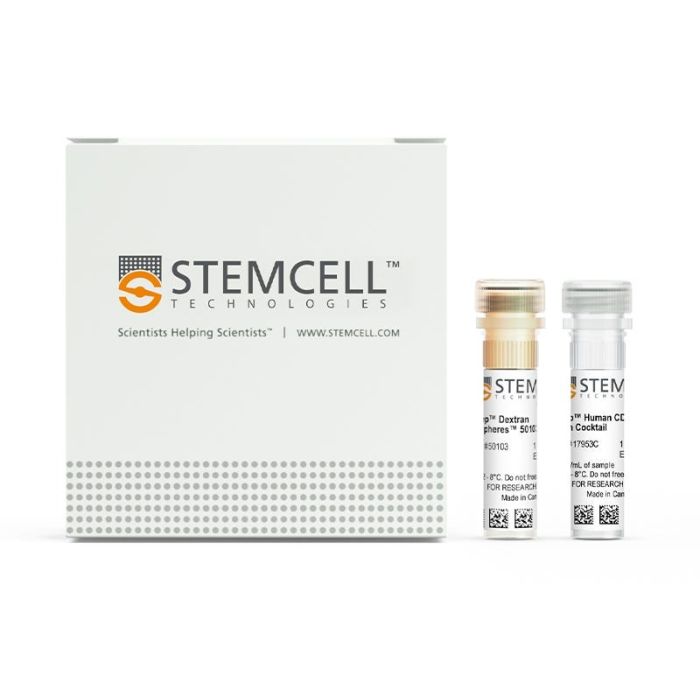
  • EasySep™人CD8+ T细胞分选试剂盒(产品号 #17953)
    • EasySep™人CD8+ T细胞分选抗体混合物,1 mL
    • EasySep™ Dextran RapidSpheres™磁珠,1 mL
  • EasySep™人CD8+ T细胞分选试剂盒(产品号 #100-0710)
    • EasySep™人CD8+ T细胞分选抗体混合物,1 x 10 mL
    • EasySep™ Dextran RapidSpheres™ 磁珠,1 x 10 mL
  • RoboSep™人CD8+ T细胞分选试剂盒(产品号 #17953RF)
    • EasySep™人CD8+ T细胞分选抗体混合物,1 mL
    • EasySep™ Dextran RapidSpheres™磁珠,1 mL
    • RoboSep™ 缓冲液(产品号 #20104)
    • RoboSep™过滤吸头(产品号 #20125)
New look, same high quality and support! You may notice that your instrument or reagent packaging looks slightly different from images displayed on the website, or from previous orders. We are updating our look but rest assured, the products themselves and how you should use them have not changed. Learn more
专为您的实验方案打造的产品
要查看实验方案所需的所有配套产品,请参阅《实验方案与技术文档》

总览

使用 EasySep™ 人 CD8⁺ T 细胞分选试剂盒,通过免疫磁性负选,可轻松高效地从新鲜或冻存的人外周血单个核细胞(PBMCs)或洗涤的白细胞单采样本中分离高纯度的人 CD8⁺ T 细胞。EasySep™ 技术结合单克隆抗体的特异性与无柱磁系统的简便性,已在发表的研究中广泛应用超过 20 年。   

在此 EasySep™ 负选步骤中,不需要的细胞通过抗体复合物和磁珠标记。表达以下标记的非目的细胞将被去除:CD4、CD14、CD16、CD19、CD20、CD36、CD56、CD66b、CD123、GlyA 和 TCRγδ。使用 EasySep™ 磁极进行无柱分选,磁珠标记的细胞被去除,只需将未标记的CD8⁺ T 细胞倒入或移取至新的管中即可。仅需 8 分钟即可完成磁珠分选过程,分离后的CD8⁺ T细胞可直接用于下游应用,例如流式细胞术、细胞培或DNA/RNA 提取。

本产品可替代 EasySep™ 人 CD8⁺ T 细胞富集试剂盒(产品号 #19053),实现更快速的细胞分选。

如需从白细胞单采术样本中进行大规模(1×10¹⁰ 个细胞)的人 CD8⁺ T 细胞分离,请参阅大规格试剂盒(产品号 #100-0710)。

了解更多关于 EasySep™ 免疫磁性技术的工作原理,或了解如何使用 RoboSep™ 实现全自动化的免疫磁珠细胞分选。您也可以选择使用 EasySep™ 人 CD8⁺ T 细胞分选试剂盒制备的即用型、符合伦理的冻存人外周血 CD8⁺ T 细胞。探索更多优化实验流程的产品,包括培养基、补充物、抗体等。


磁极兼容性
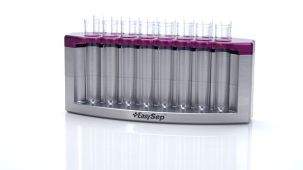
• EasySep™磁极(产品号 #18000)
• “The Big Easy” EasySep™磁极(产品号 #18001)
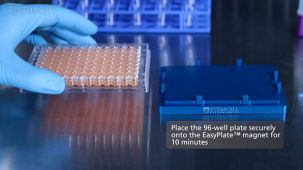
• EasyPlate™ EasySep™磁极(产品号 #18102)
• Easy 50 EasySep™磁极(产品号 #18002)
• EasyEights™ EasySep™磁极(产品号 #18103)
• RoboSep™-S(产品号 #21000)
• Easy 250 EasySep™磁极(产品号 #100-0821)
 
分类
细胞分选试剂盒
 
细胞类型
T 细胞,T 细胞,CD8+
 
种属

 
样本来源
白细胞单采术样本、PBMC
 
分选方法
负选
 
应用
细胞分选
 
品牌
EasySep,RoboSep
 
研究领域
免疫
 

实验数据

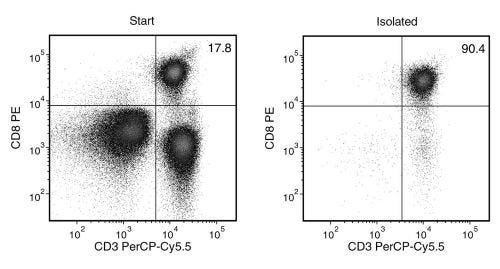
EasySep™ Human CD8+ T Cell Isolation Kit

Figure 1. EasySep™ Human CD8+ T Cell Isolation Kit

Starting with human peripheral blood mononuclear cells (PBMCs), the CD8+ T cell content (CD3+CD8+) of the isolated fraction is typically 85.6 ± 4.9% (mean ± SD for the purple EasySep™ Magnet).

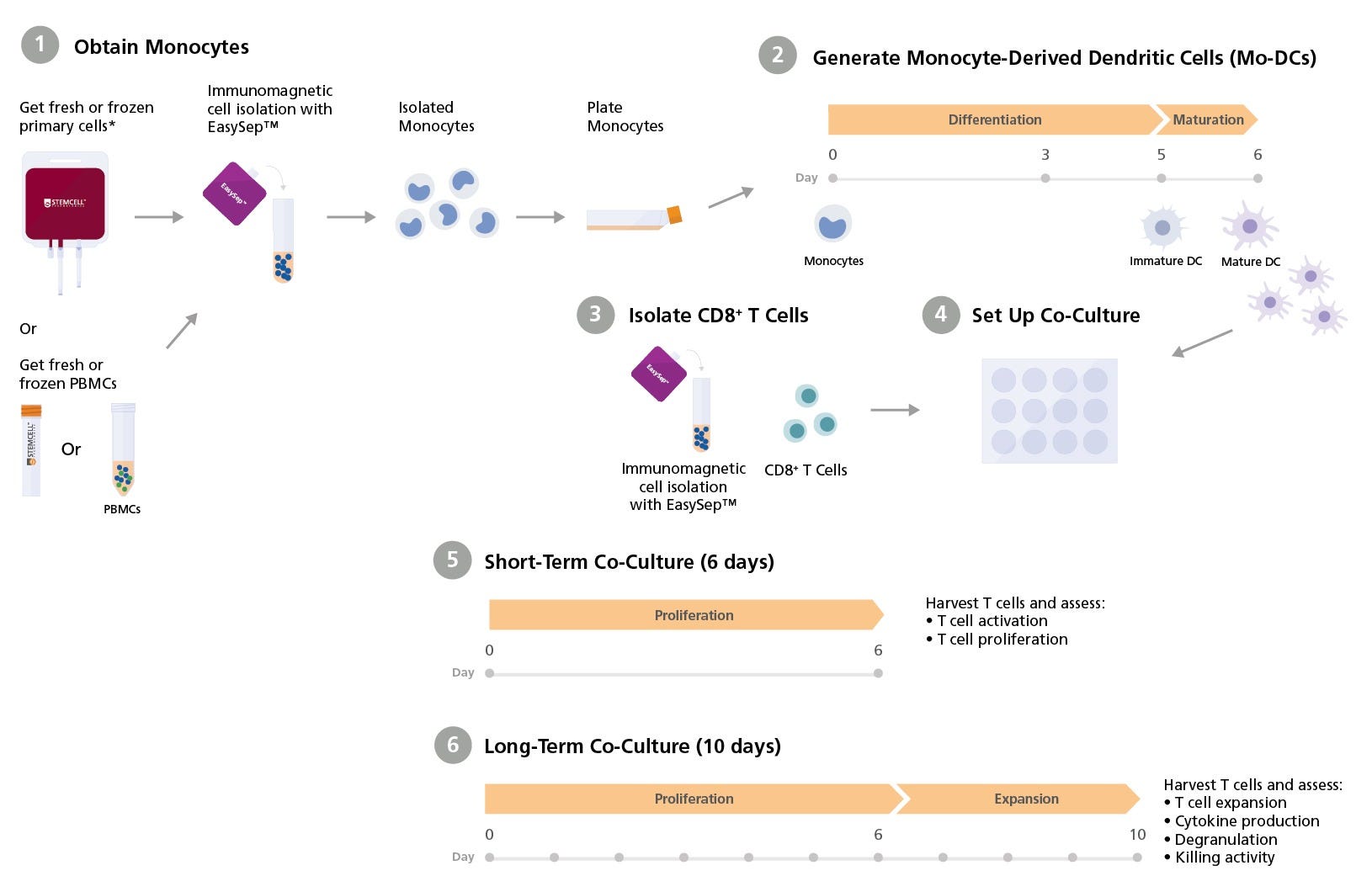
Experimental Workflow: DC/T Cell Co-Culture Protocol for the Activation and Expansion of Antigen-Induced CD8+ T Cells

Figure 2. Experimental Workflow: DC/T Cell Co-Culture Protocol for the Activation and Expansion of Antigen-Induced CD8+ T Cells

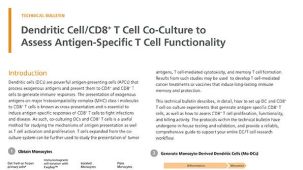
The EasySep™ Human CD8+ T Cell Isolation Kit (Catalog #17953) can be used as a part of a workflow to assess antigen-specific T cell functionality by co-culturing dendritic cells (DCs) and CD8+ T cells. (1) Isolate monocytes from Human Peripheral Blood Leukopak, Fresh (Catalog #70500) or from Human Peripheral Blood Mononuclear Cells (PBMCs), Fresh or Frozen (Catalog #70025), using EasySep™ Human Monocyte Isolation Kit (Catalog #19359). (2) Culture monocytes to generate monocyte-derived dendritic cells (Mo-DCs) using ImmunoCult™ Dendritic Cell Culture Kit (Catalog #10985) and the peptide(s) of interest. (3) Isolate CD8+ T cells from the same donor’s blood or PBMCs using EasySep™ Human CD8+ T Cell Isolation Kit. (4) Co-culture DCs and CD8+ T cells in ImmunoCult™-XF T Cell Expansion Medium (Catalog #10981). (5) For short-term co-culture, isolate CD8+ T cells using EasySep™ Human CD8+ Cell Isolation Kit and label the isolated CD8+ T cells with a cell proliferation tracking dye. Set up co-culture by seeding peptide-pulsed dendritic cell suspension with the CD8+ T cell suspension at a 1:4 ratio. Harvest the co-cultures and quantify the antigen-specific CD8+ T cells with tetramer staining after 6 days. (6) For long-term co-culture, expand antigen-specific CD8+ T cells with additional supplements. Analyze the phenotype and function of expanded CD8+ T cells by assessing surface markers or cytokine production. Alternatively, enrich antigen-specific CD8+ T cells with EasySep™, rest the cells for 2 days, and then assess killing activity.

产品说明书及文档

请在《产品说明书》中查找相关支持信息和使用说明,或浏览下方更多实验方案。

Document Type
Product Name
Catalog #
Lot #
Language
Catalog #
17953
Lot #
All
Language
English
Catalog #
100-0710
Lot #
All
Language
English
Catalog #
17953RF
Lot #
All
Language
English
Document Type
Safety Data Sheet 1
Catalog #
17953
Lot #
All
Language
English
Document Type
Safety Data Sheet 2
Catalog #
17953
Lot #
All
Language
English
Document Type
Safety Data Sheet
Catalog #
100-0710
Lot #
All
Language
English
Document Type
Safety Data Sheet 1
Catalog #
17953RF
Lot #
All
Language
English
Document Type
Safety Data Sheet 2
Catalog #
17953RF
Lot #
All
Language
English
Document Type
Safety Data Sheet 3
Catalog #
17953RF
Lot #
All
Language
English

应用领域

本产品专为以下研究领域设计,适用于工作流程中的高亮阶段。探索这些工作流程,了解更多我们为各研究领域提供的其他配套产品。

相关材料与文献

技术资料 (17)

常见问题 (11)

Can EasySep™ be used for either positive or negative selection?

Yes. The EasySep™ kits use either a negative selection approach by targeting and removing unwanted cells or a positive selection approach targeting desired cells. Depletion kits are also available for the removal of cells with a specific undesired marker (e.g. GlyA).

How does the separation work?

Magnetic particles are crosslinked to cells using Tetrameric Antibody Complexes (TAC). When placed in the EasySep™ Magnet, labeled cells migrate to the wall of the tube. The unlabeled cells are then poured off into a separate fraction.

Which columns do I use?

The EasySep™ procedure is column-free. That's right - no columns!

How can I analyze the purity of my enriched sample?

The Product Information Sheet provided with each EasySep™ kit contains detailed staining information.

Can EasySep™ separations be automated?

Yes. RoboSep™, the fully automated cell separator, automates all EasySep™ labeling and cell separation steps.

Can EasySep™ be used to isolate rare cells?

Yes. We recommend a cell concentration of 2x10⁸ cells/mL and a minimum working volume of 100 µL. Samples containing 2x10⁷ cells or fewer should be suspended in 100 µL of buffer.

Are the EasySep™ magnetic particles FACS-compatible?

Yes, the EasySep™ particles are flow cytometry-compatible, as they are very uniform in size and about 5000X smaller than other commercially available magnetic beads used with column-free systems.

Can the EasySep™ magnetic particles be removed after enrichment?

No, but due to the small size of these particles, they will not interfere with downstream applications.

Can I alter the separation time in the magnet?

Yes; however, this may impact the kit's performance. The provided EasySep™ protocols have already been optimized to balance purity, recovery and time spent on the isolation.

For positive selection, can I perform more than 3 separations to increase purity?

Yes, the purity of targeted cells will increase with additional rounds of separations; however, cell recovery will decrease.

How does the binding of the EasySep™ magnetic particle affect the cells? is the function of positively selected cells altered by the bound particles?

Hundreds of publications have used cells selected with EasySep™ positive selection kits for functional studies. Our in-house experiments also confirm that selected cells are not functionally altered by the EasySep™ magnetic particles.

If particle binding is a key concern, we offer two options for negative selection. The EasySep™ negative selection kits can isolate untouched cells with comparable purities, while RosetteSep™ can isolate untouched cells directly from whole blood without using particles or magnets.

文献 (23)

High-efficiency magnetophoretic labelling of adoptively-transferred T cells for longitudinal in vivo Magnetic Particle Imaging Theranostics 2024 Sep

Abstract

While adoptive cell therapies (ACT) have been successful as therapies for blood cancers, they have limited efficacy in treating solid tumours, where the tumour microenvironment excludes and suppresses adoptively transferred tumour-specific immune cells. A major obstacle to improving cell therapies for solid tumours is a lack of accessible and quantitative imaging modalities capable of tracking the migration and immune functional activity of ACT products for an extended duration in vivo.Methods: A high-efficiency magnetophoretic method was developed for facile magnetic labelling of hard-to-label immune cells, which were then injected into tumour-bearing mice and imaged over two weeks with a compact benchtop Magnetic Particle Imager (MPI) design.Results: Labelling efficiency was improved more than 10-fold over prior studies enabling longer-term tracking for at least two weeks in vivo of the labelled immune cells and their biodistribution relative to the tumour. The new imager showed 5-fold improved throughput enabling much larger density of data (up to 20 mice per experiment).Conclusions: Taken together, our innovations enable the convenient and practical use of MPI to visualise the localisation of ACT products in in vivo preclinical models for longitudinal, non-invasive functional evaluation of therapeutic efficacy.
Hypoimmunogenic human iPSCs expressing HLA-G, PD-L1, and PD-L2 evade innate and adaptive immunity Stem Cell Research & Therapy 2024 Jul

Abstract

BackgroundThe human induced pluripotent stem cells (hiPSCs) can generate all the cells composing the human body, theoretically. Therefore, hiPSCs are thought to be a candidate source of stem cells for regenerative medicine. The major challenge of allogeneic hiPSC-derived cell products is their immunogenicity. The hypoimmunogenic cell strategy is allogenic cell therapy without using immune suppressants. Advances in gene engineering technology now permit the generation of hypoimmunogenic cells to avoid allogeneic immune rejection. In this study, we generated a hypoimmunogenic hiPSC (HyPSC) clone that had diminished expression of human leukocyte antigen (HLA) class Ia and class II and expressed immune checkpoint molecules and a safety switch.MethodsFirst, we generated HLA class Ia and class II double knockout (HLA class Ia/II DKO) hiPSCs. Then, a HyPSC clone was generated by introducing exogenous β-2-microglobulin (B2M), HLA-G, PD-L1, and PD-L2 genes, and the Rapamycin-activated Caspase 9 (RapaCasp9)-based suicide gene as a safety switch into the HLA class Ia/II DKO hiPSCs. The characteristics and immunogenicity of the HyPSCs and their derivatives were analyzed.ResultsWe found that the expression of HLA-G on the cell surface can be enhanced by introducing the exogenous HLA-G gene along with B2M gene into HLA class Ia/II DKO hiPSCs. The HyPSCs retained a normal karyotype and had the characteristics of pluripotent stem cells. Moreover, the HyPSCs could differentiate into cells of all three germ layer lineages including CD45+ hematopoietic progenitor cells (HPCs), functional endothelial cells, and hepatocytes. The HyPSCs-derived HPCs exhibited the ability to evade innate and adaptive immunity. Further, we demonstrated that RapaCasp9 could be used as a safety switch in vitro and in vivo.ConclusionThe HLA class Ia/II DKO hiPSCs armed with HLA-G, PD-L1, PD-L2, and RapaCasp9 molecules are a potential source of stem cells for allogeneic transplantation.Supplementary InformationThe online version contains supplementary material available at 10.1186/s13287-024-03810-4.
Preclinical characterization and phase 1 results of ADG106 in patients with advanced solid tumors and non-Hodgkin’s lymphoma Cell Reports Medicine 2024 Feb

Abstract

SummaryADG106, a ligand-blocking agonistic antibody targeting CD137 (4-1BB), exhibits promising results in preclinical studies, demonstrating tumor suppression in various animal models and showing a balanced profile between safety and efficacy. This phase 1 study enrolls 62 patients with advanced malignancies, revealing favorable tolerability up to the 5.0 mg/kg dose level. Dose-limiting toxicity occurs in only one patient (6.3%) at 10.0 mg/kg, resulting in grade 4 neutropenia. The most frequent treatment-related adverse events include leukopenia (22.6%), neutropenia (22.6%), elevated alanine aminotransferase (22.6%), rash (21.0%), itching (17.7%), and elevated aspartate aminotransferase (17.7%). The overall disease control rates are 47.1% for advanced solid tumors and 54.5% for non-Hodgkin’s lymphoma. Circulating biomarkers suggest target engagement by ADG106 and immune modulation of circulating T, B, and natural killer cells and cytokines interferon γ and interleukin-6, which may affect the probability of clinical efficacy. ADG106 has a manageable safety profile and preliminary anti-tumor efficacy in patients with advanced cancers (this study was registered at ClinicalTrials.gov: NCT03802955). Graphical abstract Highlights•ADG106 is a ligand-blocking agonistic antibody targeting CD137•ADG106 enhances cytotoxic T cell activity within the tumor environment•ADG106 shows manageable safety and preliminary anti-tumor efficacy in this phase 1 study Ma et al. demonstrate the safety, efficacy, and survival benefits of ADG106, a fully human agonistic monoclonal IgG4 antibody targeting a unique and crossreactive epitope of CD137, in patients with advanced solid tumors and non-Hodgkin’s lymphoma. They show that ADG106 exhibits a favorable safety profile and encourages anti-tumor activity.

更多信息

更多信息
物种 人类
Magnet Compatibility • EasySep™ Magnet (Catalog #18000) • “The Big Easy” EasySep™ Magnet (Catalog #18001) • Easy 50 EasySep™ Magnet (Catalog #18002) • EasyPlate™ EasySep™ Magnet (Catalog 18102) • EasyEights™ EasySep™ Magnet (Catalog #18103) • RoboSep™-S (Catalog #21000) • Eas
样本来源 PBMC, 白细胞单采术样本
Selection Method Negative
标记抗体

质量保证:

本产品仅供科研使用,除非另有说明,不得用于人体或动物的诊断或治疗用途。如需了解 STEMCELL 的质量体系,请访问 WWW.STEMCELL.CN/COMPLIANCE

Copyright © 2025 by STEMCELL Technologies. All rights reserved.

在线联系