若您需要咨询产品或有任何技术问题,请通过官方电话 400 885 9050 或邮箱 info.cn@stemcell.com 与我们联系。

EasySep™人CD56正选试剂盒 II

人CD56+细胞的免疫磁珠正选
只有 %1
¥8,474.00

产品号 #(选择产品)

产品号 #17855_C

人CD56+细胞的免疫磁珠正选

产品优势

  • 快捷、操作简单    
  • 纯度高达98%
  • 无需分离柱     

产品组分包括

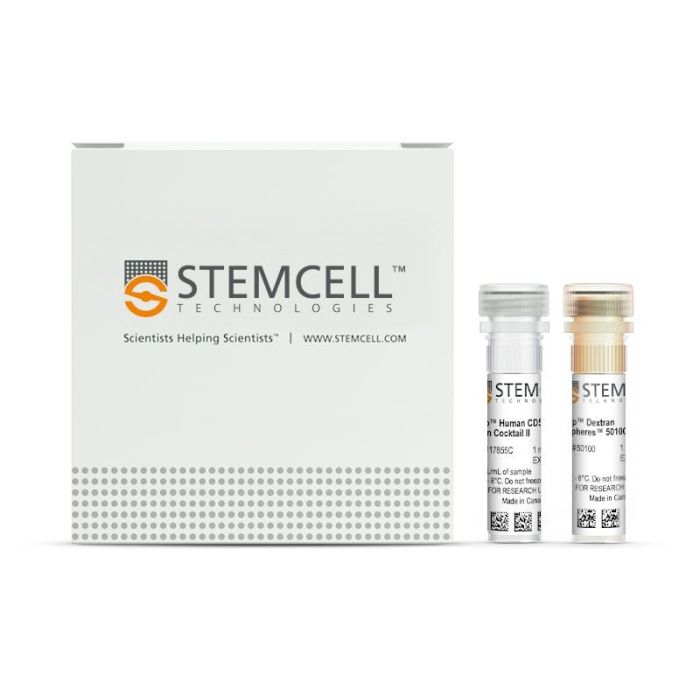
  • EasySep™人CD56正选试剂盒 II(产品号 #17855)
    • EasySep™人CD56正选抗体混合物 II,1 mL
    • EasySep™ Dextran RapidSpheres™ 50100 磁珠,1 mL
  • RoboSep™人CD56正选试剂盒 II(产品号 #17855RF)
    • EasySep™人CD56正选抗体混合物 II,1 mL
    • EasySep™ Dextran RapidSpheres™ 50100 磁珠,1 mL
    • RoboSep™ 缓冲液(产品号 #20104)
    • RoboSep™过滤吸头(产品号 #20125)
New look, same high quality and support! You may notice that your instrument or reagent packaging looks slightly different from images displayed on the website, or from previous orders. We are updating our look but rest assured, the products themselves and how you should use them have not changed. Learn more
专为您的实验方案打造的产品
要查看实验方案所需的所有配套产品,请参阅《实验方案与技术文档》

总览

使用EasySep™人CD56正选试剂盒 II,通过免疫磁珠正选 ,从新鲜或冻存的外周血单个核细胞或人骨骼肌(成肌细胞和成纤维细胞)培养样本中分离高纯度的人CD56+细胞。EasySep™结合了单克隆抗体的特异性和无柱磁性系统的简便性,迄今已广泛应用于发表的研究中超过20年。    

在此EasySep™正选过程中,目的细胞被识别CD56的抗体复合物及磁珠结合标记。该试剂盒中还含有人Fc受体阻断剂 ,可最大程度减少非特异性结合。使用EasySep™磁极分离标记的目的细胞,只需倾倒或吸弃非目的细胞,目标细胞则保留在管中。经磁珠分选后的目的CD56+细胞可直接用于下游应用,如流式细胞术、细胞培养或DNA/RNA提取。CD56抗原表达于NK细胞、NKT细胞和人成肌细胞表面 。

该产品可替代EasySep™人CD56细胞正选试剂盒 (产品号 #18055 ) 以进行更快的细胞分选。

了解更多关于免疫磁珠EasySep™技术的工作原理,或如何通过RoboSep™实现全自动化免疫磁珠细胞分选。或选择即用型、符合伦理规范的冻存人外周血CD56+原代细胞,该细胞通过EasySep™人CD56正选试剂盒 II分离获得。探索更多优化您实验流程的产品     ,包括培养基、添加剂、抗体等。

磁极兼容性
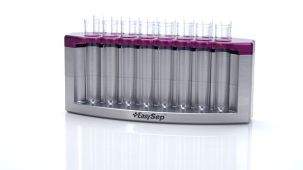
• EasySep™磁极(产品号 #18000)
• “The Big Easy” EasySep™磁极(产品号 #18001)
• EasyPlate™ EasySep™磁极(产品号 #18102)
• EasyEights™ EasySep™磁极(产品号 #18103)
• RoboSep™-S(产品号 #21000)
 
分类
细胞分选试剂盒
 
细胞类型
NK 细胞
 
种属

 
样本来源
其他物种,PBMC
 
分选方法
正选
 
应用
细胞分选
 
品牌
EasySep,RoboSep
 
研究领域
嵌合体,免疫
 

实验数据

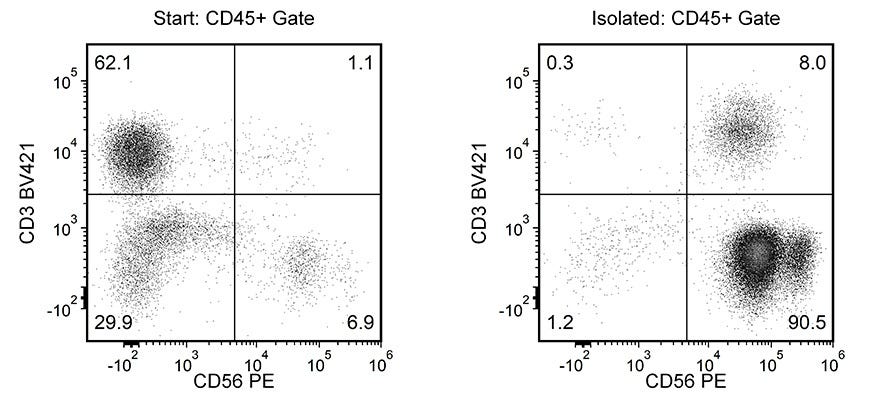
Typical EasySep™ Human CD56 Positive Selection Profile

Figure 1. Typical EasySep™ Human CD56 Positive Selection Kit II (Catalog #17855)

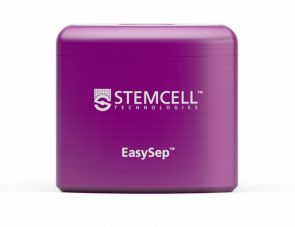
Starting with human PBMCs, the CD56+ cell content of the isolated fraction is typically 96.3 ± 2.4% (mean ± SD), using the purple EasySep™ Magnet. In the above example, the purities of the start and final isolated fractions are 8.0% and 98.5%, respectively.

FACS Data for Anti-Human CD56 Antibody, Clone HCD56, Alexa Fluor® 488-Conjugated

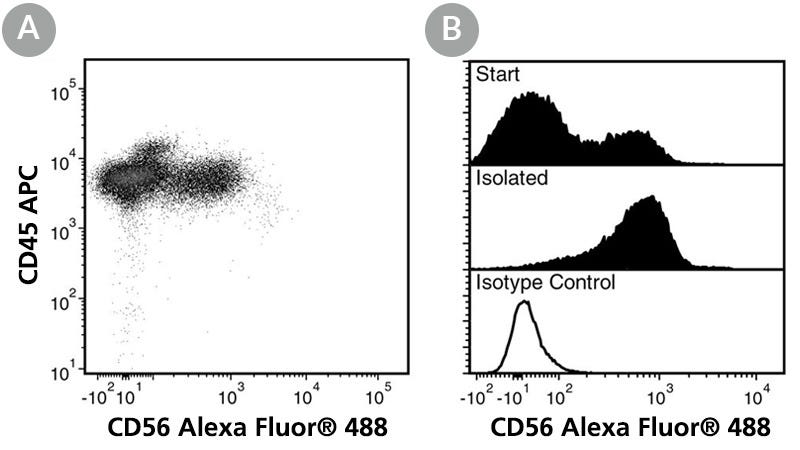
Figure 2. FACS Data for Anti-Human CD56 Antibody, Clone HCD56, Alexa Fluor® 488-Conjugated

(A) Flow cytometry analysis of human peripheral blood mononuclear cells (PBMCs) labeled with Anti-Human CD56 Antibody, Clone HCD56, Alexa Fluor® (Catalog #60021AD) and Anti-Human CD45 Antibody, Clone HI30, APC (Catalog #60018AZ).

(B) Flow cytometry analysis of human PBMCs processed with the EasySep™ Human CD56 Positive Selection Kit (Catalog #17885) and labeled with Anti-Human CD56 Clone HCD56, Alexa Fluor® 488. Histograms show labeling of PBMCs (Start) and isolated cells (Isolated). Labeling of start cells with a mouse IgG1, kappa Alexa Fluor® 488 isotype control antibody is shown (solid line histogram).

产品说明书及文档

请在《产品说明书》中查找相关支持信息和使用说明,或浏览下方更多实验方案。

Document Type
Product Name
Catalog #
Lot #
Language
Catalog #
17855
Lot #
1000087747 or higher
Language
English
Catalog #
17855
Lot #
All
Language
English
Catalog #
17855RF
Lot #
All
Language
English
Catalog #
17855RF
Lot #
1000087747 or higher
Language
English
Document Type
Safety Data Sheet 1
Catalog #
17855
Lot #
All
Language
English
Document Type
Safety Data Sheet 2
Catalog #
17855
Lot #
All
Language
English
Document Type
Safety Data Sheet 1
Catalog #
17855RF
Lot #
All
Language
English
Document Type
Safety Data Sheet 2
Catalog #
17855RF
Lot #
All
Language
English
Document Type
Safety Data Sheet 3
Catalog #
17855RF
Lot #
All
Language
English

应用领域

本产品专为以下研究领域设计,适用于工作流程中的高亮阶段。探索这些工作流程,了解更多我们为各研究领域提供的其他配套产品。

相关材料与文献

技术资料 (11)

常见问题 (11)

Can EasySep™ be used for either positive or negative selection?

Yes. The EasySep™ kits use either a negative selection approach by targeting and removing unwanted cells or a positive selection approach targeting desired cells. Depletion kits are also available for the removal of cells with a specific undesired marker (e.g. GlyA).

How does the separation work?

Magnetic particles are crosslinked to cells using Tetrameric Antibody Complexes (TAC). When placed in the EasySep™ Magnet, labeled cells migrate to the wall of the tube. The unlabeled cells are then poured off into a separate fraction.

Which columns do I use?

The EasySep™ procedure is column-free. That's right - no columns!

How can I analyze the purity of my enriched sample?

The Product Information Sheet provided with each EasySep™ kit contains detailed staining information.

Can EasySep™ separations be automated?

Yes. RoboSep™, the fully automated cell separator, automates all EasySep™ labeling and cell separation steps.

Can EasySep™ be used to isolate rare cells?

Yes. We recommend a cell concentration of 2x10⁸ cells/mL and a minimum working volume of 100 µL. Samples containing 2x10⁷ cells or fewer should be suspended in 100 µL of buffer.

Are the EasySep™ magnetic particles FACS-compatible?

Yes, the EasySep™ particles are flow cytometry-compatible, as they are very uniform in size and about 5000X smaller than other commercially available magnetic beads used with column-free systems.

Can the EasySep™ magnetic particles be removed after enrichment?

No, but due to the small size of these particles, they will not interfere with downstream applications.

Can I alter the separation time in the magnet?

Yes; however, this may impact the kit's performance. The provided EasySep™ protocols have already been optimized to balance purity, recovery and time spent on the isolation.

For positive selection, can I perform more than 3 separations to increase purity?

Yes, the purity of targeted cells will increase with additional rounds of separations; however, cell recovery will decrease.

How does the binding of the EasySep™ magnetic particle affect the cells? is the function of positively selected cells altered by the bound particles?

Hundreds of publications have used cells selected with EasySep™ positive selection kits for functional studies. Our in-house experiments also confirm that selected cells are not functionally altered by the EasySep™ magnetic particles.

If particle binding is a key concern, we offer two options for negative selection. The EasySep™ negative selection kits can isolate untouched cells with comparable purities, while RosetteSep™ can isolate untouched cells directly from whole blood without using particles or magnets.

文献 (4)

Targeting ERRs to counteract age-related muscle atrophy associated with physical inactivity: a pilot study Frontiers in Physiology 2025 Jul

Abstract

IntroductionEstrogen-related receptors has been suggested as a potential therapeutic target to counteract muscle decline associated with aging or inactivity, being known to regulate mitochondrial function and cellular respiration by up-regulating key factors in muscle responses to exercise. This study aimed to evaluate the targeting of ERRs in myoblasts isolated from the skeletal muscle of inactive women by assessing the metabolic and expression changes associated with its activation.MethodsTwenty women undergoing hip arthroplasty for coxarthrosis were enrolled and divided into an active group (n = 10) and an inactive group (n = 10) based on self-reported physical activity. During surgery, muscle biopsies were taken for histological and western blotting analysis, measuring the expression levels of NADPH oxidase 4 (NOX4), sirtuin 1 (SIRT1), peroxisome proliferator-activated receptor gamma coactivator 1-alpha (PGC-1α), estrogen related receptor alpha (ERRα), and fibronectin type III domain-containing protein 5 (FNDC5). Primary cultures of myoblasts were set up from the muscle tissue of inactive women and treated with the ERRs agonist, SLU-PP-332, for subsequent qualitative and quantitative investigations. In addition, myoblasts were differentiated into myotubes for 15 days, and the success of differentiation was evaluated by immunofluorescence analysis.ResultsClinical and instrumental evaluation showed less functional limitation, higher handgrip strength values, and significantly reduced visual analogue scale scores in active subjects, in association with a significant increase in muscle fiber diameter. In addition, significantly higher expression of NOX4, concomitant with reduced levels of SIRT1, PGC-1α, ERRα, and FNDC5, was detected in the muscle tissue of inactive women. Interestingly, SLU-PP-332 treatment promoted down-regulation of NOX4 and upregulation of SIRT1, PGC-1α, ERRα, FNDC5, Akt, and B-cell lymphoma 2 (Bcl-2) in myoblasts, reducing cytotoxicity, oxidative stress, and senescence, as well as increasing levels of reduced glutathione. Furthermore, SLU-PP-332 treatment promoted abundant myotube formation, positively influencing cell differentiation.DiscussionTargeting ERRs could represent a promising therapeutic strategy to counteract muscle atrophy in elderly and sedentary subjects. However, further studies are needed to clarify the molecular mechanisms involved and explore the impact of ERRs activation on muscle metabolism.
Modulation of Carnitine Palmitoyl Transferase 1b Expression and Activity in Muscle Pathophysiology in Osteoarthritis and Osteoporosis Biomolecules 2024 Oct

Abstract

In the pathophysiology of osteoarthritis and osteoporosis, articular cartilage and bone represent the target tissues, respectively, but muscle is also involved. Since many changes in energy metabolism occur in muscle with aging, the aim of the present work was to investigate the involvement of carnitine palmitoyl transferase 1b (Cpt1b) in the muscle pathophysiology of the two diseases. Healthy subjects (CTR, n = 5), osteoarthritic (OA, n = 10), and osteoporotic (OP, n = 10) patients were enrolled. Gene expression analysis conducted on muscle and myoblasts showed up-regulation of CPT1B in OA patients; this result was confirmed by immunohistochemical and immunofluorescence analyses and enzyme activity assay, which showed increased Cpt1b activity in OA muscle. In addition, CPT1B expression resulted down-regulated in cultured OP myoblasts. Given the potential involvement of Cpt1b in the modulation of oxidative stress, we investigated ROS levels, which were found to be lower in OA myoblasts, and gene expression of nicotinamide adenine dinucleotide phosphate hydrogen oxidase 4 (Nox4), which resulted up-regulated in OA cells. Finally, the immunofluorescence of BCL2/adenovirus E1B 19 kDa protein-interacting protein 3 (Bnip3) showed a decreased expression in OP myoblasts, with respect to CTR and OA. Contextually, through an ultrastructural analysis conducted by Transmission Electron Microscopy (TEM), the presence of aberrant mitochondria was observed in OP muscle. This study highlights the potential role of Cpt1b in the regulation of muscle homeostasis in both osteoarthritis and osteoporosis, allowing for the expansion of the current knowledge of what are the molecular biological pathways involved in the regulation of muscle physiology in both diseases.
PD-1 blockade potentiates HIV latency reversal ex vivo in CD4+ T cells from ART-suppressed individuals. R. Fromentin et al. Nature communications 2019 feb

Abstract

HIV persists in latently infected CD4+ T cells during antiretroviral therapy (ART). Immune checkpoint molecules, including PD-1, are preferentially expressed at the surface of persistently infected cells. However, whether PD-1 plays a functional role in HIV latency and reservoir persistence remains unknown. Using CD4+ T cells from HIV-infected individuals, we show that the engagement of PD-1 inhibits viral production at the transcriptional level and abrogates T-cell receptor (TCR)-induced HIV reactivation in latently infected cells. Conversely, PD-1 blockade with the monoclonal antibody pembrolizumab enhances HIV production in combination with the latency reversing agent bryostatin without increasing T cell activation. Our results suggest that the administration of immune checkpoint blockers to HIV-infected individuals on ART may facilitate latency disruption.

更多信息

更多信息
物种 人类
Magnet Compatibility • EasySep™ Magnet (Catalog #18000) • “The Big Easy” EasySep™ Magnet (Catalog #18001) • EasyPlate™ EasySep™ Magnet (Catalog #18102) • EasyEights™ EasySep™ Magnet (Catalog #18103) • RoboSep™-S (Catalog #21000)
样本来源 PBMC, 其它细胞系
Selection Method Positive
标记抗体
质量保证:

产品仅供研究使用,不用于针对人或动物的诊断或治疗。 欲获悉更多关于STEMCELL的质控信息,请访问 STEMCELL.CN/COMPLIANCE.
Copyright © 2025 by STEMCELL Technologies. All rights reserved.

在线联系