若您需要咨询产品或有任何技术问题,请通过官方电话 400 885 9050 或邮箱 info.cn@stemcell.com 与我们联系。

EasySep™人CD4+ T细胞富集试剂盒

人CD4+ T细胞的免疫磁珠负选
只有 %1
¥11,738.00

产品号 #(选择产品)

产品号 #19052_C

人CD4+ T细胞的免疫磁珠负选

产品优势

  • 操作简单、快捷,且无需分离柱
  • 纯度高达97%
  • 获得无磁珠标记的活性细胞

产品组分包括

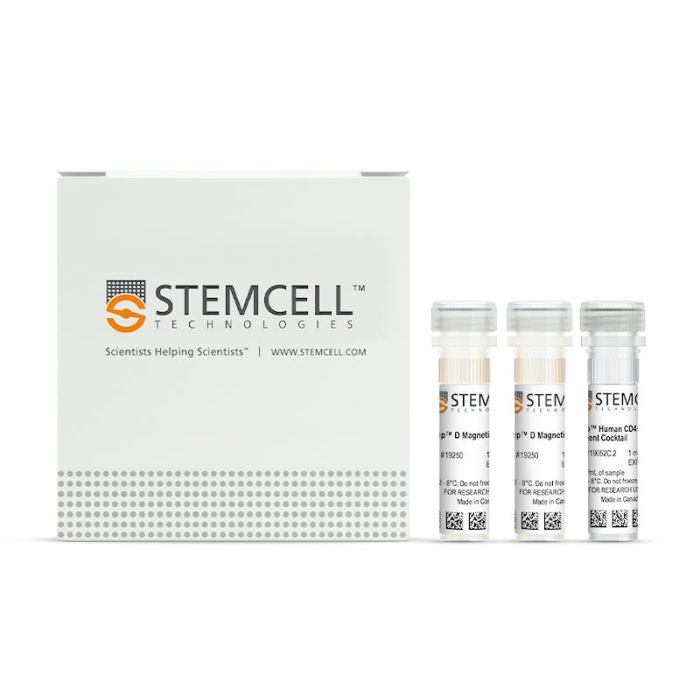
  • EasySep™人CD4+ T细胞富集试剂盒(产品号 #19052)
    • EasySep™人CD4+ T细胞富集抗体混合物,1 mL
    • EasySep™ D Magnetic Particles磁珠,2 x 1 mL
  • RoboSep™ 人CD4+ T细胞富集试剂盒(含滤芯吸头,产品号 #19052RF)
    • EasySep™人CD4+ T细胞富集抗体混合物,1 mL
    • EasySep™ D Magnetic Particles磁珠,2 x 1 mL
    • RoboSep™ 缓冲液(产品号 #20104)
    • RoboSep™过滤吸头(产品号 #20125)
New look, same high quality and support! You may notice that your instrument or reagent packaging looks slightly different from images displayed on the website, or from previous orders. We are updating our look but rest assured, the products themselves and how you should use them have not changed. Learn more
专为您的实验方案打造的产品
要查看实验方案所需的所有配套产品,请参阅《实验方案与技术文档》

总览

使用EasySep™ 人CD4+ T细胞富集试剂盒,通过免疫磁珠负选,可轻松高效地从新鲜或冻存的人外周血单个核细胞(PBMCs)或裂解的白细胞单采术样本中分离高纯度的人CD4+ T细胞。EasySep™结合了单克隆抗体的特异性和无柱磁珠系统的简便性,迄今已广泛应用于发表的研究中超过20年。    

在此 EasySep™负选过程中,表达以下标记的非目的 细胞通过抗体复合物和磁珠标记被靶向去除:CD8、CD14、CD16、CD19、CD20、CD36、CD56、CD66b、CD123、GlyA及TCRγδ 。通过EasySep™磁极将被磁珠标记的细胞与未被标记的目的细胞分离,接着简单地将目的细胞倾倒或吸取至一个新的试管中即可。经磁珠分选后获得的 CD4+ T细胞即可用于流式细胞术、细胞培养或DNA/RNA提取等下游应用。

如需更快速的细胞分选,我们推荐EasySep™ 人CD4+ T细胞分选试剂盒(产品号 #17952),仅需8分钟即可完成分选。

了解更多关于EasySep™免疫磁珠细胞分选技术的工作原理,或如何通过RoboSep™实现全自动化免疫磁珠细胞分选。或选择即用型、符合伦理规范的冻存原代人外周血CD4+ T细胞,该细胞通过  EasySep™ 人CD4+ T细胞富集试剂盒分离所得。探索更多优化您实验流程的产品 ,包括培养基、添加物、抗体等。


磁极兼容性
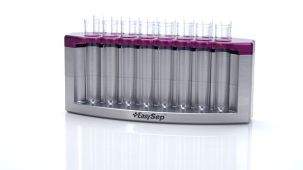
• EasySep™磁极(产品号 #18000)
• “The Big Easy” EasySep™磁极(产品号 #18001)
• Easy 50 EasySep™磁极(产品号 #18002)
• EasyPlate™ EasySep™磁极(产品号 #18102)
• EasyEights™ EasySep™磁极(产品号 #18103)
• RoboSep™-S(产品号 #21000)
 
分类
细胞分选试剂盒
 
细胞类型
T 细胞,T 细胞,CD4+
 
种属

 
样本来源
白细胞单采术样本、PBMC
 
分选方法
负选
 
应用
细胞分选
 
品牌
EasySep,RoboSep
 
研究领域
免疫
 

实验数据

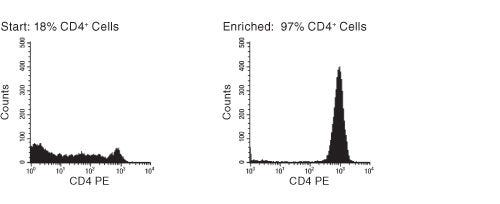
FACS Histogram Results Using EasySep™ Human CD4+ T Cell Enrichment Kit

Figure 1. FACS Histogram Results Using EasySep™ Human CD4+ T Cell Enrichment Kit

Starting with frozen mononuclear cells, the CD4+ T cell content of the enriched fraction typically ranges from 92% - 97%.

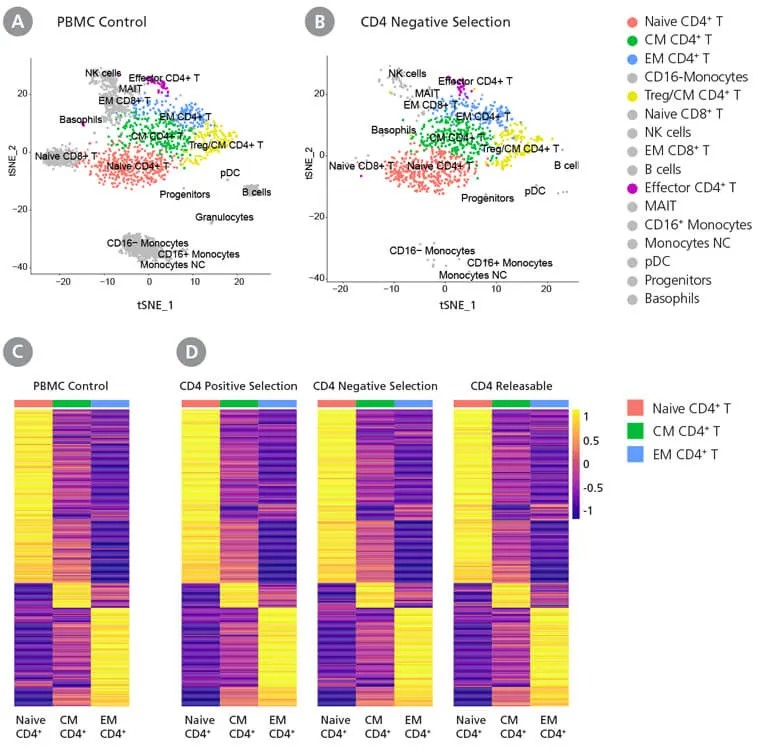
Gene Expression Profiles of EasySep™-Isolated CD4+ T Cells Are Similar to PBMC Control

Figure 2. Gene Expression Profiles of EasySep™-Isolated CD4+ T Cells Are Similar to PBMC Control

(A,B) tSNE plots were generated using data from (A) PBMC control or (B) cells isolated using the EasySep™ Human CD4+ T Cell Enrichment Kit (Catalog #19052). CD4+ T cell clusters are colored as indicated in the legend. (C,D) 500 genes were selected from a previously published list of CD4+ T cell signature markers (Zhang et al., 2018). Expression heatmaps were generated for CD4+ cells from (C) PBMC control and (D) cells isolated using the EasySep™ Human CD4 Positive Selection Kit II (Catalog #17852), EasySep™ Human CD4+ T Cell Enrichment Kit (Catalog #19052), or the EasySep™ Release Human CD4 Positive Selection Kit (Catalog #17752). The average expression was calculated within each sample for three CD4+ T cell clusters identified by Seurat (naïve, central memory, and effector memory CD4+ T cells).

产品说明书及文档

请在《产品说明书》中查找相关支持信息和使用说明,或浏览下方更多实验方案。

Document Type
Product Name
Catalog #
Lot #
Language
Catalog #
19052RF
Lot #
All
Language
English
Catalog #
19052
Lot #
All
Language
English
Document Type
Safety Data Sheet 1
Catalog #
19052RF
Lot #
All
Language
English
Document Type
Safety Data Sheet 2
Catalog #
19052RF
Lot #
All
Language
English
Document Type
Safety Data Sheet 3
Catalog #
19052RF
Lot #
All
Language
English
Document Type
Safety Data Sheet 1
Catalog #
19052
Lot #
All
Language
English
Document Type
Safety Data Sheet 2
Catalog #
19052
Lot #
All
Language
English

应用领域

本产品专为以下研究领域设计,可应用于工作流程中的关键步骤(图中高亮)。探索这些工作流程,了解更多我们为各研究领域提供的其他配套产品。

相关材料与文献

技术资料 (10)

常见问题 (11)

Can EasySep™ be used for either positive or negative selection?

Yes. The EasySep™ kits use either a negative selection approach by targeting and removing unwanted cells or a positive selection approach targeting desired cells. Depletion kits are also available for the removal of cells with a specific undesired marker (e.g. GlyA).

How does the separation work?

Magnetic particles are crosslinked to cells using Tetrameric Antibody Complexes (TAC). When placed in the EasySep™ Magnet, labeled cells migrate to the wall of the tube. The unlabeled cells are then poured off into a separate fraction.

Which columns do I use?

The EasySep™ procedure is column-free. That's right - no columns!

How can I analyze the purity of my enriched sample?

The Product Information Sheet provided with each EasySep™ kit contains detailed staining information.

Can EasySep™ separations be automated?

Yes. RoboSep™, the fully automated cell separator, automates all EasySep™ labeling and cell separation steps.

Can EasySep™ be used to isolate rare cells?

Yes. We recommend a cell concentration of 2x10⁸ cells/mL and a minimum working volume of 100 µL. Samples containing 2x10⁷ cells or fewer should be suspended in 100 µL of buffer.

Are the EasySep™ magnetic particles FACS-compatible?

Yes, the EasySep™ particles are flow cytometry-compatible, as they are very uniform in size and about 5000X smaller than other commercially available magnetic beads used with column-free systems.

Can the EasySep™ magnetic particles be removed after enrichment?

No, but due to the small size of these particles, they will not interfere with downstream applications.

Can I alter the separation time in the magnet?

Yes; however, this may impact the kit's performance. The provided EasySep™ protocols have already been optimized to balance purity, recovery and time spent on the isolation.

For positive selection, can I perform more than 3 separations to increase purity?

Yes, the purity of targeted cells will increase with additional rounds of separations; however, cell recovery will decrease.

How does the binding of the EasySep™ magnetic particle affect the cells? is the function of positively selected cells altered by the bound particles?

Hundreds of publications have used cells selected with EasySep™ positive selection kits for functional studies. Our in-house experiments also confirm that selected cells are not functionally altered by the EasySep™ magnetic particles.

If particle binding is a key concern, we offer two options for negative selection. The EasySep™ negative selection kits can isolate untouched cells with comparable purities, while RosetteSep™ can isolate untouched cells directly from whole blood without using particles or magnets.

文献 (56)

Retinol Binding Protein 4 reactivates latent HIV-1 by triggering canonical NF-κB, JAK/STAT5 and JNK signalling C. Pastorio et al. Signal Transduction and Targeted Therapy 2025 Oct

Abstract

Reactivation of the latent viral reservoirs is crucial for a cure of HIV/AIDS. However, current latency reversing agents are inefficient, and the endogenous factors that have the potential to reactivate HIV in vivo remain poorly understood. To identify natural activators of latent HIV-1, we screened a comprehensive peptide/protein library derived from human hemofiltrate, representing the entire blood peptidome, using J-Lat cell lines harboring transcriptionally silent HIV-1 GFP reporter viruses. Fractions potently reactivating HIV-1 from latency contained human Retinol Binding Protein 4 (RBP4), the carrier of retinol (Vitamin A). We found that retinol-bound holo-RBP4 but not retinol-free apo-RBP4 strongly reactivates HIV-1 in a variety of latently infected T cell lines. Functional analyses indicate that this reactivation involves activation of the canonical NF-κB pathway and is strengthened by JAK/STAT5 and JNK signalling but does not require retinoic acid production. High levels of RBP4 were detected in plasma from both healthy individuals and people living with HIV-1. Physiological concentrations of RBP4 induced significant viral reactivation in latently infected cells from individuals on long-term antiretroviral therapy with undetectable viral loads. As a potent natural HIV-1 latency-reversing agent, RBP4 offers a novel approach to activating the latent reservoirs and bringing us closer to a cure. Subject terms: Preclinical research, Infectious diseases
HIV-Tat upregulates the expression of senescence biomarkers in CD4+ T-cells Frontiers in Immunology 2025 Apr

Abstract

IntroductionCurrent antiretroviral therapy (ART) for HIV infection reduces plasma viral loads to undetectable levels and has increased the life expectancy of people with HIV (PWH). However, this increased lifespan is accompanied by signs of accelerated aging and a higher prevalence of age-related comorbidities. Tat (Trans-Activator of Transcription) is a key protein for viral replication and pathogenesis. Tat is encoded by 2 exons, with the full-length Tat ranging from 86 to 101 aa (Tat101). Introducing a stop codon in position 73 generates a 1 exon, synthetic 72aa Tat (Tat72). Intracellular, full-length Tat activates the NF-κB pro-inflammatory pathway and increases antiapoptotic signals and ROS generation. These effects may initiate a cellular senescence program, characterized by cell cycle arrest, altered cell metabolism, and increased senescence-associated secretory phenotype (SASP) mediator release However, the precise role of HIV-Tat in inducing a cellular senescence program in CD4+ T-cells is currently unknown.MethodsJurkat Tetoff cell lines stably transfected with Tat72, Tat101, or an empty vector were used. Flow cytometry and RT-qPCR were used to address senescence biomarkers, and 105 mediators were assessed in cell supernatants with an antibody-based membrane array. Key results obtained in Jurkat-Tat cells were addressed in primary, resting CD4+ T-cells by transient electroporation of HIV-Tat-FLAG plasmid DNA.ResultsIn the Jurkat cell model, expression of Tat101 increased the levels of the senescence biomarkers BCL-2, CD87, and p21, and increased the release of sCD30, PDGF-AA, and sCD31, among other factors. Tat101 upregulated CD30 and CD31 co-expression in the Jurkat cell surface, distinguishing these cells from Tat72 and Tetoff Jurkats. The percentage of p21+, p16+, and γ-H2AX+ cells were higher in Tat-expressing CD4+ T-cells, detected as a FLAG+ population compared to their FLAG- (Tat negative) counterparts. Increased levels of sCD31 and sCD26 were also detected in electroporated CD4+ T-cell supernatants.DiscussionIntracellular, full-length HIV-Tat expression increases several senescence biomarkers in Jurkat and CD4+ T-cells, and SASP/Aging mediators in cell supernatants. Intracellular HIV-Tat may initiate a cellular senescence program, contributing to the premature aging phenotype observed in PWH. Graphical Abstract
People Living With HIV Have More Intact HIV DNA in Circulating CD4+ T Cells if They Have History of Pulmonary Tuberculosis Pathogens and Immunity 2024 Sep

Abstract

Background:A primary barrier to curing HIV is the HIV reservoir. The leading infectious cause of death worldwide for people living with HIV is tuberculosis (TB), but we do not know how TB impacts the HIV reservoir.Methods:Participants in identification and validation cohorts were selected from previously enrolled studies at Groupe Haïtien d'Étude du Sarcome de Kaposi et des Infections Opportunistes (GHESKIO) in Port au Prince, Haiti. Intact and non-intact proviral DNA were quantified using droplet digital PCR of peripheral blood mononuclear cell (PBMC)-derived CD4+ T cells. Kruskal-Wallis tests were used to compare medians with tobit regression for censoring.Results:In the identification cohort, we found that people living with HIV with a history of active pulmonary TB (n=19) had higher levels of intact provirus than people living with HIV without a history of active TB (n=47) (median 762; IQR, 183-1173 vs 117; IQR, 24-279 intact provirus per million CD4, respectively; P=0.0001). This difference also was seen in the validation cohort (n=31), (median 102; IQR, 0-737 vs 0; IQR, 0-24.5 intact provirus per million CD4, P=0.03) for TB vs no-TB history groups, respectively. The frequencies of CD4+ T cells with any detectable proviral fragment was directly proportional to the levels of interleukin-1 beta (r=0.524, P= 0.0025) and interleukin-2 (r=0.622, P=0.0002).Conclusions:People living with HIV with a history of active pulmonary TB have more HIV pro-virus in their circulating CD4+ T cells, even years after TB cure. We need to characterize which CD4+ T cells are harboring intact provirus to consider the impact of T cell-targeting HIV cure interventions for people living in TB-endemic areas.

更多信息

更多信息
物种 人类
Magnet Compatibility • EasySep™ Magnet (Catalog #18000) • “The Big Easy” EasySep™ Magnet (Catalog #18001) • Easy 50 EasySep™ Magnet (Catalog #18002) • EasyPlate™ EasySep™ Magnet (Catalog 18102) • EasyEights™ EasySep™ Magnet (Catalog #18103) • RoboSep™-S (Catalog #21000)
样本来源 PBMC, 白细胞单采术样本
Selection Method Negative
质量保证:

产品仅供研究使用,不用于针对人或动物的诊断或治疗。 欲获悉更多关于STEMCELL的质控信息,请访问 STEMCELL.CN/COMPLIANCE.
Copyright © 2025 by STEMCELL Technologies. All rights reserved.

在线联系