若您需要咨询产品或有任何技术问题,请通过官方电话 400 885 9050 或邮箱 info.cn@stemcell.com 与我们联系。

EasySep™人B细胞富集试剂盒II(不去除CD43)

对来源于 B 细胞白血病、淋巴瘤或其他表达 CD43 的疾病患者外周血单个核细胞中的B 细胞进行免疫磁珠负选分离

产品号 #(选择产品)

产品号 #17963_C

免疫磁珠负选试剂盒

产品优势

  • 操作简单、快捷
  • 纯度高达99%
  • 分选得到的细胞不带标记

产品组分包括

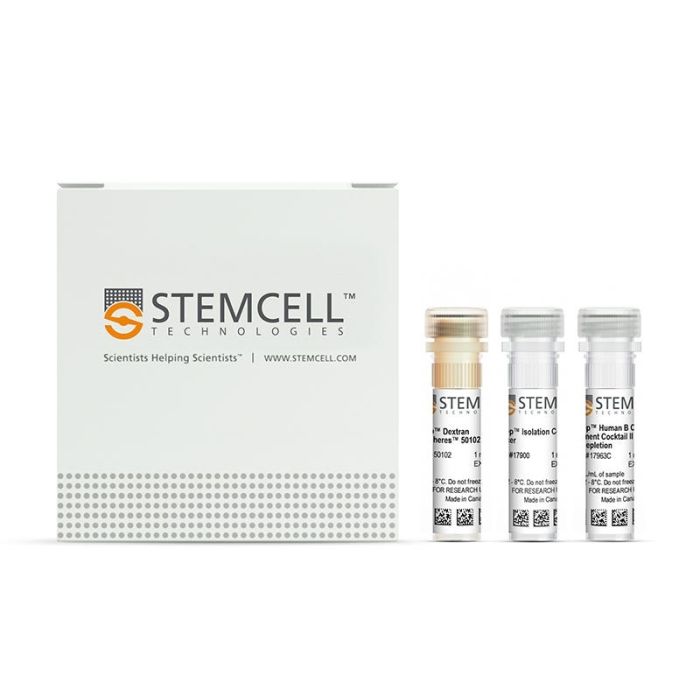
  • EasySep™人B细胞富集试剂盒II(不去除CD43) (产品号 #17963)    
    • EasySep™人B细胞富集抗体混合物(不去除CD43), 1 mL
    • EasySep™人分选抗体混合物增强剂, 1 mL    
    • EasySep™ Dextran RapidSpheres™ 50102磁珠, 1 mL
  • RoboSep™人B细胞富集试剂盒II(不去除CD43) (产品号 #17963RF)    
    • EasySep™人B细胞富集抗体混合物(不去除CD43), 1 mL
    • EasySep™人分选抗体混合物增强剂, 1 mL    
    • EasySep™ Dextran RapidSpheres™ 50102磁珠, 1 mL
    • RoboSep™ 缓冲液(产品号 #20104)
    • RoboSep™过滤吸头(产品号 #20125)
专为您的实验方案打造的产品
要查看实验方案所需的所有配套产品,请参阅《实验方案与技术文档》

总览

使用 EasySep™ 人 B 细胞富集试剂盒 II(不去除 CD43),通过免疫磁珠负选,可轻松高效地从新鲜或冻存的人外周血单个核细胞(PBMCs)中分离高纯度的人 B 细胞。该产品适用于 B 细胞白血病、淋巴瘤或其他可能表达 CD43 的疾病样本。EasySep™ 技术结合单克隆抗体的特异性与无柱磁系统的简便性,已在发表的研究中广泛应用超过 20 年。

在此 EasySep™ 负选过程中,不需要的细胞通过抗体复合物和磁珠标记。表达以下标记的细胞将被去除:CD2、CD3、CD14、CD16、CD56 和 GlyA。使用 EasySep™ 磁极进行无柱分选,磁珠标记的细胞被去除,只需将未标记的 B 细胞倒入或移取至新的管中即可。完成磁珠分选后,目的 B 细胞可直接用于下游应用,如流式细胞术、培养或 DNA/RNA 提取。

本试剂盒可替代 EasySep™ 人 B 细胞富集试剂盒(不含 CD43)(产品号 #19154),实现更快速的细胞分离。

了解更多关于EasySep™ 免疫磁性技术的工作原理,或了解如何使用 RoboSep™ 实现全自动化的免疫磁性细胞分离。探索更多优化实验流程的产品,包括培养基、补充物、抗体等。


磁极兼容性
• EasySep™磁极(产品号 #18000)
• “The Big Easy” EasySep™磁极(产品号 #18001)
• EasyEights™ EasySep™磁极(产品号 #18103)
• RoboSep™-S(产品号 #21000)
 
分类
细胞分选试剂盒
 
细胞类型
B 细胞
 
种属

 
样本来源
PBMC
 
分选方法
负选
 
应用
细胞分选
 
品牌
EasySep,RoboSep
 
研究领域
免疫
 

实验数据

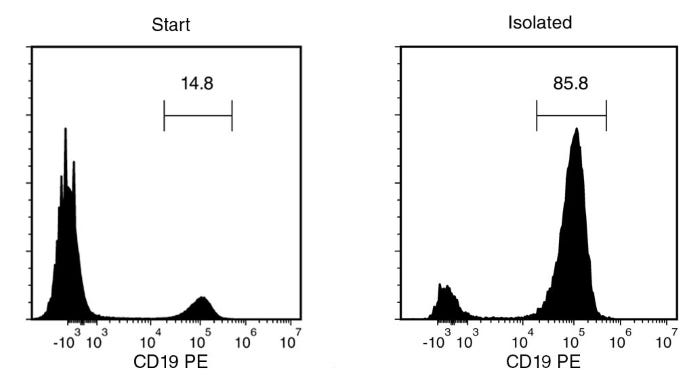
Starting with fresh PBMCs, the B cell content (CD19+) of the enriched fraction is typically 84.9 ± 13.9% (mean ± SD using the purple EasySep™ Magnet). In the above example, the purities of the start and final enriched fractions are 14.8% and 85.8%, respectively.

产品说明书及文档

请在《产品说明书》中查找相关支持信息和使用说明,或浏览下方更多实验方案。

Document Type
Product Name
Catalog #
Lot #
Language
Catalog #
17963
Lot #
All
Language
English
Catalog #
17963RF
Lot #
All
Language
English
Document Type
Safety Data Sheet 1
Catalog #
17963
Lot #
All
Language
English
Document Type
Safety Data Sheet 2
Catalog #
17963
Lot #
All
Language
English
Document Type
Safety Data Sheet 3
Catalog #
17963
Lot #
All
Language
English
Document Type
Safety Data Sheet 1
Catalog #
17963RF
Lot #
All
Language
English
Document Type
Safety Data Sheet 2
Catalog #
17963RF
Lot #
All
Language
English
Document Type
Safety Data Sheet 3
Catalog #
17963RF
Lot #
All
Language
English
Document Type
Safety Data Sheet 4
Catalog #
17963RF
Lot #
All
Language
English

应用领域

本产品专为以下研究领域设计,适用于工作流程中的高亮阶段。探索这些工作流程,了解更多我们为各研究领域提供的其他配套产品。

相关材料与文献

技术资料 (8)

文献 (5)

Cytotoxic B Cells in Relapsing-Remitting Multiple Sclerosis Patients. V. O. Boldrini et al. Frontiers in immunology 2022

Abstract

BACKGROUND Emerging evidence of antibody-independent functions, as well as the clinical efficacy of anti-CD20 depleting therapies, helped to reassess the contribution of B cells during multiple sclerosis (MS) pathogenesis. OBJECTIVE To investigate whether CD19+ B cells may share expression of the serine-protease granzyme-B (GzmB), resembling classical cytotoxic CD8+ T lymphocytes, in the peripheral blood from relapsing-remitting MS (RRMS) patients. METHODS In this study, 104 RRMS patients during different treatments and 58 healthy donors were included. CD8, CD19, Runx3, and GzmB expression was assessed by flow cytometry analyses. RESULTS RRMS patients during fingolimod (FTY) and natalizumab (NTZ) treatment showed increased percentage of circulating CD8+GzmB+ T lymphocytes when compared to healthy volunteers. An increase in circulating CD19+GzmB+ B cells was observed in RRMS patients during FTY and NTZ therapies when compared to glatiramer (GA), untreated RRMS patients, and healthy donors but not when compared to interferon-$\beta$ (IFN). Moreover, regarding Runx3, the transcriptional factor classically associated with cytotoxicity in CD8+ T lymphocytes, the expression of GzmB was significantly higher in CD19+Runx3+-expressing B cells when compared to CD19+Runx3- counterparts in RRMS patients. CONCLUSIONS CD19+ B cells may exhibit cytotoxic behavior resembling CD8+ T lymphocytes in MS patients during different treatments. In the future, monitoring cytotoxic" subsets might become an accessible marker for investigating MS pathophysiology and even for the development of new therapeutic interventions."
Autologous tumor cell vaccine induces antitumor T cell immune responses in patients with mantle cell lymphoma: A phase I/II trial. M. J. Frank et al. The Journal of experimental medicine 2020 sep

Abstract

Here, we report on the results of a phase I/II trial (NCT00490529) for patients with mantle cell lymphoma who, having achieved remission after immunochemotherapy, were vaccinated with irradiated, CpG-activated tumor cells. Subsequently, vaccine-primed lymphocytes were collected and reinfused after a standard autologous stem cell transplantation (ASCT). The primary endpoint was detection of minimal residual disease (MRD) within 1 yr after ASCT at the previously validated threshold of ≥1 malignant cell per 10,000 leukocyte equivalents. Of 45 evaluable patients, 40 (89{\%}) were found to be MRD negative, and the MRD-positive patients experienced early subsequent relapse. The vaccination induced antitumor CD8 T cell immune responses in 40{\%} of patients, and these were associated with favorable clinical outcomes. Patients with high tumor PD-L1 expression after in vitro exposure to CpG had inferior outcomes. Vaccination with CpG-stimulated autologous tumor cells followed by the adoptive transfer of vaccine-primed lymphocytes after ASCT is feasible and safe.
Time to first treatment and P53 dysfunction in chronic lymphocytic leukaemia: results of the O-CLL1 study in early stage patients. P. Monti et al. Scientific reports 2020

Abstract

Chronic lymphocytic leukaemia (CLL) is characterised by a heterogeneous clinical course. Such heterogeneity is associated with a number of markers, including TP53 gene inactivation. While TP53 gene alterations determine resistance to chemotherapy, it is not clear whether they can influence early disease progression. To clarify this issue, TP53 mutations and deletions of the corresponding locus [del(17p)] were evaluated in 469 cases from the O-CLL1 observational study that recruited a cohort of clinically and molecularly characterised Binet stage A patients. Twenty-four cases harboured somatic TP53 mutations [accompanied by del(17p) in 9 cases], 2 patients had del(17p) only, and 5 patients had TP53 germ-line variants. While del(17p) with or without TP53 mutations was capable of significantly predicting the time to first treatment, a reliable measure of disease progression, TP53 mutations were not. This was true for cases with high or low variant allele frequency. The lack of predictive ability was independent of the functional features of the mutant P53 protein in terms of transactivation and dominant negative potential. TP53 mutations alone were more frequent in patients with mutated IGHV genes, whereas del(17p) was associated with the presence of adverse prognostic factors, including CD38 positivity, unmutated-IGHV gene status, and NOTCH1 mutations.

更多信息

更多信息
物种 人类
Magnet Compatibility • EasySep™ Magnet (Catalog #18000) • “The Big Easy” EasySep™ Magnet (Catalog #18001) • EasyEights™ EasySep™ Magnet (Catalog #18103) • RoboSep™-S (Catalog #21000)
样本来源 PBMC
Selection Method Negative
标记抗体
质量保证:

产品仅供研究使用,不用于针对人或动物的诊断或治疗。 欲获悉更多关于STEMCELL的质控信息,请访问 STEMCELL.CN/COMPLIANCE.
Copyright © 2025 by STEMCELL Technologies. All rights reserved.

在线联系