Ibarra I et al. (DEC 2007)
Genes & development 21 24 3238--43
A role for microRNAs in maintenance of mouse mammary epithelial progenitor cells.
microRNA (miRNA) expression profiles are often characteristic of specific cell types. The mouse mammary epithelial cell line,Comma-Dbeta,contains a population of self-renewing progenitor cells that can reconstitute the mammary gland. We purified this population and determined its miRNA signature. Several microRNAs,including miR-205 and miR-22,are highly expressed in mammary progenitor cells,while others,including let-7 and miR-93,are depleted. Let-7 sensors can be used to prospectively enrich self-renewing populations,and enforced let-7 expression induces loss of self-renewing cells from mixed cultures.
View Publication
产品类型:
产品号#:
01700
01705
01701
01702
产品名:
ALDEFLUOR™ 试剂盒
ALDEFLUOR™ DEAB试剂, 1.5 mM, 1 mL
ALDEFLUOR™检测缓冲液
Bruserud &O et al. (MAY 2003)
Leukemia research 27 5 455--64
In vitro culture of human acute lymphoblastic leukemia (ALL) cells in serum-free media; a comparison of native ALL blasts, ALL cell lines and virus-transformed B cell lines.
The aim of this study was to standardize in vitro culture conditions for human acute lymphoblastic leukemia (ALL) cells. The cells were cultured in medium containing 10% fetal calf serum (FCS) and in the four serum-free media X-vivo 10,X-vivo 15,X-vivo 20 and Stem Span. Native ALL blasts could proliferate in all four serum-free media,but the strongest responses were usually observed with Stem Span. Native leukemia blasts were also cultured in the presence of various single cytokines or cytokine combinations. The highest proliferation was usually observed in the presence of Flt3-Ligand (Flt3-L) when single cytokines were examined,and these responses could be further increased especially by combining Flt3-L with interleukin 3 (IL3),IL7 or stem cell factor (SCF). Proliferation could also be increased when ALL blasts were cultured in the presence of two commercially available fibroblast cell lines (Hs27 and HFL1). Based on these results we suggest that in vitro culture conditions for native human ALL blasts can be standardized by using serum-free culture media supplemented with exogenous Flt3-L+IL3+SCF,and the use of accessory cells can also be standardized by using well-characterized fibroblast cell lines. Detectable ALL blast proliferation can then be observed for most patients. Our experimental model can thereby be used for in vitro evaluation of possible antileukemic treatment strategies,and it will then allow comparison of experimental results between different studies.
View Publication
产品类型:
产品号#:
产品名:
Finstad SL et al. (JUL 2007)
Journal of virology 81 13 7274--9
Diminished potential for B-lymphoid differentiation after murine leukemia virus infection in vivo and in EML hematopoietic progenitor cells.
Infection with a recombinant murine-feline gammaretrovirus,MoFe2,or with the parent virus,Moloney murine leukemia virus,caused significant reduction in B-lymphoid differentiation of bone marrow at 2 to 8 weeks postinfection. The suppression was selective,in that myeloid potential was significantly increased by infection. Analysis of cell surface markers and immunoglobulin H gene rearrangements in an in vitro model demonstrated normal B-lymphoid differentiation after infection but significantly reduced viability of differentiating cells. This reduction in viability may confer a selective advantage on undifferentiated lymphoid progenitors in the bone marrow of gammaretrovirus-infected animals and thereby contribute to the establishment of a premalignant state.
View Publication
Akatsuka A et al. (SEP 2010)
International immunology 22 9 783--90
Tumor cells of non-hematopoietic and hematopoietic origins express activation-induced C-type lectin, the ligand for killer cell lectin-like receptor F1.
Killer cell lectin-like receptor F1 (KLRF1) is an activating C-type lectin-like receptor expressed on human NK cells and subsets of T cells. In this study,we show that activation-induced C-type lectin (AICL) is a unique KLRF1 ligand expressed on tumor cell lines of hematopoietic and non-hematopoietic origins. We screened a panel of human tumor cell lines using the KLRF1 reporter cells and found that several tumor lines expressed KLRF1 ligands. We characterized a putative KLRF1 ligand expressed on the U937 cell line. The molecular mass for the deglycosylated ligand was 28 kDa under non-reducing condition and 17 kDa under reducing condition,suggesting that the KLRF1 ligand is a homodimer. By expression cloning from a U937 cDNA library,we identified AICL as a KLRF1 ligand. We generated mAbs against AICL to identify the KLRF1 ligands on non-hematopoietic tumor lines. The anti-AICL mAbs stained the tumor lines that express the KLRF1 ligands and importantly the interaction of KLRF1 with the KLRF1 ligand on non-hematopoietic tumors was completely blocked by the two anti-AICL mAbs. Moreover,NK cell degranulation triggered by AICL-expressing targets was partially inhibited by the anti-AICL mAb. Finally,we demonstrate that AICL is expressed in human primary liver cancers. These results suggest that AICL is expressed on tumor cells of non-hematopoietic origins and raise the possibility that AICL may contribute to NK cell surveillance of tumor cells.
View Publication


 EasySep™小鼠TIL(CD45)正选试剂盒




 含抗CD36的 RosetteSep™ CTC富集抗体混合物 免疫密度负选试剂混合物
 冻存的人外周血树突状细胞(pan-DCs) 冻存的人原代细胞
 NeuroCult™ 扩增添加物(小鼠和大鼠) 用于扩增小鼠和大鼠神经干细胞和祖细胞的添加物
 NeuroCult™扩增试剂盒(小鼠和大鼠) 小鼠和大鼠神经干细胞及祖细胞扩增培养基套装
 NeuroCult™ 基础培养基(小鼠和大鼠) 小鼠和大鼠神经干祖细胞培养的基础培养基
 抗小鼠CD138(Syndecan-1)抗体,clone 281-2 抗小鼠 CD138(syndecan-1)的大鼠Monoclonal IgG2a 抗体
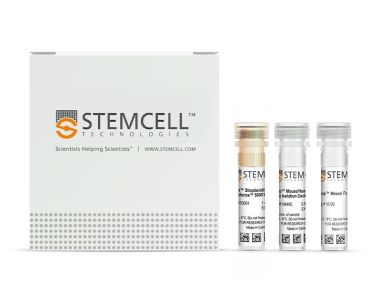 EasySep™小鼠/人嵌合体分选试剂盒
 产品手册Mammary Epithelial Cells: Standardized Media and Reagents
 沪公网安备31010102008431号