若您需要咨询产品或有任何技术问题,请通过官方电话 400 885 9050 或邮箱 info.cn@stemcell.com 与我们联系。

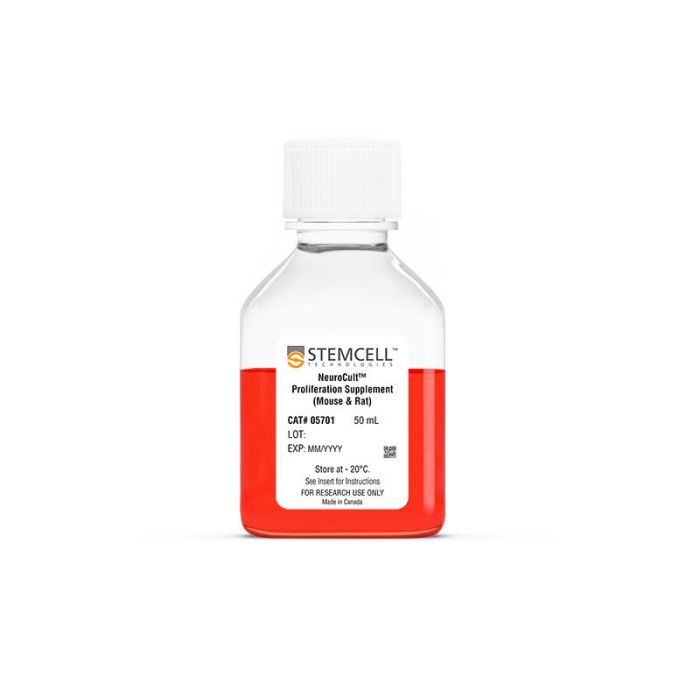
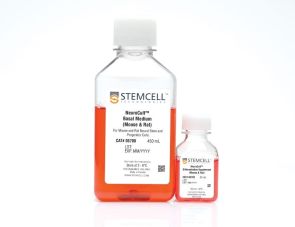
NeuroCult™ 扩增添加物(小鼠和大鼠)

用于扩增小鼠和大鼠神经干细胞和祖细胞的添加物
只有 %1
¥2,618.00

产品号 #(选择产品)

产品号 #05701_C

用于扩增小鼠和大鼠神经干细胞和祖细胞的添加物

专为您的实验方案打造的产品
要查看实验方案所需的所有配套产品,请参阅《实验方案与技术文档》

总览

NeuroCult™ 扩增添加物(小鼠和大鼠)是一种标准化的无血清添加物,用于小鼠和大鼠神经干/祖细胞的体外培养。该添加物需与 NeuroCult™ 基础培养基(小鼠和大鼠;产品号 #05700)及相应的细胞因子(未包含在内,需另购)联合使用。NeuroCult™ 扩增添加物经过优化,可在不丧失细胞自我更新、增殖和分化潜能的前提下,长期维持小鼠和大鼠神经干细胞的体外培养状态。该产品同时也是 NeuroCult™ 扩增试剂盒(小鼠和大鼠;产品号 #05702)中的组成部分。

注意:在配制NeuroCult™ 完全扩增培养基时,需添加人重组 EGF(产品号 #78006.1)。如使用来源于成年小鼠或大鼠的细胞,还需额外添加人重组 bFGF(产品号 #78003.1)及肝素溶液(产品号 #07980)。

分类
添加剂
 
细胞类型
脑肿瘤干细胞,神经干/祖细胞
 
种属
小鼠、大鼠
 
应用
细胞培养,克隆筛选,扩增,功能学筛选,球状体培养
 
品牌
NeuroCult
 
研究领域
癌症,疾病建模,药物发现和毒性检测,神经科学,干细胞生物学
 
制剂类别
无血清
 

实验数据

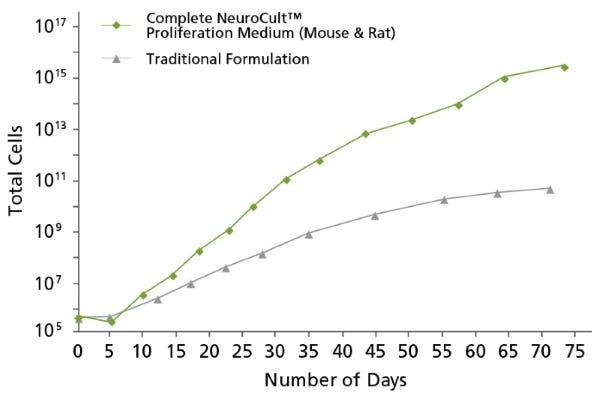
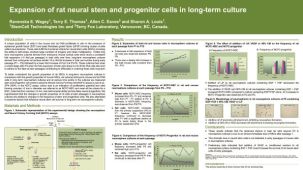
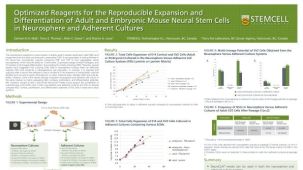
Figure 1. Comparison of Cell Expansion for Mouse Neurospheres Cultured with Complete NeuroCult™ Proliferation Medium (Mouse & Rat) or a Traditional Formulation

Cells microdissected from the cortices of E14 mice were cultured in Complete NeuroCult™ Proliferation Medium (Mouse & Rat) or a traditional formulation containing 20 ng/mL rh EGF. At Day 71, cells cultured in Complete NeuroCult™ Proliferation Medium (Mouse & Rat) were at Passage 13 while cells cultured in a traditional medium formulation were at Passage 10. Complete NeuroCult™ Proliferation Medium (Mouse & Rat) consists of NeuroCult™ NSC Basal Medium (Mouse & Rat), NeuroCult™ NSC Proliferation Supplement (Mouse & Rat) and 20 ng/mL rh EGF.

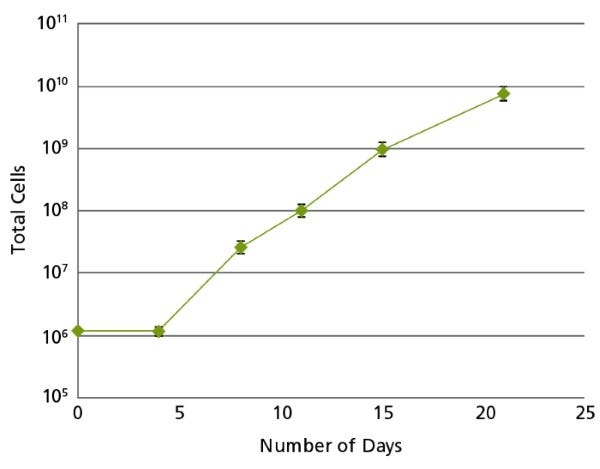
Figure 2. Cell Expansion for Rat Neurospheres Cultured with Complete NeuroCult™ Proliferation Medium (Mouse & Rat)

Cells microdissected from the cortices of E18 rat were cultured in 3 different lots of NeuroCult™ Proliferation Medium (Mouse & Rat). In each sample, cells continued to generate neurospheres beyond passage 5, resulting in an increase in total cell number. At passages 1 and 5, cells dissociated from the neurospheres were able to differentiate into neurons, oligodendrocytes and astrocytes [data not shown].

产品说明书及文档

请在《产品说明书》中查找相关支持信息和使用说明,或浏览下方更多实验方案。

Document Type
Product Name
Catalog #
Lot #
Language
Catalog #
05701
Lot #
All
Language
English
Document Type
Technical Manual
Catalog #
05701
Lot #
All
Language
English
Document Type
Safety Data Sheet
Catalog #
05701
Lot #
All
Language
English

应用领域

本产品专为以下研究领域设计,适用于工作流程中的高亮阶段。探索这些工作流程,了解更多我们为各研究领域提供的其他配套产品。

相关材料与文献

技术资料 (9)

文献 (117)

Bone marrow as a home of heterogenous populations of nonhematopoietic stem cells. Kucia M et al. Leukemia 2005 JUL

Abstract

Evidence is presented that bone marrow (BM) in addition to CD45(positive) hematopoietic stem cells contains a rare population of heterogenous CD45(negative) nonhematopoietic tissue committed stem cells (TCSC). These nonhematopoietic TCSC (i) are enriched in population of CXCR4(+) CD34(+) AC133(+) lin(-) CD45(-) and CXCR4(+) Sca-1(+) lin(-) CD45(-) in humans and mice,respectively,(ii) display several markers of pluripotent stem cells (PSC) and (iii) as we envision are deposited in BM early in development. Thus,since BM contains versatile nonhematopoietic stem cells,previous studies on plasticity trans-dedifferentiation of BM-derived hematopoietic stem cells (HSC) that did not include proper controls to exclude this possibility could lead to wrong interpretations. Therefore,in this spotlight review we present this alternative explanation of 'plasticity' of BM-derived stem cells based on the assumption that BM stem cells are heterogenous. We also discuss a potential relationship of TCSC/PSC identified by us with other BM-derived CD45(negative) nonhematopoietic stem cells that were recently identified by other investigators (eg MSC,MAPC,USSC and MIAMI cells). Finally,we discuss perspectives and pitfalls in potential application of these cells in regenerative medicine.
Sox2 expression defines a heterogeneous population of neurosphere-forming cells in the adult murine brain. Brazel CY et al. Aging cell 2005 AUG

Abstract

The identification of neural stem cells (NSCs) in situ has been prevented by the inability to identify a marker consistently expressed in all adult NSCs and is thus generally accomplished using the in vitro neurosphere-forming assay. The high-mobility group transcription factor Sox2 is expressed in embryonic neural epithelial stem cells; because these cells are thought to give rise to the adult NSC population,we hypothesized that Sox2 may continue to be expressed in adult NSCs. Using Sox2:EGFP transgenic mice,we show that Sox2 is expressed in neurogenic regions along the rostral-caudal axis of the central nervous system throughout life. Furthermore,all neurospheres derived from these neurogenic regions express Sox2,suggesting that Sox2 is indeed expressed in adult NSCs. We demonstrate that NSCs are heterogeneous within the adult brain,with differing capacities for cell production. In vitro,all neurospheres express Sox2,but the expression of markers common to early progenitor cells within individual neurospheres varies; this heterogeneity of NSCs is mirrored in vivo. For example,both glial fibrillary acidic protein and NG2 are expressed within individual neurospheres,but their expression is mutually exclusive; likewise,these two markers show distinct staining patterns within the Sox2+ regions of the brain's neurogenic regions. Thus,we propose that the expression of Sox2 is a unifying characteristic of NSCs in the adult brain,but that not all NSCs maintain the ability to form all neural cell types in vivo.
Neural stem cell differentiation is dependent upon endogenous caspase 3 activity. Fernando P et al. FASEB journal : official publication of the Federation of American Societies for Experimental Biology 2005 OCT

Abstract

Caspase proteases have become the focal point for the development and application of anti-apoptotic therapies in a variety of central nervous system diseases. However,this approach is based on the premise that caspase function is limited to invoking cell death signals. Here,we show that caspase-3 activity is elevated in nonapoptotic differentiating neuronal cell populations. Moreover,peptide inhibition of protease activity effectively inhibits the differentiation process in a cultured neurosphere model. These results implicate caspase-3 activation as a conserved feature of neuronal differentiation and suggest that targeted inhibition of this protease in neural cell populations may have unintended consequences.

更多信息

更多信息
物种 大鼠, 小鼠
配方 无血清
法律声明:

Sold under license from StemCells California, Inc. US Patent Nos. 5,750,376; 5,851,832; 5,980,885; 5,968,829; 5,981,165; 6,071,889; 6,093,531; 6,103,530; 6,165,783; 6,238,922. 质量保证:

产品仅供研究使用,不用于针对人或动物的诊断或治疗。 欲获悉更多关于STEMCELL的质控信息,请访问 STEMCELL.CN/COMPLIANCE. Safety Statement: CA WARNING: This product can expose you to Progesterone which is known to the State of California to cause cancer. For more information go to www.P65Warnings.ca.gov
Copyright © 2026 by STEMCELL Technologies. All rights reserved.

在线联系