若您需要咨询产品或有任何技术问题,请通过官方电话 400 885 9050 或邮箱 info.cn@stemcell.com 与我们联系。

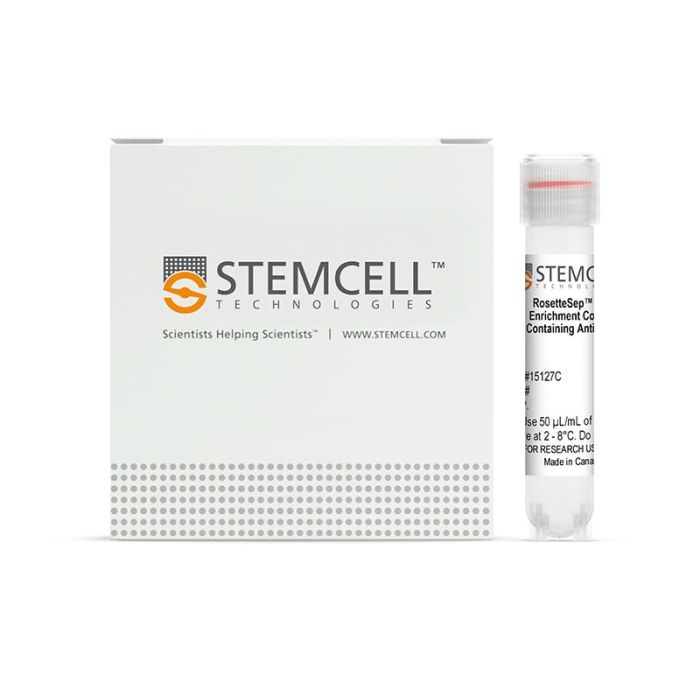
含抗CD36的 RosetteSep™ CTC富集抗体混合物

免疫密度负选试剂混合物
只有 %1
¥5,516.00

产品号 #(选择产品)

产品号 #15127_C

免疫密度负选试剂混合物

产品优势

  • 快捷、操作简单
  • 纯度可高达98%
  • 无需分离柱
  • 可与SepMate™联合使用,实现一致的     高通量的样本处理

产品组分包括

  • 含抗CD36的 RosetteSep™ CTC富集抗体混合物     (产品号#15127)
    • 含抗CD36的 RosetteSep™ CTC富集抗体混合物,2mL
  • 含抗CD36的 RosetteSep™ CTC富集抗体混合物     (产品号#15167)
    • 含抗CD36的 RosetteSep™ CTC富集抗体混合物     ,5x2mL
专为您的实验方案打造的产品
要查看实验方案所需的所有配套产品,请参阅《实验方案与技术文档》

总览

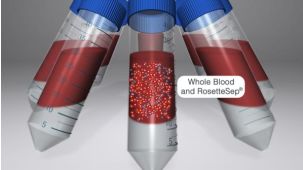
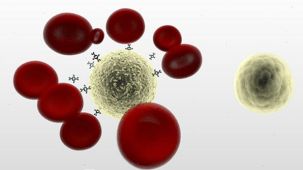
含抗CD36的RosetteSep™ CTC富集抗体混合物用于通过负选从新鲜全血富集循环上皮肿瘤细胞。四聚体抗体复合物可识别CD2、CD16、CD19、CD36、CD38、CD45、D66b以及红细胞(RBC)上的糖蛋白A,从而靶向去除非目的细胞。使用密度梯度离心液如Lymphoprep™(产品号 #18060)离心后     ,非目的细胞会与红细胞一起沉淀。纯化的肿瘤细胞将为血浆和密度梯度离心液的交界界面中高度富集的细胞。    

该抗体混合物适用于小细胞癌样本,包括肺癌样本。若您的样本是乳腺癌样本,请使用含抗CD56的RosetteSep™ CTC富集抗体混合物(产品号 #15137)。

磁极兼容性
 
 
分类
细胞分选试剂盒
 
细胞类型
癌细胞及细胞系
 
种属

 
样本来源
白膜层、全血
 
分选方法
负选
 
应用
细胞分选
 
品牌
RosetteSep
 
研究领域
癌症,药物发现和毒性检测,免疫学
 

实验数据

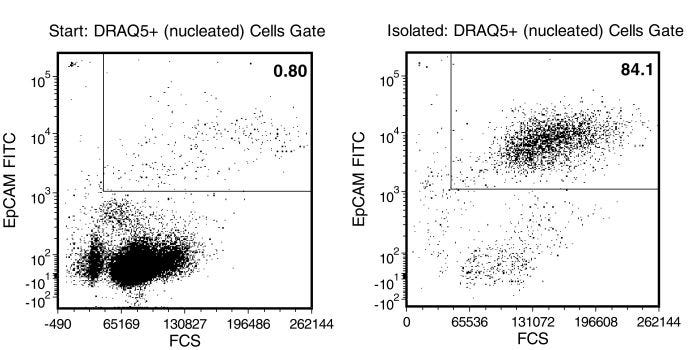
Typical RosetteSep™ CTC Enrichment Profile

Figure 1. Typical RosetteSep™ CTC Enrichment Profile

In the example above, CAMA (epithelial tumor cell line) cells were seeded into whole blood at a starting frequency of 0.8%. The CAMA cell content of the enriched fraction is 84%. Typically 3.4 to 4.7 log depletion of targeted CD45+ cells is attained.

产品说明书及文档

请在《产品说明书》中查找相关支持信息和使用说明,或浏览下方更多实验方案。

Document Type
Product Name
Catalog #
Lot #
Language
Document Type
产品说明书
Catalog #
15127
Lot #
All
Language
中文
Document Type
产品说明书
Catalog #
15167
Lot #
All
Language
中文
Catalog #
15127, 15167
Lot #
All
Language
English
Document Type
Safety Data Sheet
Catalog #
15127, 15167
Lot #
All
Language
English

应用领域

本产品专为以下研究领域设计,适用于工作流程中的高亮阶段。探索这些工作流程,了解更多我们为各研究领域提供的其他配套产品。

相关材料与文献

技术资料 (4)

常见问题

What is RosetteSep™?

RosetteSep™ is a rapid cell separation procedure for the isolation of purified cells directly from whole blood, without columns or magnets.

How does RosetteSep™ work?

The antibody cocktail crosslinks unwanted cells to red blood cells (RBCs), forming rosettes. The unwanted cells then pellet with the free RBCs when centrifuged over a density centrifugation medium (e.g. Ficoll-Paque™ PLUS, Lymphoprep™).

What factors affect cell recovery?

The temperature of the reagents can affect cell recovery. All reagents should be at room temperature (sample, density centrifugation medium, PBS, centrifuge) before performing the isolations. Layering can also affect recovery so be sure to carefully layer the sample to avoid mixing with the density centrifugation medium as much as possible. Be sure to collect the entire enriched culture without disturbing the RBC pellet. A small amount of density centrifugation medium can be collected without worry.

Which cell samples can RosetteSep™ be used with?

RosetteSep™ can be used with leukapheresis samples, bone marrow or buffy coat, as long as: the concentration of cells does not exceed 5 x 10⁷ per mL (can dilute if necessary); and there are at least 100 RBCs for every nucleated cell (RBCs can be added if necessary).

Can RosetteSep™ be used with previously frozen or cultured cells?

Yes. Cells should be re-suspended at 2 - 5 x 10⁷ cells / mL in PBS + 2% FBS. Fresh whole blood should be added at 250 µL per mL of sample, as a source of red cells.

Can RosetteSep™ be used to enrich progenitors from cord blood?

Yes. Sometimes cord blood contains immature nucleated red cells that have a lower density than mature RBCs. These immature red cells do not pellet over Ficoll™, which can lead to a higher RBC contamination than peripheral blood separations.

Does RosetteSep™ work with mouse cells?

No, but we have developed EasySep™, a magnetic-based cell isolation system which works with mouse and other non-human species.

Which anticoagulant should be used with RosetteSep™?

Peripheral blood should be collected in heparinized Vacutainers. Cord blood should be collected in ACD.

Should the anticoagulant be washed off before using RosetteSep™?

No, the antibody cocktail can be added directly to the sample.

文献 (7)

Cell-free tumor DNA in blood plasma as a marker for circulating tumor cells in prostate cancer. Schwarzenbach H et al. Clinical cancer research : an official journal of the American Association for Cancer Research 2009 FEB

Abstract

PURPOSE: Circulating cell-free DNA in the blood of cancer patients harbors tumor-specific aberrations. Here,we investigated whether this DNA might also reflect the presence of circulating tumor cells (CTC). EXPERIMENTAL DESIGN: To identify the source of cell-free DNA in blood,plasma derived from 81 patients with prostate cancer was examined for CTCs and cell-free DNA. An epithelial immunospot assay was applied for detection of CTCs,and a PCR-based fluorescence microsatellite analysis with a panel of 14 polymorphic markers was used for detection of allelic imbalances (AI). RESULTS: The plasma DNA levels significantly correlated with the diagnosis subgroups of localized (stage M0,n = 69) and metastasized prostate cancer (stage M1,n = 12; P = 0.03) and with the tumor stage of these patients (P textless 0.005). AI was found on cell-free DNA in plasma from 45.0% and 58.5% of M0 and M1 patients,respectively. Detection of CTCs showed that 71.0% or 92.0% of the M0 and M1 patients harbored 1 to 40 CTCs in their blood,respectively. The occurrence of CTCs correlated with tumor stage (P textless 0.03) and increasing Gleason scores (P = 0.04). Notably,significant associations of the number of CTCs with the AI frequencies at the markers D8S137 (P = 0.03),D9S171 (P = 0.04),and D17S855 (P = 0.02) encoding the cytoskeletal protein dematin,the inhibitor of the cyclin-dependent kinase CDKN2/p16 and BRCA1,respectively,were observed. CONCLUSIONS: These findings show,for the first time,a relationship between the occurrence of CTCs and circulating tumor-associated DNA in blood,which,therefore,might become a valuable new source for monitoring metastatic progression in cancer patients.
Circulating tumor cells (CTCs): detection methods and their clinical relevance in breast cancer. Mostert B et al. Cancer treatment reviews 2009 AUG

Abstract

The enumeration of circulating tumor cells has long been regarded as an attractive diagnostic tool,as circulating tumor cells are thought to reflect aggressiveness of the tumor and may assist in therapeutic decisions in patients with solid malignancies. However,implementation of this assay into clinical routine has been cumbersome,as a validated test was not available until recently. Circulating tumor cells are rare events which can be detected specifically only by using a combination of surface and intracellular markers,and only recently a number of technical advances have made their reliable detection possible. Most of these new techniques rely on a combination of an enrichment and a detection step. This review addresses the assays that have been described so far in the literature,including the enrichment and detection steps and the markers used in these assays. We have focused on breast cancer as most clinical studies on CTC detection so far have been done in these patients.
New technologies for the detection of circulating tumour cells. Gerges N et al. British medical bulletin 2010 JAN

Abstract

The vast majority of cancer-related death is due to the metastatic spread of the primary tumour. Circulating tumour cells (CTC) are essential for establishing metastasis and their detection has long been considered as a possible tool to assess the aggressiveness of a given tumour and its potential of subsequent growth at distant organs. Conventional markers are not reliable in detecting occult metastasis and,for example,fail to identify approximately 40% of cancer patients in need of more aggressive or better adjusted therapies. Recent studies in metastatic breast cancer have shown that CTC detection can be used as a marker for overall survival and assessment of the therapeutic response. The benefits of CTC detection in early breast cancer and other solid tumours need further validation. Moreover,optimal CTC detection techniques are the subject of controversy as several lack reproducibility,sensitivity and/or specificity. Recent technical advances allow CTC detection and characterization at the single-cell level in the blood or in the bone marrow. Their reproducibility propels the use of CTC in cancer staging and real-time monitoring of systemic anticancer therapies in several large clinical trials. CTC assays are being integrated in large clinical trials to establish their potential in the management of cancer patients and improve our understanding of metastasis biology. This review will focus on the techniques currently used,the technical advancements made,the limitations of CTC detection and future perspectives in this field.

更多信息

更多信息
物种
Magnet Compatibility  
样本来源 全血, 白膜层
Selection Method Negative
质量保证:

产品仅供研究使用,不用于针对人或动物的诊断或治疗。 欲获悉更多关于STEMCELL的质控信息,请访问 STEMCELL.CN/COMPLIANCE.
Copyright © 2026 by STEMCELL Technologies. All rights reserved.

在线联系