若您需要咨询产品或有任何技术问题,请通过官方电话 400 885 9050 或邮箱 info.cn@stemcell.com 与我们联系。

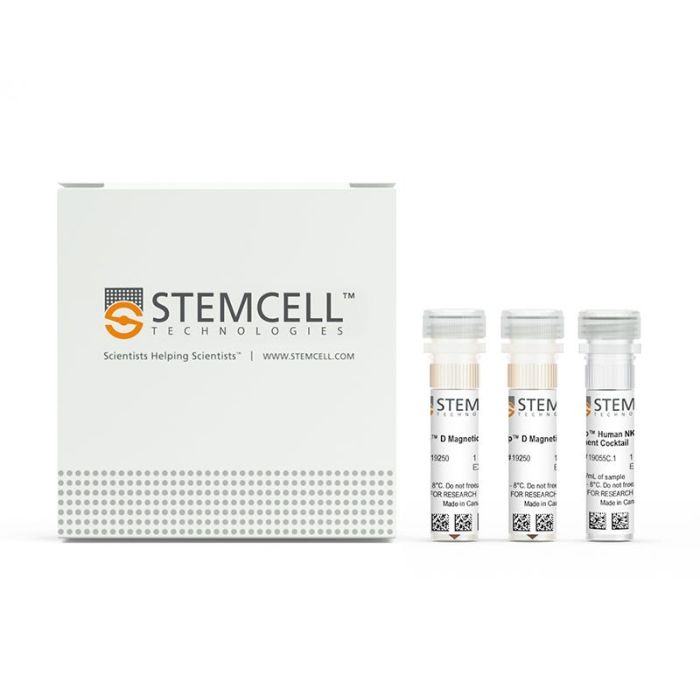
EasySep™人NK细胞富集试剂盒

免疫磁珠负选未标记的人NK细胞
只有 %1
¥11,154.00

产品号 #(选择产品)

产品号 #19055_C

免疫磁珠负选未标记的人NK细胞

产品优势

  • 操作简单、快捷,且无需分离柱
  • 纯度高达95%
  • 获得的活细胞无标记

产品组分包括

  • EasySep™ 人NK 细胞富集试剂盒(产品号 #19055)
    • EasySep™人NK细胞富集抗体混合物, 1 mL
    • EasySep™ D Magnetic Particles磁珠, 2 x 1 mL
  • RoboSep™ 人NK细胞富集试剂盒(含过滤吸头)(产品号 #19055RF)
    • EasySep™人NK细胞富集抗体混合物, 1 mL
    • EasySep™ D Magnetic Particles磁珠, 2 x 1 mL
    • RoboSep™ 缓冲液(产品号 #20104)
    • RoboSep™过滤吸头(产品号 #20125)
专为您的实验方案打造的产品
要查看实验方案所需的所有配套产品,请参阅《实验方案与技术文档》

总览

通过免疫磁珠负选,从新鲜或冻存的人外周血单个核细胞 (PBMCs) 或裂解的白细胞单采术样本中分离出无磁珠标记和高纯度的NK细胞。EasySep™技术结合单克隆抗体的特异性和无柱磁分选系统的简便性,已在发表的研究中广泛应用超过20年。

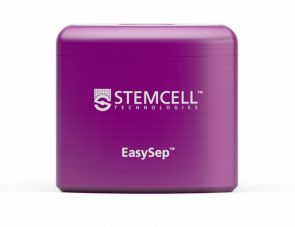
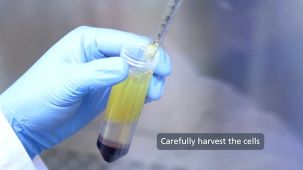
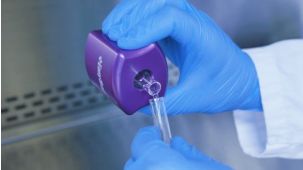
在该EasySep™负选流程中,非目的细胞被抗体复合物与磁珠标记。以下非目标细胞将被特异性去除:粒细胞、T细胞、B细胞、单核细胞、树突状细胞及红系细胞。通过EasySep™磁极将被磁珠标记的细胞与未被标记的目的人NK细胞分离,接着简单地将目的细胞倾倒或吸取至一个新的试管中。完成磁珠细胞分选后,目的NK细胞即可用于流式细胞术、培养或DNA/RNA提取等下游应用。

如需更快速的细胞分选,我们推荐使用EasySep™ 人NK细胞分选试剂盒(产品号 #17955),仅需8分钟即可完成细胞分选。

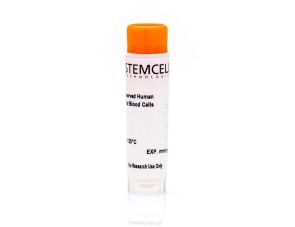
了解更多关于免疫磁珠EasySep™技术的工作原理,或如何通过RoboSep™实现免疫磁珠细胞分选全自动化。或选择即用型、符合伦理来源的用EasySep™ 人NK细胞富集试剂盒进行分选的冻存原代人外周血NK细胞。探索为您的实验流程优化的更多产品,包括培养基、补充剂、抗体等。

磁极兼容性
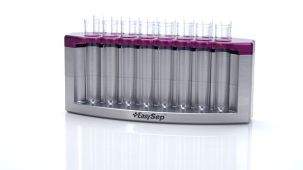
• EasySep™磁极(产品号 #18000)
• “The Big Easy” EasySep™磁极(产品号 #18001)
• Easy 50 EasySep™磁极(产品号 #18002)
• EasyPlate™ EasySep™磁极(产品号 #18102)
• EasyEights™ EasySep™磁极(产品号 #18103)
• RoboSep™-S(产品号 #21000)
 
分类
细胞分选试剂盒
 
细胞类型
NK 细胞
 
种属

 
样本来源
PBMC
 
分选方法
负选
 
应用
细胞分选
 
品牌
EasySep,RoboSep
 
研究领域
免疫
 

实验数据

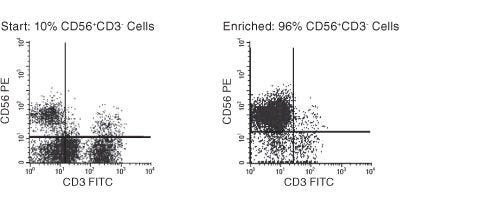
FACS Profile Results With EasySep™ Human NK Cell Enrichment Kit

Figure 1. FACS Profile Results With EasySep™ Human NK Cell Enrichment Kit

The NK cell content of the enriched fraction varies, depending on the starting sample. Starting with previously frozen mononuclear cells containing more than 10% NK cells, the NK cell content of the enriched fraction typically ranges from 73% - 95%. Purities may be lower when starting with samples containing less than 10% NK cells.

产品说明书及文档

请在《产品说明书》中查找相关支持信息和使用说明,或浏览下方更多实验方案。

Document Type
Product Name
Catalog #
Lot #
Language
Document Type
产品说明书
Catalog #
19055RF
Lot #
All
Language
中文
Document Type
产品说明书
Catalog #
19055
Lot #
All
Language
中文
Catalog #
19055RF
Lot #
All
Language
English
Catalog #
19055
Lot #
All
Language
English
Document Type
Safety Data Sheet 1
Catalog #
19055RF
Lot #
All
Language
English
Document Type
Safety Data Sheet 2
Catalog #
19055RF
Lot #
All
Language
English
Document Type
Safety Data Sheet 3
Catalog #
19055RF
Lot #
All
Language
English
Document Type
Safety Data Sheet 1
Catalog #
19055
Lot #
All
Language
English
Document Type
Safety Data Sheet 2
Catalog #
19055
Lot #
All
Language
English

应用领域

本产品专为以下研究领域设计,适用于工作流程中的高亮阶段。探索这些工作流程,了解更多我们为各研究领域提供的其他配套产品。

相关材料与文献

技术资料 (11)

常见问题 (11)

Can EasySep™ be used for either positive or negative selection?

Yes. The EasySep™ kits use either a negative selection approach by targeting and removing unwanted cells or a positive selection approach targeting desired cells. Depletion kits are also available for the removal of cells with a specific undesired marker (e.g. GlyA).

How does the separation work?

Magnetic particles are crosslinked to cells using Tetrameric Antibody Complexes (TAC). When placed in the EasySep™ Magnet, labeled cells migrate to the wall of the tube. The unlabeled cells are then poured off into a separate fraction.

Which columns do I use?

The EasySep™ procedure is column-free. That's right - no columns!

How can I analyze the purity of my enriched sample?

The Product Information Sheet provided with each EasySep™ kit contains detailed staining information.

Can EasySep™ separations be automated?

Yes. RoboSep™, the fully automated cell separator, automates all EasySep™ labeling and cell separation steps.

Can EasySep™ be used to isolate rare cells?

Yes. We recommend a cell concentration of 2x10⁸ cells/mL and a minimum working volume of 100 µL. Samples containing 2x10⁷ cells or fewer should be suspended in 100 µL of buffer.

Are the EasySep™ magnetic particles FACS-compatible?

Yes, the EasySep™ particles are flow cytometry-compatible, as they are very uniform in size and about 5000X smaller than other commercially available magnetic beads used with column-free systems.

Can the EasySep™ magnetic particles be removed after enrichment?

No, but due to the small size of these particles, they will not interfere with downstream applications.

Can I alter the separation time in the magnet?

Yes; however, this may impact the kit's performance. The provided EasySep™ protocols have already been optimized to balance purity, recovery and time spent on the isolation.

For positive selection, can I perform more than 3 separations to increase purity?

Yes, the purity of targeted cells will increase with additional rounds of separations; however, cell recovery will decrease.

How does the binding of the EasySep™ magnetic particle affect the cells? is the function of positively selected cells altered by the bound particles?

Hundreds of publications have used cells selected with EasySep™ positive selection kits for functional studies. Our in-house experiments also confirm that selected cells are not functionally altered by the EasySep™ magnetic particles.

If particle binding is a key concern, we offer two options for negative selection. The EasySep™ negative selection kits can isolate untouched cells with comparable purities, while RosetteSep™ can isolate untouched cells directly from whole blood without using particles or magnets.

文献 (57)

CD4 expression on activated NK cells: ligation of CD4 induces cytokine expression and cell migration. Bernstein HB et al. Journal of immunology (Baltimore,Md. : 1950) 2006 SEP

Abstract

NK cells play an important role in the innate immune response. We have isolated NK cells from human lymphoid tissues and found that these cells express the CD4 molecule on their surface at levels higher than those found on peripheral blood NK cells. To study the functional role of the CD4 molecule on NK cells,we developed an in vitro system by which we are able to obtain robust CD4 expression on NK cells derived from blood. CD4+ NK cells efficiently mediate NK cell cytotoxicity,and CD4 expression does not appear to alter lytic function. CD4+ NK cells are more likely to produce the cytokines gamma-IFN and TNF-alpha than are CD4- NK cells. Ligation of CD4 further increases the number of NK cells producing these cytokines. NK cells expressing CD4 are also capable of migrating toward the CD4-specific chemotactic factor IL-16,providing another function for the CD4 molecule on NK cells. Thus,the CD4 molecule is present and functional on NK cells and plays a role in innate immune responses as a chemotactic receptor and by increasing cytokine production,in addition to its well-described function on T cells as a coreceptor for Ag responsive cell activation.
HIV-1 envelope protein binds to and signals through integrin alpha4beta7, the gut mucosal homing receptor for peripheral T cells. Arthos J et al. Nature immunology 2008 MAR

Abstract

Infection with human immunodeficiency virus 1 (HIV-1) results in the dissemination of virus to gut-associated lymphoid tissue. Subsequently,HIV-1 mediates massive depletion of gut CD4+ T cells,which contributes to HIV-1-induced immune dysfunction. The migration of lymphocytes to gut-associated lymphoid tissue is mediated by integrin alpha4beta7. We demonstrate here that the HIV-1 envelope protein gp120 bound to an activated form of alpha4beta7. This interaction was mediated by a tripeptide in the V2 loop of gp120,a peptide motif that mimics structures presented by the natural ligands of alpha4beta7. On CD4+ T cells,engagement of alpha4beta7 by gp120 resulted in rapid activation of LFA-1,the central integrin involved in the establishment of virological synapses,which facilitate efficient cell-to-cell spreading of HIV-1.
The transcriptome of human cytotoxic T cells: similarities and disparities among allostimulated CD4(+) CTL, CD8(+) CTL and NK cells. Hidalgo LG et al. American journal of transplantation : official journal of the American Society of Transplantation and the American Society of Transplant Surgeons 2008 MAR

Abstract

Transcripts expressed in cytotoxic T lymphocytes (CTL) have mechanistic and diagnostic importance in transplantation. We used microarrays to select CTL-associated transcripts (CATs) expressed in human CD4(+) CTL,CD8(+) CTL and NK cells,excluding transcripts expressed in B cells,monocytes and kidney. This generated three transcript sets: CD4(+)-associated,CD8(+)-associated and NK-associated. Surprisingly,many CATs were expressed in effector memory cells e.g. granzyme B/GZMB,interferon-gamma/IFNG. Transcript expression was very similar between CD4(+) and CD8(+) CTL. There were no transcripts highly selective for CD4(+) CTL or CD8(+) CTL: for example,cytotoxic molecule transcripts (perforin,granzymes,granulysin) were shared between CD8(+) CTL and CD4(+) CTL although expression remained higher in CD8(+) CTL. Transcripts that differentiated between CD8(+) CTL and CD4(+) CTL were primarily those shared between CD8(+) CTL and NK cells (e.g. NK receptors KLRC1,KLRC3,KLRD1,KLRK1). No transcripts could differentiate CD4(+) CTL from CD8(+) CTL but NK cell-associated transcripts could differentiate NK cells from CTL. This study serves as a foundation for the interpretation of CATs in rejecting allografts and highlights the extensive sharing of CATs among CD4(+) CTL,CD8(+) CTL and effector memory T cells.

更多信息

更多信息
物种
Magnet Compatibility • EasySep™ Magnet (Catalog #18000) • “The Big Easy” EasySep™ Magnet (Catalog #18001) • Easy 50 EasySep™ Magnet (Catalog #18002) • EasyPlate™ EasySep™ Magnet (Catalog 18102) • EasyEights™ EasySep™ Magnet (Catalog #18103) • RoboSep™-S (Catalog #21000)
样本来源 PBMC
Selection Method Negative
标记抗体
质量保证:

产品仅供研究使用,不用于针对人或动物的诊断或治疗。 欲获悉更多关于STEMCELL的质控信息,请访问 STEMCELL.CN/COMPLIANCE.
Copyright © 2026 by STEMCELL Technologies. All rights reserved.

在线联系