若您需要咨询产品或有任何技术问题,请通过官方电话 400 885 9050 或邮箱 info.cn@stemcell.com 与我们联系。

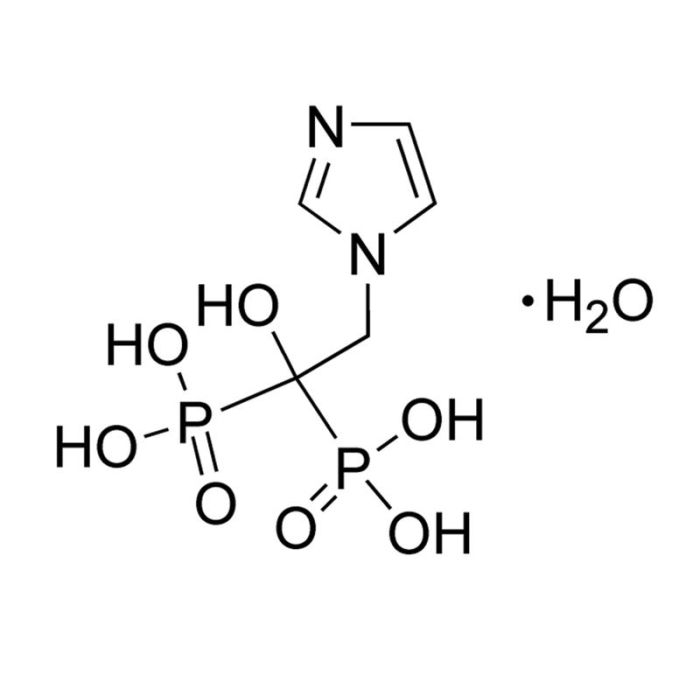
唑来膦酸

骨吸收抑制剂;抑制法呢基二磷酸(FPP)合成酶
只有 %1
¥1,714.00

产品号 #(选择产品)

产品号 #73572_C

骨吸收抑制剂;抑制法呢基二磷酸(FPP)合成酶

总览

唑来膦酸(Zoledronic Acid)是一种含氮双膦酸盐,可抑制法呢基二磷酸(FPP)合酶(IC₅₀=5 nM),从而阻止蛋白质异戊烯化和破骨细胞介导的骨吸收(Dunford et al.)。此外,它对羟基磷灰石 (Ki=3.5 μM) 具有高亲和力,可直接与矿化骨结合(Nancollas et al.)。本产品以分子水合物形式提供。

癌症研究
·抑制多种癌细胞系的增殖、血管生成和骨粘附(Li & Davis; Zekri et al.)。
·体外抑制乳腺癌和前列腺癌细胞侵袭(Boissier et al.; Li & Davis)。
·体外诱导破骨细胞瘤细胞凋亡(Benford et al.)。

细胞类型
癌细胞及细胞系
 
种属
人,小鼠,非人灵长类,其他物种,大鼠
 
CAS 编号
165800-06-6
 
化学式
C₅H₁₀N₂O₇P₂ · H₂O
 
纯度
≥ 95 %
 
靶点
FPP合酶
 

产品说明书及文档

请在《产品说明书》中查找相关支持信息和使用说明,或浏览下方更多实验方案。

Document Type
Product Name
Catalog #
Lot #
Language
Catalog #
73572
Lot #
All
Language
English
Document Type
Safety Data Sheet
Catalog #
73572
Lot #
All
Language
English

相关材料与文献

技术资料 (1)

研究综述

文献 (6)

Bisphosphonates inhibit breast and prostate carcinoma cell invasion, an early event in the formation of bone metastases. Boissier S et al. Cancer research 2000 JUN

Abstract

The molecular mechanisms by which tumor cells metastasize to bone are likely to involve invasion,cell adhesion to bone,and the release of soluble mediators from tumor cells that stimulate osteoclast-mediated bone resorption. Bisphosphonates (BPs) are powerful inhibitors of the osteoclast activity and are,therefore,used in the treatment of patients with osteolytic metastases. However,an added beneficial effect of BPs may be direct antitumor activity. We previously reported that BPs inhibit breast and prostate carcinoma cell adhesion to bone (Boissier et al.,Cancer Res.,57: 3890-3894,1997). Here,we provided evidence that BP pretreatment of breast and prostate carcinoma cells inhibited tumor cell invasion in a dose-dependent manner. The order of potency for four BPs in inhibiting tumor cell invasion was: zoledronate textgreater ibandronate textgreater NE-10244 (active pyridinium analogue of risedronate) textgreater clodronate. In addition,NE-58051 (the inactive pyridylpropylidene analogue of risedronate) had no inhibitory effect,whereas NE-10790 (a phosphonocarboxylate analogue of risedronate in which one of the phosphonate groups is substituted by a carboxyl group) inhibited tumor cell invasion to an extent similar to that observed with NE-10244,indicating that the inhibitory activity of BPs on tumor cells involved the R2 chain of the molecule. BPs did not induce apoptosis in tumor cells,nor did they inhibit tumor cell migration at concentrations that did inhibit tumor cell invasion. However,although BPs did not interfere with the production of matrix metalloproteinases (MMPs) by tumor cells,they inhibited their proteolytic activity. The inhibitory effect of BPs on MMP activity was completely reversed in the presence of an excess of zinc. In addition,NE-10790 did not inhibit MMP activity,suggesting that phosphonate groups of BPs are responsible for the chelation of zinc and the subsequent inhibition of MMP activity. In conclusion,our results provide evidence for a direct cellular effect of BPs in preventing tumor cell invasion and an inhibitory effect of BPs on the proteolytic activity of MMPs through zinc chelation. These results suggest,therefore,that BPs may be useful agents for the prophylactic treatment of patients with cancers that are known to preferentially metastasize to bone.
Structure-activity relationships for inhibition of farnesyl diphosphate synthase in vitro and inhibition of bone resorption in vivo by nitrogen-containing bisphosphonates. Dunford JE et al. The Journal of pharmacology and experimental therapeutics 2001

Abstract

It has long been known that small changes to the structure of the R(2) side chain of nitrogen-containing bisphosphonates can dramatically affect their potency for inhibiting bone resorption in vitro and in vivo,although the reason for these differences in antiresorptive potency have not been explained at the level of a pharmacological target. Recently,several nitrogen-containing bisphosphonates were found to inhibit osteoclast-mediated bone resorption in vitro by inhibiting farnesyl diphosphate synthase,thereby preventing protein prenylation in osteoclasts. In this study,we examined the potency of a wider range of nitrogen-containing bisphosphonates,including the highly potent,heterocycle-containing zoledronic acid and minodronate (YM-529). We found a clear correlation between the ability to inhibit farnesyl diphosphate synthase in vitro,to inhibit protein prenylation in cell-free extracts and in purified osteoclasts in vitro,and to inhibit bone resorption in vivo. The activity of recombinant human farnesyl diphosphate synthase was inhibited at concentrations textgreater or = 1 nM zoledronic acid or minodronate,the order of potency (zoledronic acid approximately equal to minodronate textgreater risedronate textgreater ibandronate textgreater incadronate textgreater alendronate textgreater pamidronate) closely matching the order of antiresorptive potency. Furthermore,minor changes to the structure of the R(2) side chain of heterocycle-containing bisphosphonates,giving rise to less potent inhibitors of bone resorption in vivo,also caused a reduction in potency up to approximately 300-fold for inhibition of farnesyl diphosphate synthase in vitro. These data indicate that farnesyl diphosphate synthase is the major pharmacological target of these drugs in vivo,and that small changes to the structure of the R(2) side chain alter antiresorptive potency by affecting the ability to inhibit farnesyl diphosphate synthase.
Visualization of bisphosphonate-induced caspase-3 activity in apoptotic osteoclasts in vitro. Benford HL et al. Bone 2001 MAY

Abstract

Bisphosphonates inhibit osteoclast-mediated bone resorption by mechanisms that have only recently become clear. Whereas nitrogen-containing bisphosphonates affect osteoclast function by preventing protein prenylation (especially geranylgeranylation),non-nitrogen-containing bisphosphonates have a different molecular mechanism of action. In this study,we demonstrate that nitrogen-containing bisphosphonates (risedronate,alendronate,pamidronate,and zoledronic acid) and non-nitrogen-containing bisphosphonates (clodronate and etidronate) cause apoptosis of rabbit osteoclasts,human osteoclastoma-derived osteoclasts,and human osteoclast-like cells generated in cultures of bone marrow in vitro. Osteoclast apoptosis was shown to involve characteristic morphological changes,loss of mitochondrial membrane potential,and the activation of caspase-3-like proteases capable of cleaving peptide substrates with the sequence DEVD. Caspase-3-like activity could be visualized in unfixed,dying osteoclasts and osteoclast-like cells using a cell-permeable,fluorogenic substrate. Bisphosphonate-induced osteoclast apoptosis was dependent on caspase activation,because apoptosis resulting from alendronate,clodronate,or zoledronic acid treatment was suppressed by zVAD-fmk,a broad-range caspase inhibitor,or by SB-281277,a specific isatin sulfonamide inhibitor of caspase-3/-7. Furthermore,caspase-3 (but not caspase-6 or caspase-7) activity could be detected and quantitated in lysates from purified rabbit osteoclasts,whereas the p17 fragment of active caspase-3 could be detected in human osteoclast-like cells by immunofluorescence staining. Caspase-3,therefore,appears to be the major effector caspase activated in osteoclasts by bisphosphonate treatment. Caspase activation and apoptosis induced by nitrogen-containing bisphosphonates are likely to be the consequence of the loss of geranylgeranylated rather than farnesylated proteins,because the ability to cause apoptosis and caspase activation was mimicked by GGTI-298,a specific inhibitor of protein geranylgeranylation,whereas FTI-277,a specific inhibitor of protein farnesylation,had no effect on apoptosis or caspase activity.

更多信息

更多信息
物种 人, 其它物种, 大鼠, 小鼠, 非人灵长类
Cas Number 165800-06-6
Chemical Formula C₅H₁₀N₂O₇P₂ · H₂O
纯度 ≥ 95 %
Target FPP Synthase
质量保证:

产品仅供研究使用,不用于针对人或动物的诊断或治疗。 欲获悉更多关于STEMCELL的质控信息,请访问 STEMCELL.CN/COMPLIANCE.
Copyright © 2026 by STEMCELL Technologies. All rights reserved.

在线联系