若您需要咨询产品或有任何技术问题,请通过官方电话 400 885 9050 或邮箱 info.cn@stemcell.com 与我们联系。

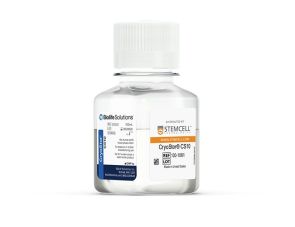
TeSR™-E8™

无饲养层、无动物成分的人胚胎干细胞和诱导多能干细胞维持培养基
只有 %1
¥3,550.00

产品号 #(选择产品)

产品号 #05990_C

无饲养层、无动物成分的人胚胎干细胞和诱导多能干细胞维持培养基

产品优势

  • 基于广受欢迎的 mTeSR™1 培养基的简化低蛋白配方,用于维持人胚胎干细胞(ES)和诱导多能干细胞(iPS)

产品组分包括

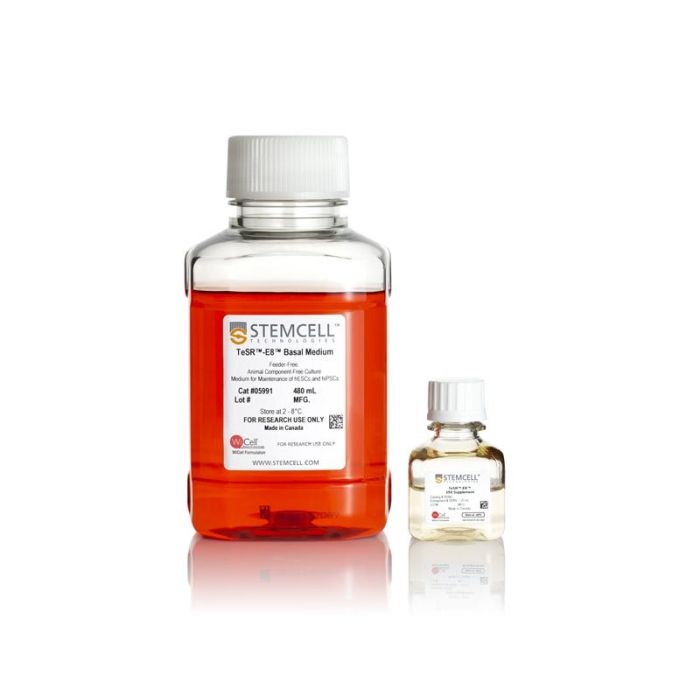
  • TeSR™-E8™ 基础培养基,480 mL
  • TeSR™-E8™ 25X 补充剂,20 mL

总览

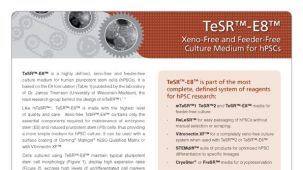
TeSR™-E8™ 是一款无饲养层、无动物成分的培养基,适用于培养人胚胎干细胞 (ES) 和人诱导性多能干细胞 (iPS)。它基于威斯康星大学麦迪逊分校 James Thomson 博士实验室研发的 E8 配方,该实验室是 mTeSR™1 研发的主导研发团队,mTeSR™1 是目前发表最广泛的多能干细胞无饲养层培养基。

与 TeSR™ 产品家族中的其他产品一样,TeSR™-E8™ 培养基以最高标准和严谨工艺制造。该培养基专门研发,仅包含维持 ES 和 iPS 细胞生长所需的必需成分,是多能干细胞培养中最简化的培养基。TeSR™-E8™ 可搭配 Corning® Matrigel® hESC-Qualified Matrix(Corning 354277)一起使用,若需完全明确的无异种成分系统,可选用 Vitronectin XF™(目录号 07180)或 Laminin-521(目录号 77003)作为培养基质。

分类
专用培养基
 
细胞类型
多能干细胞
 
种属

 
应用
细胞培养,扩增,培养
 
品牌
TeSR
 
研究领域
干细胞生物学
 
制剂类别
无动物成分,化学成分明确,无血清
 

产品说明书及文档

请在《产品说明书》中查找相关支持信息和使用说明,或浏览下方更多实验方案。

Document Type
Product Name
Catalog #
Lot #
Language
Catalog #
05990
Lot #
All
Language
English
Document Type
Technical Manual
Product Name
TeSR™-E8™
Catalog #
05990
Lot #
All
Language
English
Document Type
Safety Data Sheet 1
Catalog #
05990
Lot #
All
Language
English
Document Type
Safety Data Sheet 2
Catalog #
05990
Lot #
All
Language
English

应用领域

本产品专为以下研究领域设计,适用于工作流程中的高亮阶段。探索这些工作流程,了解更多我们为各研究领域提供的其他配套产品。

相关材料与文献

技术资料 (18)

文献 (52)

Optimizing the in vitro neuronal microenvironment to mitigate phototoxicity in live-cell imaging C. R. Hoffmann et al. Stem Cell Research & Therapy 2025 Sep

Abstract

Long-term imaging formats are ideal for capturing dynamic neuronal network formation in vitro, yet fluorescent techniques are often constrained by the impact of phototoxicity on cell survival. Here we present a live-imaging protocol that was optimised via quantitative analysis of 3 target culturing conditions on neuromorphological health: extracellular matrix (human- versus murine-derived laminin), culture media (Neurobasal™ versus Brainphys™ Imaging media), and seeding density (1 × 105 versus 2 × 105 cells/cm2). A cortical neuron reporter line was differentiated from human embryonic stem cells by transduction of Neurogenin-2 and green fluorescent protein, then fluorescently imaged in 8 different microenvironments daily for 33 days. Alongside viability analysis by PrestoBlue assay and gene quantification by digital polymerase chain reaction, an automated image analysis pipeline was developed to characterise network morphology and organisation over time. Brainphys™ Imaging medium was observed to support neuron viability, outgrowth, and self-organisation to a greater extent than Neurobasal™ medium with either laminin type, while the combination of Neurobasal™ medium and human laminin reduced cell survival. Further, a higher seeding density fostered somata clustering, but did not significantly extend viability compared to low density. These findings suggest a synergistic relationship between species-specific laminin and culture media in phototoxic environments, which is positively mediated by light-protective compounds found in Brainphys™ Imaging medium.Supplementary InformationThe online version contains supplementary material available at 10.1186/s13287-025-04591-0.
Functional characterization of the MED12 p.Arg1138Trp variant in females: implications for neural development and disease mechanism N. C. Shaw et al. Molecular Medicine 2025 Sep

Abstract

Seven female individuals with multiple congenital anomalies, developmental delay and/or intellectual disability have been found to have a genetic variant of uncertain significance in the mediator complex subunit 12 gene ( MED12 c.3412C>T, p.Arg1138Trp). The functional consequence of this genetic variant in disease is undetermined, and insight into disease mechanism is required. We identified a de novo MED12 p.Arg1138Trp variant in a female patient and compared disease phenotypes with six female individuals identified in the literature. To investigate affected biological pathways, we derived two induced pluripotent stem cell (iPSC) lines from the patient: one expressing wildtype MED12 and the other expressing the MED12 p.Arg1138Trp variant. We performed neural disease modelling, transcriptomics and protein analysis, comparing healthy and variant cells. When comparing the two cell lines, we identified altered gene expression in neural cells expressing the variant, including genes regulating RNA polymerase II activity, transcription, pre-mRNA processing, and neural development. We also noted a decrease in MED12L expression. Pathway analysis indicated temporal delays in axon development, forebrain differentiation, and neural cell specification with significant upregulation of pre-ribosome complex gene pathways. In a human neural model, expression of MED12 p.Arg1138Trp altered neural cell development and dysregulated the pre-ribosome complex providing functional evidence of disease aetiology and mechanism in MED12-related disorders. The online version contains supplementary material available at 10.1186/s10020-025-01365-5.
Optimizing recombinant mini proinsulin production via response surface method and microbioreactor screening E. Ayan et al. PLOS One 2025 Sep

Abstract

The increasing demand for efficient recombinant insulin production necessitates the development of scalable, high-yield, and cost-effective bioprocesses. In this study, we engineered a novel mini-proinsulin (nMPI) with enhanced expression properties by shortening the C-peptide and incorporating specific residue substitutions to eliminate the need for enzymatic cleavage. To optimize its production, we applied a hybrid approach combining microscale high-throughput cultivation using the BioLector microbioreactor and statistical modeling via response surface methodology (RSM). Critical medium components were first screened using Plackett–Burman Design (PBD) and refined through Central Composite Design (CDD), identifying glycerol as the most influential factor for yield. Among the four statistically derived formulations, Scenario III demonstrated the highest productivity in the microscale platform (13.00 g/L) and maintained strong performance upon scale-up to a 3-L bioreactor (11.5 g/L). The optimized medium balanced carbon and nitrogen sources to enhance cell viability and maximize protein expression. This study not only confirms the predictive accuracy and scalability of the hybrid optimization system but also introduces a robust production platform for nMPI that can be translated into industrial settings. The workflow presented here can serve as a model for the development of efficient expression systems for complex recombinant proteins in E. coli.

更多信息

更多信息
物种 人类
配方 不含动物成分
法律声明:

本产品系基于WiCell™研究院(WiCell™ Research Institute)知识产权授权许可开发。本产品的出售目的仅限于基于不可转让、用途受限之许可下的研究用途(无论购买者为学术机构或营利性主体)。购买本产品并不被授予为商业用途(即,以获利为目的的任何行为,如将本产品用于制造用途、或转售本产品或使用本产品所制成的任何材料、或将本产品或使用本产品所制成的材料用于提供服务)或临床应用(即,将本产品或本产品所用材料应用于人体)而出售、使用或另行转让本产品的权利,或出于基础临床前研究应用(包括但不限于畸胎瘤试验)以外的目的,由营利性主体或与其合作,将使用本产品制造的任何材料植入动物体内的权利。
购买者若不同意前述条款和条件,应保持产品完好,将其退还出售方以获退款。

质量保证:

产品仅供研究使用,不用于针对人或动物的诊断或治疗。 欲获悉更多关于STEMCELL的质控信息,请访问 STEMCELL.CN/COMPLIANCE.
Copyright © 2025 by STEMCELL Technologies. All rights reserved.

在线联系