产品号 #100-0684_C
用于从人iPS细胞衍生的感觉神经元前体细胞生成功能性感觉神经元的成熟试剂盒
若您需要咨询产品或有任何技术问题,请通过官方电话 400 885 9050 或邮箱 info.cn@stemcell.com 与我们联系。
用于从人iPS细胞衍生的感觉神经元前体细胞生成功能性感觉神经元的成熟试剂盒
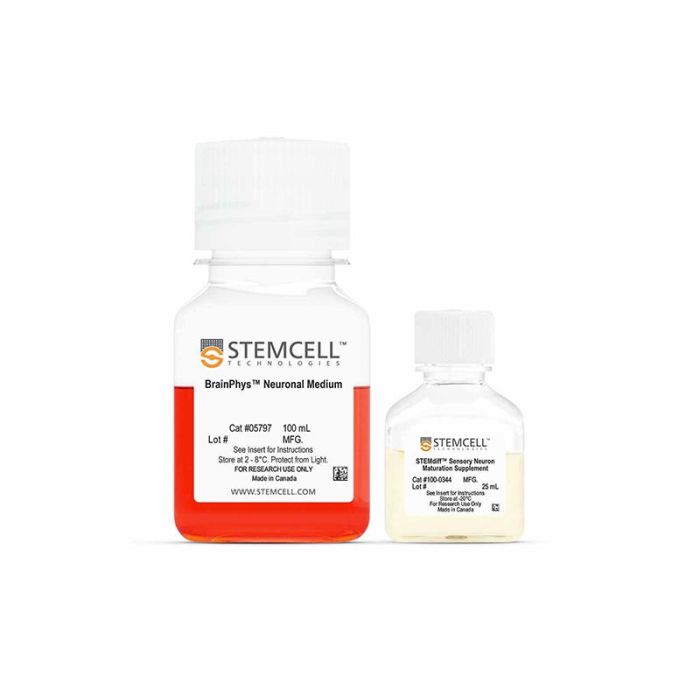
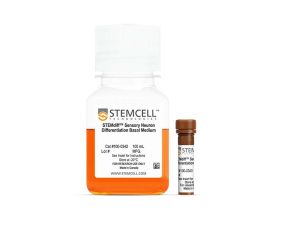
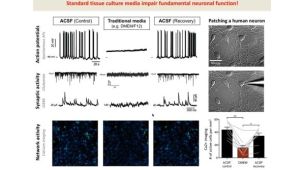
使用这种易于使用的培养系统在培养皿中生成功能性的、人类特异性的感觉神经元。STEMdiff™ 感觉神经元成熟试剂盒是从人多能干细胞 (hPSC) 开始,最终生成可用于药物研发和疼痛研究应用的感觉神经元的工作流程的最后一步。使用STEMdiff™ 神经嵴分化试剂盒获得 PSC 衍生的神经嵴细胞 (NCC) 后,可使用无血清 STEMdiff™ 感觉神经元分化试剂盒生成感觉神经元前体细胞。然后,可以使用 STEMdiff™ 感觉神经元成熟试剂盒来维持和成熟感觉神经元前体细胞。最终获得的细胞中,BRN3A 阳性,且超过 70% 为 TUJ1 阳性。以 BrainPhys™ 为基础培养基,提供生理水平的葡萄糖和渗透压条件,使得成熟神经元能对感觉配体及温度变化作出反应,展现出功能活性。
分类
专用培养基
细胞类型
神经细胞,PSC衍生,神经元
种属
人
应用
细胞培养,鉴定,分化,功能学筛选,免疫细胞化学,表型鉴定
品牌
BrainPhys,STEMdiff
研究领域
疾病建模,药物发现和毒理检测,神经科学
制剂类别
无血清
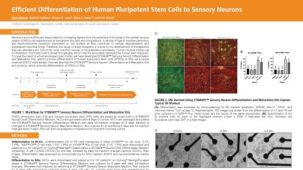
Figure 1. Schematic for the STEMdiff™ Sensory Neuron Culture System Protocol
Sensory neurons can be generated in 7 days from sensory neuron precursors after 6 days in STEMdiff™ Sensory Neuron Differentiation Medium. For the differentiation of sensory neuron precursors from hPSC-derived neural crest cells, see the PIS.
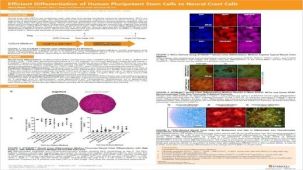
Figure 2. STEMdiff™ Sensory Neuron Kits Promote Differentiation Across Multiple Embryonic Stem and Induced Pluripotent Stem Cell Lines
NCCs generated from hPSCs in mTeSR™ Plus using the STEMdiff™ Neural Crest Differentiation Kit were differentiated and matured to sensory neurons using the STEMdiff™ Sensory Neuron Differentiation and Maturation Kits. (A) Sensory neurons were generated after hPSC-derived NCCs were cultured with the STEMdiff™ Sensory Neuron Differentiation Kit for 6 days and then the STEMdiff™ Sensory Neuron Maturation Kit for 6 days. The resulting cultures contain a population of cells expressing sensory neuron markers peripherin (green) and BRN3A (red) along with (B) neuronal marker class III β-tubulin (TUJ1, red). (C) Midbrain neuron controls generated with STEMdiff™ Midbrain Neuron Differentiation and Maturation Kits do not have detectable peripherin (green) or BRN3A (red) expression, although they express (D) neuronal marker class III β-tubulin (TUJ1, red). Nuclei are labeled with DAPI (blue). Human ES and iPS cell lines were maintained in either mTeSR™1, TeSR™-E8™, or mTeSR™ Plus and differentiated with STEMdiff™ Neural Crest Differentiation Kit, followed by STEMdiff™ Sensory Neuron Differentiation and Maturation Kits. The percentage expression of (E) BRN3A+ and (F) TUJ1+ cells in the resulting cultures was quantified. This differentiation generated BRN3A+ sensory neurons (25.3% ± 6.9%, mean ± SEM; n=7 cell lines, 3 - 23 replicates per condition) that expressed neuronal marker class III β-tubulin (TUJ1; 90.3% ± 4.1%, mean ± SEM; n=4 cell lines, 3 - 12 replicates per condition). Numbers are % positive over total DAPI in a tiled image. NCCs = neural crest cells; hPSCs = human pluripotent stem cells; ES = embryonic stem; iPS = induced pluripotent stem
Figure 3. Temporal Gene Expression Profile of Sensory Neurons Generated Using STEMdiff™ Sensory Neuron Kits Reveals Loss of Pluripotency and Progressive Acquisition of Sensory Neuron Identity and Maturity
PCA of whole-transcriptome bulk RNA-seq data collected across four time points show distinct transcriptomic shifts from pluripotency to mature sensory neuron identity. Tight clustering of hPSCs, distinct from sensory neurons, indicates significant transcriptional divergence. Day 6 neural crest cells are positioned closer to hPSCs along the first principal component than the Day 12 and Day 18 sensory neurons, suggesting progressive differentiation over time. The number of DEGs increases with maturation: 3,321 DEGs between hPSCs and Day 6 neural crest cells, 3,399 DEGs between hPSCs and Day 12 sensory neurons, and 3,689 DEGs between hPSCs and Day 18 sensory neurons, reflecting dynamic transcriptomic shifts during neuronal development. PCA = principal component analysis; hPSCs = human pluripotent stem cells; DEGs = differentially expressed genes
Figure 4. hPSC-Derived Sensory Neurons Generated Using STEMdiff™ Kits Show Lineage-Specific Upregulation of Pain and Itch Genes Compared to hPSC-Derived Forebrain Neurons
hPSC-derived forebrain neuron precursor cells and sensory neurons were generated from hPSC lines (SCTi003-A, H1, and H9) using the STEMdiff™ Forebrain Neuron or STEMdiff™ Sensory Neuron Differentiation Kits, respectively. The neuron precursors were then matured with corresponding STEMdiff™ maturation kits for an additional 14 days (forebrain neurons) or 6 days (sensory neurons) according to recommended protocols. RNA from mature forebrain and sensory neurons along with parent hPSC controls was subsequently sequenced using bulk RNA-seq. The heatmap shows expression of selected pain- and itch-related genes, including sensory neuron ion channels and receptors involved in nociception and thermosensation (e.g. TRPV1/2, TRPM8, SCN9A/SCN10A, P2RX3, and the itch-associated neuropeptide GRP), along with markers of sensory neuron identity (POU4F1/BRN3A) and neuronal and regional controls (TUBB3, FOXG1). Over- (orange) and under-expression (grey) compared to the gene expression average is computed for each gene. Each column represents a replicate from a specific cell line. Three hPSC lines were used across all samples, with a greater number of replicates in the hPSC controls. hPSC = human pluripotent stem cell; iPSC = induced pluripotent stem cell
请在《产品说明书》中查找相关支持信息和使用说明,或浏览下方更多实验方案。
本产品专为以下研究领域设计,适用于工作流程中的高亮阶段。探索这些工作流程,了解更多我们为各研究领域提供的其他配套产品。
Thank you for your interest in IntestiCult™ Organoid Growth Medium (Human). Please provide us with your contact information and your local representative will contact you with a customized quote. Where appropriate, they can also assist you with a(n):
Estimated delivery time for your area
Product sample or exclusive offer
In-lab demonstration
| 物种 | 人类 |
|---|---|
| 配方 | 无血清 |
提升神经元功能的无血清基础培养基
用于将人 ES 和 iPS 细胞衍生的神经前体细胞分化为神经元前体细胞的分化试剂盒
用于从人ES和iPS细胞衍生的神经元前体细胞生成功能性神经元的成熟试剂盒
抗人、小鼠、大鼠β-球蛋白III的小鼠Monoclonal IgG2a抗体
扫描二维码或搜索微信号STEMCELLTech,即可关注我们的微信平台,第一时间接收丰富的技术资源和最新的活动信息。
如您有任何问题,欢迎发消息给STEMCELLTech微信公众平台,或与我们通过电话/邮件联系:400 885 9050 INFO.CN@STEMCELL.COM。
在线联系