Smedman C et al. (SEP 2011)
Scandinavian journal of immunology
FluoroSpot analysis of TLR-activated monocytes reveals several distinct cytokine secreting subpopulations.
Monocytes have long been considered a heterogeneous group of cells both in terms of morphology and function. In humans,three distinct subsets have been described based on their differential expression of the cell surface markers CD14 and CD16. However,the relationship between these subsets and the production of cytokines has for the most part been based on ELISA measurements,making it difficult to draw conclusions as to their functional profile on the cellular level. In the present study,we have investigated lipoteichoic acid (LTA) and lipopolysaccharide (LPS) induced cytokine secretion by monocytes using the FluoroSpot technique. This method measures the number of cytokine secreting cells on the single cell level and uses fluorescent detection,allowing for the simultaneous analysis of two cytokines from the same population of isolated cells. By this approach,human monocytes from healthy volunteers could be divided into several subgroups as IL-1β,IL-6,TNF-α and MIP-1β were secreted by larger populations of responding cells (25.9-39.2%) compared to the smaller populations of GM-CSF (9.1%),IL-10 (1.3%) and IL-12p40 (1.2%). Furthermore,when studying co-secretion in FluoroSpot,an intricate relationship between the monocytes secreting IL-1β and/or IL-6 and those secreting TNF-α,MIP-1β,GM-CSF,IL-10 and IL-12p40 was revealed. In this way,dissecting the secretion pattern of the monocytes in response to TLR-2 or TLR-4 stimulation,several subpopulations with distinct cytokine secreting profiles could be identified.
View Publication
产品号#:
15028
15068
产品名:
RosetteSep™人单核细胞富集抗体混合物
RosetteSep™人单核细胞富集抗体混合物
Guzzo C et al. ( 2012)
The Journal of Immunology 188 2 864--873
IL-27 Enhances LPS-Induced Proinflammatory Cytokine Production via Upregulation of TLR4 Expression and Signaling in Human Monocytes
IL-27,which is produced by activated APCs,bridges innate and adaptive immunity by regulating the development of Th cells. Recent evidence supports a role for IL-27 in the activation of monocytic cells in terms of inflammatory responses. Indeed,proinflammatory and anti-inflammatory activities are attributed to IL-27,and IL-27 production itself is modulated by inflammatory agents such as LPS. IL-27 primes LPS responses in monocytes; however,the molecular mechanism behind this phenomenon is not understood. In this study,we demonstrate that IL-27 priming results in enhanced LPS-induced IL-6,TNF-α,MIP-1α,and MIP-1β expression in human primary monocytes. To elucidate the molecular mechanisms responsible for IL-27 priming,we measured levels of CD14 and TLR4 required for LPS binding. We determined that IL-27 upregulates TLR4 in a STAT3- and NF-κB-dependent manner. Immunofluorescence microscopy revealed enhanced membrane expression of TLR4 and more distinct colocalization of CD14 and TLR4 upon IL-27 priming. Furthermore,IL-27 priming enhanced LPS-induced activation of NF-κB family members. To our knowledge,this study is the first to show a role for IL-27 in regulating TLR4 expression and function. This work is significant as it reveals new mechanisms by which IL-27 can enhance proinflammatory responses that can occur during bacterial infections.
View Publication
产品号#:
19059
19059RF
产品名:
EasySep™人单核细胞富集试剂盒
RoboSep™ 人单核细胞富集试剂盒含滤芯吸头
Su YR et al. (AUG 2008)
Arteriosclerosis,thrombosis,and vascular biology 28 8 1439--46
Lentiviral transduction of apoAI into hematopoietic progenitor cells and macrophages: applications to cell therapy of atherosclerosis.
OBJECTIVE: We used genetically engineered mouse hematopoietic progenitor cells (HPCs) to investigate the therapeutic effects of human apoAI on atherosclerosis in apoE(-/-) mice. METHODS AND RESULTS: Lentiviral constructs expressing either human apoAI (LV-apoAI) or green fluorescent protein (LV-GFP) cDNA under a macrophage specific promoter (CD68) were generated and used for ex vivo transduction of mouse HPCs and macrophages. The transduction efficiency was textgreater25% for HPCs and textgreater70% for macrophages. ApoAI was found in the macrophage culture media,mostly associated with the HDL fraction. Interestingly,a significant increase in mRNA and protein levels for ATP binding cassette A1 (ABCA1) and ABCG1 were found in apoAI-expressing macrophages after acLDL loading. Expression of apoAI significantly increased cholesterol efflux in wild-type and apoE(-/-) macrophages. HPCs transduced with LV-apoAI ex vivo and then transplanted into apoE(-/-) mice caused a 50% reduction in atherosclerotic lesion area compared to GFP controls,without influencing plasma HDL-C levels. CONCLUSIONS: Lentiviral transduction of apoAI into HPCs reduces atherosclerosis in apoE(-/-) mice. Expression of apoAI in macrophages improves cholesterol trafficking in wild-type apoE-producing macrophages and causes upregulation of ABCA1 and ABCG1. These novel observations set the stage for a cell therapy approach to atherosclerosis regression,exploiting the cooperation between apoE and apoAI to maximize cholesterol exit from the plaque.
View Publication
产品号#:
09600
09650
18756
18756RF
18757
18757RF
产品名:
StemSpan™ SFEM
StemSpan™ SFEM
EasySep™小鼠SCA1正选试剂盒
RoboSep™ 小鼠SCA1正选试剂盒含滤芯吸头
EasySep™小鼠CD117(cKIT)正选试剂盒
RoboSep™ 小鼠CD117(cKIT)正选试剂盒含滤芯吸头
Reddy K et al. (JUN 2008)
Molecular cancer research : MCR 6 6 929--36
Bone marrow subsets differentiate into endothelial cells and pericytes contributing to Ewing's tumor vessels.
Hematopoietic progenitor cells arising from bone marrow (BM) are known to contribute to the formation and expansion of tumor vasculature. However,whether different subsets of these cells have different roles in this process is unclear. To investigate the roles of BM-derived progenitor cell subpopulations in the formation of tumor vasculature in a Ewing's sarcoma model,we used a functional assay based on endothelial cell and pericyte differentiation in vivo. Fluorescence-activated cell sorting of human cord blood/BM or mouse BM from green fluorescent protein transgenic mice was used to isolate human CD34+/CD38(-),CD34+/CD45+,and CD34(-)/CD45+ cells and mouse Sca1+/Gr1+,Sca1(-)/Gr1+,VEGFR1+,and VEGFR2+ cells. Each of these progenitor subpopulations was separately injected intravenously into nude mice bearing Ewing's sarcoma tumors. Tumors were resected 1 week later and analyzed using immunohistochemistry and confocal microscopy for the presence of migrated progenitor cells expressing endothelial,pericyte,or inflammatory cell surface markers. We showed two distinct patterns of stem cell infiltration. Human CD34+/CD45+ and CD34+/CD38(-) and murine VEGFR2+ and Sca1+/Gr1+ cells migrated to Ewing's tumors,colocalized with the tumor vascular network,and differentiated into cells expressing either endothelial markers (mouse CD31 or human vascular endothelial cadherin) or the pericyte markers desmin and alpha-smooth muscle actin. By contrast,human CD34(-)/CD45+ and mouse Sca1(-)/Gr1+ cells migrated predominantly to sites outside of the tumor vasculature and differentiated into monocytes/macrophages expressing F4/80 or CD14. Our data indicate that only specific BM stem/progenitor subpopulations participate in Ewing's sarcoma tumor vasculogenesis.
View Publication
产品号#:
02690
09600
09650
产品名:
StemSpan™ CC100
StemSpan™ SFEM
StemSpan™ SFEM
Dewhurst JA et al. (AUG 2017)
Scientific reports 7 1 7143
Characterisation of lung macrophage subpopulations in COPD patients and controls.
Lung macrophage subpopulations have been identified based on size. We investigated characteristics of small and large macrophages in the alveolar spaces and lung interstitium of COPD patients and controls. Alveolar and interstitial cells were isolated from lung resection tissue from 88 patients. Macrophage subpopulation cell-surface expression of immunological markers and phagocytic ability were assessed by flow cytometry. Inflammatory related gene expression was measured. Alveolar and interstitial macrophages had subpopulations of small and large macrophages based on size and granularity. Alveolar macrophages had similar numbers of small and large cells; interstitial macrophages were mainly small. Small macrophages expressed significantly higher cell surface HLA-DR,CD14,CD38 and CD36 and lower CD206 compared to large macrophages. Large alveolar macrophages showed lower marker expression in COPD current compared to ex-smokers. Small interstitial macrophages had the highest pro-inflammatory gene expression levels,while large alveolar macrophages had the lowest. Small alveolar macrophages had the highest phagocytic ability. Small alveolar macrophage CD206 expression was lower in COPD patients compared to smokers. COPD lung macrophages include distinct subpopulations; Small interstitial and small alveolar macrophages with more pro-inflammatory and phagocytic function respectively,and large alveolar macrophages with low pro-inflammatory and phagocytic ability.
View Publication
N. Kuroda et al. (jun 2019)
Scientific reports 9 1 8568
Infiltrating CCR2+ monocytes and their progenies, fibrocytes, contribute to colon fibrosis by inhibiting collagen degradation through the production of TIMP-1.
Intestinal fibrosis is a serious complication in inflammatory bowel disease (IBD). Despite the remarkable success of recent anti-inflammatory therapies for IBD,incidence of intestinal fibrosis and need for bowel resection have not significantly changed. To clarify the contribution of haematopoietic-derived cells in intestinal fibrosis,we prepared bone marrow (BM) chimeric mice (chimeras),which were reconstituted with BM cells derived from enhanced green fluorescent protein (EGFP)-transgenic mice or CC chemokine receptor 2 (CCR2)-deficient mice. After 2 months of transplantation,BM chimeras were treated with azoxymethane/dextran sodium sulphate. During chronic inflammation,CCR2+ BM-derived monocyte and fibrocyte infiltration into the colon and CC chemokine ligand 2 production increased,leading to colon fibrosis in EGFP BM chimeras. In CCR2-deficient BM chimeras,monocyte and fibrocyte numbers in the colonic lamina propria significantly decreased,and colon fibrosis was attenuated. In colon tissue,mRNA expression of tissue inhibitor of metalloproteinase (TIMP)-1 but not of collagen I,transforming growth factor-beta1 or matrix metalloproteinases was significantly different between the two chimeras. CCR2+ monocytes and fibrocytes showed high Timp1 mRNA expression. Our results suggest that infiltrating CCR2+ monocytes and their progenies,fibrocytes,promote colon fibrosis by inhibiting collagen degradation through TIMP-1 production.
View Publication


 EasySep™小鼠TIL(CD45)正选试剂盒





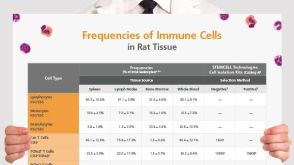 挂图Frequencies of Immune Cells in Rat Tissue Lists the estimated frequencies of more than 15 immune cell types in Sprague Dawley rats



 沪公网安备31010102008431号