Poulin LF et al. (JUN 2010)
The Journal of experimental medicine 207 6 1261--71
Characterization of human DNGR-1+ BDCA3+ leukocytes as putative equivalents of mouse CD8alpha+ dendritic cells.
In mouse,a subset of dendritic cells (DCs) known as CD8alpha+ DCs has emerged as an important player in the regulation of T cell responses and a promising target in vaccination strategies. However,translation into clinical protocols has been hampered by the failure to identify CD8alpha+ DCs in humans. Here,we characterize a population of human DCs that expresses DNGR-1 (CLEC9A) and high levels of BDCA3 and resembles mouse CD8alpha+ DCs in phenotype and function. We describe the presence of such cells in the spleens of humans and humanized mice and report on a protocol to generate them in vitro. Like mouse CD8alpha+ DCs,human DNGR-1+ BDCA3hi DCs express Necl2,CD207,BATF3,IRF8,and TLR3,but not CD11b,IRF4,TLR7,or (unlike CD8alpha+ DCs) TLR9. DNGR-1+ BDCA3hi DCs respond to poly I:C and agonists of TLR8,but not of TLR7,and produce interleukin (IL)-12 when given innate and T cell-derived signals. Notably,DNGR-1+ BDCA3+ DCs from in vitro cultures efficiently internalize material from dead cells and can cross-present exogenous antigens to CD8+ T cells upon treatment with poly I:C. The characterization of human DNGR-1+ BDCA3hi DCs and the ability to grow them in vitro opens the door for exploiting this subset in immunotherapy.
View Publication
Direct interaction of whole-inactivated influenza A and pneumococcal vaccines enhances influenza-specific immunity.
The upper respiratory tract is continuously exposed to a vast array of potentially pathogenic viruses and bacteria. Influenza A virus (IAV) has particular synergism with the commensal bacterium Streptococcus pneumoniae in this niche,and co-infection exacerbates pathogenicity and causes significant mortality. However,it is not known whether this synergism is associated with a direct interaction between the two pathogens. We have previously reported that co-administration of a whole-inactivated IAV vaccine (gamma-Flu) with a whole-inactivated pneumococcal vaccine (gamma-PN) enhances pneumococcal-specific responses. In this study,we show that mucosal co-administration of gamma-Flu and gamma-PN similarly augments IAV-specific immunity,particularly tissue-resident memory cell responses in the lung. In addition,our in vitro analysis revealed that S. pneumoniae directly interacts with both gamma-Flu and with live IAV,facilitating increased uptake by macrophages as well as increased infection of epithelial cells by IAV. These observations provide an additional explanation for the synergistic pathogenicity of IAV and S. pneumoniae,as well as heralding the prospect of exploiting the phenomenon to develop better vaccine strategies for both pathogens.
View Publication


 EasySep™小鼠TIL(CD45)正选试剂盒




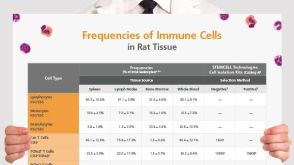 挂图Frequencies of Immune Cells in Rat Tissue Lists the estimated frequencies of more than 15 immune cell types in Sprague Dawley rats

 沪公网安备31010102008431号