Daniels TR et al. ( 2011)
Journal of immunotherapy (Hagerstown,Md. : 1997) 34 6 500--8
An antibody-based multifaceted approach targeting the human transferrin receptor for the treatment of B-cell malignancies.
We previously developed an antibody-avidin fusion protein (ch128.1Av) targeting the human transferrin receptor 1 (TfR1,also known as CD71),which demonstrates direct in vitro cytotoxicity against malignant hematopoietic cells. This cytotoxicity is attributed to its ability to decrease the level of TfR1 leading to lethal iron deprivation. We now report that ch128.1Av shows the ability to bind the Fcγ receptors and the complement component C1q,suggesting that it is capable of eliciting Fc-mediated effector functions such as antibody-dependent cell-mediated cytotoxicity and complement-mediated cytotoxicity. In addition,in 2 disseminated multiple myeloma xenograft mouse models,we show that a single dose of ch128.1Av results in significant antitumor activity,including long-term survival. It is interesting to note that the parental antibody without avidin (ch128.1) also shows remarkable in vivo anticancer activity despite its limited in vitro cytotoxicity. Finally,we demonstrate that ch128.1Av is not toxic to pluripotent hematopoietic progenitor cells using the long-term cell-initiating culture assay suggesting that these important progenitors would be preserved in different therapeutic approaches,including the in vitro purging of cancer cells for autologous transplantation and in vivo passive immunotherapy. Our results suggest that ch128.1Av and ch128.1 may be effective in the therapy of human multiple myeloma and potentially other hematopoietic malignancies.
View Publication
产品号#:
70001
70001.1
70001.2
70001.3
70001.4
产品名:
Zeng J et al. (MAY 2012)
The Journal of Immunology 188 9 4297--4304
Enhancing Immunostimulatory Function of Human Embryonic Stem Cell-Derived Dendritic Cells by CD1d Overexpression
Human embryonic stem cell-derived dendritic cells (hESC-DCs) may potentially provide a platform to generate off-the-shelf" therapeutic cancer vaccines. To apply hESC-DCs for cancer immunotherapy in a semiallogeneic setting�
View Publication
产品号#:
05850
05857
05870
05875
09600
09650
70024
70024.1
85850
85857
85870
85875
70025
70025.1
70025.2
70025.3
70047
70047.1
70047.2
70048
70048.1
70048.2
产品名:
StemSpan™ SFEM
StemSpan™ SFEM
冻存的人外周血Pan T细胞
冻存的人外周血Pan T细胞
mTeSR™1
mTeSR™1
冻存的人外周血单个核细胞
冻存的人外周血单个核细胞
冻存的人外周血单个核细胞
冻存的人外周血单个核细胞
Nettenstrom L et al. (JAN 2013)
Journal of immunological methods 387 2-Jan 81--8
An optimized multi-parameter flow cytometry protocol for human T regulatory cell analysis on fresh and viably frozen cells, correlation with epigenetic analysis, and comparison of cord and adult blood.
Multi-parameter flow cytometry analysis of T regulatory (Treg) cells is a widely used approach in basic and translational research studies. This approach has been complicated by a lack of specific markers for Treg cells and lack of uniformity in the quantification of Treg cells. Given the central role of Treg cells in the inception and perpetuation of diverse immune responses as well as its target as a therapeutic,it is imperative to have established methodologies for Treg cell analysis that are robust and usable for studies with multiple subjects as well as multicenter studies. In this study,we describe an optimized multi-parameter flow cytometry protocol for the quantification of human Treg cells from freshly obtained and viably frozen samples and correlations with epigenetic Treg cell analysis (TSDR demethylation). We apply these two methodologies to characterize Treg cell differences between cord blood and adult peripheral blood. In summary,the optimized protocol appears to be robust for Treg cell quantification from freshly isolated or viably frozen cells and the multi-parameter flow cytometry findings are strongly positively correlated with TSDR demethylation thus providing several options for the characterization of Treg cell frequency and function in large translational or clinical studies.
View Publication


 EasySep™小鼠TIL(CD45)正选试剂盒






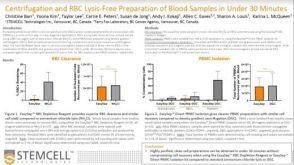 科学海报Centrifugation and RBC Lysis-Free Preparation of Blood Samples in Under 30 Minutes
 沪公网安备31010102008431号