若您需要咨询产品或有任何技术问题,请通过官方电话 400 885 9050 或邮箱 info.cn@stemcell.com 与我们联系。

STEMdiff™ 间充质祖细胞试剂盒

用于分化和扩增间充质祖细胞的成分明确的培养试剂盒
只有 %1
¥11,168.00

产品号 #(选择产品)

产品号 #05240_C

用于分化和扩增间充质祖细胞的成分明确的培养试剂盒

产品优势

  • 无血清、无动物成分的配方
  • 可高效且重复性良好地从人胚胎干细胞(ES)和诱导多能干细胞(iPS)系中生成间充质祖细胞(MPCs)
  • 3 周内快速诱导生成 MPCs
  • 所生成的 MPCs 可长期扩增,并具备向脂肪细胞、成骨细胞和软骨细胞分化的能力

产品组分包括

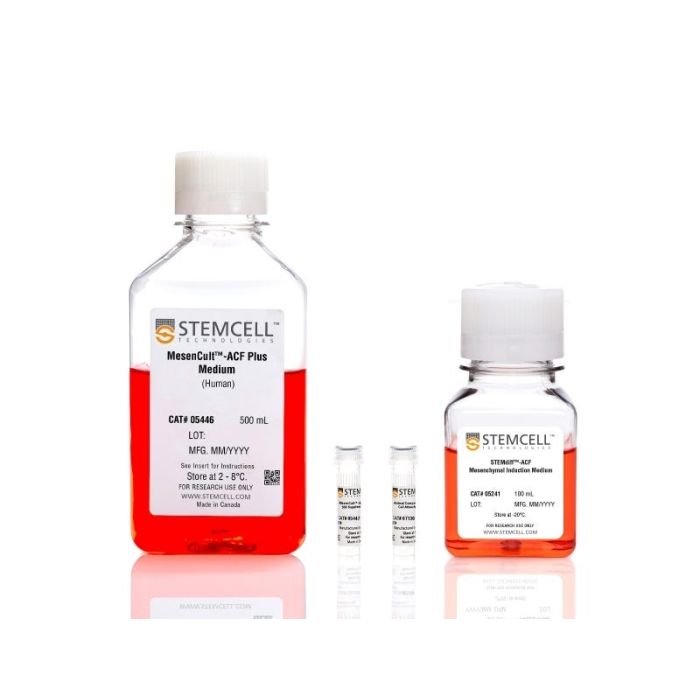
  • STEMdiff™-ACF 间充质诱导培养基,100 mL
  • MesenCult™-ACF Plus 培养基,500 mL
  • MesenCult™-ACF Plus 500X 补充剂,1 mL
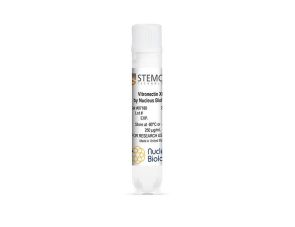
  • 无动物成分细胞附着基质,1 mL
Need a high-quality cell source? Use the hiPSC SCTi003-A (female) or SCTi004-A (male) control lines, manufactured with mTeSR™ Plus.
专为您的实验方案打造的产品
要查看实验方案所需的所有配套产品,请参阅《实验方案与技术文档》

总览

使用STEMdiff™间充质祖细胞试剂盒,可高效且可重复地从人多能干细胞(hPSCs)中诱导生成间充质祖细胞(MPCs)。这款完全无动物成分(ACF)的试剂盒提供从人胚胎干细胞(ESCs)或诱导多能干细胞(iPSCs)诱导和扩增MPCs所需的所有试剂。

使用该试剂盒生成的细胞表达标志性的间充质标志物(CD73、CD90、CD105),当与MesenCult™分化试剂盒配合使用时,表现出强效扩增以及向脂肪生成、成骨和软骨生成谱系的分化能力。与原代间充质基质细胞(MSCs)相比,使用该工作流程衍生的MPCs表现出降低的异质性,并为再生医学研究、疾病建模和药物发现提供了一致且可重复的平台。

有关MSC的进一步分化和培养,请查看我们的MesenCult™ MSC细胞培养产品组合,其中包含人iPSC衍生的间充质祖细胞,以便您使用经过验证的纯MSC细胞培养物开始您的实验。

CollPlant是细胞贴附基质中重组人胶原蛋白(rhCollagen)成分的制造商。

本产品仅供研究使用。如需将本产品用于任何临床或商业用途,请联系STEMCELL。


分类
专用培养基
 
细胞类型
间充质细胞,PSC衍生
 
种属

 
应用
细胞培养,分化
 
品牌
STEMdiff
 
研究领域
药物发现和毒性检测,干细胞生物学
 
制剂类别
不含动物成分,无血清
 

实验数据

Human ES- and iPS-derived MPCs Can Be Further Differentiated Into Adipogenic, Chondrogenic and Osteogenic Lineages

Figure 1. Schematic of Differentiation Protocol and Timeline

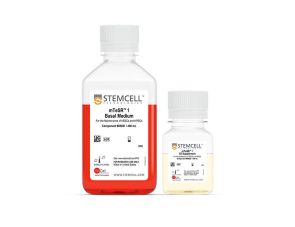
In Phase 1, human embryonic stem cells (hESCs) or human induced pluripotent stem cells (hiPSCs) are cultured in mTeSR™1, mTeSR™Plus, or TeSR™-E8™ medium. On Day 0 (Phase 2) of the protocol, cells are ready for induction into early mesoderm progenitor cells by replacing TeSR™ medium with STEMdiff™-ACF Mesenchymal Induction Medium. By Day 4 (Phase 3), STEMdiff™-ACF Mesenchymal Induction Medium is replaced with MesenCult™-ACF Plus Medium to derive early mesenchymal progenitor cells (MPCs). On Day 6, cells are passaged onto cultureware precoated with MesenCult™-ACF Attachment Substrate in MesenCult™-ACF Plus Medium. By Day 21, hESC- or hiPSC-derived MPCs exhibit the characteristics of MPCs.

Cell Expansion and Doubling Rate of MPCs Derived from Human ES (H9) and iPS (STiPS-F016 and -F031) Cells in MesenCult™-ACF Medium

Figure 2. Cell Expansion and Doubling Rate of MPCs Derived from hESCs (H9) and hiPSCs (STiPS-M001, SCTi003-A, WLS-1C H9 ) in MesenCult™-ACF Plus Medium

(A) Cumulative cell expansion over 12 passages for MPCs derived from hESC and hiPSC lines. (B) Doubling time for hESC- and hiPSC-derived MPCs.

A Representative Flow Cytometric Analysis of STiPS-F016-derived MPCs Expressing Mesenchymal Surface Markers By Day 21

Figure 3. A Representative Flow Cytometric Analysis of STiPS-M001-derived MPCs Expressing Mesenchymal Surface Markers by Day 21

hiPSC-derived MPCs, generated using the STEMdiff™ Mesenchymal Progenitor Kit, express high levels of mesenchymal surface markers (CD73, CD90, and CD105). hESC-derived MPCs display the same phenotype (data not shown).

Human ES- and iPS-derived MPCs Can Be Further Differentiated Into Adipogenic, Chondrogenic and Osteogenic Lineages

Figure 4. hESC- and hiPSC-derived MPCs Can Be Further Differentiated into Adipogenic, Chondrogenic and Osteogenic Lineages

(A) MPCs generated from the 21 day protocol (described in Figure 1) and subsequently cultured in MesenCult™-ACF Plus Medium develop MPC-like morphology. MPCs can be differentiated to (B) adipocytes (Oil Red O staining); (C) chondrocytes (Alcian Blue staining); and (D) osteoblasts (Alizarin Red S staining).

产品说明书及文档

请在《产品说明书》中查找相关支持信息和使用说明,或浏览下方更多实验方案。

Document Type
Product Name
Catalog #
Lot #
Language
Catalog #
05240
Lot #
All
Language
English
Document Type
Safety Data Sheet 1
Catalog #
05240
Lot #
All
Language
English
Document Type
Safety Data Sheet 2
Catalog #
05240
Lot #
All
Language
English
Document Type
Safety Data Sheet 3
Catalog #
05240
Lot #
All
Language
English
Document Type
Safety Data Sheet 4
Catalog #
05240
Lot #
All
Language
English

应用领域

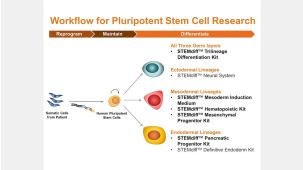
本产品专为以下研究领域设计,适用于工作流程中的高亮阶段。探索这些工作流程,了解更多我们为各研究领域提供的其他配套产品。

相关材料与文献

技术资料 (9)

文献 (12)

Ex Vivo Expansion of CD34+ CD90+ CD49f+ Hematopoietic Stem and Progenitor Cells from Non-Enriched Umbilical Cord Blood with Azole Compounds. S. Bari et al. Stem cells translational medicine 2018

Abstract

Umbilical cord blood (UCB) transplants in adults have slower hematopoietic recovery compared to bone marrow (BM) or peripheral blood (PB) stem cells mainly due to low number of total nucleated cells and hematopoietic stem and progenitor cells (HSPC). As such in this study,we aimed to perform ex vivo expansion of UCB HSPC from non-enriched mononucleated cells (MNC) using novel azole-based small molecules. Freshly-thawed UCB-MNC were cultured in expansion medium supplemented with small molecules and basal cytokine cocktail. The effects of the expansion protocol were measured based on in vitro and in vivo assays. The proprietary library of {\textgreater}50 small molecules were developed using structure-activity-relationship studies of SB203580,a known p38-MAPK inhibitor. A particular analog,C7,resulted in 1,554.1 ± 27.8-fold increase of absolute viable CD45+ CD34+ CD38- CD45RA- progenitors which was at least 3.7-fold higher than control cultures (p {\textless} .001). In depth phenotypic analysis revealed {\textgreater}600-fold expansion of CD34+ /CD90+ /CD49f+ rare HSPCs coupled with significant (p {\textless} .01) increase of functional colonies from C7 treated cells. Transplantation of C7 expanded UCB grafts to immunodeficient mice resulted in significantly (p {\textless} .001) higher engraftment of human CD45+ and CD45+ CD34+ cells in the PB and BM by day 21 compared to non-expanded and cytokine expanded grafts. The C7 expanded grafts maintained long-term human multilineage chimerism in the BM of primary recipients with sustained human CD45 cell engraftment in secondary recipients. In conclusion,a small molecule,C7,could allow for clinical development of expanded UCB grafts without pre-culture stem cell enrichment that maintains in vitro and in vivo functionality. Stem Cells Translational Medicine 2018;7:376-393.
Linking a cell-division gene and a suicide gene to define and improve cell therapy safety. Q. Liang et al. Nature 2018

Abstract

Human pluripotent cell lines hold enormous promise for the development of cell-based therapies. Safety,however,is a crucial prerequisite condition for clinical applications. Numerous groups have attempted to eliminate potentially harmful cells through the use of suicide genes1,but none has quantitatively defined the safety level of transplant therapies. Here,using genome-engineering strategies,we demonstrate the protection of a suicide system from inactivation in dividing cells. We created a transcriptional link between the suicide gene herpes simplex virus thymidine kinase (HSV-TK) and a cell-division gene (CDK1); this combination is designated the safe-cell system. Furthermore,we used a mathematical model to quantify the safety level of the cell therapy as a function of the number of cells that is needed for the therapy and the type of genome editing that is performed. Even with the highly conservative estimates described here,we anticipate that our solution will rapidly accelerate the entry of cell-based medicine into the clinic.
miR-520d-5p can reduce the mutations in hepatoma cancer cells and iPSCs-derivatives. N. Miura et al. BMC cancer 2019 jun

Abstract

BACKGROUND Human microRNAs (miRNAs) have diverse functions in biology,and play a role in nearly every biological process. Here we report that miR-520d-5p (520d-5p) causes undifferentiated cancer cells to adopt benign or normal status in vivo in immunodeficient mice via demethylation and P53 upregulation. Further we found that 520-5p causes normal cells to elongate cellular lifetime and mesenchymal stem cell-like status with CD105 positivity. We hypothesized that ectopic 520d-5p expression reduced mutations in undifferentiated type of hepatoma (HLF) cells through synergistic modulation of methylation-related enzymatic expression. METHODS To examine whether there were any changes in mutation status in cells treated with 520d-5p,we performed next generation sequencing (NGS) in HLF cells and human iPSC-derivative cells in pre-mesenchymal stem cell status. We analyzed the data using both genome-wide and individual gene function approaches. RESULTS 520d-5p induced a shift towards a wild type or non-malignant phenotype,which was regulated by nucleotide mutations in both HLF cells and iPSCs. Further,520d-5p reduced mutation levels in both the whole genome and genomic fragment assemblies. CONCLUSIONS Cancer cell genomic mutations cannot be repaired in most contexts. However,these findings suggest that applied development of 520d-5p would allow new approaches to cancer research and improve the quality of iPSCs used in regenerative medicine.

更多信息

更多信息
物种
配方 不含动物成分, 无血清
质量保证:

产品仅供研究使用,不用于针对人或动物的诊断或治疗。 欲获悉更多关于STEMCELL的质控信息,请访问 STEMCELL.CN/COMPLIANCE.
Copyright © 2026 by STEMCELL Technologies. All rights reserved.

在线联系