若您需要咨询产品或有任何技术问题,请通过官方电话 400 885 9050 或邮箱 info.cn@stemcell.com 与我们联系。

MesenCult™ 脂肪分化试剂盒 (人)

人MSCs向脂肪细胞分化的培养基
只有 %1
¥2,710.00

产品号 #(选择产品)

产品号 #05412_C

人MSCs向脂肪细胞分化的培养基

产品优势

  • 高效和通用的人MSC向脂肪细胞分化培养基;
  • 为先前在含血清或无血清培养基(如MesenCult™-ACF Plus 培养基)中培养的骨髓和脂肪组织来源的人MSCs的分化而优化;
  • 先前在含血小板裂解物培养基中培养的人MSCs兼容

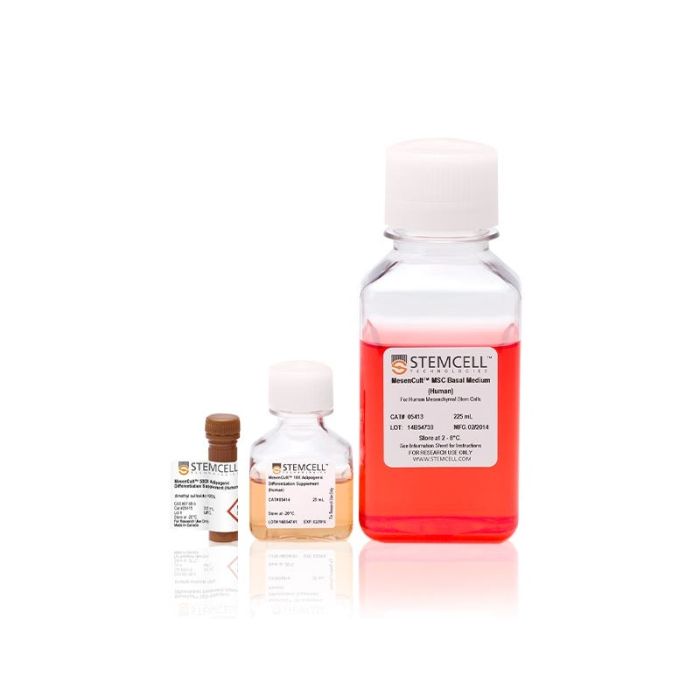
产品组分包括

  • MesenCult™ MSC 脂肪分化基础培养基 (人), 225 mL
  • MesenCult™ 10X 脂肪分化补充剂 (人), 25 mL
  • MesenCult™ 500X 脂肪分化补充剂 (人), 0.5 mL

总览

MesenCult™ 脂肪分化试剂盒 (人) 是专门为原代人间充质间质细胞和多能干细胞来源的间充质祖细胞(也称为间充质干细胞或MSCs)在体外分化成脂肪生成谱系细胞而研发。该试剂盒适用于分化来源于人骨髓(Bone marrow),脂肪组织(Adipose tissue),脐带组织或多能干细胞的 MSCs的成脂分化。这些MSCs分化前可在无血清和无动物成分培养基(例如MesenCult™ACF Plus培养基[产品号 #05445]),含血清培养基(例如MesenCult™ 扩增试剂盒 (人)[产品号 #05411])或含血小板裂解物培养基(例如MesenCult™-hPL培养基试剂盒[产品号 #05439])中培养扩增。

分类
专用培养基
 
细胞类型
脂肪细胞,间充质干/祖细胞
 
种属

 
应用
细胞培养,分化
 
品牌
MesenCult
 
研究领域
干细胞生物学
 

实验数据

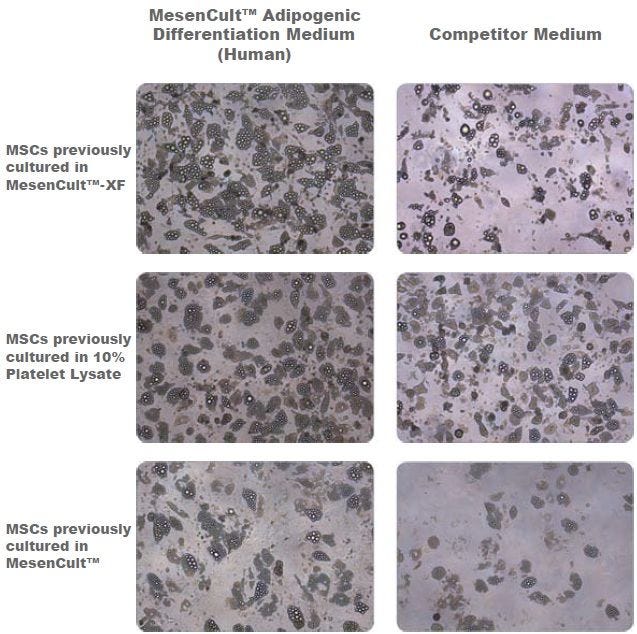
Adipogenic Differentiation of Human Bone Marrow-Derived MSCs

Figure 1. Adipogenic Differentiation of Human Bone Marrow-Derived MSCs

Adipogenic differentiation of human bone marrow-derived MSCs using MesenCult™ Adipogenic Differentiation Medium (Human) or a competitor medium. Prior to differentiation, MSCs were cultured for 2 passages in either serum- and xeno-free media (MesenCult™-XF or a 10% platelet lysate-based formulation) or serum-containing medium (MesenCult™) before undergoing differentiation. Even though differentation results are donor dependent, MesenCult™ Adipogenic Differentiation Medium (Human) consistently performed as well as, or better than the competitor medium. This trend was consistent for MSCs previously cultured in MesenCult™-XF, 10% Platelet Lysate or MesenCult™ medium.

产品说明书及文档

请在《产品说明书》中查找相关支持信息和使用说明,或浏览下方更多实验方案。

Document Type
Product Name
Catalog #
Lot #
Language
Catalog #
05412
Lot #
All
Language
English
Document Type
Safety Data Sheet 1
Catalog #
05412
Lot #
All
Language
English
Document Type
Safety Data Sheet 2
Catalog #
05412
Lot #
All
Language
English
Document Type
Safety Data Sheet 3
Catalog #
05412
Lot #
All
Language
English
Document Type
Safety Data Sheet 4
Catalog #
05412
Lot #
All
Language
English

应用领域

本产品专为以下研究领域设计,适用于工作流程中的高亮阶段。探索这些工作流程,了解更多我们为各研究领域提供的其他配套产品。

相关材料与文献

技术资料 (6)

文献 (14)

Mesenchymal stem cell cryopreservation with cavitation-mediated trehalose treatment C. V. Fuenteslópez et al. Communications Engineering 2024 Sep

Abstract

Dimethylsulfoxide (DMSO) has conventionally been used for cell cryopreservation both in research and in clinical applications, but has long-term cytotoxic effects. Trehalose, a natural disaccharide, has been proposed as a non-toxic cryoprotectant. However, the lack of specific cell membrane transporter receptors inhibits transmembrane transport and severely limits its cryoprotective capability. This research presents a method to successfully deliver trehalose into mesenchymal stem cells (MSCs) using ultrasound in the presence of microbubbles. The optimised trehalose concentration was shown to be able to not only preserve membrane integrity and cell viability but also the multipotency of MSCs, which are essential for stem cell therapy. Confocal imaging revealed that rhodamine-labelled trehalose was transported into cells rather than simply attached to the membrane. Additionally, the membranes were successfully preserved in lyophilised cells. This study demonstrates that ultrasonication with microbubbles facilitated trehalose delivery, offering promising cryoprotective capability without the cytotoxicity associated with DMSO-based methods. Subject terms: Membrane biophysics, Biomedical engineering
Differential expression of drug resistance genes in CD146 positive dental pulp derived stem cells and CD146 negative fibroblasts. M. S. Tavangar et al. Clinical and experimental dental research 2020 may

Abstract

INTRODUCTION The stem cell portion of the dental pulp derived cultures (DPSCs) showed a higher resistance to cytotoxic effect of restorative dental materials compared to pulpal fibroblasts (DPFs). Here, we aimed to compare the expression of some drug resistant genes between these cells. METHODS AND MATERIALS To separate DPSCs from DPFs, we used magnetic cell sorting technique based on CD146 expression. To assess the stem cell properties, the positive and negative portions underwent colony forming assays and were induced to be differentiated into the adipocytes, osteoblasts, hepatocytes, and neural cells. Cell surface antigen panels were checked using immune fluorescence and flow-cytometry techniques. The mRNA expression of 14 ABC transporters including ABCA2, ABCB1, ABCB11, ABCC1, ABCC2, ABCC3, ABCC4, ABCC5-2, ABCC5-4,ABCC5-13, ABCC6, ABCC10, ABCC11, and ABCG2 genes was assessed, using quantitative RT-PCR technique. RESULTS Only the CD146 positive portion could be differentiated into the desired fates, and they formed higher colonies (16.7 ± 3.32 vs. 1.7 ± 1.67, p {\textless} .001). The cell surface antigen panels were the same, except for CD146 and STRO-1 markers which were expressed only in the positive portion. Among the ABC transporter genes studied, the positive portion showed a higher expression (approximately two-fold) of ABCA2, ABCC5-13, and ABCC5-2 genes. CONCLUSION Dental pulp stem cells which can be separated from dental pulp fibroblasts based on CD146 expression, express higher levels of some drug resistance genes which probably accounts for their features of more resistance to cytotoxic effects of some dental materials. This needs to be more validated in future.
In situ repair abilities of human umbilical cord-derived mesenchymal stem cells and autocrosslinked hyaluronic acid gel complex in rhesus monkeys with intrauterine adhesion. L. Wang et al. Science advances 2020 may

Abstract

Increasing occurrence of moderate to severe intrauterine adhesion (IUA) is seriously affecting the quality of human life. The aim of the study was to establish IUA models in nonhuman primates and to explore the dual repair effects of human umbilical cord-derived mesenchymal stem cells (huMSCs) loaded on autocrosslinked hyaluronic acid gel (HA-GEL) on endometrial damage and adhesion. Here, we recorded the menstrual cycle data in detail with uterine cavities observed and endometrial tissues detected after intervention, and the thicker endometria, decreased amount of fibrotic formation, increased number of endometrium glands, etc., suggested that both HA-GEL and huMSC/HA-GEL complexes could partially repair IUA caused by mechanical injury, but huMSC/HA-GEL complex transplantation had notable dual repair effects: a reliable antiadhesion property and the promotion of endometrial regeneration.

更多信息

更多信息
物种 人类
质量保证:

产品仅供研究使用,不用于针对人或动物的诊断或治疗。 欲获悉更多关于STEMCELL的质控信息,请访问 STEMCELL.CN/COMPLIANCE.
Copyright © 2025 by STEMCELL Technologies. All rights reserved.

在线联系