若您需要咨询产品或有任何技术问题,请通过官方电话 400 885 9050 或邮箱 info.cn@stemcell.com 与我们联系。

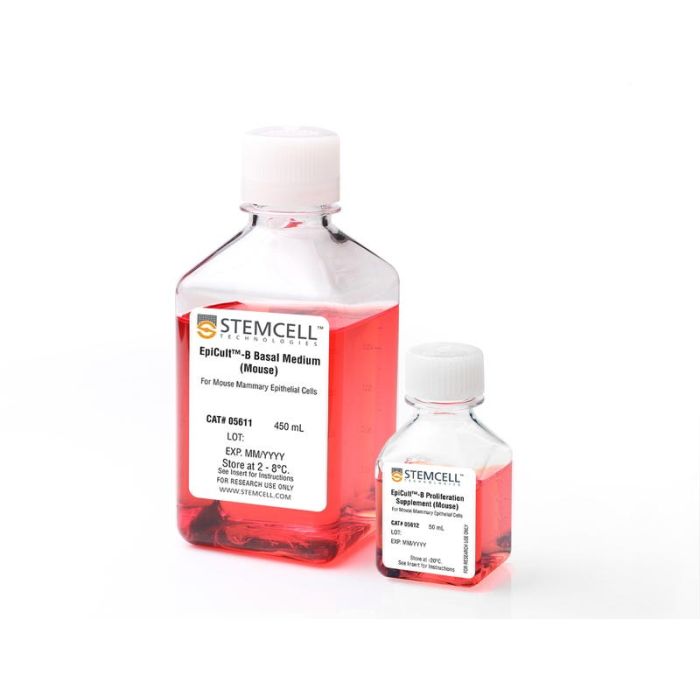
EpiCult™-B 小鼠培养基

用于小鼠乳腺上皮细胞的培养和评估
只有 %1
¥4,550.00

产品号 #(选择产品)

产品号 #05610_C

用于小鼠乳腺上皮细胞的培养和评估

产品组分包括

  • EpiCult™-B 基础培养基(小鼠),450 mL
  • EpiCult™-B 增殖添加物(小鼠),50 mL
专为您的实验方案打造的产品
要查看实验方案所需的所有配套产品,请参阅《实验方案与技术文档》

总览

EpiCult™-B(小鼠)是一种无血清液体培养基,专为培养小鼠乳腺腔细胞和肌上皮细胞而优化。它与辐照饲养层细胞(例如NIH 3T3细胞)配合使用,是乳腺集落形成单位(CMD)实验中培养和评估小鼠乳腺上皮祖细胞的理想选择。添加胶原酶和透明质酸酶后,该培养基也可用于小鼠乳腺组织的酶解。培养细胞时需要添加人重组EGF(产品号 #78006)、人重组bFGF(产品号 #78003)和肝素溶液(产品号 #07980)。

分类
专用培养基
 
细胞类型
乳腺细胞
 
种属
小鼠
 
应用
细胞培养,克隆筛选
 
品牌
EpiCult
 
研究领域
上皮细胞研究
 
制剂类别
无血清
 

实验数据

Protocol for isolation and identification of human and mouse mammary epithelial progenitor cells

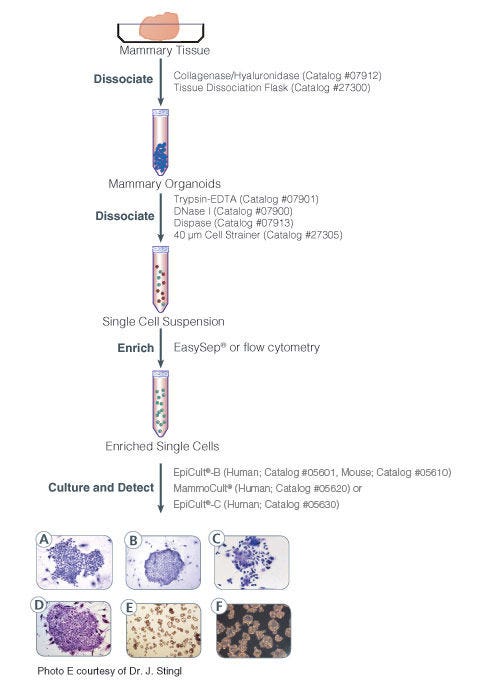
Figure 1. Protocol for Isolation and Identification of Human and Mouse Mammary Epithelial Progenitor Cells

Phase contrast photographs of (A) a pure human myoepithelial cell colony, (B) a pure human luminal cell colony, and (C) a mixed human colony. (D) is a mouse colony. Unlike human mammary CFC colonies, subtypes of mouse mammary epithelial cell colonies are not easily identifiable. All colonies were cultured in either EpiCult®-B (Human: Catalog #05601) or EpiCult®-B (Mouse:Catalog #5610) in the presence of an irradiated NIH 3T3 feeder layer. Colonies were visualized by staining with Wright"s Giemsa. (E) is a picture of mammospheres obtained from primary human mammary epithelial cells and (F) is an image of tumorspheres obtained from MCF7 human breast cancer cell line.

产品说明书及文档

请在《产品说明书》中查找相关支持信息和使用说明,或浏览下方更多实验方案。

Document Type
Product Name
Catalog #
Lot #
Language
Catalog #
05610
Lot #
All
Language
English
Document Type
Safety Data Sheet 1
Catalog #
05610
Lot #
All
Language
English
Document Type
Safety Data Sheet 2
Catalog #
05610
Lot #
All
Language
English

应用领域

本产品专为以下研究领域设计,适用于工作流程中的高亮阶段。探索这些工作流程,了解更多我们为各研究领域提供的其他配套产品。

相关材料与文献

技术资料 (2)

文献 (9)

Characterization of bipotent mammary epithelial progenitor cells in normal adult human breast tissue. Stingl J et al. Breast cancer research and treatment 2001 MAY

Abstract

The purpose of the present study was to characterize primitive epithelial progenitor populations present in adult normal human mammary tissue using a combination of flow cytometry and in vitro colony assay procedures. Three types of human breast epithelial cell (HBEC) progenitors were identified: luminal-restricted,myoepithelial-restricted and bipotent progenitors. The first type expressed epithelial cell adhesion molecule (EpCAM),alpha6 integrin and MUC1 and generated colonies composed exclusively of cells positive for the luminal-associated markers keratin 8/18,keratin 19,EpCAM and MUC1. Bipotent progenitors produced colonies containing a central core of cells expressing luminal markers surrounded by keratin 14+ myoepithelial-like cells. Single cell cultures confirmed the bipotentiality of these progenitors. Their high expression of alpha6 integrin and low expression of MUC1 suggests a basal position of these cells in the mammary epithelium in vivo. Serial passage in vitro of an enriched population of bipotent progenitors demonstrated that only myoepithelial-restricted progenitors could be readily generated under the culture conditions used. These results support a hierarchical branching model of HBEC progenitor differentiation from a primitive uncommitted cell to luminal- and myoepithelial-restricted progenitors.
Generation of a functional mammary gland from a single stem cell. Shackleton M et al. Nature 2006 JAN

Abstract

The existence of mammary stem cells (MaSCs) has been postulated from evidence that the mammary gland can be regenerated by transplantation of epithelial fragments in mice. Interest in MaSCs has been further stimulated by their potential role in breast tumorigenesis. However,the identity and purification of MaSCs has proved elusive owing to the lack of defined markers. We isolated discrete populations of mouse mammary cells on the basis of cell-surface markers and identified a subpopulation (Lin-CD29hiCD24+) that is highly enriched for MaSCs by transplantation. Here we show that a single cell,marked with a LacZ transgene,can reconstitute a complete mammary gland in vivo. The transplanted cell contributed to both the luminal and myoepithelial lineages and generated functional lobuloalveolar units during pregnancy. The self-renewing capacity of these cells was demonstrated by serial transplantation of clonal outgrowths. In support of a potential role for MaSCs in breast cancer,the stem-cell-enriched subpopulation was expanded in premalignant mammary tissue from MMTV-wnt-1 mice and contained a higher number of MaSCs. Our data establish that single cells within the Lin-CD29hiCD24+ population are multipotent and self-renewing,properties that define them as MaSCs.
Cancer stem cells contribute to cisplatin resistance in Brca1/p53-mediated mouse mammary tumors. Shafee N et al. Cancer research 2008 MAY

Abstract

The majority of BRCA1-associated breast cancers are basal cell-like,which is associated with a poor outcome. Using a spontaneous mouse mammary tumor model,we show that platinum compounds,which generate DNA breaks during the repair process,are more effective than doxorubicin in Brca1/p53-mutated tumors. At 0.5 mg/kg of daily cisplatin treatment,80% primary tumors (n = 8) show complete pathologic response. At greater dosages,100% show complete response (n = 19). However,after 2 to 3 months of complete remission following platinum treatment,tumors relapse and become refractory to successive rounds of treatment. Approximately 3.8% to 8.0% (mean,5.9%) of tumor cells express the normal mammary stem cell markers,CD29(hi)24(med),and these cells are tumorigenic,whereas CD29(med)24(-/lo) and CD29(med)24(hi) cells have diminished tumorigenicity or are nontumorigenic,respectively. In partially platinum-responsive primary transplants,6.6% to 11.0% (mean,8.8%) tumor cells are CD29(hi)24(med); these populations significantly increase to 16.5% to 29.2% (mean,22.8%; P textless 0.05) in platinum-refractory secondary tumor transplants. Further,refractory tumor cells have greater colony-forming ability than the primary transplant-derived cells in the presence of cisplatin. Expression of a normal stem cell marker,Nanog,is decreased in the CD29(hi)24(med) populations in the secondary transplants. Top2A expression is also down-regulated in secondary drug-resistant tumor populations and,in one case,was accompanied by genomic deletion of Top2A. These studies identify distinct cancer cell populations for therapeutic targeting in breast cancer and implicate clonal evolution and expansion of cancer stem-like cells as a potential cause of chemoresistance.

更多信息

更多信息
物种 小鼠
配方 无血清
质量保证:

产品仅供研究使用,不用于针对人或动物的诊断或治疗。 欲获悉更多关于STEMCELL的质控信息,请访问 STEMCELL.CN/COMPLIANCE.
Copyright © 2026 by STEMCELL Technologies. All rights reserved.

在线联系