若您需要咨询产品或有任何技术问题,请通过官方电话 400 885 9050 或邮箱 info.cn@stemcell.com 与我们联系。

EasySep™ Direct人B细胞分选试剂盒

直接从全血中分离未标记人 B 细胞的免疫磁珠负选分离

只有 %1
¥7,044.00

产品号 #(选择产品)

产品号 #19674_C

全血免疫磁珠负选试剂盒

产品优势

  • 99.9%红细胞去除率,无需密度梯度离心、沉降或裂解
  • 分选获得的细胞纯度高达95%
  • 操作简单、快捷,且无需分离柱
  • 分选得到的细胞不带标记

产品组分包括

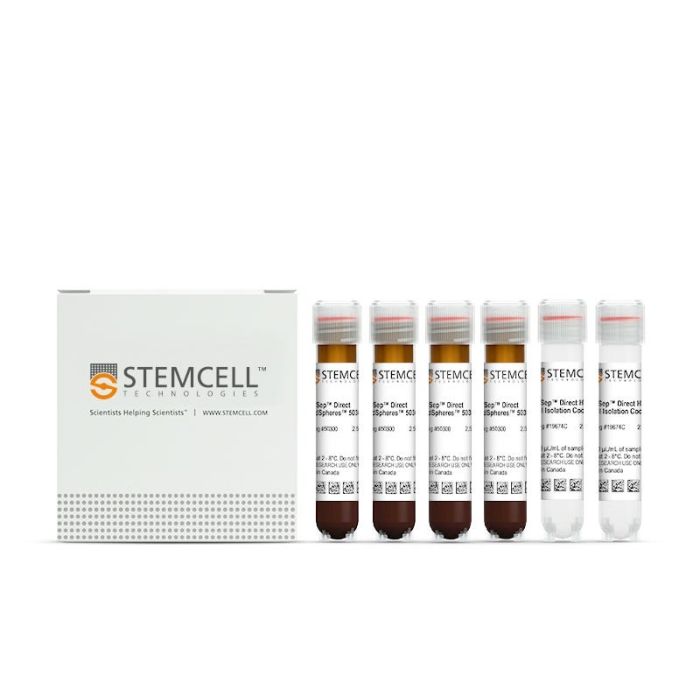
  • EasySep™ Direct人B细胞分选试剂盒(产品号 #19674)
    • EasySep™ Direct人B细胞分选抗体混合物,2 x 2.5 mL
    • EasySep™ Direct RapidSpheres™磁珠,4 x 2.5 mL
  • RoboSep™Direct人B细胞分选试剂盒(产品号 #19674RF)
    • EasySep™ Direct人B细胞分选抗体混合物,2 x 2.5 mL
    • EasySep™ Direct RapidSpheres™磁珠,4 x 2.5 mL
    • RoboSep™ 缓冲液(产品号 #20104)
    • RoboSep™过滤吸头(产品号 #20125)x 2
专为您的实验方案打造的产品
要查看实验方案所需的所有配套产品,请参阅《实验方案与技术文档》

总览

使用 EasySep™ 直接人 B 细胞分离试剂盒,可通过免疫磁性负选法直接从人全血样本中轻松高效地分离高纯度的 B 细胞,无需密度梯度离心、沉降或红细胞裂解步骤。EasySep™ 技术在已发表研究中被广泛应用超过 20 年,结合了单克隆抗体的特异性与无柱磁系统的简便性。

在此 EasySep™ 负选步骤中,不需要的细胞通过抗体复合物和名为 EasySep™ Direct RapidSpheres™ 的磁性颗粒进行标记。以下标志物阳性的细胞将被去除:CD2、CD3、CD15、CD16、CD36、CD43、CD56 和 CD66b。经 EasySep™ 磁体分离后,带有磁性标记的不需要细胞被去除,未标记的目标 B 细胞通过倾倒或移液方式转移到新试管中。磁性细胞分离最快可在 20 分钟内完成,目标 B 细胞可直接用于流式细胞术、培养或 DNA/RNA 提取等下游应用。

了解更多关于 EasySep™ 免疫磁性技术的工作原理,或了解如何使用 RoboSep™ 实现免疫磁性细胞分离的全自动化,以节省时间并提高实验室通量。探索更多优化实验流程的产品,包括细胞表征、低温保存及其他相关产品。


磁极兼容性
• EasySep™磁极(产品号 #18000)
• “The Big Easy” EasySep™磁极(产品号 #18001)
• Easy 50 EasySep™磁极(产品号 #18002)
• EasyEights™ EasySep™磁极(产品号 #18103)
• RoboSep™-S(产品号 #21000)
 
分类
细胞分选试剂盒
 
细胞类型
B 细胞
 
种属

 
样本来源
全血
 
分选方法
负选
 
应用
细胞分选
 
品牌
EasySep,RoboSep
 
研究领域
药物发现和毒性检测,免疫学
 

实验数据

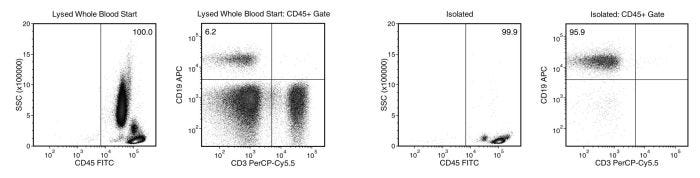
Typical EasySep™ Direct Human B Cell Isolation Profile

Figure 1. Typical EasySep™ Direct Human B Cell Isolation Profile

Starting with human whole blood from normal healthy donors, the typical B cell (CD3-CD19+) content of the non-lysed final isolated fraction is 95.3 ± 2.7% (gated on CD45) or 88.5 ± 11.5% (not gated on CD45). In the above example, the B cell (CD3-CD19+) content of the lysed whole blood start sample and the non-lysed final isolated fraction is 6.2% and 95.9% (gated on CD45), respectively, or 6.2% and 95.8% (not gated on CD45), respectively. The starting frequency of B cells in the non-lysed whole blood start sample above is 0.011% (data not shown).

产品说明书及文档

请在《产品说明书》中查找相关支持信息和使用说明,或浏览下方更多实验方案。

Document Type
Product Name
Catalog #
Lot #
Language
Catalog #
19674RF
Lot #
All
Language
中文
Catalog #
19674
Lot #
All
Language
中文
Catalog #
19674
Lot #
All
Language
English
Catalog #
19674RF
Lot #
All
Language
English
Document Type
Safety Data Sheet 1
Catalog #
19674
Lot #
All
Language
English
Document Type
Safety Data Sheet 2
Catalog #
19674
Lot #
All
Language
English
Document Type
Safety Data Sheet 1
Catalog #
19674RF
Lot #
All
Language
English
Document Type
Safety Data Sheet 2
Catalog #
19674RF
Lot #
All
Language
English
Document Type
Safety Data Sheet 3
Catalog #
19674RF
Lot #
All
Language
English

应用领域

本产品专为以下研究领域设计,适用于工作流程中的高亮阶段。探索这些工作流程,了解更多我们为各研究领域提供的其他配套产品。

相关材料与文献

技术资料 (15)

常见问题 (11)

Can EasySep™ be used for either positive or negative selection?

Yes. The EasySep™ kits use either a negative selection approach by targeting and removing unwanted cells or a positive selection approach targeting desired cells. Depletion kits are also available for the removal of cells with a specific undesired marker (e.g. GlyA).

How does the separation work?

Magnetic particles are crosslinked to cells using Tetrameric Antibody Complexes (TAC). When placed in the EasySep™ Magnet, labeled cells migrate to the wall of the tube. The unlabeled cells are then poured off into a separate fraction.

Which columns do I use?

The EasySep™ procedure is column-free. That's right - no columns!

How can I analyze the purity of my enriched sample?

The Product Information Sheet provided with each EasySep™ kit contains detailed staining information.

Can EasySep™ separations be automated?

Yes. RoboSep™, the fully automated cell separator, automates all EasySep™ labeling and cell separation steps.

Can EasySep™ be used to isolate rare cells?

Yes. We recommend a cell concentration of 2x10⁸ cells/mL and a minimum working volume of 100 µL. Samples containing 2x10⁷ cells or fewer should be suspended in 100 µL of buffer.

Are the EasySep™ magnetic particles FACS-compatible?

Yes, the EasySep™ particles are flow cytometry-compatible, as they are very uniform in size and about 5000X smaller than other commercially available magnetic beads used with column-free systems.

Can the EasySep™ magnetic particles be removed after enrichment?

No, but due to the small size of these particles, they will not interfere with downstream applications.

Can I alter the separation time in the magnet?

Yes; however, this may impact the kit's performance. The provided EasySep™ protocols have already been optimized to balance purity, recovery and time spent on the isolation.

For positive selection, can I perform more than 3 separations to increase purity?

Yes, the purity of targeted cells will increase with additional rounds of separations; however, cell recovery will decrease.

How does the binding of the EasySep™ magnetic particle affect the cells? is the function of positively selected cells altered by the bound particles?

Hundreds of publications have used cells selected with EasySep™ positive selection kits for functional studies. Our in-house experiments also confirm that selected cells are not functionally altered by the EasySep™ magnetic particles.

If particle binding is a key concern, we offer two options for negative selection. The EasySep™ negative selection kits can isolate untouched cells with comparable purities, while RosetteSep™ can isolate untouched cells directly from whole blood without using particles or magnets.

文献 (6)

Downregulation of MicroRNA-152 contributes to high expression of DKK1 in multiple myeloma. Y. Xu et al. RNA biology 2015

Abstract

Multiple myeloma (MM) induced bone lesion is one of the most crippling characteristics,and the MM secreted Dickkopf-1 (DKK1) has been reported to play important role in this pathologic process. However,the underlying regulation mechanisms involved in DKK1 expression are still unclear. In this study,we validated the expression patterns of microRNA (miR) 15a,34a,152,and 223 in MM cells and identified that miR-152 was significantly downregulated in the MM group compared with the non-MM group,and that miR-152 level was negatively correlated with the expression of DKK1 in the MM cells. Mechanistic studies showed that manipulating miR-152 artificially in MM cells led to changes in DKK-1 expression,and miR-152 blocked DKK1 transcriptional activity by binding to the 3'UTR of DKK1 mRNA. Importantly,we revealed that MM cells stably expressing miR-152 improved the chemotherapy sensitivity,and counteracted the bone disruption in an intrabone-MM mouse model. Our study contributes better understanding of the regulation mechanism of DKK-1 in MM,and opens up the potential for developing newer therapeutic strategies in the MM treatment.
A novel antibody discovery platform identifies anti-influenza A broadly neutralizing antibodies from human memory B cells. Xiao X et al. mAbs 2016 JUL

Abstract

Monoclonal antibody isolation directly from circulating human B cells is a powerful tool to delineate humoral responses to pathological conditions and discover antibody therapeutics. We have developed a platform aimed at improving the efficiencies of B cell selection and V gene recovery. Here,memory B cells are activated and amplified using Epstein-Barr virus infection,co-cultured with CHO-muCD40L cells,and then assessed by functional screenings. An in vitro transcription and translation (IVTT) approach was used to analyze variable (V) genes recovered from each B cell sample and identify the relevant heavy/light chain pair(s). We achieved efficient amplification and activation of memory B cells,and eliminated the need to: 1) seed B cells at clonal level (≤1 cell/well) or perform limited dilution cloning; 2) immortalize B cells; or 3) assemble V genes into an IgG expression vector to confirm the relevant heavy/light chain pairing. Cross-reactive antibodies targeting a conserved epitope on influenza A hemagglutinin were successfully isolated from a healthy donor. In-depth analysis of the isolated antibodies suggested their potential uses as anti-influenza A antibody therapeutics and uncovered a distinct affinity maturation pathway. Importantly,our results showed that cognate heavy/light chain pairings contributed to both the expression level and binding abilities of our newly isolated VH1-69 family,influenza A neutralizing antibodies,contrasting with previous observations that light chains do not significantly contribute to the function of this group of antibodies. Our results further suggest the potential use of the IVTT as a powerful antibody developability assessment tool.
FcγRIIB-Independent Mechanisms Controlling Membrane Localization of the Inhibitory Phosphatase SHIP in Human B Cells. Pauls SD et al. Journal of immunology (Baltimore,Md. : 1950) 2016 JUL

Abstract

SHIP is an important regulator of immune cell signaling that functions to dephosphorylate the phosphoinositide phosphatidylinositol 3,4,5-trisphosphate at the plasma membrane and mediate protein-protein interactions. One established paradigm for SHIP activation involves its recruitment to the phospho-ITIM motif of the inhibitory receptor FcγRIIB. Although SHIP is essential for the inhibitory function of FcγRIIB,it also has critical modulating functions in signaling initiated from activating immunoreceptors such as B cell Ag receptor. In this study,we found that SHIP is indistinguishably recruited to the plasma membrane after BCR stimulation with or without FcγRIIB coligation in human cell lines and primary cells. Interestingly,fluorescence recovery after photobleaching analysis reveals differential mobility of SHIP-enhanced GFP depending on the mode of stimulation,suggesting that although BCR and FcγRIIB can both recruit SHIP,this occurs via distinct molecular complexes. Mutagenesis of a SHIP-enhanced GFP fusion protein reveals that the SHIP-Src homology 2 domain is essential in both cases whereas the C terminus is required for recruitment via BCR stimulation,but is less important with FcγRIIB coligation. Experiments with pharmacological inhibitors reveal that Syk activity is required for optimal stimulation-induced membrane localization of SHIP,whereas neither PI3K or Src kinase activity is essential. BCR-induced association of SHIP with binding partner Shc1 is dependent on Syk,as is tyrosine phosphorylation of both partners. Our results indicate that FcγRIIB is not uniquely able to promote membrane recruitment of SHIP,but rather modulates its function via formation of distinct signaling complexes. Membrane recruitment of SHIP via Syk-dependent mechanisms may be an important factor modulating immunoreceptor signaling.

更多信息

更多信息
物种
Magnet Compatibility • EasySep™ Magnet (Catalog #18000) • “The Big Easy” EasySep™ Magnet (Catalog #18001) • Easy 50 EasySep™ Magnet (Catalog #18002) • EasyEights™ EasySep™ Magnet (Catalog #18103) • RoboSep™-S (Catalog #21000)
样本来源 全血
Selection Method Negative
标记抗体
质量保证:

产品仅供研究使用,不用于针对人或动物的诊断或治疗。 欲获悉更多关于STEMCELL的质控信息,请访问 STEMCELL.CN/COMPLIANCE.
Copyright © 2026 by STEMCELL Technologies. All rights reserved.

在线联系