若您需要咨询产品或有任何技术问题,请通过官方电话 400 885 9050 或邮箱 info.cn@stemcell.com 与我们联系。

Ku - 0063794

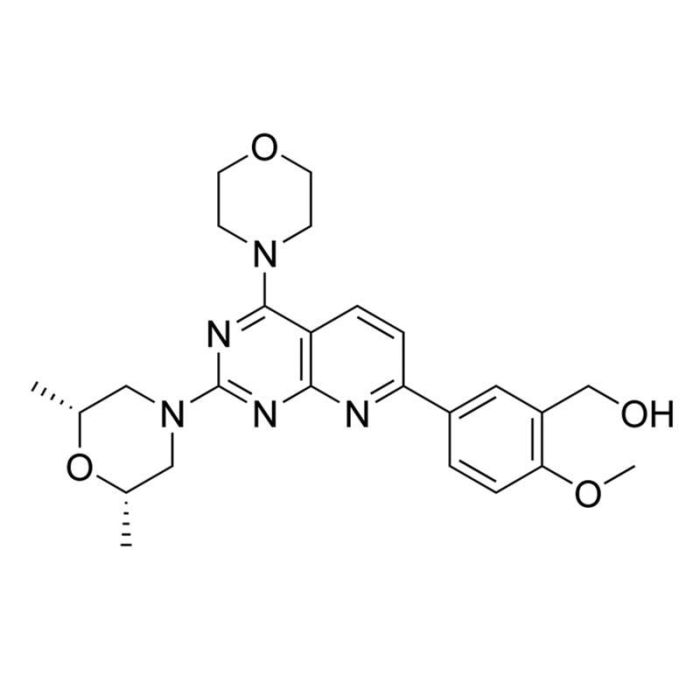
mTOR通路抑制剂;抑制mTORC1和mTORC2复合物
只有 %1
¥1,242.00

产品号 #(选择产品)

产品号 #73232_C

mTOR通路抑制剂;抑制mTORC1和mTORC2复合物

总览

Ku-0063794是一种细胞渗透性的,作用于丝氨酸-苏氨酸激酶哺乳动物雷帕霉素(mTOR)靶点的选择性抑制剂,同时抑制mTORC1和mTORC2复合物(IC₅₀= 10 nM)。它对76种其他蛋白激酶或7种脂质激酶(包括PI3激酶)具有良好的特异性(> 1000倍)(García-Martínez等人)。

维持
·通过保持线粒体氧化磷酸化,延长toll样受体(TLR)激活的树突状细胞的寿命(Amiel等人)。

癌症研究
·通过诱导 G1 期细胞周期阻滞,抑制小鼠胚胎成纤维细胞和人非小细胞肺癌细胞系的生长(García-Martínez 等人;Fei 等人)。
·在肾细胞癌异种移植模型中抑制肿瘤生长(Zhang等人)。
·在离体瘢痕疙瘩器官培养模型中减少瘢痕疙瘩(真皮纤维增生病变)体积,并在体外抑制瘢痕疙瘩细胞的扩散、增殖、迁移和侵袭性(Syed等人)。

细胞类型
癌细胞及细胞系,树突状细胞(DCs)
 
种属
人,小鼠,非人灵长类,其他物种,大鼠
 
应用
培养
 
研究领域
癌症
 
CAS 编号
938440-64-3
 
化学式
C₂₅H₃₁N₅O₄
 
纯度
≥98%
 
通路
mTOR
 
靶点
mTOR
 

产品说明书及文档

请在《产品说明书》中查找相关支持信息和使用说明,或浏览下方更多实验方案。

Document Type
Product Name
Catalog #
Lot #
Language
Product Name
Ku-0063794
Catalog #
73232
Lot #
All
Language
English
Document Type
Safety Data Sheet
Product Name
Ku-0063794
Catalog #
73232
Lot #
All
Language
English

相关材料与文献

技术资料 (2)

文献 (5)

Ku-0063794 is a specific inhibitor of the mammalian target of rapamycin (mTOR). Garcí et al. The Biochemical journal 2009

Abstract

mTOR (mammalian target of rapamycin) stimulates cell growth by phosphorylating and promoting activation of AGC (protein kinase A/protein kinase G/protein kinase C) family kinases such as Akt (protein kinase B),S6K (p70 ribosomal S6 kinase) and SGK (serum and glucocorticoid protein kinase). mTORC1 (mTOR complex-1) phosphorylates the hydrophobic motif of S6K,whereas mTORC2 phosphorylates the hydrophobic motif of Akt and SGK. In the present paper we describe the small molecule Ku-0063794,which inhibits both mTORC1 and mTORC2 with an IC50 of approximately 10 nM,but does not suppress the activity of 76 other protein kinases or seven lipid kinases,including Class 1 PI3Ks (phosphoinositide 3-kinases) at 1000-fold higher concentrations. Ku-0063794 is cell permeant,suppresses activation and hydrophobic motif phosphorylation of Akt,S6K and SGK,but not RSK (ribosomal S6 kinase),an AGC kinase not regulated by mTOR. Ku-0063794 also inhibited phosphorylation of the T-loop Thr308 residue of Akt phosphorylated by PDK1 (3-phosphoinositide-dependent protein kinase-1). We interpret this as implying phosphorylation of Ser473 promotes phosphorylation of Thr308 and/or induces a conformational change that protects Thr308 from dephosphorylation. In contrast,Ku-0063794 does not affect Thr308 phosphorylation in fibroblasts lacking essential mTORC2 subunits,suggesting that signalling processes have adapted to enable Thr308 phosphorylation to occur in the absence of Ser473 phosphorylation. We found that Ku-0063794 induced a much greater dephosphorylation of the mTORC1 substrate 4E-BP1 (eukaryotic initiation factor 4E-binding protein 1) than rapamycin,even in mTORC2-deficient cells,suggesting a form of mTOR distinct from mTORC1,or mTORC2 phosphorylates 4E-BP1. Ku-0063794 also suppressed cell growth and induced a G1-cell-cycle arrest. Our results indicate that Ku-0063794 will be useful in delineating the physiological roles of mTOR and may have utility in treatment of cancers in which this pathway is inappropriately activated.
Potent dual inhibitors of TORC1 and TORC2 complexes (KU-0063794 and KU-0068650) demonstrate in vitro and ex vivo anti-keloid scar activity. Syed F et al. The Journal of investigative dermatology 2013

Abstract

Mammalian target of rapamycin (mTOR) is essential in controlling several cellular functions. This pathway is dysregulated in keloid disease (KD). KD is a common fibroproliferative dermal lesion with an ill-defined treatment strategy. KD demonstrates excessive matrix deposition,angiogenesis,and inflammatory cell infiltration. In KD,both total and phosphorylated forms of mTOR and p70(S6K)(Thr421/Ser424) are upregulated. Therefore,the aim of this study was to investigate adenosine triphosphate-competitive inhibitors of mTOR kinase previously unreported in keloid and their comparative efficacy with Rapamycin. Here,we present two mTOR kinase inhibitors,KU-0063794 and KU-0068650,that target both mTORC1 and mTORC2 signaling. Treatment with either KU-0063794 or KU-0068650 resulted in complete suppression of Akt,mTORC1,and mTORC2,and inhibition of keloid cell spreading,proliferation,migration,and invasive properties at a very low concentration (2.5 μmol l(-1)). Both KU-0063794 and KU-0068650 significantly (Ptextless0.05) inhibited cell cycle regulation and HIF1-α expression compared with that achieved with Rapamycin alone. In addition,both compounds induced shrinkage and growth arrest in KD,associated with the inhibition of angiogenesis,induction of apoptosis,and reduction in keloid phenotype-associated markers. In contrast,Rapamycin induced minimal antitumor activity. In conclusion,potent dual mTORC1 and mTORC2 inhibitors display therapeutic potential for the treatment of KD.
A comparison of Ku0063794, a dual mTORC1 and mTORC2 inhibitor, and temsirolimus in preclinical renal cell carcinoma models. Zhang H et al. PloS one 2013

Abstract

Rapamycin analogs,temsirolimus and everolimus,are approved for the treatment of advance renal cell carcinoma (RCC). Currently approved agents inhibit mechanistic target of rapamycin (mTOR) complex 1 (mTORC1). However,the mTOR kinase exists in two distinct multiprotein complexes,mTORC1 and mTORC2,and both complexes may be critical regulators of cell metabolism,growth and proliferation. Furthermore,it has been proposed that drug resistance develops due to compensatory activation of mTORC2 signaling during treatment with temsirolimus or everolimus. We evaluated Ku0063794,which is a small molecule that inhibits both mTOR complexes. Ku0063794 was compared to temsirolimus in preclinical models for renal cell carcinoma. Ku0063794 was effective in inhibiting the phosphorylation of signaling proteins downstream of both mTORC1 and mTORC2,including p70 S6K,4E-BP1 and Akt. Ku0063794 was more effective than temsirolimus in decreasing the viability and growth of RCC cell lines,Caki-1 and 786-O,in vitro by inducing cell cycle arrest and autophagy,but not apoptosis. However,in a xenograft model there was no difference in the inhibition of tumor growth by Ku0063794 or temsirolimus. A potential explanation is that temsirolimus has additional effects on the tumor microenvironment. Consistent with this possibility,temsirolimus,but not Ku0063794,decreased tumor angiogenesis in vivo,and decreased the viability of HUVEC (Human Umbilical Vein Endothelial Cells) cells in vitro at pharmacologically relevant concentrations. Furthermore,expression levels of VEGF and PDGF were lower in Caki-1 and 786-O cells treated with temsirolimus than cells treated with Ku0063794.

更多信息

更多信息
物种 人, 其它物种, 大鼠, 小鼠, 非人灵长类
Cas Number 938440-64-3
Chemical Formula C₂₅H₃₁N₅O₄
纯度 ≥ 98%
Target mTOR
Pathway mTOR
质量保证:

产品仅供研究使用,不用于针对人或动物的诊断或治疗。 欲获悉更多关于STEMCELL的质控信息,请访问 STEMCELL.CN/COMPLIANCE.
Copyright © 2026 by STEMCELL Technologies. All rights reserved.

在线联系