若您需要咨询产品或有任何技术问题,请通过官方电话 400 885 9050 或邮箱 info.cn@stemcell.com 与我们联系。

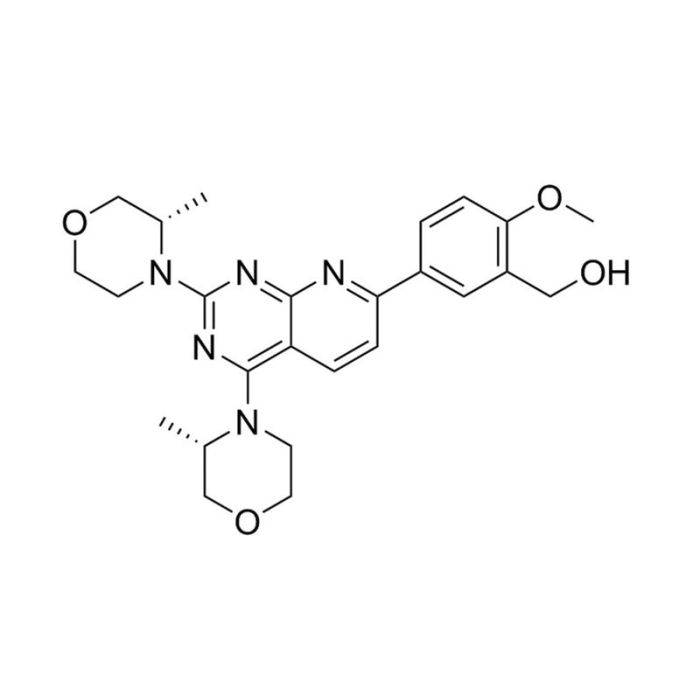
AZD8055

mTOR通路抑制剂;抑制mTOR
只有 %1
¥506.00

产品号 #(选择产品)

产品号 #73002_C

mTOR通路抑制剂;抑制mTOR

总览

AZD8055是一种有效、选择性强的 ATP 竞争性哺乳动物雷帕霉素靶蛋白(mTOR)抑制剂,IC₅₀值为0.8 nM (Chresta等)。针对所有PI3K同工酶,对mTOR具有约1000倍的选择性,且在高达 10 µM 的浓度下对 260 种激酶的测试中未显示出活性(Chresta 等)。

癌症研究
·在体外可抑制 A549 和 H838 小细胞肺癌细胞系的增殖,并在口服给药后抑制多种人类肿瘤异种移植模型的小鼠肿瘤生长(Chresta 等)。
·可抑制细胞增殖、促进细胞死亡,并减少他莫昔芬耐药(TamR)和雌激素剥夺耐药(MCF7-X)乳腺癌细胞系的迁移能力(Jordan 等)。
·诱导人喉癌细胞系(Hep-2)凋亡并抑制增殖(Zhao等)。
·联合ABT-737使用时,通过抑制髓系白血病细胞分化蛋白的表达,协同诱导横纹肌肉瘤(RMS)中的细胞凋亡(MCL1;Preuss等)。
·可抑制 HeLa(人宫颈癌细胞系)的增殖和糖酵解,诱导细胞凋亡(Li等人)。

细胞类型
癌细胞及细胞系
 
种属
人,小鼠,非人灵长类,其他物种,大鼠
 
研究领域
癌症
 
CAS 编号
1009298-09-2
 
化学式
C₂₅H₃₁N₅O₄
 
纯度
≥98%
 
通路
mTOR
 
靶点
mTOR
 

产品说明书及文档

请在《产品说明书》中查找相关支持信息和使用说明,或浏览下方更多实验方案。

Document Type
Product Name
Catalog #
Lot #
Language
Product Name
AZD8055
Catalog #
73002, 73004
Lot #
All
Language
English
Document Type
Safety Data Sheet
Product Name
AZD8055
Catalog #
73002, 73004
Lot #
All
Language
English

相关材料与文献

技术资料 (2)

文献 (5)

AZD8055 is a potent, selective, and orally bioavailable ATP-competitive mammalian target of rapamycin kinase inhibitor with in vitro and in vivo antitumor activity. Chresta CM et al. Cancer research 2010

Abstract

The mammalian target of rapamycin (mTOR) kinase forms two multiprotein complexes,mTORC1 and mTORC2,which regulate cell growth,cell survival,and autophagy. Allosteric inhibitors of mTORC1,such as rapamycin,have been extensively used to study tumor cell growth,proliferation,and autophagy but have shown only limited clinical utility. Here,we describe AZD8055,a novel ATP-competitive inhibitor of mTOR kinase activity,with an IC50 of 0.8 nmol/L. AZD8055 showed excellent selectivity (approximately 1,000-fold) against all class I phosphatidylinositol 3-kinase (PI3K) isoforms and other members of the PI3K-like kinase family. Furthermore,there was no significant activity against a panel of 260 kinases at concentrations up to 10 micromol/L. AZD8055 inhibits the phosphorylation of mTORC1 substrates p70S6K and 4E-BP1 as well as phosphorylation of the mTORC2 substrate AKT and downstream proteins. The rapamycin-resistant T37/46 phosphorylation sites on 4E-BP1 were fully inhibited by AZD8055,resulting in significant inhibition of cap-dependent translation. In vitro,AZD8055 potently inhibits proliferation and induces autophagy in H838 and A549 cells. In vivo,AZD8055 induces a dose-dependent pharmacodynamic effect on phosphorylated S6 and phosphorylated AKT at plasma concentrations leading to tumor growth inhibition. Notably,AZD8055 results in significant growth inhibition and/or regression in xenografts,representing a broad range of human tumor types. AZD8055 is currently in phase I clinical trials.
The mTOR inhibitor AZD8055 inhibits proliferation and glycolysis in cervical cancer cells. Li S et al. Oncology letters 2013

Abstract

The aim of the present study was to determine the effect of AZD8055 on proliferation,apoptosis and glycolysis in the human cervical cancer cell line HeLa and to investigate the underlying mechanism(s) of action. HeLa human cervical cancer cells were treated with 10 nM AZD8055 for 24,48 or 72 h. MTT was used to determine cell proliferation. Annexin V/propidium iodide staining was used to determine cell apoptosis analyzed by fluorescence-activated cell sorting (FACS). Glycolytic activity was determined by measuring the activity of the key enzyme lactate dehydrogenase (LDH) and lactate production. RNA and protein expression were examined by qRT-PCR and western blotting,respectively. Treatment with AZD8055 inhibited proliferation and glycolysis,and induced apoptosis in HeLa cells in a time-dependent manner. During the prolonged treatment with AZD8055,the phosphorylation of mammalian target of rapamycin (mTOR) C1 substrates p70S6K and phosphorylation of the mTORC2 substrate Akt were deregulated,suggesting that the activity of mTOR was downregulated. Furthermore,our study showed that the expression of miR-143 was upregulated in a time-dependent manner in HeLa cells treated with AZD8055. In summary,the present study reveals a novel antitumor mechanism of AZD8055 in HeLa human cervical cancer cells.
Pan-mammalian target of rapamycin (mTOR) inhibitor AZD8055 primes rhabdomyosarcoma cells for ABT-737-induced apoptosis by down-regulating Mcl-1 protein. Preuss E et al. The Journal of biological chemistry 2013

Abstract

The PI3K/mammalian Target of Rapamycin (mTOR) pathway is often aberrantly activated in rhabdomyosarcoma (RMS) and represents a promising therapeutic target. Recent evaluation of AZD8055,an ATP-competitive mTOR inhibitor,by the Preclinical Pediatric Testing Program showed in vivo antitumor activity against childhood solid tumors,including RMS. Therefore,in the present study,we searched for AZD8055-based combination therapies. Here,we identify a new synergistic lethality of AZD8055 together with ABT-737,a BH3 mimetic that antagonizes Bcl-2,Bcl-xL,and Bcl-w but not Mcl-1. AZD8055 and ABT-737 cooperate to induce apoptosis in alveolar and embryonal RMS cells in a highly synergistic fashion (combination index textless 0.2). Synergistic induction of apoptosis by AZD8055 and ABT-737 is confirmed on the molecular level,as AZD8055 and ABT-737 cooperate to trigger loss of mitochondrial membrane potential,activation of caspases,and caspase-dependent apoptosis that is blocked by the pan-caspase inhibitor Z-VAD-fmk. Similar to AZD8055,the PI3K/mTOR inhibitor NVP-BEZ235,the PI3K inhibitor NVP-BKM120 and Akt inhibitor synergize with ABT-737 to trigger apoptosis,whereas no cooperativity is found for the mTOR complex 1 inhibitor RAD001. Interestingly,molecular studies reveal a correlation between the ability of different PI3K/mTOR inhibitors to potentiate ABT-737-induced apoptosis and to suppress Mcl-1 protein levels. Importantly,knockdown of Mcl-1 increases ABT-737-induced apoptosis similar to AZD8055/ABT-737 cotreatment. This indicates that AZD8055-mediated suppression of Mcl-1 protein plays an important role in the synergistic drug interaction. By identifying a novel synergistic interaction of AZD8055 and ABT-737,our findings have important implications for the development of molecular targeted therapies for RMS.

更多信息

更多信息
物种 人, 其它物种, 大鼠, 小鼠, 非人灵长类
Cas Number 1009298-09-2
Chemical Formula C₂₅H₃₁N₅O₄
纯度 ≥ 98%
Target mTOR
Pathway mTOR
质量保证:

产品仅供研究使用,不用于针对人或动物的诊断或治疗。 欲获悉更多关于STEMCELL的质控信息,请访问 STEMCELL.CN/COMPLIANCE.
Copyright © 2026 by STEMCELL Technologies. All rights reserved.

在线联系