若您需要咨询产品或有任何技术问题,请通过官方电话 400 885 9050 或邮箱 info.cn@stemcell.com 与我们联系。

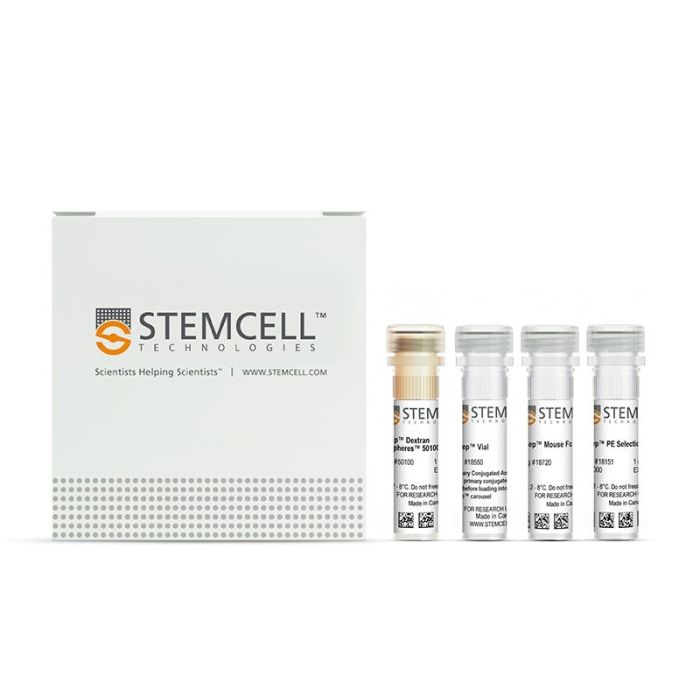
EasySep™小鼠PE正选试剂盒II

对标记 PE 缀合抗体的小鼠细胞进行免疫磁珠正选分离

只有 %1
¥7,442.00

产品号 #(选择产品)

产品号 #17666_C

免疫磁珠正选试剂盒

产品优势

  • 快速、简单
  • 无需分离柱

产品组分包括

  • EasySep™小鼠PE正选试剂盒II(产品号 #17666)
    • EasySep™ PE分选抗体混合物,1 mL
    • 小鼠FcR阻断剂,0.1 mL
    • EasySep™ Dextran RapidSpheres™磁珠,1 mL
    • RoboSep™ 一抗偶联物专用管(手动操作无需使用),1支
  • RoboSep™小鼠PE正选试剂盒II(产品号 #17666RF)
    • EasySep™ PE分选抗体混合物,1 mL
    • 小鼠FcR阻断剂,0.1 mL
    • EasySep™ Dextran RapidSpheres™磁珠,1 mL
    • RoboSep™ 一抗偶联物专用管(手动操作无需使用),1支
    • RoboSep™ 缓冲液(产品号 #20104)
    • RoboSep™ 过滤吸头(产品号 #20125)x 2
  • EasySep™小鼠PE正选试剂盒II(产品号 #17696)
    • EasySep™小鼠PE正选试剂盒(产品号 #17666)x 5
  • RoboSep™ 小鼠PE正选试剂盒II(产品号 #17696RF)
    • EasySep™小鼠PE正选试剂盒(产品号 #17666)x 5
    • RoboSep™ 缓冲液(产品号 #20104)x 5
    • RoboSep™ 过滤吸头(产品号 #20125)x 10
New look, same high quality and support! You may notice that your instrument or reagent packaging looks slightly different from images displayed on the website, or from previous orders. We are updating our look but rest assured, the products themselves and how you should use them have not changed. Learn more
专为您的实验方案打造的产品
要查看实验方案所需的所有配套产品,请参阅《实验方案与技术文档》

总览

使用EasySep™小鼠PE正选试剂盒II,通过免疫磁性正选法可从小鼠脾细胞、骨髓或其他单细胞悬液中分离经藻红蛋白(PE)偶联抗体标记的高纯度小鼠细胞。EasySep™技术已在超过20年的公开研究中得到广泛应用,结合单克隆抗体特异性与无柱磁系统简便性。在此正选步骤中,目标细胞与能够识别PE的和磁珠的抗体复合物结合。本试剂盒还含抗小鼠Fc受体阻断剂,以防止非特异性结合。标记细胞经EasySep™磁体分离后,未标记细胞被去除,PE阳性细胞留在试管中。

推荐使用EasySep™ Release小鼠PE正选试剂盒(产品号#17656)以获得无颗粒高纯度细胞。

了解更多EasySep™免疫磁性技术或RoboSep™自动化系统。


磁极兼容性
• EasySep™磁极(产品号 #18000)
• “The Big Easy” EasySep™磁极(产品号 #18001)
• EasyEights™ EasySep™磁极(产品号 #18103)
• RoboSep™-S(产品号 #21000)
 
分类
细胞分选试剂盒
 
细胞类型
B 细胞,树突状细胞(DCs),粒细胞及其亚群,造血干/祖细胞,巨噬细胞,骨髓基质细胞,间充质干/祖细胞,单核细胞,单个核细胞,髓系细胞,NK 细胞,其他物种,血浆,T 细胞
 
种属
小鼠
 
样本来源
骨髓,其他物种,脾脏
 
分选方法
正选
 
应用
细胞分选
 
品牌
EasySep,RoboSep
 
研究领域
免疫
 

实验数据

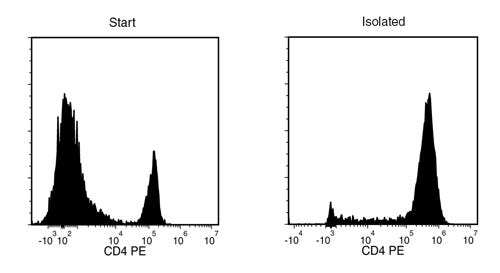
Starting with mouse splenocytes, the purities of the start and final isolated fractions in the above example are 20.5% and 91.6%, respectively, using a PEconjugated anti-mouse CD4 antibody and EasySep™ Mouse PE Positive Selection Kit II.

产品说明书及文档

请在《产品说明书》中查找相关支持信息和使用说明,或浏览下方更多实验方案。

Document Type
Product Name
Catalog #
Lot #
Language
Catalog #
17666, 17696
Lot #
All
Language
English
Catalog #
17696RF, 17666RF
Lot #
All
Language
English
Document Type
Safety Data Sheet 1
Catalog #
17666, 17696
Lot #
All
Language
English
Document Type
Safety Data Sheet 2
Catalog #
17666, 17696
Lot #
All
Language
English
Document Type
Safety Data Sheet 3
Catalog #
17666, 17696
Lot #
All
Language
English
Document Type
Safety Data Sheet 1
Catalog #
17696RF, 17666RF
Lot #
All
Language
English
Document Type
Safety Data Sheet 2
Catalog #
17696RF, 17666RF
Lot #
All
Language
English
Document Type
Safety Data Sheet 3
Catalog #
17696RF, 17666RF
Lot #
All
Language
English
Document Type
Safety Data Sheet 4
Catalog #
17696RF, 17666RF
Lot #
All
Language
English

相关材料与文献

技术资料 (8)

文献 (7)

Neutrophils promote the activation of monocytes via ROS to boost systemic antitumor immunity after cryo-thermal therapy Frontiers in Immunology 2024 Nov

Abstract

BackgroundThe characteristics of the tumor immunosuppressive microenvironment represent a major challenge that limits the efficacy of immunotherapy. Our previous results suggested that cryo-thermal therapy, a tumor ablation system developed in our laboratory, promotes macrophage M1-type polarization and the complete maturation of DCs to remodel the immunosuppressive environment. However, the cells that respond promptly to CTT have not yet been identified. CTT can cause extensive cell death and the release of danger-associated molecular patterns and antigens. Neutrophils are the first white blood cells recruited to sites of damage and acute inflammation. Therefore, we hypothesized that neutrophils are the initial cells that respond to CTT and are involved in the subsequent establishment of antitumor immunity.MethodsIn this study, we examined the kinetics of neutrophil recruitment after CTT via flow cytometry and immunofluorescence staining and explored the effect of neutrophils on the establishment of systemic antitumor immunity by in vivo neutrophil depletion and in vitro co-culture assays.ResultsWe found that CTT led to a rapid and strong proinflammatory neutrophil response, which was essential for the long-term survival of mice. CTT-induced neutrophils promoted the activation of monocytes via reactive oxygen species and further upregulated the expression of IFN-γ and cytotoxic molecules in T and NK cells. Adoptive neutrophil transfer further enhanced the antitumor efficacy of CTT in tumor models of spontaneous and experimental metastasis.ConclusionThese results reveal the important role of neutrophil‒monocyte interactions in the development of anti-tumor immunity and highlight that CTT could be used as an immunotherapy for targeting neutrophils and monocytes to enhance antitumor immunity.
B7-H3 Suppresses Antitumor Immunity via the CCL2-CCR2-M2 Macrophage Axis and Contributes to Ovarian Cancer Progression. T. Miyamoto et al. Cancer immunology research 2022 jan

Abstract

New approaches beyond PD-1/PD-L1 inhibition are required to target the immunologically diverse tumor microenvironment (TME) in high-grade serous ovarian cancer (HGSOC). In this study, we explored the immunosuppressive effect of B7-H3 (CD276) via the CCL2-CCR2-M2 macrophage axis and its potential as a therapeutic target. Transcriptome analysis revealed that B7-H3 is highly expressed in PD-L1-low, nonimmunoreactive HGSOC tumors, and its expression negatively correlated with an IFN$\gamma$ signature, which reflects the tumor immune reactivity. In syngeneic mouse models, B7-H3 (Cd276) knockout (KO) in tumor cells, but not in stromal cells, suppressed tumor progression, with a reduced number of M2 macrophages and an increased number of IFN$\gamma$+CD8+ T cells. CCL2 expression was downregulated in the B7-H3 KO tumor cell lines. Inhibition of the CCL2-CCR2 axis partly negated the effects of B7-H3 suppression on M2 macrophage migration and differentiation, and tumor progression. In patients with HGSOC, B7-H3 expression positively correlated with CCL2 expression and M2 macrophage abundance, and patients with B7-H3-high tumors had fewer tumoral IFN$\gamma$+CD8+ T cells and poorer prognosis than patients with B7-H3-low tumors. Thus, B7-H3 expression in tumor cells contributes to CCL2-CCR2-M2 macrophage axis-mediated immunosuppression and tumor progression. These findings provide new insights into the immunologic TME and could aid the development of new therapeutic approaches against the unfavorable HGSOC phenotype.
Activated NK cells reprogram MDSCs via NKG2D-NKG2DL and IFN-$\gamma$ to modulate antitumor T-cell response after cryo-thermal therapy. P. Peng et al. Journal for immunotherapy of cancer 2022 dec

Abstract

BACKGROUND Myeloid-derived suppressor cells (MDSCs) can potently inhibit T-cell activity, promote growth and metastasis of tumor and contribute to resistance to immunotherapy. Targeting MDSCs to alleviate their protumor functions and immunosuppressive activities is intimately associated with cancer immunotherapy. Natural killer (NK) cells can engage in crosstalk with multiple myeloid cells to alter adaptive immune responses, triggering T-cell immunity. However, whether the NK-cell-MDSC interaction can modulate the T-cell immune response requires further study. Cryo-thermal therapy could induce the maturation of MDSCs by creating an acute inflammatory environment to elicit a CD4+ Th1-dominant immune response, but the mechanism regulating this process remains unclear. METHODS NK cells were depleted and NKG2D was blocked with monoclonal antibodies in vivo. MDSCs, NK cells and T cells were assessed by flow cytometry and isolated by magnetic-activated cell sorting (MACS). MDSCs and NK cells were cocultured with T cells to determine their immunological function. The transcriptional profiles of MDSCs were measured by qRT-PCR and RNA-sequencing. Isolated NK cells and MDSCs by MACS were cocultured to study the viability and maturation of MDSCs regulated by NK cells. TIMER was used to comprehensively examine the immunological, clinical, and genomic features of tumors. RESULTS NK-cell activation after cryo-thermal therapy decreased MDSC accumulation and reprogrammed immunosuppressive MDSCs toward a mature phenotype to promote T cell antitumor immunity. Furthermore, we discovered that NK cells could kill MDSCs via the NKG2D-NKG2DL axis and promote MDSC maturation by interferon gamma (IFN-$\gamma$) in response to NKG2D. In addition, CD4+ Th1-dominant antitumor immune response was dependent on NKG2D, which promoted the major histocompatibility complex …¡ pathway of MDSCs. High activated NK-cell infiltration and NKG2D level in tumors were positively correlated with better clinical outcomes. CONCLUSIONS Cryo-thermal therapy induces effective CD4+ Th1-dominant antitumor immunity by activating NK cells to reprogram MDSCs, providing a promising therapeutic strategy for cancer immunotherapy.

更多信息

更多信息
物种 小鼠
Magnet Compatibility • EasySep™ Magnet (Catalog #18000) • “The Big Easy” EasySep™ Magnet (Catalog #18001) • EasyEights™ EasySep™ Magnet (Catalog #18103) • RoboSep™-S (Catalog #21000)
样本来源 其它细胞系, 脾脏, 骨髓
Selection Method Positive
法律声明:

Users of this kit should ensure that they are entitled to use the antibody of interest. STEMCELL Technologies Inc. is not responsible for patent infringements or violations that may occur when using this product. 质量保证:

产品仅供研究使用,不用于针对人或动物的诊断或治疗。 欲获悉更多关于STEMCELL的质控信息,请访问 STEMCELL.CN/COMPLIANCE.
Copyright © 2025 by STEMCELL Technologies. All rights reserved.

在线联系