若您需要咨询产品或有任何技术问题,请通过官方电话 400 885 9050 或邮箱 info.cn@stemcell.com 与我们联系。

EasySep™小鼠CD8+ T细胞分选试剂盒

通过免疫磁珠负选分离无磁珠标记的小鼠CD8+ T细胞
只有 %1
¥9,146.00

产品号 #(选择产品)

产品号 #19853_C

通过免疫磁珠负选分离无磁珠标记的小鼠CD8+ T细胞

产品优势

  • 快速且易于使用
  • 纯度高达95%
  • 无需分离柱
  • 获得无磁珠标记的活性细胞

产品组分包括

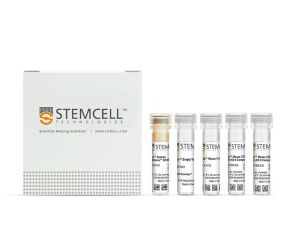
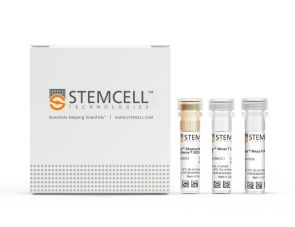
  • EasySep™小鼠CD8+ T细胞分选试剂盒(产品号 #19853)
    • EasySep™小鼠CD8+ T细胞分选抗体混合物,0.5 mL
    • EasySep™ Streptavidin RapidSpheres™ 50001磁珠,2 x 1 mL
    • EasySep™小鼠FcR阻断剂,0.2 mL
  • RoboSep™小鼠CD8+ T细胞分选试剂盒(产品号 #19853RF)
    • EasySep™小鼠CD8+ T细胞分选抗体混合物,0.5 mL
    • EasySep™ Streptavidin RapidSpheres™ 50001磁珠,2 x 1 mL
    • EasySep™小鼠FcR阻断剂,0.2 mL
    • RoboSep™ 缓冲液(产品号 #20104)
    • RoboSep™过滤吸头(产品号20125)
New format, same high quality! You may notice that your kit contents and packaging look slightly different from previous orders. We are currently updating the format of select EasySep™ Mouse kits to include a Mouse FcR blocker instead of Normal Rat Serum. With this change, all components will now be shipped in a single package, while providing the same cell isolation performance as before.
专为您的实验方案打造的产品
要查看实验方案所需的所有配套产品,请参阅《实验方案与技术文档》

总览

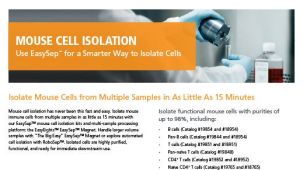
使用EasySep™小鼠CD8+ T细胞分选试剂盒,可通过免疫磁珠负选技术,轻松高效地从脾细胞或其他组织的单细胞悬液中分离高纯度的小鼠CD8+ T细胞。EasySep™无柱免疫磁珠分选技术结合单克隆抗体的特异性和无需分选柱的简便性,20多年来被广泛引用于已发表的文献中。

在此EasySep™负选流程中,非目标细胞会被抗体复合物和磁珠标记。表达以下标志物的非目标细胞将被特异性去除:CD11b、CD45R、Ter119、CD4、CD49b、CD19、CD11c、TCRγδ和CD24。通过EasySep™磁极将被磁珠标记的细胞与未被标记的目的细胞分离,接着只需将目的细胞倾倒或吸取至一个新的试管中,仅需17.5分钟即可获得高纯度的CD8+ T细胞,且可立即用于流式细胞术、细胞培养及细胞实验等下游应用。

该产品可替代EasySep™人CD8+ T细胞富集试剂盒 (产品号 #19053) 以进行更快的细胞分选。

深入了解EasySep™免疫磁珠分选技术原理,或探索如何通过RoboSep™实现免疫磁珠细胞分选全自动化。探索为您的实验流程优化的更多产品,包括培养基、添加剂、抗体等。

磁极兼容性
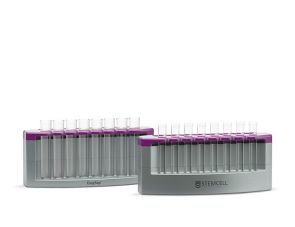
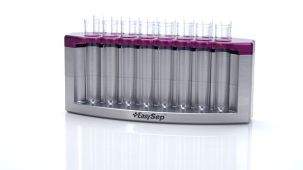
• EasySep™磁极(产品号 #18000)
• “The Big Easy” EasySep™磁极(产品号 #18001)
• EasyPlate™ EasySep™磁极(产品号 #18102)
• EasyEights™ EasySep™磁极(产品号 #18103)
• RoboSep™-S(产品号 #21000)
 
分类
细胞分选试剂盒
 
细胞类型
T 细胞,T 细胞,CD8+
 
种属
小鼠
 
样本来源
其他物种,脾脏
 
分选方法
负选
 
应用
细胞分选
 
品牌
EasySep,RoboSep
 
研究领域
免疫
 

实验数据

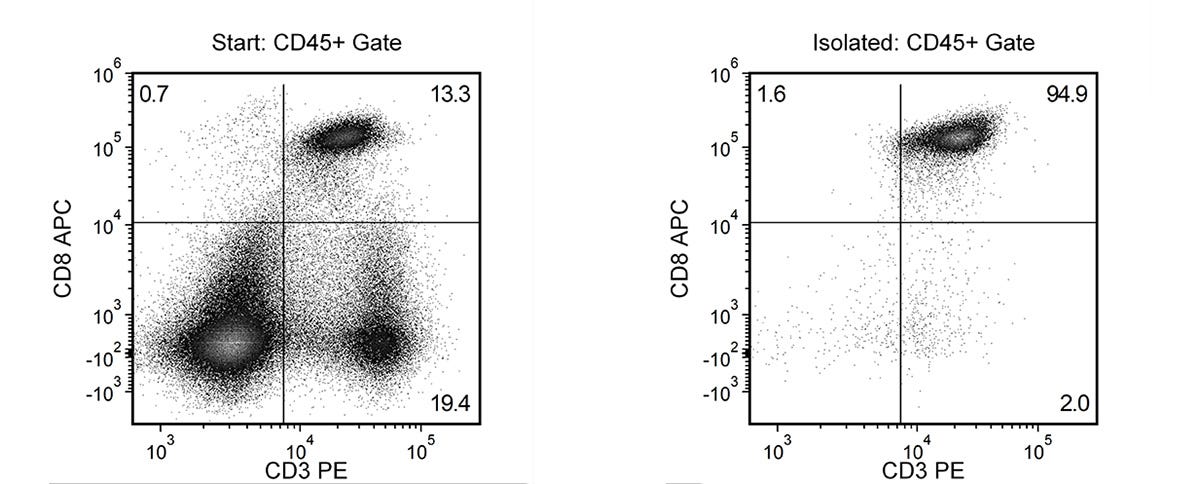
Typical EasySep™ Mouse CD8+ T Cell Isolation Profile

Figure 1. Typical EasySep™ Mouse CD8+ T Cell Isolation Profile

Starting with mouse splenocytes, the CD8+ T cell content (CD3+CD8+) of the isolated fraction is 94.4 ± 0.7% (mean ± SD), using the purple EasySep™ Magnet.

产品说明书及文档

请在《产品说明书》中查找相关支持信息和使用说明,或浏览下方更多实验方案。

Document Type
Product Name
Catalog #
Lot #
Language
Catalog #
19853RF
Lot #
1000120417 or higher
Language
English
Catalog #
19853
Lot #
1000120417 or higher
Language
English
Document Type
Safety Data Sheet 1
Catalog #
19853RF
Lot #
All
Language
English
Document Type
Safety Data Sheet 2
Catalog #
19853RF
Lot #
All
Language
English
Document Type
Safety Data Sheet 3
Catalog #
19853RF
Lot #
All
Language
English
Document Type
Safety Data Sheet 4
Catalog #
19853RF
Lot #
All
Language
English
Document Type
Safety Data Sheet 5
Catalog #
19853RF
Lot #
All
Language
English
Document Type
Safety Data Sheet 1
Catalog #
19853
Lot #
All
Language
English
Document Type
Safety Data Sheet 2
Catalog #
19853
Lot #
All
Language
English
Document Type
Safety Data Sheet 3
Catalog #
19853
Lot #
All
Language
English
Document Type
Safety Data Sheet 4
Catalog #
19853
Lot #
All
Language
English

应用领域

本产品专为以下研究领域设计,适用于工作流程中的高亮阶段。探索这些工作流程,了解更多我们为各研究领域提供的其他配套产品。

相关材料与文献

技术资料 (15)

常见问题 (7)

Can EasySep™ Streptavidin RapidSpheres™ be used for either positive or negative selection?

Currently, EasySep™ Streptavidin RapidSphere™ kits are only available for negative selection and work by targeting and removing unwanted cells.

How does the separation work?

Streptavidin RapidSphere™ magnetic particles are crosslinked to unwanted cells using biotinylated antibodies. When placed in the EasySep™ Magnet, labeled cells migrate to the wall of the tube. The unlabeled cells are then poured off into a new tube.

Which columns do I use?

The EasySep™ procedure is column-free. That's right - no columns!

How can I analyze the purity of my enriched sample?

The Product Information Sheet provided with each EasySep™ kit contains detailed staining information.

Can EasySep™ Streptavidin RapidSphere™ separations be automated?

Yes. RoboSep™, the fully automated cell separator, automates all EasySep™ labeling and cell separation steps.

Are cells isolated using EasySep™ RapidSphere™ products FACS-compatible?

Yes. Desired cells are unlabeled and ready to use in downstream applications, such as FACS analysis.

Can I alter the separation time in the magnet?

Yes; however, this may impact the kit's performance. The provided EasySep™ protocols have already been optimized to balance purity, recovery and time spent on the isolation.

文献 (64)

Dynamic Change of PD‐L2 on Circulating Plasma Extracellular Vesicles as a Predictor of Treatment Response in Melanoma Patients Receiving Anti‐PD‐1 Therapy Journal of Extracellular Vesicles 2025 Mar

Abstract

ABSTRACTImmune checkpoint inhibitors (ICIs) have provided new hope for melanoma patients, however, not all patients benefit. Furthermore, ICI‐related therapies cause significant immune‐related adverse events that adversely affect patient outcomes. Therefore, there is a pressing need for reliable biomarkers to identify patients most likely to benefit from these treatments. In this study, we employed an extracellular vesicles (EVs) protein expression array to explore the longitudinal membrane protein profiles of plasma‐derived EVs from 32 melanoma patients receiving anti‐PD‐1 and anti‐angiogenesis therapy at baseline and early treatment. We found that the dynamic changes in PD‐L2 on the EV membrane were associated with treatment response and patient survival. The dynamic change of EV PD‐L2 as an indication of treatment efficacy was validated in an independent cohort of melanoma patients treated with anti‐PD‐1 monotherapy. Plasma‐derived PD‐L2+ EVs from patients with mucosal melanoma significantly reduced the frequency of granzyme B+ CD8 T cells within the peripheral blood mononuclear cells (PBMCs) of healthy individuals. The inhibitory effect of PD‐L2+ EVs on CD8 T cells was further validated using human melanoma cell lines and the B16‐F10 mouse model. Although intratumoural injection of PD‐L2+ EVs could promote melanoma growth in vivo, tumours with PD‐L2+ EVs showed a higher response to anti‐PD‐1 than those without PD‐L2+ EVs. Collectively, our study demonstrates that PD‐L2+ EVs inhibit CD8 T cell activation and promote melanoma growth, and changes in PD‐L2 on circulating EVs during early treatment could serve as a biomarker for ICI‐based therapy.
The microbial metabolite butyrate enhances the effector and memory functions of murine CD8+ T cells and improves anti-tumor activity Frontiers in Medicine 2025 Jun

Abstract

IntroductionCD8+ T cells are vital in the immune control of cancer and a key player in cell-based cancer immunotherapy. Recent studies have shown that microbial short-chain fatty acids (SCFA) can promote both effector and memory phenotypes in CD8+ T cells and may thereby enhance protection against cancer.MethodsIn this study, we determined the effect of SCFA butyrate on mouse CD8+ T cell function in vitro and in vivo, using the OT-I model.ResultsButyrate co-culture with anti-CD3 + anti-CD28 activated T cells in vitro enhanced the frequency of effector CD8+ IFN-γ-producing cells, and the amount of cytokine produced per cell. Culture with butyrate also enhanced the activation, TCR expression, and levels of phosphorylated mTOR proteins within CD8+ T cells but reduced proliferation rate and increased apoptosis. Butyrate-treated activated cells conferred tumor protection after adoptive transfer. Butyrate-treated cells were present at higher frequencies within the tumor compared to non-butyrate treated cells, and expressed IFN-γ. When analyzed using high dimensional cytometry, the tumors of mice that received butyrate-treated cells were enriched in clusters displaying an effector memory phenotype with high expression of IL-15Rβ and T-bet.DiscussionOur findings show that butyrate promotes the effector activity of CD8+ T cells in culture, which can persist in vivo while also stimulating memory phenotypes. Consequently, butyrate treatment may have strong application in T cell-based immunotherapies to improve protective cell functions and patient outcomes.
Biomimetic Aggregation-Induced Emission Luminogens Mediated Effective Phototherapy and Immune Checkpoint Blockade for the Synergistic Treatment of Lung Cancer L. Yang et al. International Journal of Nanomedicine 2025 Aug

Abstract

BackgroundLung cancer has become one of the most fatal cancers at present. Traditional treatments showed limited therapeutic effects on lung cancer. The phototherapy has emerged as a powerful approach for lung cancer treatment. Aggregation-induced emission luminogens (AIEgens) exhibit excellent optical performance such as strong fluorescence, enhanced reactive oxygen species (ROS) generation, and effective thermal effect after aggregation, which show great potential in phototherapy. However, the disadvantages including hydrophobicity, low specificity, and short circulation lifetime limited their efficacy on cancer therapy.MethodsWe developed a biomimetic AIEgens constructed using CD8+ T cells membrane to camouflage the AIEgen C41H37N2O3S2 (named BITT) nanoparticles (termed TB). The prepared TB improved the tumor accumulation of AIEgen by PD-1/PD-L1 recognition on the CD8+ T and LLC cell membranes, respectively.ResultsThe prepared TB showed improved binding efficiency, photothermal effects, and ROS generation ability to kill the lung cancer cells. TB also showed improved circulation lifetime and excellent tumor targeting ability, leading to effective phototherapy and immunotherapy in vivo based on BITT and the CD8+ T cell-derived membranes. Based on the AIE and immune checkpoint blockade (ICB) strategies, TB enhanced the antitumor activities of lung cancer by phototherapy and immunotherapy.ConclusionThe present work developed a type of biomimetic AIEgens, which overcame the inherent limitations of conventional AIEgens and leveraged immune recognition for targeted tumor accumulation. Furthermore, the integration of AIE-driven phototherapy with immune checkpoint blockade demonstrated potent synergistic antitumor efficacy, establishing a promising combinatorial strategy against aggressive lung malignancies.

更多信息

更多信息
物种 小鼠
Magnet Compatibility • EasySep™ Magnet (Catalog #18000) • “The Big Easy” EasySep™ Magnet (Catalog #18001) • EasyPlate™ EasySep™ Magnet (Catalog 18102) • EasyEights™ EasySep™ Magnet (Catalog #18103) • RoboSep™-S (Catalog #21000)
样本来源 其它细胞系, 脾脏
Selection Method Negative
质量保证:

产品仅供研究使用,不用于针对人或动物的诊断或治疗。 欲获悉更多关于STEMCELL的质控信息,请访问 STEMCELL.CN/COMPLIANCE.
Copyright © 2025 by STEMCELL Technologies. All rights reserved.

在线联系