若您需要咨询产品或有任何技术问题,请通过官方电话 400 885 9050 或邮箱 info.cn@stemcell.com 与我们联系。

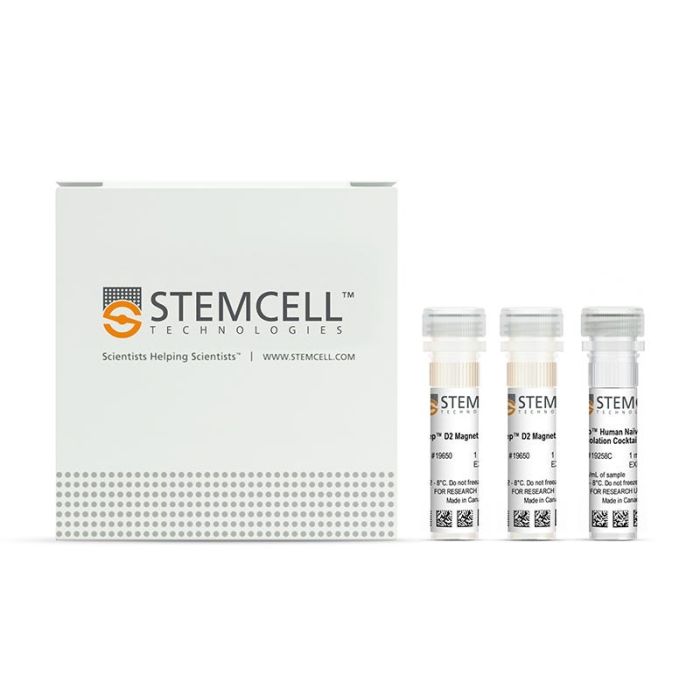
EasySep™人Naïve CD8+ T细胞分选试剂盒

人Naïve CD8+ T细胞的免疫磁珠负选

产品号 #(选择产品)

产品号 #19258_C

人Naïve CD8+ T细胞的免疫磁珠负选

产品优势

  • 操作简单、快捷,且无需分离柱
  • 纯度高达97%
  • 获得的活细胞无标记

产品组分包括

  • EasySep™人 Naïve CD8+ T细胞分选试剂盒(产品号 #19258)
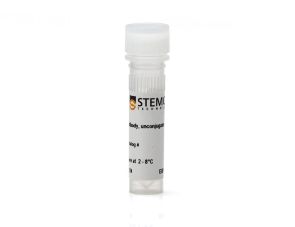
    • EasySep™人Naïve CD8+ T细胞分选抗体混合物,1 mL
    • EasySep™ D2 Magnetic Particles磁珠,2 x 1 mL
  • RoboSep™人Naïve CD8+ T细胞分选试剂盒(产品号 #19258RF)
    • EasySep™人Naïve CD8+ T细胞分选抗体混合物,1 mL
    • EasySep™ D2 Magnetic Particles磁珠,5 x 1 mL
    • RoboSep™ 缓冲液(产品号 #20104)
    • RoboSep™过滤吸头(产品号 #20125)x 2
专为您的实验方案打造的产品
要查看实验方案所需的所有配套产品,请参阅《实验方案与技术文档》

总览

使用 EasySep™ 人初始 CD8⁺ T 细胞分离试剂盒,可通过免疫磁性负选法从新鲜人外周血单个核细胞(PBMC)样本中轻松高效地分离高纯度的初始 CD8⁺ T 细胞(CD8⁺CD45RA⁺CCR7⁺ 且 CD45RO⁻CD57⁻CD56⁻)。EasySep™ 技术在已发表的研究中被广泛应用超过 20 年,结合了单克隆抗体的特异性与无柱磁分选系统的简便性。

在此 EasySep™ 负选步骤中,非目的细胞被抗体复合物和磁性颗粒标记。以下标志物阳性的细胞将被去除:CD4、CD14、CD16、CD19、CD20、CD36、CD45RO、CD56、CD57、CD94、CD123、CD244、IgM、TCRγ/δ 和糖蛋白 A。经 EasySep™ 磁极分离后,未标记的初始 CD8⁺ T 目的细胞被转移至新管中。磁性分离完成后,目的细胞可直接用于流式细胞术、培养或 DNA/RNA 提取等下游应用。

如需更快的分离,可使用 EasySep™ 人初始 CD8⁺ T 细胞分离试剂盒 II(产品号 #17968),可在短至 11 分钟内完成分离。

了解更多关于 EasySep™ 免疫磁性技术的工作原理,或了解如何使用 RoboSep™ 实现全自动化免疫磁性细胞分离。探索更多产品,包括培养基、补充物、抗体等,以优化您的实验流程。


磁极兼容性
• EasySep™磁极(产品号 #18000)
• “The Big Easy” EasySep™磁极(产品号 #18001)
• RoboSep™-S(产品号 #21000)
 
分类
细胞分选试剂盒
 
细胞类型
T 细胞,T 细胞,CD8+
 
种属

 
样本来源
PBMC
 
分选方法
负选
 
应用
细胞分选
 
品牌
EasySep,RoboSep
 
研究领域
免疫
 

实验数据

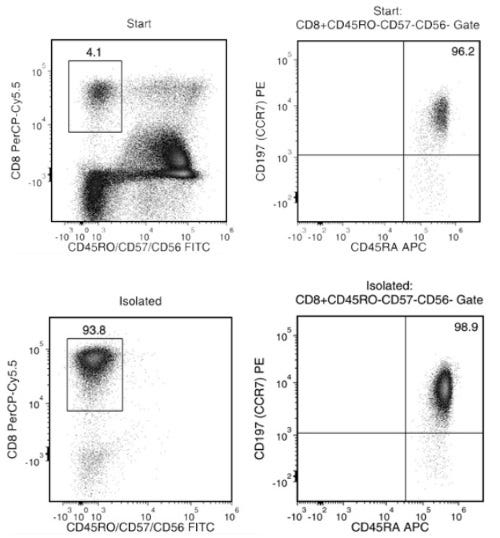
Typical EasySep™ Human Naïve CD8+ T Cell Isolation Profile

Figure 1. Typical EasySep™ Human Naïve CD8+ T Cell Isolation Profile

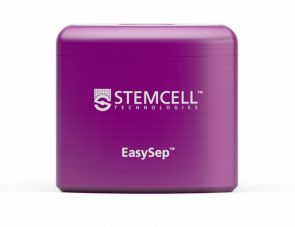
Starting with fresh PBMCs, the naïve CD8+ T cell content (CD8+CD45RA+CCR7+ and CD45RO-CD57-CD56-) of the isolated fraction is typically 92.3 ± 4.0% (mean ± SD) using the purple EasySep™ Magnet. In the above example, the purities of the start and final isolated fractions are 3.9% and 92.8%, respectively.

产品说明书及文档

请在《产品说明书》中查找相关支持信息和使用说明,或浏览下方更多实验方案。

Document Type
Product Name
Catalog #
Lot #
Language
Catalog #
19258
Lot #
All
Language
English
Catalog #
19258RF
Lot #
All
Language
English
Document Type
Safety Data Sheet 1
Catalog #
19258
Lot #
All
Language
English
Document Type
Safety Data Sheet 2
Catalog #
19258
Lot #
All
Language
English
Document Type
Safety Data Sheet 1
Catalog #
19258RF
Lot #
All
Language
English
Document Type
Safety Data Sheet 2
Catalog #
19258RF
Lot #
All
Language
English
Document Type
Safety Data Sheet 3
Catalog #
19258RF
Lot #
All
Language
English

应用领域

本产品专为以下研究领域设计,适用于工作流程中的高亮阶段。探索这些工作流程,了解更多我们为各研究领域提供的其他配套产品。

相关材料与文献

技术资料 (2)

文献 (4)

Comparative analysis of the DNA methylation landscape in CD4, CD8, and B memory lineages. Z. Zhang et al. Clinical epigenetics 2022 dec

Abstract

BACKGROUND There is considerable evidence that epigenetic mechanisms and DNA methylation are critical drivers of immune cell lineage differentiation and activation. However, there has been limited coordinated investigation of common epigenetic pathways among cell lineages. Further, it remains unclear if long-lived memory cell subtypes differentiate distinctly by cell lineages. RESULTS We used the Illumina EPIC array to investigate the consistency of DNA methylation in B cell, CD4 T, and CD8 T na{\{i}}ve and memory cells states. In the process of na{\"{i}}ve to memory activation across the three lineages we identify considerable shared epigenetic regulation at the DNA level for immune memory generation. Further in central to effector memory differentiation our analyses revealed specific CpG dinucleotides and genes in CD4 T and CD8 T cells with DNA methylation changes. Finally we identified unique DNA methylation patterns in terminally differentiated effector memory (TEMRA) CD8 T cells compared to other CD8 T memory cell subtypes. CONCLUSIONS Our data suggest that epigenetic alterations are widespread and essential in generating human lymphocyte memory. Unique profiles are involved in methylation changes that accompany memory genesis in the three subtypes of lymphocytes."
IL-9/STAT3/fatty acid oxidation-mediated lipid peroxidation contributes to Tc9 cell longevity and enhanced antitumor activity. L. Xiao et al. The Journal of clinical investigation 2022 apr

Abstract

CD8+ T cell longevity regulated by metabolic activity plays important roles in cancer immunotherapy. Although in vitro-polarized, transferred IL-9-secreting CD8+ Tc9 (cytotoxic T lymphocyte subset 9) cells exert greater persistence and antitumor efficacy than Tc1 cells, the underlying mechanism remains unclear. Here, we show that tumor-infiltrating Tc9 cells display significantly lower lipid peroxidation than Tc1 cells in several mouse models, which is strongly correlated with their persistence. Using RNA-sequence and functional validation, we found that Tc9 cells exhibited unique lipid metabolic programs. Tc9 cell-derived IL-9 activated STAT3, upregulated fatty acid oxidation and mitochondrial activity, and rendered Tc9 cells with reduced lipid peroxidation and resistance to tumor- or ROS-induced ferroptosis in the tumor microenvironment. IL-9 signaling deficiency, inhibiting STAT3, or fatty acid oxidation increased lipid peroxidation and ferroptosis of Tc9 cells, resulting in impaired longevity and antitumor ability. Similarly, human Tc9 cells also exhibited lower lipid peroxidation than Tc1 cells and tumor-infiltrating CD8+ T cells expressed lower IL9 and higher lipid peroxidation- and ferroptosis-related genes than circulating CD8+ T cells in patients with melanoma. This study indicates that lipid peroxidation regulates Tc9 cell longevity and antitumor effects via the IL-9/STAT3/fatty acid oxidation pathway and regulating T cell lipid peroxidation can be used to enhance T cell-based immunotherapy in human cancer.
Age-Associated Changes to Lymph Node Fibroblastic Reticular Cells. T. Kwok et al. Frontiers in aging 2022

Abstract

The decreased proportion of antigen-inexperienced, na{\{i}}ve T cells is a hallmark of aging in both humans and mice and contributes to reduced immune responses particularly against novel and re-emerging pathogens. Na{\"{i}}ve T cells depend on survival signals received during their circulation among the lymph nodes by direct contacts with stroma in particular fibroblastic reticular cells. Macroscopic changes to the architecture of the lymph nodes have been described but it is unclear how lymph node stroma are altered with age and whether these changes contribute to reduced na{\"{i}}ve T cell maintenance. Here using 2-photon microscopy we determined that the aged lymph node displayed increased fibrosis and correspondingly that na{\"{i}}ve T-cell motility was impaired in the aged lymph node especially in proximity to fibrotic deposition. Functionally adoptively transferred young na{\"{i}}ve T-cells exhibited reduced homeostatic turnover in aged hosts supporting the role of T cell-extrinsic mechanisms that regulate their survival. Further we determined that early development of resident fibroblastic reticular cells was impaired which may correlate to the declining levels of na{\"{i}}ve T-cell homeostatic factors observed in aged lymph nodes. Thus our study addresses the controversy as to whether aging impacts the composition lymph node stroma and supports a model in which impaired differentiation of lymph node fibroblasts and increased fibrosis inhibits the interactions necessary for na{\"{i}}ve T cell homeostasis."

更多信息

更多信息
物种 人类
Magnet Compatibility • EasySep™ Magnet (Catalog #18000) • “The Big Easy” EasySep™ Magnet (Catalog #18001) • RoboSep™-S (Catalog #21000)
样本来源 PBMC
Selection Method Negative
标记抗体
质量保证:

产品仅供研究使用,不用于针对人或动物的诊断或治疗。 欲获悉更多关于STEMCELL的质控信息,请访问 STEMCELL.CN/COMPLIANCE.
Copyright © 2025 by STEMCELL Technologies. All rights reserved.

在线联系