若您需要咨询产品或有任何技术问题,请通过官方电话 400 885 9050 或邮箱 info.cn@stemcell.com 与我们联系。

Dispase (1 U/mL)

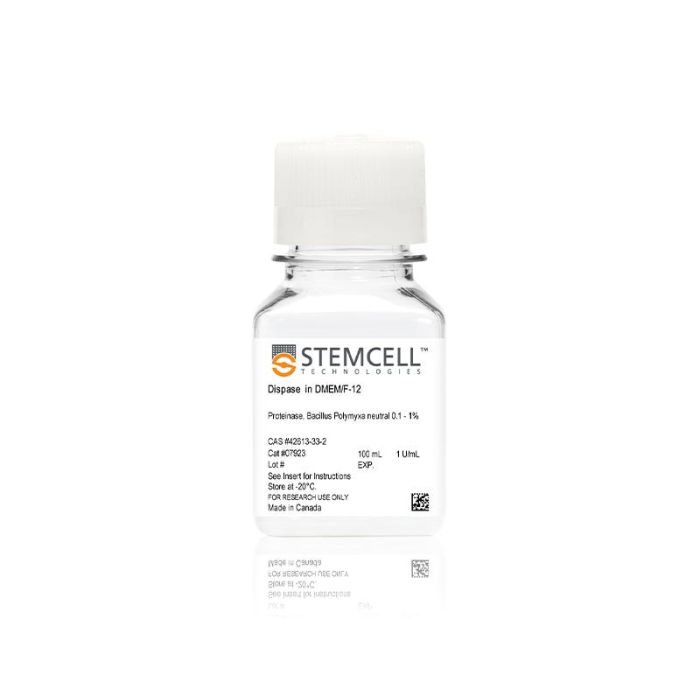
含 1 U/mL Dispase 的 DMEM/F-12 培养基溶液
只有 %1
¥872.00

产品号 #(选择产品)

产品号 #07923_C

含 1 U/mL Dispase 的 DMEM/F-12 培养基溶液

产品优势

  • 实现多种组织的温和解离
  • 针对人ES和iPS细胞的酶解传代进行了优化

总览

Dispase(1 U/mL)适用于多种组织的温和解离。该蛋白水解解离试剂已针对人胚胎干细胞(ES)和人诱导多能干细胞(iPS)酶解传代进行了优化。将剪碎的组织与预温的 Dispase一起孵育并轻柔搅拌,将以最小的细胞损伤释放细胞。预温的 Dispase可用于从组织培养皿中分离细胞。

本产品含有 1 U/mL 的 Dispase II(来源于多粘类芽孢杆菌的中性蛋白酶),溶于 DMEM/F-12 培养基中。与胰蛋白酶不同,Dispase 不受血清抑制,但其活性会受到 EDTA 和 EGTA 的抑制。使用后,应通过离心去除 Dispase,并用缓冲液或培养基清洗细胞。

分类
酶法相关(或酶解类产品)
 
别名
中性蛋白酶;蛋白酶
 
细胞类型
肠道细胞,乳腺细胞,其他物种,多能干细胞,前列腺细胞
 
种属
人,小鼠,非人灵长类,其他物种,大鼠
 
应用
细胞培养
 
研究领域
上皮细胞研究,干细胞生物学
 

产品说明书及文档

请在《产品说明书》中查找相关支持信息和使用说明,或浏览下方更多实验方案。

Document Type
Product Name
Catalog #
Lot #
Language
Product Name
Dispase (1 U/mL)
Catalog #
07923
Lot #
All
Language
English
Document Type
Safety Data Sheet
Product Name
Dispase (1 U/mL)
Catalog #
07923
Lot #
All
Language
English

应用领域

本产品专为以下研究领域设计,适用于工作流程中的高亮阶段。探索这些工作流程,了解更多我们为各研究领域提供的其他配套产品。

相关材料与文献

技术资料 (3)

文献 (72)

Alkaline phosphatase-positive colony formation is a sensitive, specific, and quantitative indicator of undifferentiated human embryonic stem cells. O'Connor MD et al. Stem cells (Dayton,Ohio) 2008 MAY

Abstract

Human embryonic stem cells (hESCs) can be maintained in vitro as immortal pluripotent cells but remain responsive to many differentiation-inducing signals. Investigation of the initial critical events involved in differentiation induction would be greatly facilitated if a specific,robust,and quantitative assay for pluripotent hESCs with self-renewal potential were available. Here we describe the results of a series of experiments to determine whether the formation of adherent alkaline phosphatase-positive (AP(+)) colonies under conditions optimized for propagating undifferentiated hESCs would meet this need. The findings can be summarized as follows. (a) Most colonies obtained under these conditions consist of textgreateror=30 AP(+) cells that coexpress OCT4,NANOG,SSEA3,SSEA4,TRA-1-60,and TRA-1-81. (b) Most such colonies are derived from SSEA3(+) cells. (c) Primary colonies contain cells that produce secondary colonies of the same composition,including cells that initiate multilineage differentiation in embryoid bodies (EBs). (d) Colony formation is independent of plating density or the colony-forming cell (CFC) content of the test population over a wide range of cell concentrations. (e) CFC frequencies decrease when differentiation is induced by exposure either to retinoic acid or to conditions that stimulate EB formation. Interestingly,this loss of AP(+) clonogenic potential also occurs more rapidly than the loss of SSEA3 or OCT4 expression. The CFC assay thus provides a simple,reliable,broadly applicable,and highly specific functional assay for quantifying undifferentiated hESCs with self-renewal potential. Its use under standardized assay conditions should enhance future elucidation of the mechanisms that regulate hESC propagation and their early differentiation.
Derivation of human embryonic stem cell lines after blastocyst microsurgery. Meng G et al. Biochemistry and cell biology = Biochimie et biologie cellulaire 2010 JUN

Abstract

Embryonic stem cells (ESCs) are derived from the inner cell mass (ICM) of the blastocyst. Because of their ability to differentiate into a variety of cell types,human embryonic stem cells (hESCs) provide an unlimited source of cells for clinical medicine and have begun to be used in clinical trials. Presently,although several hundred hESC lines are available in the word,only few have been widely used in basic and applied research. More and more hESC lines with differing genetic backgrounds are required for establishing a bank of hESCs. Here,we report the first Canadian hESC lines to be generated from cryopreserved embryos and we discuss how we navigated through the Canadian regulatory process. The cryopreserved human zygotes used in this study were cultured to the blastocyst stage,and used to isolate ICM via microsurgery. Unlike previous microsurgery methods,which use specialized glass or steel needles,our method conveniently uses syringe needles for the isolation of ICM and subsequent hESC lines. ICM were cultured on MEF feeders in medium containing FBS or serum replacer (SR). Resulting outgrowths were isolated,cut into several cell clumps,and transferred onto fresh feeders. After more than 30 passages,the two hESC lines established using this method exhibited normal morphology,karyotype,and growth rate. Moreover,they stained positively for a variety of pluripotency markers and could be differentiated both in vitro and in vivo. Both cell lines could be maintained under a variety of culture conditions,including xeno-free conditions we have previously described. We suggest that this microsurgical approach may be conducive to deriving xeno-free hESC lines when outgrown on xeno-free human foreskin fibroblast feeders.
DNA damage responses in human induced pluripotent stem cells and embryonic stem cells. Momcilovic O et al. PLoS ONE 2010 JAN

Abstract

BACKGROUND: Induced pluripotent stem (iPS) cells have the capability to undergo self-renewal and differentiation into all somatic cell types. Since they can be produced through somatic cell reprogramming,which uses a defined set of transcription factors,iPS cells represent important sources of patient-specific cells for clinical applications. However,before these cells can be used in therapeutic designs,it is essential to understand their genetic stability. METHODOLOGY/PRINCIPAL FINDINGS: Here,we describe DNA damage responses in human iPS cells. We observe hypersensitivity to DNA damaging agents resulting in rapid induction of apoptosis after γ-irradiation. Expression of pluripotency factors does not appear to be diminished after irradiation in iPS cells. Following irradiation,iPS cells activate checkpoint signaling,evidenced by phosphorylation of ATM,NBS1,CHEK2,and TP53,localization of ATM to the double strand breaks (DSB),and localization of TP53 to the nucleus of NANOG-positive cells. We demonstrate that iPS cells temporary arrest cell cycle progression in the G(2) phase of the cell cycle,displaying a lack of the G(1)/S cell cycle arrest similar to human embryonic stem (ES) cells. Furthermore,both cell types remove DSB within six hours of γ-irradiation,form RAD51 foci and exhibit sister chromatid exchanges suggesting homologous recombination repair. Finally,we report elevated expression of genes involved in DNA damage signaling,checkpoint function,and repair of various types of DNA lesions in ES and iPS cells relative to their differentiated counterparts. CONCLUSIONS/SIGNIFICANCE: High degrees of similarity in DNA damage responses between ES and iPS cells were found. Even though reprogramming did not alter checkpoint signaling following DNA damage,dramatic changes in cell cycle structure,including a high percentage of cells in the S phase,increased radiosensitivity and loss of DNA damage-induced G(1)/S cell cycle arrest,were observed in stem cells generated by induced pluripotency.

更多信息

更多信息
物种 人, 其它物种, 大鼠, 小鼠, 非人灵长类
Alternative Names Neutral protease; Proteinase
质量保证:

产品仅供研究使用,不用于针对人或动物的诊断或治疗。 欲获悉更多关于STEMCELL的质控信息,请访问 STEMCELL.CN/COMPLIANCE.
Copyright © 2026 by STEMCELL Technologies. All rights reserved.

在线联系