若您需要咨询产品或有任何技术问题,请通过官方电话 400 885 9050 或邮箱 info.cn@stemcell.com 与我们联系。

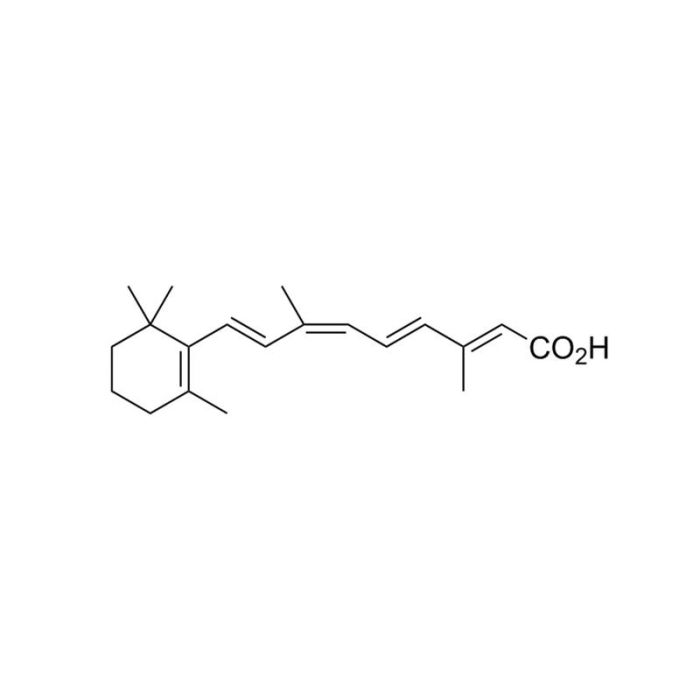
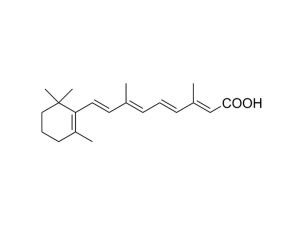
9-顺式视黄酸

维甲酸通路激活剂;可激活视黄酸受体(RAR)和类视黄醇X受体(RXR)
只有 %1
¥2,642.00

产品号 #(选择产品)

产品号 #72382_C

维甲酸通路激活剂;可激活视黄酸受体(RAR)和类视黄醇X受体(RXR)

总览

9-顺式视黄酸可激活所有视黄酸受体 (RAR) 亚型 (Ki = 0.5-27 nM) 以及类视黄酸 X 受体 (RXR) 亚型 (Ki = 3.8-12 nM) (Umemiya et al.; Wong et al.)。RAR 能够与 RXR 形成异二聚体,而 RXR 又能与其他受体形成异二聚体,这使得 9-顺式视黄酸能够产生广泛的效应 (Dawson et al.; Kane)。

分化
·增加大鼠神经干细胞培养物中衍生的神经元数量(Laeng et al.)。
·促进培养细胞和小鼠小脑切片中少突胶质细胞前体细胞的分化和髓鞘形成(Huang et al.)。
·在胶原凝胶中培养的小鼠胚胎胰腺中诱导胰管形成,但不诱导腺泡形成 (Kadison et al.; Kobayashi et al.)。
·在体外和体内增强 BMP9 诱导的间充质祖细胞成骨分化(Zhang et al.)。
·诱导 C2C12 成肌祖细胞成肌分化(Zhu et al.)。

癌症研究
·抑制 Epstein-Barr 病毒感染的淋巴母细胞系增殖(Pomponi et al.)。
·抑制培养的人胃癌细胞的生长(Naka et al.)。
·抑制原发性套细胞淋巴瘤细胞的自发增殖和 CD40 诱导的生长(Guidoboni et al.)。

细胞类型
癌细胞及细胞系,白血病/淋巴瘤细胞,间充质干/祖细胞,肌源干/祖细胞,神经干/祖细胞,成骨细胞,胰腺细胞
 
种属
人,小鼠,非人灵长类,其他物种,大鼠
 
应用
分化
 
研究领域
癌症,神经科学,干细胞生物学
 
CAS 编号
5300-03-8
 
化学式
C₂₀H₂₈O₂
 
纯度
≥ 90%
 
通路
视黄醇类
 
靶点
RAR,RXR
 

Protocols and Documentation

Find supporting information and directions for use in the Product Information Sheet or explore additional protocols below.

Document Type
Product Name
Catalog #
Lot #
Language
Catalog #
72382
Lot #
Catalog #72382, lot #1000099195 or higher | Catalog #72384, lot #1000087589 or higher
Language
English
Document Type
Safety Data Sheet
Catalog #
72382
Lot #
All
Language
English

Applications

This product is designed for use in the following research area(s) as part of the highlighted workflow stage(s). Explore these workflows to learn more about the other products we offer to support each research area.

相关材料与文献

技术资料 (3)

文献 (12)

Retinoid signaling directs secondary lineage selection in pancreatic organogenesis. Kadison A et al. Journal of pediatric surgery 2001 AUG

Abstract

BACKGROUND/PURPOSE: Retinoid signaling plays an important role in many differentiation pathways. Retinoid signaling has been implicated in the induction of differentiation by pancreatic ductal cancer cell lines and in patients with pancreatic cancer. The authors wished to better understand the role of retinoid signaling in pancreatic development. METHODS: Embryonic pancreas was harvested from mice at serial gestational ages and immunohistochemical analysis was performed for retinoic acid receptors (RAR-alpha,RAR-beta,RAR-gamma),and retinoid X receptors (RXR-alpha,RXR-beta,and RXR-gamma). Also,early embryonic pancreases were cultured for 7 days with exogenous 9-cis retinoic acid (9cRA) or all-trans retinoic acid (atRA) and analyzed histologically and immunohistochemically. RESULTS: Retinoid receptors were expressed in a lineage-specific distribution,with stronger expression for many in the exocrine compartment. The receptors were not often expressed until late gestation. Exogenous 9cRA induced predominantly ducts instead of acini,plus more mature endocrine (islet) architecture. Exogenous atRA induced predominantly acini instead of ducts,with no apparent endocrine effect. CONCLUSIONS: Retinoids may have an important role in pancreatic differentiation,with a particular effect on secondary lineage selection between ductal and acinar phenotype. Because the control of ductal versus acinar differentiation has been implicated strongly in the pathogenesis of pancreatic ductal carcinoma,these results may lay the groundwork for studies in the mechanism of induced differentiation of pancreatic ductal cancer by retinoids.
Retinoid signaling controls mouse pancreatic exocrine lineage selection through epithelial-mesenchymal interactions. Kobayashi H et al. Gastroenterology 2002 OCT

Abstract

BACKGROUND & AIMS The early embryonic pancreas gives rise to exocrine (ducts and acini) and endocrine lineages. Control of exocrine differentiation is poorly understood,but may be a critical avenue through which to manipulate pancreatic ductal carcinoma. Retinoids have been shown to change the character of pancreatic ductal cancer cells to a less malignant phenotype. We have shown that 9-cis retinoic acid (9cRA) inhibits acinar differentiation in the developing pancreas,in favor of ducts,and we wanted to determine the role of retinoids in duct versus acinar differentiation. METHODS We used multiple culture systems for the 11-day embryonic mouse pancreas. RESULTS Retinoic acid receptor (RAR)-selective agonists mimicked the acinar suppressive effect of 9cRA,suggesting that RAR-RXR heterodimers were critical to ductal differentiation. RARalpha was only expressed in mesenchyme,whereas RXRalpha was expressed in epithelium and mesenchyme. Retinaldehyde dehydrogenase 2,a critical enzyme in retinoid synthesis,was expressed only in pancreatic epithelium. 9cRA did not induce ductal differentiation in the absence of mesenchyme,implicating a requirement for mesenchyme in 9cRA effects. Mesenchymal laminin is necessary for duct differentiation,and retinoids are known to enhance laminin expression. In 9cRA-treated pancreas,immunohistochemistry for laminin showed a strong band of staining around ducts,and blockage of laminin signaling blocked all 9cRA effects. Western blot and RT-PCR of pancreatic mesenchyme showed laminin-beta1 protein and mRNA induction by 9cRA. CONCLUSIONS Retinoids regulate exocrine lineage selection through epithelial-mesenchymal interactions,mediated through up-regulation of mesenchymal laminin-1.
The mood stabilizer valproic acid stimulates GABA neurogenesis from rat forebrain stem cells. Laeng P et al. Journal of neurochemistry 2004 OCT

Abstract

Valproate,an anticonvulsant drug used to treat bipolar disorder,was studied for its ability to promote neurogenesis from embryonic rat cortical or striatal primordial stem cells. Six days of valproate exposure increased by up to fivefold the number and percentage of tubulin beta III-immunopositive neurons,increased neurite outgrowth,and decreased by fivefold the number of astrocytes without changing the number of cells. Valproate also promoted neuronal differentiation in human fetal forebrain stem cell cultures. The neurogenic effects of valproate on rat stem cells exceeded those obtained with the neurotrophins brain-derived growth factor (BDNF) or NT-3,and slightly exceeded the effects obtained with another mood stabilizer,lithium. No effect was observed with carbamazepine. Most of the newly formed neurons were GABAergic,as shown by 10-fold increases in neurons that immunostained for GABA and the GABA-synthesizing enzyme GAD65/67. Double immunostaining for bromodeoxyuridine and tubulin beta III showed that valproate increased by four- to fivefold the proliferation of neuronal progenitors derived from rat stem cells and increased cyclin D2 expression. Valproate also regulated the expression of survival genes,Bad and Bcl-2,at different times of treatment. The expression of prostaglandin E synthase,analyzed by quantitative RT-PCR,was increased by ninefold as early as 6 h into treatment by valproate. The enhancement of GABAergic neuron numbers,neurite outgrowth,and phenotypic expression via increases in the neuronal differentiation of neural stem cell may contribute to the therapeutic effects of valproate in the treatment of bipolar disorder.

更多信息

更多信息
物种 人, 其它物种, 大鼠, 小鼠, 非人灵长类
Cas Number 5300-03-8
Chemical Formula C₂₀H₂₈O₂
纯度 ≥ 90%
Target RAR, RXR
Pathway Retinoid
PRODUCTS ARE FOR RESEARCH USE ONLY AND NOT INTENDED FOR HUMAN OR ANIMAL DIAGNOSTIC OR THERAPEUTIC USES UNLESS OTHERWISE STATED. FOR ADDITIONAL INFORMATION ON QUALITY AT STEMCELL, REFER TO WWW.STEMCELL.COM/COMPLIANCE.
Copyright © 2026 by STEMCELL Technologies. All rights reserved.

在线联系