若您需要咨询产品或有任何技术问题,请通过官方电话 400 885 9050 或邮箱 info.cn@stemcell.com 与我们联系。

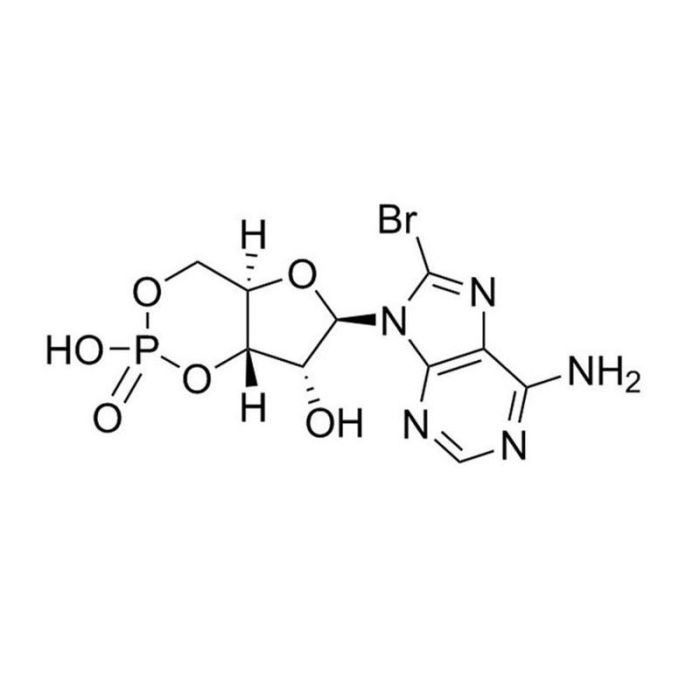
8-Bromo-cAMP

cAMP通路激活剂;激活cAMP依赖性激酶
只有 %1
¥672.00

产品号 #(选择产品)

产品号 #73602_C

cAMP通路激活剂;激活cAMP依赖性激酶

总览

8-Bromo-cAMP(8-溴环腺苷酸)是一种膜渗透性cAMP衍生物。它能够激活cAMP依赖性蛋白激酶,并由于其对cAMP磷酸二酯酶具有抗性而具有长效作用(Schwede et al.)。它可用于研究钙介导通路(IC₅₀= 0.84 mM;Xaus et al.)。

重编程
·与丙戊酸搭配使用可提高人新生儿包皮成纤维细胞(HFF1)的重编程效率(Wang & Adjaye)。

免疫学
·抑制M-CSF依赖性的巨噬细胞增殖(Xaus et al.)。
·保护中性粒细胞免受TNF-α诱导的细胞凋亡(Krakstad)。

癌症研究
·诱导IL-3依赖性白血病细胞系的增殖反应(Barge et al.)。
·诱导胰腺癌细胞系的膜去极化(Sorio et al.)。

别名
8‑溴环腺苷酸,8‑Bro‑cAMP,NSC 171719
 
细胞类型
癌细胞及细胞系,巨噬细胞,多能干细胞
 
种属
人,小鼠,非人灵长类,其他物种,大鼠
 
应用
重编程
 
研究领域
癌症,免疫,干细胞生物学
 
CAS 编号
23583-48-4
 
化学式
C₁₀H₁₁BrN₅O₆P
 
分子量
408.1 g/mol
 
纯度
≥ 95 %
 
通路
cAMP
 
靶点
cAMP依赖性激酶
 

Protocols and Documentation

Find supporting information and directions for use in the Product Information Sheet or explore additional protocols below.

Document Type
Product Name
Catalog #
Lot #
Language
Product Name
8-Bromo-cAMP
Catalog #
73604, 73602
Lot #
All
Language
English
Document Type
Safety Data Sheet
Product Name
8-Bromo-cAMP
Catalog #
73604, 73602
Lot #
All
Language
English

相关材料与文献

Publications (6)

文献 (6)

Adenosine inhibits macrophage colony-stimulating factor-dependent proliferation of macrophages through the induction of p27kip-1 expression. Xaus J et al. Journal of immunology (Baltimore,Md. : 1950) 1999 OCT

Abstract

Adenosine is produced during inflammation and modulates different functional activities in macrophages. In murine bone marrow-derived macrophages,adenosine inhibits M-CSF-dependent proliferation with an IC50 of 45 microM. Only specific agonists that can activate A2B adenosine receptors such as 5'-N-ethylcarboxamidoadenosine,but not those active on A1 (N6-(R)-phenylisopropyladenosine),A2A ([p-(2-carbonylethyl)phenylethylamino]-5'-N-ethylcarboxamido adenosine),or A3 (N6-(3-iodobenzyl)adenosine-5'-N-methyluronamide) receptors,induce the generation of cAMP and modulate macrophage proliferation. This suggests that adenosine regulates macrophage proliferation by interacting with the A2B receptor and subsequently inducing the production of cAMP. In fact,both 8-Br-cAMP (IC50 85 microM) and forskolin (IC50 7 microM) inhibit macrophage proliferation. Moreover,the inhibition of adenylyl cyclase and protein kinase A blocks the inhibitory effect of adenosine and its analogues on macrophage proliferation. Adenosine causes an arrest of macrophages at the G1 phase of the cell cycle without altering the activation of the extracellular-regulated protein kinase pathway. The treatment of macrophages with adenosine induces the expression of p27kip-1,a G1 cyclin-dependent kinase inhibitor,in a protein kinase A-dependent way. Moreover,the involvement of p27kip-1 in the adenosine inhibition of macrophage proliferation was confirmed using macrophages from mice with a disrupted p27kip-1 gene. These results demonstrate that adenosine inhibits macrophage proliferation through a mechanism that involves binding to A2B adenosine receptor,the generation of cAMP,and the induction of p27kip-1 expression.
Cyclic nucleotide analogs as biochemical tools and prospective drugs. Schwede F et al. Pharmacology & therapeutics 2000 JAN

Abstract

Cyclic AMP (cAMP) and cyclic GMP (cGMP) are key second messengers involved in a multitude of cellular events. From the wealth of synthetic analogs of cAMP and cGMP,only a few have been explored with regard to their therapeutic potential. Some of the first-generation cyclic nucleotide analogs were promising enough to be tested as drugs,for instance N(6),O(2)'-dibutyryl-cAMP and 8-chloro-cAMP (currently in clinical Phase II trials as an anticancer agent). Moreover,8-bromo and dibutyryl analogs of cAMP and cGMP have become standard tools for investigations of biochemical and physiological signal transduction pathways. The discovery of the Rp-diastereomers of adenosine 3',5'-cyclic monophosphorothioate and guanosine 3',5'-cyclic monophosphorothioate as competitive inhibitors of cAMP- and cGMP-dependent protein kinases,as well as subsequent development of related analogs,has proven very useful for studying the molecular basis of signal transduction. These analogs exhibit a higher membrane permeability,increased resistance against degradation,and improved target specificity. Furthermore,better understanding of signaling pathways and ligand/protein interactions has led to new therapeutic strategies. For instance,Rp-8-bromo-adenosine 3',5'-cyclic monophosphorothioate is employed against diseases of the immune system. This review will focus mainly on recent developments in cyclic nucleotide-related biochemical and pharmacological research,but also highlights some historical findings in the field.
cAMP protects neutrophils against TNF-alpha-induced apoptosis by activation of cAMP-dependent protein kinase, independently of exchange protein directly activated by cAMP (Epac). Krakstad C et al. Journal of leukocyte biology 2004 SEP

Abstract

It is unclear by which receptor cyclic adenosine monophosphate (cAMP) acts to promote neutrophil survival. We found that 8-(4-chlorophenylthio)-2'-O-methyl-cAMP,a specific activator of the recently discovered cAMP receptor,cAMP-regulated guanosine 5'-triphosphate exchange protein directly activated by cAMP,failed to protect human neutrophils from cell death. In contrast,specific activators of cAMP-dependent protein kinase type I (cA-PKI) could protect against death receptor [tumor necrosis factor receptor 1 (TNFR-1),Fas]-mediated apoptosis as well as cycloheximide-accelerated spontaneous" apoptosis. A novel "caged" cA-PK-activating analog�

更多信息

更多信息
Molecular Weight 408.1 g/mol
物种 人, 其它物种, 大鼠, 小鼠, 非人灵长类
Alternative Names 8-BrcAMP; 8-Bromoadenosine 3', 5'-cyclic monophosphate; NSC 171719
Cas Number 23583-48-4
Chemical Formula C₁₀H₁₁BrN₅O₆P
纯度 ≥ 95 %
Target cAMP-Dependent Kinase
Pathway cAMP
PRODUCTS ARE FOR RESEARCH USE ONLY AND NOT INTENDED FOR HUMAN OR ANIMAL DIAGNOSTIC OR THERAPEUTIC USES UNLESS OTHERWISE STATED.
Copyright © 2026 by STEMCELL Technologies. All rights reserved.

在线联系