若您需要咨询产品或有任何技术问题,请通过官方电话 400 885 9050 或邮箱 info.cn@stemcell.com 与我们联系。

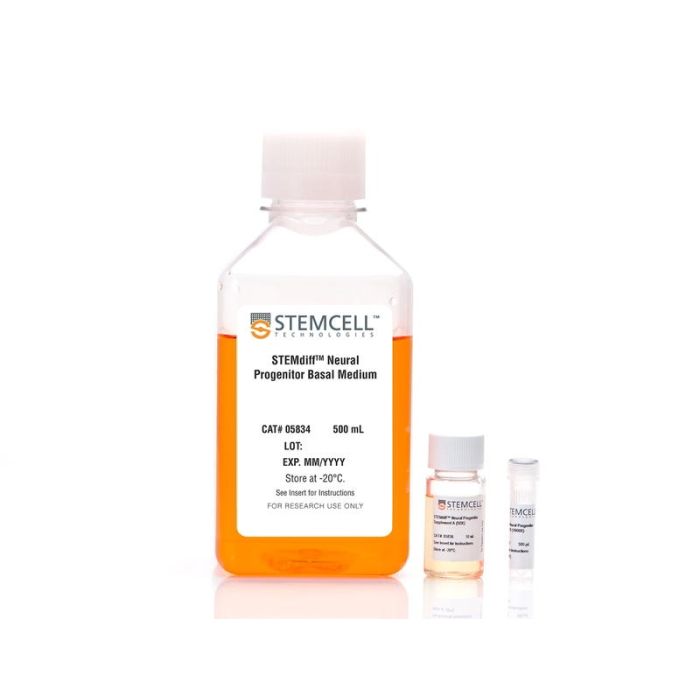
STEMdiff™神经前体细胞培养基

用于维持和扩增人ES和iPS细胞衍生的神经前体细胞的培养基
只有 %1
¥4,562.00

产品号 #(选择产品)

产品号 #05833_C

用于维持和扩增人ES和iPS细胞衍生的神经前体细胞的培养基

产品优势

  • 成分明确且不含血清
  • 支持使用 STEMdiff™ 神经诱导培养基生成的NPC的扩增
  • 针对多代传代过程中的神经祖细胞高效扩增进行了优化
  • 保留NPC的多能性,同时最大程度地减少自发神经元分化
  • 使用方便,配方和操作流程简明

产品组分包括

  • STEMdiff™ 神经前体细胞基础培养基,500 mL
  • STEMdiff™ 神经前体细胞补充剂 A (50X),10 mL
  • STEMdiff™ 神经前体细胞补充剂 B (1000X),500 µL

总览

STEMdiff™ 神经前体细胞培养基是一种成分明确且不含血清的培养基,适用于扩增使用 STEMdiff™ 神经诱导培养基(目录号 #05835)从人胚胎干细胞(ES)和诱导多能干细胞(iPS)诱导获得的神经前体细胞(NPCs)。在该培养基中培养的NPCs每代可扩增3–5倍,且可连续传代至少10代,同时自发性神经元分化极少。

分类
专用培养基
 
细胞类型
神经细胞,PSC衍生,神经干/祖细胞,多能干细胞
 
种属

 
应用
细胞培养,扩增
 
品牌
STEMdiff
 
研究领域
疾病建模,药物发现和毒理检测,神经科学,干细胞生物学
 
制剂类别
无血清
 

实验数据

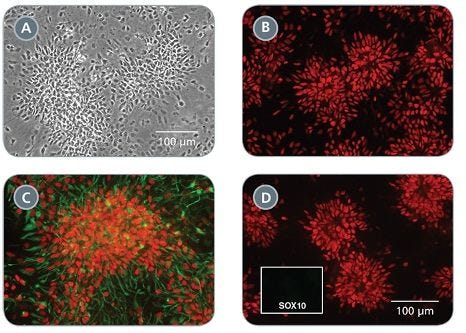
Morphology and Marker Expression of Neural Progenitor Cells Cultured in STEMdiff™ Neural Progenitor Medium

Figure 1. Morphology and Marker Expression of Neural Progenitor Cells Cultured in STEMdiff™ Neural Progenitor Medium

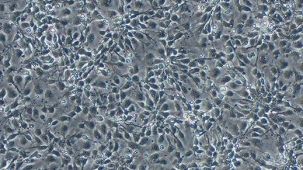
(A) Typical NPC morphology is observed in cultures (shown at day 6 of passage 1). (B-D) NPCs maintained in STEMdiff™ Neural Progenitor Medium express the CNS-type NPC markers PAX6 (B, D, red), SOX1 (C, red) and NESTIN (C, green), but not the neural crest marker SOX10 (D, green, single channel shown in inset). B-D were taken at the same magnification.

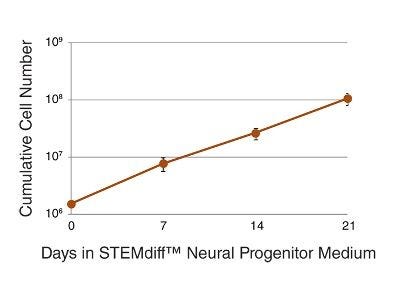
Expansion of Neural Progenitor Cells in STEMdiff™ Neural Progenitor Medium

Figure 2. Expansion of Neural Progenitor Cells in STEMdiff™ Neural Progenitor Medium

NPCs cultured in STEMdiff™ Neural Progenitor Medium can be expanded to generate a large number of cells. Three- to five-fold expansion can be achieved upon each passage. NPCs were derived using STEMdiff™ Neural Induction Medium and passaged once a week on average. n = 6.

Neural Progenitor Cells Cultured in STEMdiff™ Neural Progenitor Medium Show Minimal Spontaneous Neuronal Differentiation

Figure 3. Neural Progenitor Cells Cultured in STEMdiff™ Neural Progenitor Medium Show Minimal Spontaneous Neuronal Differentiation

Passages 1 (A) and 3 (B) of a representative NPC culture maintained in STEMdiff™ Neural Progenitor Medium. Cells were immunolabeled with SOX1 (red) to identify NPCs, and class III β-tubulin (green) to identify neurons. Spontaneous neuronal differentiation is low in NPC cultures maintained in STEMdiff™ Neural Progenitor Medium. A and B were taken at the same magnification.

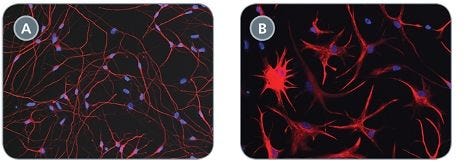
Neural Progenitor Cells Maintained in STEMdiff™ Neural Progenitor Medium can Differentiate into Neurons and Astrocytes

Figure 4. Neural Progenitor Cells Maintained in STEMdiff™ Neural Progenitor Medium can Differentiate into Neurons and Astrocytes

When directed according to published protocols, NPCs can differentiate into neurons (A, class III β-tubulin shown in red) and astrocytes (B, GFAP shown in red). Nuclei are counterstained with DAPI (blue).

产品说明书及文档

请在《产品说明书》中查找相关支持信息和使用说明,或浏览下方更多实验方案。

Document Type
Product Name
Catalog #
Lot #
Language
Catalog #
05833
Lot #
All
Language
English
Document Type
Technical Manual
Catalog #
05833
Lot #
All
Language
English
Document Type
Safety Data Sheet 1
Catalog #
05833
Lot #
All
Language
English
Document Type
Safety Data Sheet 2
Catalog #
05833
Lot #
All
Language
English
Document Type
Safety Data Sheet 3
Catalog #
05833
Lot #
All
Language
English

应用领域

本产品专为以下研究领域设计,适用于工作流程中的高亮阶段。探索这些工作流程,了解更多我们为各研究领域提供的其他配套产品。

相关材料与文献

技术资料 (14)

文献 (26)

Endolysosomal processing of neuron-derived signaling lipids regulates autophagy and lipid droplet degradation in astrocytes J. N. Bhupana et al. Nature Communications 2025 May

Abstract

Dynamic regulation of metabolic activities in astrocytes is critical to meeting the demands of other brain cells. During neuronal stress, lipids are transferred from neurons to astrocytes, where they are stored in lipid droplets (LDs). However, it is not clear whether and how neuron-derived lipids trigger metabolic adaptation in astrocytes. Here, we uncover an endolysosomal function that mediates neuron-astrocyte transcellular lipid signaling. We identify Tweety homolog 1 (TTYH1) as an astrocyte-enriched endolysosomal protein that facilitates autophagic flux and LD degradation. Astrocyte-specific deletion of mouse Ttyh1 and loss of its Drosophila ortholog lead to brain accumulation of neutral lipids. Computational and experimental evidence suggests that TTYH1 mediates endolysosomal clearance of ceramide 1-phosphate (C1P), a sphingolipid that dampens autophagic flux and LD breakdown in mouse and human astrocytes. Furthermore, neuronal C1P secretion induced by inflammatory cytokine interleukin-1β causes TTYH1-dependent autophagic flux and LD adaptations in astrocytes. These findings reveal a neuron-initiated signaling paradigm that culminates in the regulation of catabolic activities in astrocytes. Subject terms: Organelles, Glial biology, Lipid signalling
CACNA1A loss-of-function affects neurogenesis in human iPSC-derived neural models I. Musante et al. Cellular and Molecular Life Sciences: CMLS 2025 Jun

Abstract

CACNA1A encodes the pore-forming α 1A subunit of the Ca V 2.1 calcium channel, whose altered function is associated with various neurological disorders, including forms of ataxia, epilepsy, and migraine. In this study, we generated isogenic iPSC-derived neural cultures carrying CACNA1A loss-of-function mutations differently affecting Ca V 2.1 splice isoforms. Morphological, molecular, and functional analyses revealed an essential role of CACNA1A in neurodevelopmental processes. We found that different CACNA1A loss-of-function mutations produce distinct neurodevelopmental deficits. The F1491S mutation, which is located in a constitutive domain of the channel and therefore causes a complete loss-of-function, impaired neural induction at very early stages, as demonstrated by changes in single-cell transcriptomic signatures of neural progenitors, and by defective polarization of neurons. By contrast, cells carrying the Y1854X mutation, which selectively impacts the synaptically-expressed Ca V 2.1[EFa] isoform, behaved normally in terms of neural induction but showed altered neuronal network composition and lack of synchronized activity. Our findings reveal previously unrecognized roles of CACNA1A in the mechanisms underlying neural induction and neural network dynamics and highlight the differential contribution of the divergent variants Ca V 2.1[EFa] and Ca V 2.1[EFb] in the development of human neuronal cells. The online version contains supplementary material available at 10.1007/s00018-025-05740-7.
Protein Kinase C promotes peroxisome biogenesis and peroxisome–endoplasmic reticulum interaction A. Borisyuk et al. The Journal of Cell Biology 2025 Jul

Abstract

Borisyuk et al. identify a signaling regulatory network of peroxisome proliferation, uncovering PKC as a positive regulator of peroxisome–ER interaction. During neuronal differentiation, activation of PKC contributes to an increase in peroxisome formation.

更多信息

更多信息
物种 人类
配方 无血清
质量保证:

产品仅供研究使用,不用于针对人或动物的诊断或治疗。 欲获悉更多关于STEMCELL的质控信息,请访问 STEMCELL.CN/COMPLIANCE.
Copyright © 2025 by STEMCELL Technologies. All rights reserved.

在线联系