若您需要咨询产品或有任何技术问题,请通过官方电话 400 885 9050 或邮箱 info.cn@stemcell.com 与我们联系。

STEMdiff™定型内胚层检测试剂盒

用于将人胚胎干细胞(hESCs)和人诱导多能干细胞(iPSCs)分化为确定性内胚层的定义明确、无动物源成分的培养基

产品号 #(选择产品)

产品号 #05110_C

成分明确的无动物成分培养基,用于将人胚胎干细胞(ES)和诱导多能干细胞(iPS)分化为定型内胚层。

产品优势

  • 成分明确、无血清、无动物成分的完整且即用型培养基,用于人胚胎干细胞和iPS细胞分化为定型内胚层
  • 实现多种胚胎干细胞和iPS细胞系的高效和可复制分化
  • 产生定型内胚层细胞,能够进一步分化为胰腺、肝脏、肠和肺细胞系

产品组分包括

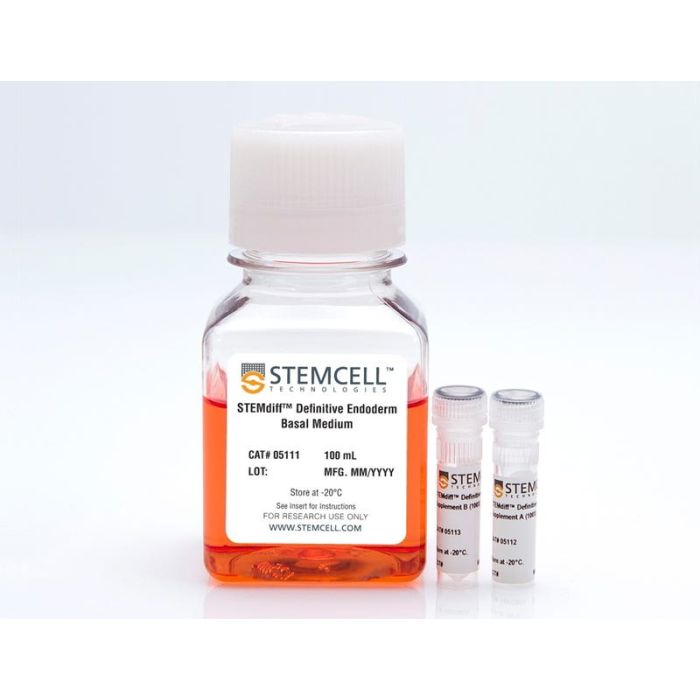
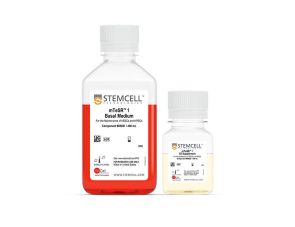
  • STEMdiff™内胚层基础培养基,100 mL
  • STEMdiff™定型内胚层补充MR (100X), 0.35 mL
  • STEMdiff™定型内胚层补充CJ (100X), 1.1 mL
专为您的实验方案打造的产品
要查看实验方案所需的所有配套产品,请参阅《实验方案与技术文档》

总览

STEMdiff™ Definitive Endoderm Kit 是一套完整的无血清、无动物源成分的培养基与添加物剂盒,可高效支持人胚胎干细胞(hESC)和人诱导多能干细胞(hiPSC)向定向内胚层细胞分化。

使用 STEMdiff™ Definitive Endoderm Kit 分化的细胞高表达内胚层标志物,包括 CD184(CXCR4)、SOX17、FOXA2 和 c-KIT,同时不表达外胚层、中胚层及多能性标志物。通过该试剂盒获得的定向内胚层细胞具有多向分化潜能,可进一步分化为胰腺、肠道、肺及肝脏谱系细胞,因此是发育生物学研究、疾病建模及药物发现的强大工具。

本试剂盒针对在 mTeSR™1、mTeSR™ Plus 或 TeSR™-AOF 中维持培养的细胞的分化进行了优化。若需了解在 TeSR™-E8™ 中培养的细胞的分化,请参阅 STEMdiff™ Definitive Endoderm Kit (TeSR™-E8™ Optimized)


分类
专用培养基
 
细胞类型
气道细胞,内胚层,PSC衍生,肝细胞,肠道细胞,胰腺细胞,多能干细胞
 
种属

 
应用
细胞培养,分化
 
品牌
STEMdiff
 
研究领域
癌症,上皮细胞研究,干细胞生物学
 
制剂类别
不含动物成分,无血清
 

实验数据

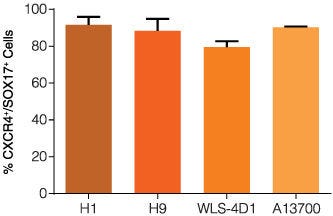
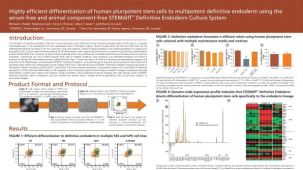
Definitive endoderm differentiation is efficient across multiple human ES and iPS cell lines

Figure 1. Definitive endoderm differentiation is efficient across multiple human ES and iPS cell lines

Quantitative analysis of definitive endoderm formulation on multiple human ES and iPS cell lines as measured by co-expression of CXCR4 and SOX17. Prior to differentiation using STEMdiff™ Definitive Endoderm, cells were maintained in their pluripotent state by culturing mTeSR™1 on Matrigel. Data are expressed as the mean percent of cells expressing both markers. Error bars indicate SEM, n = 4-18 per cell line.

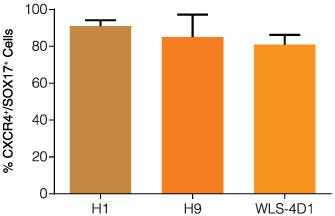
Quantitative Analysis of Definitive Endoderm hES and iPS-Derived Using STEMdiff™ Definitive Endoderm

Figure 2. Quantitative Analysis of Definitive Endoderm hES and iPS-Derived Using STEMdiff™ Definitive Endoderm

Quantitative analysis of definitive endoderm in human ES and iPS cells previously maintained in TeSR™2 prior to differentiation on Matrigel using STEMdiff™ Definitive Endoderm. Data are expressed as the mean percent of cells expressing both markers. Error bars indicate SEM. n = 4-11 per cell line.

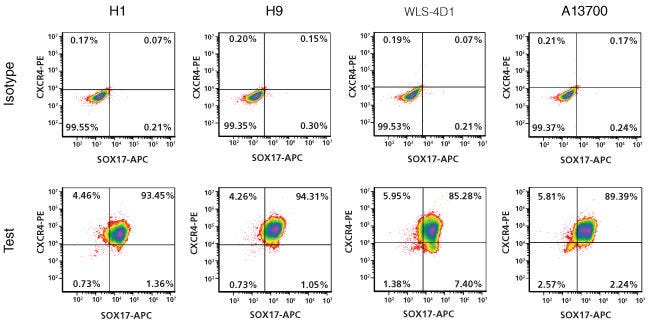
Efficient definitive endoderm differentiation in human ES and iPS cells

Figure 3. Efficient definitive endoderm differentiation in human ES and iPS cells

Representative Density plots showing CXCR4 and SOX17 expression in human ES cells (H1 and H9) and human iPS cells (WLS-4D1 and A13700) following 5 days of differentiation to definitive endoderm using STEMdiff™ Definitive Endoderm. Isotype controls were used to set quadrant gates.

STEMdiff™ Definitive Endoderm yields DE that retains potency for downstream lineage specification

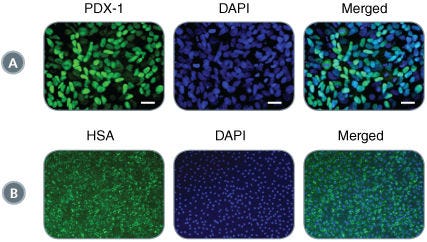
Figure 4. STEMdiff™ Definitive Endoderm yields DE that retains potency for downstream lineage specification

Cultures differentiated using STEMdiff™ Definitive Endoderm maintain their ability to be directed towards pancreatic and hepatic lineages. A) Representative image of PDX-1 immunoreactivity in H9 cells following pancreatic specification. Scale bar 20 µm. B) Representative image of human serum albumin (HSA) immunoreactivity in H9 cells following hepatic specification. Scale bar, 100 µm.

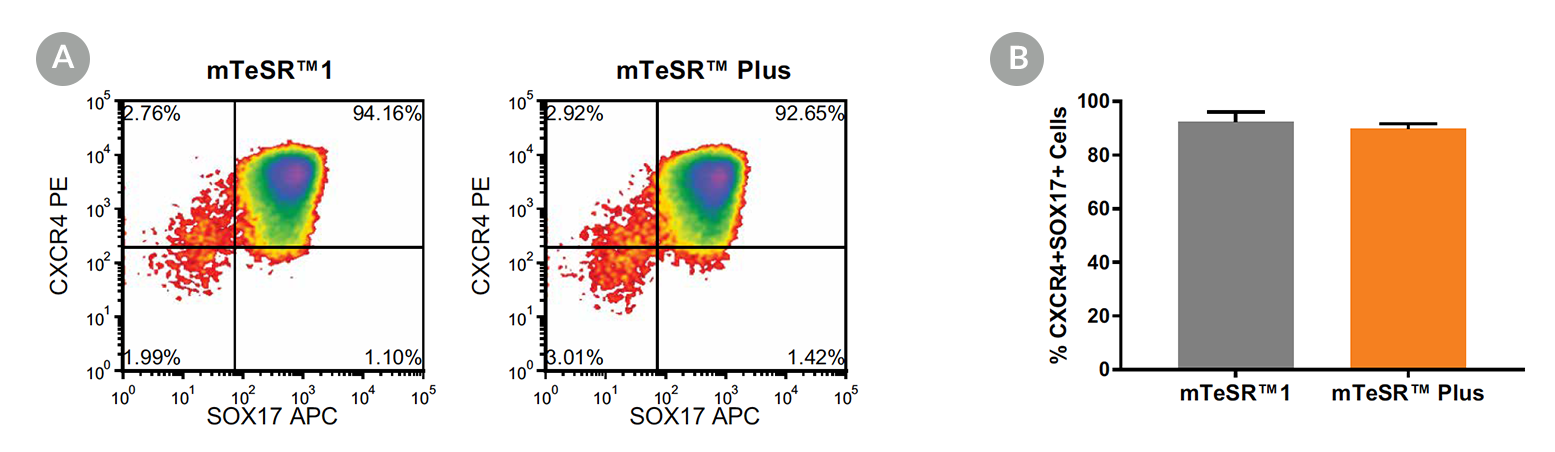
Density plots and quantitative analysis showing CXCR4 and SOX17 expression in cells cultured in mTeSR™1 (daily feeds) or mTeSR™ Plus (restricted feeds), following 5 days of differentiation using the STEMdiff™ Definitive Endoderm Kit.

Figure 5. Generation of Definitive Endoderm from hPSCs Maintained in mTeSR™ Plus

(A) Representative density plots showing CXCR4 and SOX17 expression in cells cultured in mTeSR™1 (daily feeds) or mTeSR™ Plus (restricted feeds), following 5 days of differentiation using the STEMdiff™ Definitive Endoderm Kit. (B) Quantitative analysis of definitive endoderm formation in multiple hPSC lines (H9, STiPS-M001, WLS-1C) maintained with mTeSR™1 or mTeSR™ Plus as measured by co-expression of CXCR4 and SOX17. Data are expressed as the mean percentage of cells (± SEM) expressing both markers; n=3.

产品说明书及文档

请在《产品说明书》中查找相关支持信息和使用说明,或浏览下方更多实验方案。

Document Type
Product Name
Catalog #
Lot #
Language
Catalog #
05110
Lot #
All
Language
English
Document Type
Safety Data Sheet 1
Catalog #
05110
Lot #
All
Language
English
Document Type
Safety Data Sheet 2
Catalog #
05110
Lot #
All
Language
English
Document Type
Safety Data Sheet 3
Catalog #
05110
Lot #
All
Language
English

应用领域

本产品专为以下研究领域设计,适用于工作流程中的高亮阶段。探索这些工作流程,了解更多我们为各研究领域提供的其他配套产品。

相关材料与文献

技术资料 (12)

文献 (21)

Comparative characterization of human induced pluripotent stem cells (hiPSC) derived from patients with schizophrenia and autism. L.-M. Grunwald et al. Translational psychiatry 2019

Abstract

Human induced pluripotent stem cells (hiPSC) provide an attractive tool to study disease mechanisms of neurodevelopmental disorders such as schizophrenia. A pertinent problem is the development of hiPSC-based assays to discriminate schizophrenia (SZ) from autism spectrum disorder (ASD) models. Healthy control individuals as well as patients with SZ and ASD were examined by a panel of diagnostic tests. Subsequently, skin biopsies were taken for the generation, differentiation, and testing of hiPSC-derived neurons from all individuals. SZ and ASD neurons share a reduced capacity for cortical differentiation as shown by quantitative analysis of the synaptic marker PSD95 and neurite outgrowth. By contrast, pattern analysis of calcium signals turned out to discriminate among healthy control, schizophrenia, and autism samples. Schizophrenia neurons displayed decreased peak frequency accompanied by increased peak areas, while autism neurons showed a slight decrease in peak amplitudes. For further analysis of the schizophrenia phenotype, transcriptome analyses revealed a clear discrimination among schizophrenia, autism, and healthy controls based on differentially expressed genes. However, considerable differences were still evident among schizophrenia patients under inspection. For one individual with schizophrenia, expression analysis revealed deregulation of genes associated with the major histocompatibility complex class II (MHC class II) presentation pathway. Interestingly, antipsychotic treatment of healthy control neurons also increased MHC class II expression. In conclusion, transcriptome analysis combined with pattern analysis of calcium signals appeared as a tool to discriminate between SZ and ASD phenotypes in vitro.
Intrinsic Immunity Shapes Viral Resistance of Stem Cells. Wu X et al. Cell 2018 JAN

Abstract

Stem cells are highly resistant to viral infection compared to their differentiated progeny; however, the mechanism is mysterious. Here, we analyzed gene expression in mammalian stem cells and cells at various stages of differentiation. We find that, conserved across species, stem cells express a subset of genes previously classified as interferon (IFN) stimulated genes (ISGs) but that expression is intrinsic, as stem cells are refractory to interferon. This intrinsic ISG expression varies in a cell-type-specific manner, and many ISGs decrease upon differentiation, at which time cells become IFN responsive, allowing induction of a broad spectrum of ISGs by IFN signaling. Importantly, we show that intrinsically expressed ISGs protect stem cells against viral infection. We demonstrate the in vivo importance of intrinsic ISG expression for protecting stem cells and their differentiation potential during viral infection. These findings have intriguing implications for understanding stem cell biology and the evolution of pathogen resistance.
Hepatic differentiation of human pluripotent stem cells in miniaturized format suitable for high-throughput screen Carpentier A et al. Stem Cell Research 2016 MAR

Abstract

The establishment of protocols to differentiate human pluripotent stem cells (hPSCs) including embryonic (ESC) and induced pluripotent (iPSC) stem cells into functional hepatocyte-like cells (HLCs) creates new opportunities to study liver metabolism, genetic diseases and infection of hepatotropic viruses (hepatitis B and C viruses) in the context of specific genetic background. While supporting efficient differentiation to HLCs, the published protocols are limited in terms of differentiation into fully mature hepatocytes and in a smaller-well format. This limitation handicaps the application of these cells to high-throughput assays. Here we describe a protocol allowing efficient and consistent hepatic differentiation of hPSCs in 384-well plates into functional hepatocyte-like cells, which remain differentiated for more than 3 weeks. This protocol affords the unique opportunity to miniaturize the hPSC-based differentiation technology and facilitates screening for molecules in modulating liver differentiation, metabolism, genetic network, and response to infection or other external stimuli.

更多信息

更多信息
物种 人类
配方 不含动物成分, 无血清

质量保证:

产品仅供研究使用,不用于针对人或动物的诊断或治疗。 欲获悉更多关于STEMCELL的质控信息,请访问 STEMCELL.CN/COMPLIANCE.

Copyright © 2025 by STEMCELL Technologies. All rights reserved.

在线联系