Liu S and Wicha MS (SEP 2010)
Journal of clinical oncology : official journal of the American Society of Clinical Oncology 28 25 4006--12
Targeting breast cancer stem cells.
There is increasing evidence that many cancers,including breast cancer,contain populations of cells that display stem-cell properties. These breast cancer stem cells,by virtue of their relative resistance to radiation and cytotoxic chemotherapy,may contribute to treatment resistance and relapse. The elucidation of pathways that regulate these cells has led to the identification of potential therapeutic targets. A number of agents capable of targeting breast cancer stem cells in preclinical models are currently entering clinical trials. Assessment of the efficacy of the agents will require development of innovative clinical trial designs with appropriate biologic and clinical end points. The effective targeting of breast cancer stem cells has the potential to significantly improve outcome for women with both early-stage and advanced breast cancer.
View Publication
产品号#:
01700
01705
01702
产品名:
ALDEFLUOR™ 试剂盒
ALDEFLUOR™ DEAB试剂, 1.5 mM, 1 mL
ALDEFLUOR™检测缓冲液
Visvader JE (NOV 2009)
Genes & development 23 22 2563--77
Keeping abreast of the mammary epithelial hierarchy and breast tumorigenesis.
The epithelium of the mammary gland exists in a highly dynamic state,undergoing dramatic morphogenetic changes during puberty,pregnancy,lactation,and regression. The recent identification of stem and progenitor populations in mouse and human mammary tissue has provided evidence that the mammary epithelium is organized in a hierarchical manner. Characterization of these normal epithelial subtypes is an important step toward understanding which cells are predisposed to oncogenesis. This review summarizes progress in the field toward defining constituent cells and key molecular regulators of the mammary epithelial hierarchy. Potential relationships between normal epithelial populations and breast tumor subtypes are discussed,with implications for understanding the cellular etiology underpinning breast tumor heterogeneity.
View Publication
产品号#:
产品名:
Eirew P et al. (DEC 2008)
Nature medicine 14 12 1384--9
A method for quantifying normal human mammary epithelial stem cells with in vivo regenerative ability.
Previous studies have demonstrated that normal mouse mammary tissue contains a rare subset of mammary stem cells. We now describe a method for detecting an analogous subpopulation in normal human mammary tissue. Dissociated cells are suspended with fibroblasts in collagen gels,which are then implanted under the kidney capsule of hormone-treated immunodeficient mice. After 2-8 weeks,the gels contain bilayered mammary epithelial structures,including luminal and myoepithelial cells,their in vitro clonogenic progenitors and cells that produce similar structures in secondary transplants. The regenerated clonogenic progenitors provide an objective indicator of input mammary stem cell activity and allow the frequency and phenotype of these human mammary stem cells to be determined by limiting-dilution analysis. This new assay procedure sets the stage for investigations of mechanisms regulating normal human mammary stem cells (and possibly stem cells in other tissues) and their relationship to human cancer stem cell populations.
View Publication
产品号#:
05601
产品名:
EpiCult™-B 人培养基
Alison MR et al. (DEC 2010)
The Journal of pathology 222 4 335--44
Finding cancer stem cells: are aldehyde dehydrogenases fit for purpose?
Despite many years of intensive effort,there is surprisingly little consensus on the most suitable markers with which to locate and isolate stem cells from adult tissues. By comparison,the study of cancer stem cells is still in its infancy; so,unsurprisingly,there is great uncertainty as to the identity of these cells. Stem cell markers can be broadly categorized into molecular determinants of self-renewal,clonogenicity,multipotentiality,adherence to the niche,and longevity. This review assesses the utility of recognizing cancer stem cells by virtue of high expression of aldehyde dehydrogenases (ALDHs),probably significant determinants of cell survival through their ability to detoxify many potentially cytotoxic molecules,and contributing to drug resistance. Antibodies are available against the ALDH enzyme family,but the vast majority of studies have used cell sorting techniques to enrich for cells expressing these enzymes. Live cells expressing high ALDH activity are usually identified by the ALDEFLUOR kit and sorted by fluorescence activated cell sorting (FACS). For many human tumours,but notably breast cancer,cell selection based upon ALDH activity appears to be a useful marker for enriching for cells with tumour-initiating activity (presumed cancer stem cells) in immunodeficient mice,and indeed the frequency of so-called ALDH(bri) cells in many tumours can be an independent prognostic indicator.
View Publication
Reutershan J et al. (MAR 2006)
The Journal of clinical investigation 116 3 695--702
Critical role of endothelial CXCR2 in LPS-induced neutrophil migration into the lung.
In models of acute lung injury,CXC chemokine receptor 2 (CXCR2) mediates migration of polymorphonuclear leukocytes (PMNs) into the lung. Since CXCR2 ligands,including CXCL1 and CXCL2/3,are chemotactic for PMNs,CXCR2 is thought to recruit PMNs by inducing chemotactic migration. In a model of PMN recruitment to the lung,aerosolized bacterial LPS inhalation induced PMN recruitment to the lung in wild-type mice,but not in littermate CXCR2-/- mice. Surprisingly,lethally irradiated wild-type mice reconstituted with CXCR2-/- BM still showed about 50% PMN recruitment into bronchoalveolar lavage fluid and into lung interstitium,but CXCR2-/- mice reconstituted with CXCR2-/- BM showed no PMN recruitment. Conversely,CXCR2-/- mice reconstituted with wild-type BM showed a surprisingly large defect in PMN recruitment,inconsistent with a role of CXCR2 on PMNs alone. Cell culture,immunohistochemistry,flow cytometry,and real-time RT-PCR were used to show expression of CXCR2 on pulmonary endothelial and bronchial epithelial cells. The LPS-induced increase in lung microvascular permeability as measured by Evans blue extravasation required CXCR2 on nonhematopoietic cells. Our data revealed what we believe to be a previously unrecognized role of endothelial and epithelial CXCR2 in LPS-induced PMN recruitment and lung injury.
View Publication
产品号#:
18556
18556RF
产品名:
Xaymardan M et al. (AUG 2009)
Stem cells (Dayton,Ohio) 27 8 1911--20
c-Kit function is necessary for in vitro myogenic differentiation of bone marrow hematopoietic cells.
In recent years,the differentiation of bone marrow cells (BMCs) into myocytes has been extensively investigated,but the findings remain inconclusive. The purpose of this study was to determine the conditions necessary to induce myogenic differentiation in short-term cultures of adult BMCs,and to identify the BMC subpopulation responsible for this phenomenon. We report that high-density cultures of murine hematopoietic BMCs gave rise to spontaneous beating cell clusters in the presence of vascular endothelial and fibroblast growth factors. These clusters originated from c-kit(pos) cells. The formation of the clusters could be completely blocked by adding a c-kit/tyrosine kinase inhibitor,Gleevec (imatinib mesylate; Novartis International,Basel,Switzerland,http://www.novartis.com),to the culture. Cluster formation was also blunted in BMCs from c-kit-deficient (Kit(W)/Kit(W-v)) mice. Clustered cells expressed cardiomyocyte-specific transcription factor genes Gata-4 and Nkx2.5,sarcomeric proteins beta-MHC and MLC-2v,and ANF and connexin-43. Immunostaining revealed alpha-sarcomeric actinin expression in more than 90% of clustered cells. Under electron microscopy,the clustered cells exhibited a sarcomeric myofiber arrangement and z-bands. This study defines the microenvironment required to achieve a reproducible in vitro model of beating,myogenic cell clusters. This model could be used to examine the mechanisms responsible for the postnatal myogenic differentiation of BMCs. Our results identify c-kit(pos) bone marrow hematopoietic cells as the source of the myogenic clusters.
View Publication
产品号#:
18757
18757RF
产品名:
EasySep™小鼠CD117(cKIT)正选试剂盒
RoboSep™ 小鼠CD117(cKIT)正选试剂盒含滤芯吸头
Petersen OW and Polyak K (MAY 2010)
Cold Spring Harbor perspectives in biology 2 5 a003160
Stem cells in the human breast.
The origins of the epithelial cells participating in the development,tissue homeostasis,and cancer of the human breast are poorly understood. However,emerging evidence suggests a role for adult tissue-specific stem cells in these processes. In a hierarchical manner,these generate the two main mammary cell lineages,producing an increasing number of cells with distinct properties. Understanding the biological characteristics of human breast stem cells and their progeny is crucial in attempts to compare the features of normal stem cells and cancer precursor cells and distinguish these from nonprecursor cells and cells from the bulk of a tumor. A historical overview of research on human breast stem cells in primary tissue and in culture reveals the progress that has been made in this area,whereas a focus on the cell-of-origin and reprogramming that occurs during neoplastic conversion provides insight into the enigmatic way in which human breast cancers are skewed toward the luminal epithelial lineage.
View Publication
产品号#:
01700
01705
01702
产品名:
ALDEFLUOR™ 试剂盒
ALDEFLUOR™ DEAB试剂, 1.5 mM, 1 mL
ALDEFLUOR™检测缓冲液
Xiao Y et al. (JAN 2011)
Oncogene 30 3 287--300
The lymphovascular embolus of inflammatory breast cancer exhibits a Notch 3 addiction.
Inflammatory breast carcinoma (IBC) is characterized by exaggerated lymphovascular invasion (LVI),recapitulated in our human xenograft,MARY-X. This model exhibited lymphovascular emboli in vivo and corresponding spheroids in vitro. Owing to the morphological and gene profile resemblance of these spheroids to embryonal blastocysts,we wondered whether they might exhibit embryonic stem cell signaling. Specifically we investigated Notch and observed selective Notch 3 activation by expression profiling,reverse transcriptase- and real-time PCR,western blot and immunofluorescence in vitro,and immunohistochemistry in vivo. Notch 3 intracellular domain (N3icd) and six target genes,HES-5,HEY-1,c-Myc,Deltex-1,NRARP and PBX1,markedly increased in MARY-X. In addition,a significant percentage of MARY-X cells expressed aldehyde dehydrogenase (ALDH),a stem cell marker. Only the ALDH(+) cells were capable of secondary spheroidgenesis,tumorigenicity and self-renewal. Inhibiting Notch 3 activation in vitro with γ-secretase inhibitors (GSIs) or small interfering RNA resulted in a downregulation of Notch target genes,including CD133,and an induction of caspase 3-mediated apoptosis. Transfection of N3icd but not Notch 1 intracellular domain into normal human mammary epithelial cells resulted in increased expression of Notch target genes and induction of spheroidgenesis. GSI in vivo resulted in inhibitory but diffusion-limited effects on Notch 3 signaling,resulting in xenograft growth reduction. The lymphovascular emboli of human IBC exhibited dual N3icd and ALDH1 immunoreactivities independently of molecular subtype. This Notch 3 addiction of lymphovascular emboli might be exploited in future therapeutic strategies.
View Publication


 EasySep™小鼠TIL(CD45)正选试剂盒






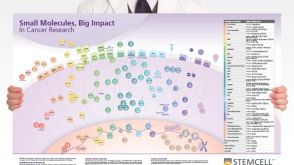 挂图Small Molecules, Big Impact in Cancer Research Overview of signaling pathways and small molecules in cancer research
 沪公网安备31010102008431号