BCR/ABL induces chromosomal instability after genotoxic stress and alters the cell death threshold.
Earlier reports have suggested that the BCR/ABL oncogene,associated with chronic myeloid leukemia,induces a mutator phenotype; however,it is unclear whether this leads to long-term changes in chromosomes and whether the phenotype is found in primary chronic myelogeneous leukemia (CML) cells. We have addressed both these issues. BCR/ABL-expressing cell lines show an increase in DNA breaks after treatment with etoposide as compared to control cells. However,although BCR/ABL-expressing cell lines have an equivalent cell survival,they have an increase in chromosomal translocations after DNA repair as compared to control cells. This demonstrates that BCR/ABL expression decreases the fidelity of DNA repair. To see whether this is true in primary CML samples,normal CD34+ progenitor cells and CML progenitor cells were treated with etoposide. CML progenitor cells have equivalent survival but have an increase in DNA double-strand breaks (DSBs). Spectral karyotyping demonstrates new chromosomal translocations in CML cells,but not normal progenitor cells,consistent with error-prone DNA repair. Taken together,these data demonstrate that BCR/ABL enhances the accumulation of DSBs and alters the apoptotic threshold in CML leading to error-prone DNA repair.
View Publication
产品号#:
01700
01705
04434
04444
01702
产品名:
ALDEFLUOR™ 试剂盒
ALDEFLUOR™ DEAB试剂, 1.5 mM, 1 mL
MethoCult™ H4434 Classic
MethoCult™ H4434 Classic
ALDEFLUOR™检测缓冲液
Balasubramaniam V et al. (MAR 2010)
American journal of physiology. Lung cellular and molecular physiology 298 3 L315--23
Bone marrow-derived angiogenic cells restore lung alveolar and vascular structure after neonatal hyperoxia in infant mice.
Neonatal hyperoxia impairs vascular and alveolar growth in mice and decreases endothelial progenitor cells. To determine the role of bone marrow-derived cells in restoration of neonatal lung structure after injury,we studied a novel bone marrow myeloid progenitor cell population from Tie2-green fluorescent protein (GFP) transgenic mice (bone marrow-derived angiogenic cells; BMDAC). We hypothesized that treatment with BMDAC would restore normal lung structure in infant mice during recovery from neonatal hyperoxia. Neonatal mice (1-day-old) were exposed to 80% oxygen for 10 days. BMDACs (1 x 10(5)),embryonic endothelial progenitor cells,mouse embryonic fibroblasts (control),or saline were then injected into the pulmonary circulation. At 21 days of age,saline-treated mice had enlarged alveoli,reduced septation,and a reduction in vascular density. In contrast,mice treated with BMDAC had complete restoration of lung structure that was indistinguishable from room air controls. BMDAC comprised 12% of distal lung cells localized to pulmonary vessels or alveolar type II (AT2) cells and persist (8.8%) for 8 wk postinjection. Coculture of AT2 cells or lung endothelial cells (luEC) with BMDAC augmented AT2 and luEC cell growth in vitro. We conclude that treatment with BMDAC after neonatal hyperoxia restores lung structure in this model of bronchopulmonary dysplasia.
View Publication
产品号#:
03534
产品名:
MethoCult™ GF M3534
Clendening JW et al. (JUN 2010)
Blood 115 23 4787--97
Exploiting the mevalonate pathway to distinguish statin-sensitive multiple myeloma.
Statin inhibitors,used to control hypercholesterolemia,trigger apoptosis of hematologic tumor cells and therefore have immediate potential as anticancer agents. Evaluations of statins in acute myelogenous leukemia and multiple myeloma have shown that statin efficacy is mixed,with only a subset of tumor cells being highly responsive. Our goal was to distinguish molecular features of statin-sensitive and -insensitive myeloma cells and gain insight into potential predictive markers. We show that dysregulation of the mevalonate pathway is a key determinant of sensitivity to statin-induced apoptosis in multiple myeloma. In sensitive cells,the classic feedback response to statin exposure is lost. This results in deficient up-regulation of 2 isoforms of hydroxymethylglutaryl coenzyme A reductase: the rate-limiting enzyme of the mevalonate pathway and hydroxymethylglutaryl coenzyme A synthase 1. To ascertain the clinical utility of these findings,we demonstrate that a subset of primary myeloma cells is sensitive to statins and that monitoring dysregulation of the mevalonate pathway may distinguish these cancers. We also show statins are highly effective and well tolerated in an orthotopic model of myeloma using cells harboring this dysregulation. This determinant of sensitivity further provides molecular rationale for the significant therapeutic index of statins on these tumor cells.
View Publication
产品号#:
18357
18357RF
产品名:
Agerstam H et al. (SEP 2010)
Blood 116 12 2103--11
Modeling the human 8p11-myeloproliferative syndrome in immunodeficient mice.
The 8p11 myeloproliferative syndrome (EMS),also referred to as stem cell leukemia/lymphoma,is a chronic myeloproliferative disorder that rapidly progresses into acute leukemia. Molecularly,EMS is characterized by fusion of various partner genes to the FGFR1 gene,resulting in constitutive activation of the tyrosine kinases in FGFR1. To date,no previous study has addressed the functional consequences of ectopic FGFR1 expression in the potentially most relevant cellular context,that of normal primary human hematopoietic cells. Herein,we report that expression of ZMYM2/FGFR1 (previously known as ZNF198/FGFR1) or BCR/FGFR1 in normal human CD34(+) cells from umbilical-cord blood leads to increased cellular proliferation and differentiation toward the erythroid lineage in vitro. In immunodeficient mice,expression of ZMYM2/FGFR1 or BCR/FGFR1 in human cells induces several features of human EMS,including expansion of several myeloid cell lineages and accumulation of blasts in bone marrow. Moreover,bone marrow fibrosis together with increased extramedullary hematopoiesis is observed. This study suggests that FGFR1 fusion oncogenes,by themselves,are capable of initiating an EMS-like disorder,and provides the first humanized model of a myeloproliferative disorder transforming into acute leukemia in mice. The established in vivo EMS model should provide a valuable tool for future studies of this disorder.
View Publication
产品号#:
09600
09650
产品名:
StemSpan™ SFEM
StemSpan™ SFEM
Ragu C et al. (NOV 2010)
Blood 116 22 4464--73
The transcription factor Srf regulates hematopoietic stem cell adhesion.
Adhesion properties of hematopoietic stem cells (HSCs) in the bone marrow (BM) niches control their migration and affect their cell-cycle dynamics. The serum response factor (Srf) regulates growth factor-inducible genes and genes controlling cytoskeleton structures involved in cell spreading,adhesion,and migration. We identified a role for Srf in HSC adhesion and steady-state hematopoiesis. Conditional deletion of Srf in BM cells resulted in a 3-fold expansion of the long- and short-term HSCs and multipotent progenitors (MPPs),which occurs without long-term modification of cell-cycle dynamics. Early differentiation steps to myeloid and lymphoid lineages were normal,but Srf loss results in alterations in mature-cell production and severe thrombocytopenia. Srf-null BM cells also displayed compromised engraftment properties in transplantation assays. Gene expression analysis identified Srf target genes expressed in HSCs,including a network of genes associated with cell migration and adhesion. Srf-null stem cells and MPPs displayed impair expression of the integrin network and decreased adherence in vitro. In addition,Srf-null mice showed increase numbers of circulating stem and progenitor cells,which likely reflect their reduced retention in the BM. Altogether,our results demonstrate that Srf is an essential regulator of stem cells and MPP adhesion,and suggest that Srf acts mainly through cell-matrix interactions and integrin signaling.
View Publication
产品号#:
03434
03444
09600
09650
产品名:
MethoCult™ GF M3434
MethoCult™ GF M3434
StemSpan™ SFEM
StemSpan™ SFEM
Rawat VPS et al. (SEP 2010)
Proceedings of the National Academy of Sciences of the United States of America 107 39 16946--51
The vent-like homeobox gene VENTX promotes human myeloid differentiation and is highly expressed in acute myeloid leukemia.
Recent data indicate that a variety of regulatory molecules active in embryonic development may also play a role in the regulation of early hematopoiesis. Here we report that the human Vent-like homeobox gene VENTX,a putative homolog of the Xenopus xvent2 gene,is a unique regulatory hematopoietic gene that is aberrantly expressed in CD34(+) leukemic stem-cell candidates in human acute myeloid leukemia (AML). Quantitative RT-PCR documented expression of the gene in lineage positive hematopoietic subpopulations,with the highest expression in CD33(+) myeloid cells. Notably,expression levels of VENTX were negligible in normal CD34(+)/CD38(-) or CD34(+) human progenitor cells. In contrast to this,leukemic CD34(+)/CD38(-) cells from AML patients with translocation t(8,21) and normal karyotype displayed aberrantly high expression of VENTX. Gene expression and pathway analysis demonstrated that in normal CD34(+) cells enforced expression of VENTX initiates genes associated with myeloid development and down-regulates genes involved in early lymphoid development. Functional analyses confirmed that aberrant expression of VENTX in normal CD34(+) human progenitor cells perturbs normal hematopoietic development,promoting generation of myeloid cells and impairing generation of lymphoid cells in vitro and in vivo. Stable knockdown of VENTX expression inhibited the proliferation of human AML cell lines. Taken together,these data extend our insights into the function of embryonic mesodermal factors in human postnatal hematopoiesis and indicate a role for VENTX in normal and malignant myelopoiesis.
View Publication
产品号#:
04434
04444
产品名:
MethoCult™ H4434 Classic
MethoCult™ H4434 Classic
Fiedler K et al. (JAN 2011)
Blood 117 4 1329--39
Neutrophil development and function critically depend on Bruton tyrosine kinase in a mouse model of X-linked agammaglobulinemia.
Bruton tyrosine kinase (Btk) is essential for B cell development and function and also appears to be important for myeloid cells. The bone marrow of Btk-deficient mice shows enhanced granulopoiesis compared with that of wild-type mice. In purified granulocyte-monocyte-progenitors (GMP) from Btk-deficient mice,the development of granulocytes is favored at the expense of monocytes. However,Btk-deficient neutrophils are impaired in maturation and function. Using bone marrow chimeras,we show that this defect is cell-intrinsic to neutrophils. In GMP and neutrophils,Btk plays a role in GM-CSF- and Toll-like receptor-induced differentiation. Molecular analyses revealed that expression of the lineage-determining transcription factors C/EBPα,C/EBPβ,and PU.1,depends on Btk. In addition,expression of several granule proteins,including myeloperoxidase,neutrophilic granule protein,gelatinase and neutrophil elastase,is Btk-dependent. In the Arthus reaction,an acute inflammatory response,neutrophil migration into tissues,edema formation,and hemorrhage are significantly reduced in Btk-deficient animals. Together,our findings implicate Btk as an important regulator of neutrophilic granulocyte maturation and function in vivo.
View Publication


 EasySep™小鼠TIL(CD45)正选试剂盒





 挂图Frequencies of Immune Cells in Rat Tissue Lists the estimated frequencies of more than 15 immune cell types in Sprague Dawley rats
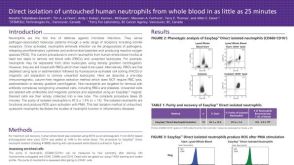 科学海报Isolation of Untouched Neutrophils Directly from Whole Blood in 20 Minutes

 沪公网安备31010102008431号