Effects of MLN518, a dual FLT3 and KIT inhibitor, on normal and malignant hematopoiesis.
Internal tandem duplications (ITDs) of the FMS-like tyrosine kinase 3 (FLT3) receptor tyrosine kinase are found in approximately 30% of patients with acute myelogenous leukemia (AML) and are associated with a poor prognosis. FLT3 ITD mutations result in constitutive kinase activation and are thought to be pathogenetically relevant,implicating FLT3 as a plausible therapeutic target. MLN518 (formerly CT53518) is a small molecule inhibitor of the FLT3,KIT,and platelet-derived growth-factor receptor (PDGFR) tyrosine kinases with significant activity in murine models of FLT3 ITD-positive leukemia. Given the importance of FLT3 and KIT for normal hematopoietic progenitor cells,we analyzed the effect of MLN518 on murine hematopoiesis under steady-state conditions,after chemotherapy-induced myelosuppression,and during bone marrow transplantation. In these assays,we show that MLN518 has mild toxicity toward normal hematopoiesis at concentrations that are effective in treating FLT3 ITD-positive leukemia in mice. We also demonstrate that MLN518 preferentially inhibits the growth of blast colonies from FLT3 ITD-positive compared with ITD-negative patients with AML,at concentrations that do not significantly affect colony formation by normal human progenitor cells. In analogy to imatinib mesylate in BCR-ABL-positive acute leukemia,MLN518-induced remissions may not be durable. Our studies provide the basis for integrating this compound into chemotherapy and transplantation protocols.
View Publication
产品号#:
03231
84434
84444
84534
84544
产品名:
MethoCult™ M3231
MethoCult GF H84534, 100mL
Lawrence HJ et al. (DEC 2005)
Blood 106 12 3988--94
Loss of expression of the Hoxa-9 homeobox gene impairs the proliferation and repopulating ability of hematopoietic stem cells.
The homeobox gene Hoxa-9 is normally expressed in primitive bone marrow cells,and overexpression of Hoxa-9 markedly expands hematopoietic stem cells,suggesting a function in early hematopoiesis. We present evidence for major functional defects in Hoxa-9-/- hematopoietic stem cells. Hoxa-9-/- marrow cells have normal numbers of immunophenotypic stem cells (Lin(-)c-kit(+)flk-2(-)Sca-1+ [KLFS] cells). However,sublethally irradiated Hoxa-9-/- mice develop persistent pancytopenia,indicating unusual sensitivity to ionizing irradiation. In competitive transplantation assays,Hoxa-9-/- cells showed an 8-fold reduction in multilineage long-term repopulating ability,a defect not seen in marrow cells deficient for the adjacent Hoxa-10 gene. Single-cell cultures of KLFS cells showed a 4-fold reduction in large high-proliferation potential colonies. In liquid cultures,Hoxa-9-deficient Lin(-)Sca-1(+) cells showed slowed proliferation (a 5-fold reduction in cell numbers at day 8) and delayed emergence of committed progenitors (a 5-fold decrease in colony-forming cells). Slowing of proliferation was accompanied by a delay in myeloid maturation,with a decrease in Gr-1hiMac-1hi cells at the end of the culture. Retroviral transduction with a Hoxa-9 expression vector dramatically enhanced the cytokine-driven proliferation and in vivo engraftment of Hoxa-9-/- marrow cells. Hoxa-9 appears to be specifically required for normal hematopoietic stem cell function both in vitro and in vivo.
View Publication
产品号#:
03231
09600
09650
产品名:
MethoCult™ M3231
StemSpan™ SFEM
StemSpan™ SFEM
Jamieson CHM et al. (APR 2006)
Proceedings of the National Academy of Sciences of the United States of America 103 16 6224--9
The JAK2 V617F mutation occurs in hematopoietic stem cells in polycythemia vera and predisposes toward erythroid differentiation.
Although a large proportion of patients with polycythemia vera (PV) harbor a valine-to-phenylalanine mutation at amino acid 617 (V617F) in the JAK2 signaling molecule,the stage of hematopoiesis at which the mutation arises is unknown. Here we isolated and characterized hematopoietic stem cells (HSC) and myeloid progenitors from 16 PV patient samples and 14 normal individuals,testing whether the JAK2 mutation could be found at the level of stem or progenitor cells and whether the JAK2 V617F-positive cells had altered differentiation potential. In all PV samples analyzed,there were increased numbers of cells with a HSC phenotype (CD34+CD38-CD90+Lin-) compared with normal samples. Hematopoietic progenitor assays demonstrated that the differentiation potential of PV was already skewed toward the erythroid lineage at the HSC level. The JAK2 V617F mutation was detectable within HSC and their progeny in PV. Moreover,the aberrant erythroid potential of PV HSC was potently inhibited with a JAK2 inhibitor,AG490.
View Publication
产品号#:
04435
04445
产品名:
MethoCult™ H4435 Enriched
MethoCult™ H4435 Enriched
Brunet de la Grange P et al. (NOV 2006)
Blood 108 9 2998--3004
Low SCL/TAL1 expression reveals its major role in adult hematopoietic myeloid progenitors and stem cells.
Stem cell leukemia/T cell acute leukemia 1 (SCL/TAL1) plays a key role in the development of murine primitive hematopoiesis but its functions in adult definitive hematopoiesis are still unclear. Using lentiviral delivery of TAL1-directed shRNA in human hematopoietic cells,we show that decreased expression of TAL1 induced major disorders at different levels of adult hematopoietic cell development. Erythroid and myeloid cell production in cultures was dramatically decreased in TAL1-directed shRNA-expressing cells,whereas lymphoid B-cell development was normal. These results confirm the role of TAL1 in the erythroid compartment and show TLA1's implication in the function of myeloid committed progenitors. Moreover,long-term cultures and transplantation of TAL1-directed shRNA-expressing CD34+ cells into irradiated nonobese diabetic-severe combined immunodeficient (NOD-SCID) mice led to dramatically low levels of human cells of all lineages including the B-lymphoid lineage,strongly suggesting that TAL1 has a role in the early commitment of hematopoietic stem cells (HSCs) in humans. Cultures and transplantation experiments performed with mouse Sca1+ cells gave identical results. Altogether,these observations definitively show that TAL1 participates in the regulation of hematopoiesis from HSCs to myeloid progenitors,and pinpoint TAL1 as a master protein of human and murine adult hematopoiesis.
View Publication
产品号#:
03434
03444
18756
18756RF
18056
18056RF
产品名:
MethoCult™ GF M3434
MethoCult™ GF M3434
EasySep™小鼠SCA1正选试剂盒
RoboSep™ 小鼠SCA1正选试剂盒含滤芯吸头
Anderson K et al. (MAY 2007)
Blood 109 9 3697--705
Ectopic expression of PAX5 promotes maintenance of biphenotypic myeloid progenitors coexpressing myeloid and B-cell lineage-associated genes.
The transcription factor PAX5 is a critical regulator of B-cell commitment and development. Although normally not expressed in myeloid progenitors,PAX5 has recently been shown to be frequently expressed in myeloid malignancies and to suppress expression of myeloid differentiation genes,compatible with an effect on the differentiation or maintenance of myeloid progenitors. However,previous studies in which PAX5 was ectopically expressed in normal myeloid progenitors in vivo and in vitro provided conflicting results as to the effect of PAX5 on myeloid development. Herein,we demonstrate that on ectopic expression of PAX5 in bone marrow multipotent stem/progenitor cells,cells with a biphenotypic B220(+)GR-1/MAC-1(+) phenotype are produced. These remain cytokine-dependent,but unlike control-transduced cells they sustain long-term generation of myeloid progenitors in vitro and remain capable of myeloid differentiation. Notably,PAX5(+)B220(+)GR-1/MAC-1(+) myeloid progenitors coexpress,at the single-cell level,myeloid genes and otherwise B-cell-specific PAX5 target genes. These findings establish that ectopic expression of PAX5 introduces extensive self-renewal properties in otherwise short-lived myeloid progenitors. Along with the established ectopic expression of PAX5 in acute myeloid leukemia,this motivates a careful investigation of the potential involvement of ectopic PAX5 expression in myeloid and biphenotypic leukemias.
View Publication
产品号#:
03434
03444
产品名:
MethoCult™ GF M3434
MethoCult™ GF M3434
Sekimoto E et al. (FEB 2007)
Cancer research 67 3 1184--92
A single-chain Fv diabody against human leukocyte antigen-A molecules specifically induces myeloma cell death in the bone marrow environment.
Cross-linked human leukocyte antigen (HLA) class I molecules have been shown to mediate cell death in neoplastic lymphoid cells. However,clinical application of an anti-HLA class I antibody is limited by possible side effects due to widespread expression of HLA class I molecules in normal tissues. To reduce the unwanted Fc-mediated functions of the therapeutic antibody,we have developed a recombinant single-chain Fv diabody (2D7-DB) specific to the alpha2 domain of HLA-A. Here,we show that 2D7-DB specifically induces multiple myeloma cell death in the bone marrow environment. Both multiple myeloma cell lines and primary multiple myeloma cells expressed HLA-A at higher levels than normal myeloid cells,lymphocytes,or hematopoietic stem cells. 2D7-DB rapidly induced Rho activation and robust actin aggregation that led to caspase-independent death in multiple myeloma cells. This cell death was completely blocked by Rho GTPase inhibitors,suggesting that Rho-induced actin aggregation is crucial for mediating multiple myeloma cell death. Conversely,2D7-DB neither triggered Rho-mediated actin aggregation nor induced cell death in normal bone marrow cells despite the expression of HLA-A. Treatment with IFNs,melphalan,or bortezomib enhanced multiple myeloma cell death induced by 2D7-DB. Furthermore,administration of 2D7-DB resulted in significant tumor regression in a xenograft model of human multiple myeloma. These results indicate that 2D7-DB acts on multiple myeloma cells differently from other bone marrow cells and thus provide the basis for a novel HLA class I-targeting therapy against multiple myeloma.
View Publication
van Rhenen A et al. (OCT 2007)
Blood 110 7 2659--66
The novel AML stem cell associated antigen CLL-1 aids in discrimination between normal and leukemic stem cells.
In CD34(+) acute myeloid leukemia (AML),the malignant stem cells reside in the CD38(-) compartment. We have shown before that the frequency of such CD34(+)CD38(-) cells at diagnosis correlates with minimal residual disease (MRD) frequency after chemotherapy and with survival. Specific targeting of CD34(+)CD38(-) cells might thus offer therapeutic options. Previously,we found that C-type lectin-like molecule-1 (CLL-1) has high expression on the whole blast compartment in the majority of AML cases. We now show that CLL-1 expression is also present on the CD34(+)CD38(-) stem- cell compartment in AML (77/89 patients). The CD34(+)CLL-1(+) population,containing the CD34(+)CD38(-)CLL-1(+) cells,does engraft in nonobese diabetic/severe combined immunodeficiency (NOD/SCID) mice with outgrowth to CLL-1(+) blasts. CLL-1 expression was not different between diagnosis and relapse (n = 9). In remission,both CLL-1(-) normal and CLL-1(+) malignant CD34(+)CD38(-) cells were present. A high CLL-1(+) fraction was associated with quick relapse. CLL-1 expression is completely absent both on CD34(+)CD38(-) cells in normal (n = 11) and in regenerating bone marrow controls (n = 6). This AML stem-cell specificity of the anti-CLL-1 antibody under all conditions of disease and the leukemia-initiating properties of CD34(+)CLL-1(+) cells indicate that anti-CLL-1 antibody enables both AML-specific stem-cell detection and possibly antigen-targeting in future.
View Publication


 EasySep™小鼠TIL(CD45)正选试剂盒





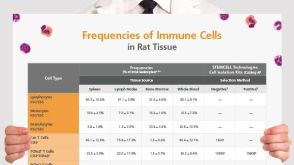 挂图Frequencies of Immune Cells in Rat Tissue Lists the estimated frequencies of more than 15 immune cell types in Sprague Dawley rats
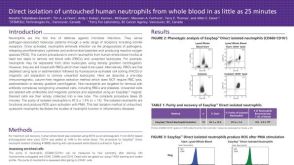 科学海报Isolation of Untouched Neutrophils Directly from Whole Blood in 20 Minutes

 沪公网安备31010102008431号